Oshkosh Air Traffic

mbauer

Pre-Flight
Joined
Jul 5, 2026
Messages
60
Display Name
mbauer
Years ago, many news articles on over worked ATC Controllers. Did this have anything to do with this years issues? Read about ways things worked in the past, that are no longer an option.

How about setting up a system for VFR arrivals/departures:

You notify and apply for landing on a certain day, a specific time, announcing your intentions to visit, length of stay, day and time of departure. This application could be set up a year or two early. This application could be on the EAA website.

Application Deadline needs to be in effect. Once the deadline is reached, the data base can now be used by ATC to coordinate. First in , gets their time, others get modified times. Don't apply, sorry, no can visit.

ATC can then give you a time that works for others arriving the same day. This could be an email, text, days before your travel date. Now you have a time.

This allows for the shutdown times when Airshow traffic has to wait. No landings departures scheduled during these times, which means they are also need to be scheduled. Same application to get all the numbers in one database. Would be a step for military H-Hour planning for the mission.

Your application now receives a window timeframe of when to arrive. For departures, you are scheduled already for the day you plan to leave.

Problem with arrivals late and early could be worked in, if they already have a slot.

Don't apply, sorry, no can visit. Communication of our intentions is all this is.

This allows ATC, to control VFR kind of like an IFR aircraft that already has clearance to fly in, with the time of their arrival, coordinating all traffic.

How many decide two days before the start they are gong to visit this year, locals maybe? Say from Montana or worldwide?

Forget to apply? You can still visit, need to land close by, arrange transportation to and from.

Everybody who plans to visit, does so in advance, some kind of system needs setup so ATC knows what to expect.

Mike
 
In my opinion, the existing system works well. The part that didn't work well were pilots acting like idiots. A lot of YouTube videos are putting videos showing how dangerous it was... yet they didn't discontinue their flights. This means they were a big part of the problem! Follow the NOTAM, make good decisions as pilots, and stop having get-there-itis.

There was a lot of people fighting on the frequency... you know, the one you're not supposed to talk on! Don't be surprised if they have to go with a system similar to ATIS, where you can hear Fisk ATC, but you can't talk on the frequency.
 
Years ago, many news articles on over worked ATC Controllers. Did this have anything to do with this years issues? Read about ways things worked in the past, that are no longer an option.

How about setting up a system for VFR arrivals/departures:

You notify and apply for landing on a certain day, a specific time, announcing your intentions to visit, length of stay, day and time of departure. This application could be set up a year or two early. This application could be on the EAA website.

Application Deadline needs to be in effect. Once the deadline is reached, the data base can now be used by ATC to coordinate. First in , gets their time, others get modified times. Don't apply, sorry, no can visit.

ATC can then give you a time that works for others arriving the same day. This could be an email, text, days before your travel date. Now you have a time.

This allows for the shutdown times when Airshow traffic has to wait. No landings departures scheduled during these times, which means they are also need to be scheduled. Same application to get all the numbers in one database. Would be a step for military H-Hour planning for the mission.

Your application now receives a window timeframe of when to arrive. For departures, you are scheduled already for the day you plan to leave.

Problem with arrivals late and early could be worked in, if they already have a slot.

Don't apply, sorry, no can visit. Communication of our intentions is all this is.

This allows ATC, to control VFR kind of like an IFR aircraft that already has clearance to fly in, with the time of their arrival, coordinating all traffic.

How many decide two days before the start they are gong to visit this year, locals maybe? Say from Montana or worldwide?

Forget to apply? You can still visit, need to land close by, arrange transportation to and from.

Everybody who plans to visit, does so in advance, some kind of system needs setup so ATC knows what to expect.

Mike
No
 
Curious, what was the pilot skill level pertaining to all those arrivals?

Young pilot on traffic overload, big time, now getting yelled at on a freq not for air to air use. Are they still flying the airplane? Airspeed/altitude deviations say probably not much.

Road rage is a thing, how many pilots had a different version during all of this?

Skill level was brought by someone already, who like me can decide the risk or not; is worth it.

Thinking a new pilot can figure out arrival times by still using a thing called flight planning, fresh in their minds from ground school and with actual flight practice to test their planning. Is there a reason why the rest of can't use the same method?

Enough is enough.

What friend here, could be the one, who we wish something had been done to save?

Mike
 
Last edited:
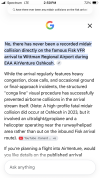
At the risk of messing with karma, here’s the answer to the question “have there ever been any midair collisions on the Fisk arrival” on Google:

IMG_0532.png

I can’t tell: have you ever done the Fisk? Regardless, if you’re ever at OSH, try to get to the FAA site (trailer) that controls it. You can find it on Google/Apple maps. They are remarkably professional yet having a good time. Their system is far more than one person trying to juggle an endless line of planes coming in.

I haven’t personally done the Fisk in a good while (I go in with a Mass Arrival group) and it has grown in volume and size since I have but the FAA continues to do a remarkable job with it.

I can’t imagine how the plan you propose could get the same number of planes in and with that same record. No offense.
 
There has been a midair and a fatality on the Oshkosh/Fisk approach. Over 30 years ago, a T-18 and a C-170, IIRC.

This year's problem was the controllers mandating 2 mile spacing at Fisk - four times the normal spacing. That brought out the worst in the me-first crowd. Whoever made the call to move to 2 mile spacing needs to reevaluate the impact of that decision on the entire arrival process and not do it again. The arrival procedure is supposed to be binary. If VFR, follow the procedure to a T, if IFR, IFR arrivals only.
 
No to the time slots. Just no.

Kyleb - yep. The 2 mile in-trail was no bueno. I guess the reason was because of the reduced visibility due to smoke. So controllers needed that separation to be able to spot aircraft? But I agree - if it's not VFR enough for 1 mile or 1/2 mile in-trail - just shut down the arrival and let everyone try when the conditions permit.

Guess I was lucky - when I flew the arrival (Monday), it was very civil and we had about 1 to 1/2 mile in-trail and it was great. The Sunday crowd got the short end of the stick and ... well... see the point above.
 
No to the time slots. Just no.

Kyleb - yep. The 2 mile in-trail was no bueno. I guess the reason was because of the reduced visibility due to smoke. So controllers needed that separation to be able to spot aircraft? But I agree - if it's not VFR enough for 1 mile or 1/2 mile in-trail - just shut down the arrival and let everyone try when the conditions permit.
The visibility was VFR. I was in it. It was not great, but 3+ miles. I could see a half dozen or more aircraft in front of me, even when ADSB was telling me I was 1 1/2 - 2 miles in trail of the one immediately in front of me. In other words, visibility was adequate to run the approach as written. Whoever was making the call on the FAA's behalf got cold feet and created a pooch-screw.
 
How does this pan take into account when your time slot becomes unavailable due to weather.

The reduced visibility weather with several periods of shut down lead to higher congestion this solution would not solve.
 
Whoever was making the call on the FAA's behalf got cold feet and created a pooch-screw.
Sorry - not seeing it that way. The cost of being too conservative is a first-world waah-waah. The cost of pushing too hard can easily be fatal, especially with the Fisk crowd and their get-there-itis and variable skills.

When they’re too conservative people whine on sites like this. If they were to push it and an accident happens it’s national news - and “why are our taxpayer dollars paying for these controllers to go watch people kill each other over our roads and towns? Let’s stop airplanes going to Airventure”

A “pooch screw” isn’t another lap at the Fisk - it’s a midair on said route.
Do you think the chances for a midair went up or down by sending aircraft around multiple times to circle for hours? Hint:all of those aircraft could have been safely landed in a quarter of the time by flying the approach at the normal spacing.
 
Do you think the chances for a midair went up or down by sending aircraft around multiple times to circle for hours? Hint:all of those aircraft could have been safely landed in a quarter of the time by flying the approach at the normal spacing.
I’m not a controller and certainly not one of the caliber needed to be one at OSH so my guess is they have figured this out over the past few decades and have done a good job of balancing the complaining people do about the inconvenience against the risk.

The “go-around” part of the route isn’t the “merge” part, so people should still be in 2nm trail, same speed, same altitude, same route. I’d say the risk there is lower than for the arrival leg regardless of when. And if people adhere to the ATIS for the arrival route they wouldn’t enter the line in less than the stated distance.

I think we as pilots can be a whiny (and entitled) group and the controllers just roll with the fact that they’re gonna lose no matter what they decide. But having watched them at the Fisk, they don’t take the job lightly and, from what I could see, seemed fine with people they saw cutting in (via ADS-B, I’m pretty sure) getting sent around.
 
I’m not a controller and certainly not one of the caliber needed to be one at OSH so my guess is they have figured this out over the past few decades and have done a good job of balancing the complaining people do about the inconvenience against the risk.
Exactly. Which is why the NOTAM calls for 1/2 mile spacing at Fisk. That’s what the smart people determined works best. Tried and proven over 30+ years. The problems occur when someone calls an audible that upsets the apple cart.
 
How many decide two days before the start they are gong to visit this year, locals maybe? Say from Montana or worldwide?

I suspect plenty of people encounter weather en route that forces them to land and wait a few hours, or maybe even overnight. There can also be weather or an incident at Osh that stops landings for a while and trashes planned arrival times. I don’t think scheduling VFR arrivals would be practical.

Just look at how often even the airlines delay flights.
 
We never picked up the ATIS... I quit trying once we were at Ripon. By then FISK approach had been telling everyone where the line starts anyway. I wasn't the only person who never got the ATIS on Monday. Talked to a lot of people on the ground who never could hear it. Might be something to improve for next year.
 
No, to OSH. Just NO.
And that means additionally, NO to EAA just NO. 40 year member here.

On Thursday, they closed the 2300 msl arrival, and forced me into the green lake queue but folks just kept cutting in. 90 is my short final speed. So falling back to 80---> redline. ATIS not findable/hearable.

The guy who cuts in, gets in and then the guy who is trying to fall back at redline gets sent around the lake again. When you get "cut in upon" you're no longer 2 miles in trail!! That happened to me. I landed at Portage.

When they opened 18 again, and there was again capacity, I tried again- line up was occurring 5 miles outside of the MSN "C"....but guys were cutting in. I bailed after making it to Green lake after another NMAC.

Yeah, no actual collision has ever happened but 80 kts and powerlines and cut-ins?
I'm never doing that again. 2 hours at redline. NFW never again.

And their 30 watt ATIS just does not work. I never heard it. Flightaware and ADSB were the only usable tools.

 
Last edited:
That takes priority over the ATIS? Ummm….
The decisions made that weekend by people on the ground were misguided and had a negative impact on the overall system, IMO. This is why smart people created a NOTAM so there would be no need to make judgement calls in the moment.
 
We never picked up the ATIS... I quit trying once we were at Ripon. By then FISK approach had been telling everyone where the line starts anyway. I wasn't the only person who never got the ATIS on Monday. Talked to a lot of people on the ground who never could hear it. Might be something to improve for next year.
Interesting. We were at 2000-2300' inbound to the arrival stream and could hear it all the way to Puckaway lake. Different radios, different installations, I get it...

Maybe the higher signal power ATIS they promised wasn't working all the time?
 
We were at 2000-2300' inbound to the arrival stream and could hear it all the way to Puckaway lake. Different radios, different installations, I get it...
That was probably it. On Monday late morning, I was around 3k' maybe 20 miles out before descending to 1800' to get into the flow in between Puckaway and Green (there was a beautiful 4 mile gap)... Never heard it even with open squelch. But yeah I think maybe the transmitter power was an issue? Dunno. All worked out, though. FISK was great about repeating much of what would have been on the ATIS anyway.
 
The decisions made that weekend by people on the ground were misguided and had a negative impact on the overall system, IMO. This is why smart people created a NOTAM so there would be no need to make judgement calls in the moment.
I can tell you exactly how things would play out if there was a mandate for a binary 1/2 mile sep or close the Fisk. It would be to close the Fisk entirely for visibility less than a number I suspect you wouldn’t like, and would be entirely in the name of safety.

The whole NOTAM is built around waiving certain FAA regs in a sensible way in order to get a large number of planes in safely and quickly.

The smoke was awful. Visibility en route was far worse in certain segments than the nearest AWOS was reporting when we came in. There’s everything from 5-digit-hour airline pilots to guys NORDO in a Luscombe going in - with nobody talking to each other unlike in the local pattern. To do it the way they’re doing with no midairs in over 30 years sounds like they’re doing it right. And contrast that with the OP’s proposal, incidentally.
My experience was the visibility was fine. On Friday, we could see aircraft several miles in front of us (in trail, which makes it harder). As to radios, I don't think radio chatter is necessary other than at Fisk and with the tower. The Fisk arrival procedure is pretty simple. Enter the line with good spacing, follow, and listen and it works.

I will add that there's never been a "1/2 mile or close the arrival" clause. It is 1/2 mile, and maybe you get sent around if you can't make that happen. In the past I've seen plenty of examples where lesser spacing was successfully managed at Fisk and at the runways. The can-do attitude seemed to be "if you'll follow instructions, we'll get you in". That more or less disappeared this year into "Man, look at all the aircraft inbound... I know what, let's reduce capacity by 75%, that'll make things better."
 
Go spend a half hour at the Fisk controller trailer next year

Add: I’ve been to the trailer when they were doing two miles because of smoke. This wasn’t novel.
 
Last edited:
I suspect plenty of people encounter weather en route that forces them to land and wait a few hours, or maybe even overnight. There can also be weather or an incident at Osh that stops landings for a while and trashes planned arrival times. I don’t think scheduling VFR arrivals would be practical.

100% this. I have gone 3 times. On two of those trips, my arrival was 24 to 48 hours late, due to weather. There seems to be a perma-front from Nebraska to Chicago at the end of July.
 
There has been a midair and a fatality on the Oshkosh/Fisk approach. Over 30 years ago, a T-18 and a C-170, IIRC.

You are correct, there was a midair between a T-18 and a C-170, just outside of Fisk, around 30 years ago-- however, there were no injuries or fatalities in that incident.

I was the controller working Fisk at the time.

After the collision, the T-18 went down in a field a couple of miles west of Fisk, while the pilot of the 170 didn't say anything as he overflew me and continued to a safe landing at the airport. Upon landing, the pilot of the 170 found prop slashes on one of his flaps and informed EAA officials he'd hit something near Fisk. EAA sent their helicopter, N90B, outbound over the railroad tracks to look for the other airplane-- and the first I knew of the incident was from the pilot of 90B as he passed me. He spotted the T-18 in the field shortly afterward and was able to land and confirm that there were no injuries.
 
How does this pan take into account when your time slot becomes unavailable due to weather.

The reduced visibility weather with several periods of shut down lead to higher congestion this solution would not solve.
Exactly - or when someone ground-loops on the runway and closes that arrival for 20 mins?

Just not a plan that could ever work!
 
Back in 1992, my first Oshkosh, I had traveled there with Paul Bertorelli. He had a bunch of contributors at the time who were ATC that had worked the show and I had the opportunity not only to go to Fisk but go up in the tower and see how things worked before I flew in the next year.

The new starting points further out than RIPON do nothing to help in my opinion, it just moves the initial screw up further away and give pilots more chance to mess up trying to follow the train.

About the only real improvement would be to add a second track in for 27 (using RIPON-FISK for 18).
 
As someone who has never had the pleasure of flying the procedure, but has watched many youtube vids of it, watched it on flightaware, and generally following the airventure shenanigans either in-person of remotely for decades...

my observations
1) Most pilots aren't really trained to know what a given horizontal distance looks like. I'd venture a guess that a vast majority of people couldn't tell you with any reasonable precision how far away a landmark is when standing on the ground...let alone in the air with no other references in view. Add in confounding variables such as smoke and forget it!
And even if you learn and practice it, a person's eye calibration can fade with time if not practiced. I used to be pretty good at judging yardage from hunting and shooting, but my calibration has faded to the point of uselessness.
Modern tech with ADS-B certainly goes a long way towards solving that problem, I suppose...IF the tech is on board and if it's used.

2) I have pretty much always wondered how much of the speed headaches are caused my the mix of MPH and Kts, and/or indicated vs ground speed....

3) There seems to be a huge amount of radio congestion tied up with the silly wing rock and needless affirmations of a "good rock". Besides, the controller says white low-wing rock your wings. There's probably at least 50 white low wings in radio range at any given moment....let's 15 of them think that they may be the subject so they all rock their wings. The controller sees the one target that he's intending do the rock and says "good rock"...now 15 white low wings think that they are the one he's talking too.
I know it's geographic and situational, and that there probably not that many near the landmark, but still it seems to me like a lot of needless and unspecific chatter propogated by ATC....
"
 
The new starting points further out than RIPON do nothing to help in my opinion
I’m pretty sure the issue with the old one was that the Rush Lake hold just didn’t have the capacity needed when the field was closed for something else, especially if new planes are still getting into the line.
About the only real improvement would be to add a second track in for 27 (using RIPON-FISK for 18).
I bet that would cause problems for departures unless you mean to do it over the water to the east.
 
You are correct, there was a midair between a T-18 and a C-170, just outside of Fisk, around 30 years ago-- however, there were no injuries or fatalities in that incident.

I was the controller working Fisk at the time.

After the collision, the T-18 went down in a field a couple of miles west of Fisk, while the pilot of the 170 didn't say anything as he overflew me and continued to a safe landing at the airport. Upon landing, the pilot of the 170 found prop slashes on one of his flaps and informed EAA officials he'd hit something near Fisk. EAA sent their helicopter, N90B, outbound over the railroad tracks to look for the other airplane-- and the first I knew of the incident was from the pilot of 90B as he passed me. He spotted the T-18 in the field shortly afterward and was able to land and confirm that there were no injuries.
Amazing. Thanks for the correction.
 
As someone who has never had the pleasure of flying the procedure, but has watched many youtube vids of it, watched it on flightaware, and generally following the airventure shenanigans either in-person of remotely for decades...

my observations
1) Most pilots aren't really trained to know what a given horizontal distance looks like. I'd venture a guess that a vast majority of people couldn't tell you with any reasonable precision how far away a landmark is when standing on the ground...let alone in the air with no other references in view. Add in confounding variables such as smoke and forget it!
And even if you learn and practice it, a person's eye calibration can fade with time if not practiced. I used to be pretty good at judging yardage from hunting and shooting, but my calibration has faded to the point of uselessness.
Modern tech with ADS-B certainly goes a long way towards solving that problem, I suppose...IF the tech is on board and if it's used.

2) I have pretty much always wondered how much of the speed headaches are caused my the mix of MPH and Kts, and/or indicated vs ground speed....

3) There seems to be a huge amount of radio congestion tied up with the silly wing rock and needless affirmations of a "good rock". Besides, the controller says white low-wing rock your wings. There's probably at least 50 white low wings in radio range at any given moment....let's 15 of them think that they may be the subject so they all rock their wings. The controller sees the one target that he's intending do the rock and says "good rock"...now 15 white low wings think that they are the one he's talking too.
I know it's geographic and situational, and that there probably not that many near the landmark, but still it seems to me like a lot of needless and unspecific chatter propogated by ATC....
"
Good questions. The spacing issue has always been a challenge. Now with many ADSB equipped aircrat, you may have range information if both aircraft are equipped. Prior to that, it was "Well, this is how it would if another aircraft was halfway down the mile long runway back home". The speed thing is less of an issue (I think) than most believe. I suspect it is more related to people trying to create spacing than someone flying at 80 instead of 90. There are tons of exceptions, I'm sure, including airspeed calibration issues. The "Good rock" is simply trying to sort the wheat from the chaff. They use aircraft type, color, etc. and are pretty good at it. In theory (1/2 mile separation), the Fisk controller has 20 seconds to "work" each aircraft and the verbal communication is how they segregate traffic between the two main approaches to the field.
 
From reading the replies, and the ideas presented, we are verifying that the ATC has done a great job with an incredible task, however, arriving traffic will only increase in the future.

Lots of ideas, lots of reasons why it won't work, posted soon after.

This is not an easy fix, but required.

Sure hope someone finds the best answer, it is sorely needed.

Conversation/communication is going to be the key, I think, for finding the answer. Communicating how many plan to attend, arriving on which day, in advance of actually flying there, will help ATC.

Even an impromptu list sent to the EAA, stating just the arrival day, could help identify what days are going to be busy for the ATC controllers.

Weather delays? Yes, they can change plans, but the aircraft heading there, notifying they plan to attend could help ATC plan just a little better.

Being a source for arrival numbers, even if weather delayed, can help.

ATC-"Looks like a busy day to day", with the MVFR weather we might need to go to the alternate Notam for high traffic days." "Lets get it up on the website stating weather related delays, and the Notam change in effect."

Notams for wildfires change daily sometimes, this could work in our favor, to have an established alternate, that can be used.

BTW-There are two kinds of Luck.

Mike
 
Last edited:
From reading the replies, and the ideas presented, we are verifying that the ATC has done a great job with an incredible task, however, arriving traffic will only increase in the future.

Lots of ideas, lots of reasons why it won't work, posted soon after.

This is not an easy fix, but required.

Sure hope someone finds the best answer, it is sorely needed.

Conversation/communication is going to be the key, I think, for finding the answer. Communicating how many plan to attend, arriving on which day, in advance of actually flying there, will help ATC.

Even an impromptu list sent to the EAA, stating just the arrival day, could help identify what days are going to be busy for the ATC controllers.

Weather delays? Yes, they can change plans, but the aircraft heading there, notifying they plan to attend could help ATC plan just a little better.

Being a source for arrival numbers, even if weather delayed, can help.

ATC-"Looks like a busy day to day", with the MVFR weather we might need to go to the alternate Notam for high traffic days." "Lets get it up on the website stating weather related delays, and the Notam change in effect."

Notams for wildfires change daily sometimes, this could work in our favor, to have an established alternate, that can be used.

BTW-There are two kinds of Luck.

Mike
The data says Oshkosh (not surrounding fields) aircraft movements have been ~16K during show week for the last decade minus 2020 (cancelled) and 2023 which had 23K movements. The traffic isn't increasing. In fact, there's an argument that with pilots and aircraft retiring, fly-in attendance may gradually decline.

EAA and the FAA are very aware of the peak days - they used to be the leading weekend Sat/Sun but lots of people (myself included) have chosen to fly-in on Friday to avoid the weekend crowd(s). Unfortunately, I'm not the only one doing that so Friday is a big day now.

The high traffic days are the days where we absolutely need to follow the NOTAM as written. That's when it'll be most beneficial.
 
Last edited:
I’m pretty sure the issue with the old one was that the Rush Lake hold just didn’t have the capacity needed when the field was closed for something else, especially if new planes are still getting into the line.
Holding is farked no matter what. If the airport closes or is delayed, they should tell people to go park at some nearby airport.

I bet that would cause problems for departures unless you mean to do it over the water to the east.
Departures head 150 degrees out from the N/S runway and due west from 27. They could find something from the SW that was spaced away from the RIPON-FISK line.
 
Whoever made the call to move to 2 mile spacing needs to reevaluate the impact of that decision on the entire arrival process and not do it again. The arrival procedure is supposed to be binary. If VFR, follow the procedure to a T, if IFR, IFR arrivals only.
This!

Sorry - not seeing it that way. The cost of being too conservative is a first-world waah-waah. The cost of pushing too hard can easily be fatal, especially with the Fisk crowd and their get-there-itis and variable skills.
No, if you increase to 2 mile spacing you mess a LOT of things up. It's no longer possible to maintain spacing via visual reference, and it creates an accordion effect that affects safety much more than anything with 1/2 mile spacing would. Besides, half mile spacing worked for 38 years before the first time someone randomly decided to increase it.

That takes priority over the ATIS? Ummm….
No, but the controllers need to follow the written procedure and not make things up on the fly.

I can tell you exactly how things would play out if there was a mandate for a binary 1/2 mile sep or close the Fisk. It would be to close the Fisk entirely for visibility less than a number I suspect you wouldn’t like, and would be entirely in the name of safety.
Except like I said, it worked fine for 38 years with nobody ever increasing the spacing.

The whole NOTAM is built around waiving certain FAA regs in a sensible way in order to get a large number of planes in safely and quickly.
The key there being large numbers. 2 miles in trail at 90 knots decreases the arrival rate to just 45 aircraft per hour. That means 177 hours to get everyone in to OSH, and the field is only open 9 hours per day. No wonder it messes everything up.

To do it the way they’re doing with no midairs in over 30 years sounds like they’re doing it right.
Again, spacing was 1/2 mile and 1/2 mile only, from 1980 all the way up to 2018. That's doing it right. Increasing it without prior notice makes it far worse.

2) I have pretty much always wondered how much of the speed headaches are caused my the mix of MPH and Kts, and/or indicated vs ground speed....
They shouldn't be. The NOTAM is pretty clear about it being 90 knots.

3) There seems to be a huge amount of radio congestion tied up with the silly wing rock and needless affirmations of a "good rock". Besides, the controller says white low-wing rock your wings.
That exists so that the pilots don't need to talk.

There's probably at least 50 white low wings in radio range at any given moment....let's 15 of them think that they may be the subject so they all rock their wings.
That's why the NOTAM says that unless you're in the immediate vicinity of Fisk, the instructions aren't for you.
 
This!


No, if you increase to 2 mile spacing you mess a LOT of things up. It's no longer possible to maintain spacing via visual reference, and it creates an accordion effect that affects safety much more than anything with 1/2 mile spacing would. Besides, half mile spacing worked for 38 years before the first time someone randomly decided to increase it.


No, but the controllers need to follow the written procedure and not make things up on the fly.


Except like I said, it worked fine for 38 years with nobody ever increasing the spacing.


The key there being large numbers. 2 miles in trail at 90 knots decreases the arrival rate to just 45 aircraft per hour. That means 177 hours to get everyone in to OSH, and the field is only open 9 hours per day. No wonder it messes everything up.


Again, spacing was 1/2 mile and 1/2 mile only, from 1980 all the way up to 2018. That's doing it right. Increasing it without prior notice makes it far worse.


They shouldn't be. The NOTAM is pretty clear about it being 90 knots.


That exists so that the pilots don't need to talk.


That's why the NOTAM says that unless you're in the immediate vicinity of Fisk, the instructions aren't for you.
He who lives by the (NOTAM) rules dies by the rules.

Sounds like you have way more expertise than the FAA peeps who have been doing this for 38 years and who might know a thing or two that we don’t realize.

Add: the controllers have responsibility for the lives of the people they’re managing. Us SGOTIs yelling at clouds (and smoke) don’t. If someone wants to be constructive, get off of these forums and talk to the FAA (PM me if you want - I can probably give you contact info).
 
Last edited:
The wing rock is not silly, it is genius. Anyone who has flown the approach understands why.
yeah, well ok it' not the rock that I see as silly I suppose.
It's the amount of frequency congestion that accompanies it.
That exists so that the pilots don't need to talk.

exactly!
but instead reducing the chatter it's adding to it!!

a "double-click" confirmation,
or a "wilco"
or a quick readback.... would normally be less freq time than what they have now!
it adds a whole bunch of needless syllables on freq!

Granted, it should be a smart way to silently confirm....even better than the double-click which ties up the freq for maybe 3/4 of a second...

But
now you have ATC actually calling out an instruction to DO a wing rock, followed by a short pause while the rocks happen, then it's a rather long affirmation that it was a good rock, welcome to oshkosh....etc.... yipeee

Maybe I'm all wrong, but I imagine that the original intention went more like this.....
ATC: "red and white high wing half-mile South of fisk, continue straight along the tracks to gravel pit, landing 27, monitor tower freq."​
then the pilot of red and white high wing silently does the rock, the controller sees that his message has been received and that it will be complied with​
and then the controller moves onto the next in line​
​
or​
​
ATC: " purple low wing with wig-wags, you're too close. Turn back to Green Lake and try again..."​
pilot silently rocks wings in acknowledgement, then makes the turn.....​
 
Back
Top