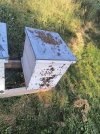
My sweet honey at C81

Got stung for the first time this afternoon lol. Wasnt even poking around the hive... Just watching from about 6 feet away to see if they were bringing in any pollen (they are:cheers:) and one of them landed on my cheek. I instinctively went to brush her away, and she nailed me. I did get to look at the stinger under the microscope after I dug it out of my face, so that was cool.
 
Got stung for the first time this afternoon lol. Wasnt even poking around the hive... Just watching from about 6 feet away to see if they were bringing in any pollen (they are:cheers:) and one of them landed on my cheek. I instinctively went to brush her away, and she nailed me. I did get to look at the stinger under the microscope after I dug it out of my face, so that was cool.
You were in the way. Brushing them away is a really hard instinct to ignore.

Pro tip: when doing a hive inspections, work behind the entrance
 
Update:
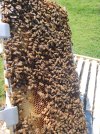
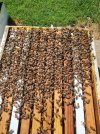
My hive is kicking ass. Two brood boxes chock full of bees. They're working on drawing out a super. Goldenrod is coming on now, so I'm hoping they can put up some honey for winter. I'll keep feeding them, but I'm confident they're strong enough to make it through.

Sadly, the hackberry hive seems to have collapsed. A month or two ago I noticed there was almost no activity. Not sure what happened to them; seems odd they would die out just a couple months after producing a swarm. Maybe the new queen got killed on her mating flight and they didn't have any eggs to produce another?

IMG_20240902_110650211_HDR.jpgIMG_20240902_111202683_HDR.jpg
 
Update:
My hive is kicking ass. Two brood boxes chock full of bees. They're working on drawing out a super. Goldenrod is coming on now, so I'm hoping they can put up some honey for winter. I'll keep feeding them, but I'm confident they're strong enough to make it through.

Sadly, the hackberry hive seems to have collapsed. A month or two ago I noticed there was almost no activity. Not sure what happened to them; seems odd they would die out just a couple months after producing a swarm. Maybe the new queen got killed on her mating flight and they didn't have any eggs to produce another?

View attachment 133118View attachment 133119
That golden rod nectar....smells like a sweaty gym bag when it's drying down.

I doubt anything happened to the new queen. It's possible, but the hive would go queenless. And then you'd have laying workers which would produce drones.

Absconding this time of year is not uncommon. For whatever reason they don't think they have what they need, mite load got too high...and they'll just leave.

The other possibility would be an after swarm. Essentially a second swarm after the primary swarm.

I'm leaving next week for my elk hunt and will be treating for mites just before I go. Formic pro. It's formic acid in strips you lay in the hive. Temperature sensitive, 55-85 degrees. Kills any mites on the bees, as well as mites in the cells. But evaporates from any capped honey. There's other treatment methods, but thats the easiest for me.
 
Up until last year I had this observation hive in the back stairs of my house
41237431434_ca66038c97_3k.jpg


The problem with this hive is that when the bees fill it up, you have to split the hive (no way to add supers). One day I'm staring at the thing thinking "I've got to split this soon or they'll swarm." Two days later they were all dead in the bottom of the hive. I've never seen a hive collapse like that (I've had many do slow deaths or not make it over the winter or such). This was very sudden from quite vibrant to dead. I figure they got into insecticide somewhere.
That is weird. Usually colony collapse disorder takes a bit of time. But who knows if something was being sprayed.

I've had my strongest hives abscond if I didn't treat in time but never die overnight.
 
I've had slow death and absconding. This was a quick drop where 90% of the bees were dead at the bottom of the hive in two days.
It's got to be chemical. The biological problems wouldn't act so fast.
 
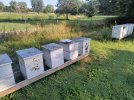
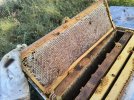
Got all the supers pulled and all 20 hives treated for mites. Should get about 1,000 pounds of honey or 80+ gallons. And that's on top of what I already pulled in June. So... If anyone is flying by pm me and I'll leave ya a quart in the fbo....unless you home brewers want to make some hooch. Then I'll leave more...as long as I get to try the final product.
IMG_20240908_165826829_HDR.jpgIMG_20240908_171313363.jpg
 

Attachments

  • IMG_20240908_165831462.jpg
    IMG_20240908_165831462.jpg
    4.3 MB · Views: 4
Got all the supers pulled and all 20 hives treated for mites. Should get about 1,000 pounds of honey or 80+ gallons. And that's on top of what I already pulled in June. So... If anyone is flying by pm me and I'll leave ya a quart in the fbo....unless you home brewers want to make some hooch. Then I'll leave more...as long as I get to try the final product.
View attachment 133282View attachment 133281
That sounds exciting, I’ll send a message when I can fly out next. Do you also eat the honeycomb?
 
there should be a 30nm TFR around every bee hive in the country, fer realz. 0 to 30,000'.
 
That sounds exciting, I’ll send a message when I can fly out next. Do you also eat the honeycomb?
Some do. I don't do cut comb. Too much work for me and the bees. But sometimes you'll get some burr comb in between boxes you scrape off. And itd be a shame to waste it. In all honesty, I really don't eat honey much. Leaving for my new Mexico archery elk hunt Thursday and I'll be gone for 2 weeks.
 
A shot in the dark I know, but, might anyone like @Racerx or @Jim K have data, or know where to get data, which might help APPMais, specifically, colony particulate measurements? I had lunch with my senior son at App State today. He's been working on a school project where they put Raspberry Pis in bee colonies with the ability to measure different particulates (don't know more than that) and transmit results to a central database for analysis. Apparently they are researching Colony Collapse Disorder.
 
Last edited:
A shot in the dark I know, but, might anyone like @Racerx or @Jim K have data, or know where to get data, which might help APPMais, specifically, colony particulate measurements? I had lunch with my senior son at App State today. He's been working on a school project where they put Raspberry Pis in bee colonies with the ability to measure different particulates (don't know more than that) and transmit results to a central database for analysis. Apparently they are researching Colony Collapse Disorder.
Beesource is a forum I've frequented in the past. Someone over there is probably more knowing than me.

As far as ccd is concerned, I thought that was largely attributed to the use of neonicotinoids
 
Resurrecting the honey thread because Nathan Pyle made me laugh again this morning.

631836526_1460823205412796_6427176163017254991_n.jpg
Had bees buzzing around both hives yesterday (it was 50 here). Made me feel better; I was worried they may not have made it through that wicked cold snap last week.
 
Resurrecting the honey thread because Nathan Pyle made me laugh again this morning.

View attachment 149772
Had bees buzzing around both hives yesterday (it was 50 here). Made me feel better; I was worried they may not have made it through that wicked cold snap last week.
I love Nathan Pyle's comics!

We're still several months from having our house completed so it'll be a while before I can try beekeeping out for myself, but is there a good "Beekeeping for Dummies" website or book that shows how to get started? I've casually looked online for resources in NC, and there seems to be various groups.

(I guess I could just walk across the runway and steal Ron's honey if they've not absconded or died. :P)
I've learned a lot from David Burns' videos on youtube. He sells online courses as well. If you follow his youtube, he usually puts them on sale a couple times a year.

 
Reminds me of one of my contract trips that turned into a flight review scenario.

Flew the owner to RCV (Del Norte, CO). Walked around town for hours waiting. Found out they have locally produced honey during the summer, so I bought some.

Ever since then, one of my favorite flight review ground training scenarios is "we're flying to RCV because I'm addicted to honey and we're going to fill the plane up with as much as we can carry." This discussion usually ends up filling up the whole hour of the flight review because:
- It's a high altitude airport (7955 MSL)
- It's warm (density altitude)
- We need to run the performance charts carefully, not just for runway length but for climb gradient/terrain.
- We look at the obstacle departure procedure for guidance.
- The runway has a slope. How does this affect takeoff and landing performance? How about optical illusions?
- If the wind is from the west, do we take off with a headwind, uphill, or accept a tailwind but take off downhill?
- If it's a twin, how is our single engine climb performance? Do we even have any? Don't make me offload my precious honey!
- And then of course on the way to and from there is high terrain to cross, so we get to talk about mountain passes, weather, turbulence, etc.

 
Reminds me of one of my contract trips that turned into a flight review scenario.

Flew the owner to RCV (Del Norte, CO). Walked around town for hours waiting. Found out they have locally produced honey during the summer, so I bought some.

Ever since then, one of my favorite flight review ground training scenarios is "we're flying to RCV because I'm addicted to honey and we're going to fill the plane up with as much as we can carry." This discussion usually ends up filling up the whole hour of the flight review because:
- It's a high altitude airport (7955 MSL)
- It's warm (density altitude)
- We need to run the performance charts carefully, not just for runway length but for climb gradient/terrain.
- We look at the obstacle departure procedure for guidance.
- The runway has a slope. How does this affect takeoff and landing performance? How about optical illusions?
- If the wind is from the west, do we take off with a headwind, uphill, or accept a tailwind but take off downhill?
- If it's a twin, how is our single engine climb performance? Do we even have any? Don't make me offload my precious honey!
- And then of course on the way to and from there is high terrain to cross, so we get to talk about mountain passes, weather, turbulence, etc.
And the emergency scenario: Oh No! Some bees have followed us into the plane!
 
Had bees buzzing around both hives yesterday (it was 50 here). Made me feel better; I was worried they may not have made it through that wicked cold snap last week.
So you’re one of those owners who won’t bring their pets in the house when it’s cold outside. :)
 
So you’re one of those owners who won’t bring their pets in the house when it’s cold outside. :)
They're not pets, they're livestock.

I actually tried that argument with the kids too, but the court disagreed. :dunno:
 
Reminds me of one of my contract trips that turned into a flight review scenario.

Flew the owner to RCV (Del Norte, CO). Walked around town for hours waiting. Found out they have locally produced honey during the summer, so I bought some.

Ever since then, one of my favorite flight review ground training scenarios is "we're flying to RCV because I'm addicted to honey and we're going to fill the plane up with as much as we can carry." This discussion usually ends up filling up the whole hour of the flight review because:
- It's a high altitude airport (7955 MSL)
- It's warm (density altitude)
- We need to run the performance charts carefully, not just for runway length but for climb gradient/terrain.
- We look at the obstacle departure procedure for guidance.
- The runway has a slope. How does this affect takeoff and landing performance? How about optical illusions?
- If the wind is from the west, do we take off with a headwind, uphill, or accept a tailwind but take off downhill?
- If it's a twin, how is our single engine climb performance? Do we even have any? Don't make me offload my precious honey!
- And then of course on the way to and from there is high terrain to cross, so we get to talk about mountain passes, weather, turbulence, etc.

Oooh... That's a great scenario!
 
So you’re one of those owners who won’t bring their pets in the house when it’s cold outside. :)
I have ordered queens in the past that are shipped in the mail. Left them on the counter while I got everything ready to introduce them.

The dog hates bees and flys. She heard the buzzing, snatched the wooden queen cages off the counter and ate the bees.

We don't name the livestock.
 
And the emergency scenario: Oh No! Some bees have followed us into the plane!
I had paper wasps in the air vents, but didn’t know that until they found their way into the cockpit while setting up for landing.
 
And the emergency scenario: Oh No! Some bees have followed us into the plane!
Picked up package bees in Michigan once. Apparently one of the screens on one package got torn while loading and had a few hundred bees flying around.

Also, the pressure differential made a mess with the feeding cans
 
Back
Top