MOSAIC: Will G/A Innovation return to USA?

Worldwide trade

Pre-Flight
Joined
May 19, 2012
Messages
61
Location
Naples FL
Display Name
WorldWiseTrade
Home Airfield
KAPF
I have been to Aero Friedrichshafen several times over the past 10 years and the LSA innovation is nothing but amazing, leaving GA in the USA paltry by comparison. Actually quite sad to see. All of course impacted by a lethargic FAA, bureaucratic, slow to react and seemingly frozen in time. So the question is... with MOSAIC will innovation return to the birthplace of aviation? What else will affect this? Do we get our mojo back?
 
I have been to Aero Friedrichshafen several times over the past 10 years and the LSA innovation is nothing but amazing, leaving GA in the USA paltry by comparison. Actually quite sad to see. All of course impacted by a lethargic FAA, bureaucratic, slow to react and seemingly frozen in time. So the question is... with MOSAIC will innovation return to the birthplace of aviation? What else will affect this? Do we get our mojo back?
Based on my observations in other industries, I doubt it :frown:
 
BeCessCiPi isn’t going to innovate in the new LSA world beyond continued electronic tech in their current offerings that suddenly qualify. Any LSA innovation is going to have EAB roots like Cirrus.
 
We have the ability but only time will tell if we use it
 
I think so. A number of FAA approvals were issued at KOSH. And MOSAIC. The FAA is getting the word.
 
Most of european wonders you are referring to are just toys for very rich people - we are talking here 300-400k for a two seater with gross around 1500 lbs.

True innovation ( at least in context of availability to, say upper middle class ) is happening in the EAB world and actually mostly in US …
 
Fully built Sling TSI as a light sport aircraft might fall into that category. What's interesting is how that might move to something that can be flown with regular PP limitations (Night, > 1 passenger, IFR etc)
 
Most of european wonders you are referring to are just toys for very rich people - we are talking here 300-400k for a two seater with gross around 1500 lbs.

True innovation ( at least in context of availability to, say upper middle class ) is happening in the EAB world and actually mostly in US …
I suspect that a lot of the US EAB airplanes would end up similarly expensive if produced as LSAs due to the cost of labor.

If someone can figure out a way to automate much of the construction of an airplane without incurring massive capital costs, they might finally be able to make an 'affordable' airplane.
 
Maybe this will transition some EAB into LS catagory? As an example someone set up an RV-10 production line. Sure, will still need to do some certification. But it’s not an airplane with just prototypes
 
So the question is... with MOSAIC will innovation return to the birthplace of aviation?
I don't think innovation left, it's just in the SETP space.

IMO, like BasicMed, MOSAIC will primarily reduce costs by getting people off the aeromedical books, and it will be worth it for everyone involved.
 
Last edited:
I would not be surprised if Vans has plans for factory building RV-15s, or at least, they want to keep it as an option. Just the fact that they're using pull rivets rather than buck rivets, just like their only other factory-produced plane, the RV-12.

That's why I don't think we'll see factory RV-10s and RV-14s - when the customer is putting in the labor of construction you don't need to worry quite so much about minimizing construction time.
 
Manufacturing in the US is a non-starter. MOSAIC can't fix the inflationary problem we've created for ourselves in this country. You have to build these toys in SE Asia (where Vans sources their little QB shtick at, btw). Even Mexico no longer pencils out, they're well into mid level tech manufacturing, and the higher end labor costs that go along with it.

MOSAIC has some good easter eggs in there, but it's not transformative to the real issue, which is affordability. The reason EAB is the growth sector is precisely because it's the only alternative to the manufacturing cost grid lock we have in current circumstances. And at that, you're still basically relying on the charity of a few cats across the country, slowly trickling units into the resale market on account of being weird enough to attain cathartic value out of building these winged lawnmowers (vice say those of us knuckle draggers who just want to race/acro/fake BFM the ish out of them and put them away wet lol). It's an honest effort to be sure, but it doesn't scale. It's really not MOSAICs fault, nor is it its charter, to fix that.
It's transformative if it lets companies like my boss' business use S-LSA's for actual work like aerial photography. If we can ditch a 50-year old Cardinal for a new 4-seat S-LSA high wing with an adequate payload, modern avionics, a 'chute, and better or more efficient performance, it could be a game changer. I spent $18K last year on just the landing gear on one of my planes because they are getting old and parts are wearing out.
 
It's transformative if it lets companies like my boss' business use S-LSA's for actual work like aerial photography. If we can ditch a 50-year old Cardinal for a new 4-seat S-LSA high wing with an adequate payload, modern avionics, a 'chute, and better or more efficient performance, it could be a game changer. I spent $18K last year on just the landing gear on one of my planes because they are getting old and parts are wearing out.

With respect, yours is a revenue use-case, and a relative outlier, to the degree manned aerial photography registers in the pie chart of revenue [non-airline] general aviation. I'm not disagreeing with you; I always said your niche use case was precisely was MOSAIC was always meant to address principally. LAMA admitted as much from the beginning years ago. My point is that this is definitionally marginal in scope, and does not fit my definition of transformative. My definition requires wide economic scope, and MOSAIC does not achieve that, even with all the cheering about recreational medical relief of what is demographically post age-50s with less than 10-20 years of aviation impact left in the tank. I don't find it incompatible with your anecdote, we just disagree on the semantics.

Complete tangent cuz it brings me back to my pre-2023 life, funny how one can admit to a 20 AMU expense for gear maintenance on fac built and nobody bats and eye, but I make the same argument about affordability and support going forward for years, and everybody loses their mind (and call me a poor lol). Would you endure that cost structure if your ownership was recreational/non-tax deductible? Don't answer that I'm being rhetorical.....
 
And, all four of their little birds made it home over the Rockies yesterday, too.
Impressive. They had a ground loop and prop strike while doing a demo. It seems it was indeed not grounded after the incident.
 
It's transformative if it lets companies like my boss' business use S-LSA's for actual work like aerial photography. If we can ditch a 50-year old Cardinal for a new 4-seat S-LSA high wing with an adequate payload, modern avionics, a 'chute, and better or more efficient performance, it could be a game changer. I spent $18K last year on just the landing gear on one of my planes because they are getting old and parts are wearing out.
For a lot of this work, just use a drone now. There will be exceptions where a plane is more suitable, but drones will work for most situations. I was at a bar in rural Nebraska the other day and someone was advertising aerial application with drones.
 
Fully built Sling TSI as a light sport aircraft might fall into that category. What's interesting is how that might move to something that can be flown with regular PP limitations (Night, > 1 passenger, IFR etc)
My hangar neighbor has a Sling 2. He did a Quick Build (51%) at Airplane Factory in Torrance, CA. It's an absolutely beautiful aircraft, but $$$. Time will tell whether it holds up.
 
For a lot of this work, just use a drone now. There will be exceptions where a plane is more suitable, but drones will work for most situations. I was at a bar in rural Nebraska the other day and someone was advertising aerial application with drones.
I manage the Dallas office for Red Wing Aerials with three operational points covering the state of Texas and we do use drones for some things, but airplanes are far superior for most of what we do. Drones are SO overrated. For us, drones are the exception, and they’ve almost entirely replaced helicopters for low-level targets.
 
I manage the Dallas office for Red Wing Aerials with three operational points covering the state of Texas and we do use drones for some things, but airplanes are far superior for most of what we do. Drones are SO overrated. For us, drones are the exception, and they’ve almost entirely replaced helicopters for low-level targets.
Again, it depends on the application.
I'll note your web site shows as drone aerial photography services...
1753971748627.png
 
As if you know our business and market better than me? Weird. I’ve averaged 500+ hours in planes per year for the last decade and drones haven’t slowed us down.
LOL. What do I believe- you or my lying eyes?
The screen shot is from what Google shows when I look up your web page. You are "professional drone photography services". I opened the page and you guys also use manned aircraft.
1753977982029.png
 
LOL. What do I believe- you or my lying eyes?
The screen shot is from what Google shows when I look up your web page. You are "professional drone photography services". I opened the page and you guys also use manned aircraft.
View attachment 143444
That's Google pushing a particular ad your way, probably based on some of your browsing.
 
That's Google pushing a particular ad your way, probably based on some of your browsing.
No, I looked up "red wing aerials". Google picks up whatever you guys use for metatext and your own google campaign.
1754000115103.png
You guys decided to present yourselves as "professional drone photography services".
 
No, I looked up "red wing aerials". Google picks up whatever you guys use for metatext and your own google campaign.
View attachment 143498
You guys decided to present yourselves as "professional drone photography services".
That doesn’t contradict what I just said. We market for ground photos, as well as aircraft aerials, too, but Google thinks you’d be a better fit for our drone services, and we don’t push those clients away - in fact some of them realize that manned photos end up helping them achieve their mission better.
 
That doesn’t contradict what I just said. We market for ground photos, as well as aircraft aerials, too, but Google thinks you’d be a better fit for our drone services, and we don’t push those clients away - in fact some of them realize that manned photos end up helping them achieve their mission better.
I'll disagree about what google thinks I want since they will display whatever their clients want for their branding. But you haven't contradicted this either.
For a lot of this work, just use a drone now. There will be exceptions where a plane is more suitable, but drones will work for most situations. I was at a bar in rural Nebraska the other day and someone was advertising aerial application with drones.
 
I'll disagree about what google thinks I want since they will display whatever their clients want for their branding. But you haven't contradicted this either.
We should take this to another thread, but I’m confident you’re wrong and MOSAIC could be huge for this.
 
And no one has provided any data to change my mine either.
I think you'd choose to interpret any data I might present in a way that favors your notions since you insist on replying as if I don't have a valid opinion about my own industry or even know my own business.
 
Last edited:
....as if I don't have a valid opinion about my own industry or even know my own business.
Please read this whole post. With apologies to Shania Twain, comment above "...don't impress me much". Disagreeing with you doesn't imply that you don't have a valid opinion about your business or industry. You are making assumptions that aren't in evidence such as my knowledge about how google ads work, nor that I don't think you know your business. I should think I can look at things from a different point-of-view than yours.

Sears management thought they knew their business and industry too. At one time, they were the "Amazon" of their time. In 1893, they pioneered catalog mail order sales. In the 1980's their market share declined due to low-cost competitors. They discontinued their catalog in 1993, just as the web was getting started. They really declined and went bankrupt due to Amazon, who did mail order sales but with an on-line catalog- essentially how Sears got started, except with a different medium for the catalog! There are other examples of businesses losing market share or failing because things change, yet the owners and managers thought they knew their business and industry.

Drones are SO overrated.
I read that your business isn't hurting and I'm not disputing that. There's an excellent chance that you are missing business, opportunities for growth, because drone-only operators are flying under your RADAR, so to speak.

If we can ditch a 50-year old Cardinal for a new 4-seat S-LSA high wing with an adequate payload, modern avionics, a 'chute, and better or more efficient performance, it could be a game changer.
What will be the cost for such a plane already built? Does it truly remove a barrier to entry into your market? Will it be less expensive than a Vans RV-10? Completed, it will cost around $200,000 if you build it. Factory built will be more costly. I know that an RV-10 is low-wing, but other than the wing location, it is representative of your description. A Murphy Moose (high wing) will be about the same cost to a business, and it has a high-wing. I don't know if a C-172 would work, but used ones that are 10-20 years old seem to run about $200k to $300k- based on a very quick glance at Controller.com. Do you do multi-spectral imaging? Those are unique cameras and MOSIAIC doesn't affect those products.

Under MOSAIC, I will be able to do aerial manned photography, without a commercial certificate. Even if I didn't annoy you as I have done in this thread, I doubt you would hire me. That also doesn't mean I'll enter the industry. I'll need to rent or buy a plane (just as I would need to do now) and learn the skills to do this sort of photography well. Small, but important. details such as when to take images to take advantage of the lighting based on the needs of the customer and what they need to see in their pictures.

I spent $18K last year on just the landing gear on one of my planes because they are getting old and parts are wearing out.
Depending on the plane, it may be time to replace it. Or maybe the gear will give you many more years.
I think you'd choose to interpret any data I might present in a way that favors your notions
I could equally say that you would only present some of the data which supports your position, but I'm not going there. I can say that you haven't communicated your position well.
 
Last year I was invited to, and attended an FAA / D10 TRACON conference with all of the aerial survey operations that frequently operate in the DFW market, and nearly 100 people were present representing their operations just for this particular market, so I wouldn't underestimate the size of the market.
Please read this whole post. With apologies to Shania Twain, comment above "...don't impress me much". Disagreeing with you doesn't imply that you don't have a valid opinion about your business or industry.
Sure, I'll read your post, and I'm fine with people being skeptical about how much the new changes will affect the market, and it's fine to disagree with me, but I just think it's weird that you're cherry-picking stuff you see about our company to try to persuade me that my enthusiasm for the changes is illogical.
You are making assumptions that aren't in evidence such as my knowledge about how google ads work, nor that I don't think you know your business. I should think I can look at things from a different point-of-view than yours.
Meh, I'm assuming that Google showed you something relevant to the opinions you are espousing. Shocked, I am. Now if you were browsing Rob Braxton style, and Google knew nothing about your affinity for drones, that would make me slightly more intrigued.

Anyone who knows our business as a client knows we are primarily flying manned missions, but we also support "full package" customers with ground, drone, and aircraft services so they use us as a "one-stop-shop" option. It seems these days that there is a large part of the market that assumes that drones have replaced manned aerial photography, so the ads we run work pretty well to get them to consider us as an option. We do have dedicated ground and drone guys, so we are certainly capable of meeting those client's needs, but for you to paint it like we mainly advertise ourselves as a drone company is a gross misrepresentation.
Sears management thought they knew their business and industry too. At one time, they were the "Amazon" of their time. In 1893, they pioneered catalog mail order sales. In the 1980's their market share declined due to low-cost competitors. They discontinued their catalog in 1993, just as the web was getting started. They really declined and went bankrupt due to Amazon, who did mail order sales but with an on-line catalog- essentially how Sears got started, except with a different medium for the catalog! There are other examples of businesses losing market share or failing because things change, yet the owners and managers thought they knew their business and industry.
Eh, we're doing fine and we've adapted better than a lot of our peers.
I read that your business isn't hurting and I'm not disputing that. There's an excellent chance that you are missing business, opportunities for growth, because drone-only operators are flying under your RADAR, so to speak.
They aren't our primary competition. We are VERY aware of the drone operations, and the discussions in PAPA about drones are both serious and amusing, but the truth is that most of the average drone operations are also pretty-low margin, and often higher-cost for their products, too. It's truly a strange market.
What will be the cost for such a plane already built? Does it truly remove a barrier to entry into your market? Will it be less expensive than a Vans RV-10? Completed, it will cost around $200,000 if you build it. Factory built will be more costly. I know that an RV-10 is low-wing, but other than the wing location, it is representative of your description. A Murphy Moose (high wing) will be about the same cost to a business, and it has a high-wing. I don't know if a C-172 would work, but used ones that are 10-20 years old seem to run about $200k to $300k- based on a very quick glance at Controller.com. Do you do multi-spectral imaging? Those are unique cameras and MOSIAIC doesn't affect those products.
Pipistrel has had package offerings for years in Europe that would have worked for us, but the FAA wouldn't allow for any type of waiver or anything to make it work. Also, as you probably know, depreciation and all is a real thing in business. If a particular S-LSA offered the right package, it is very likely that it would be worth purchasing and we've looked at it before, but couldn't make it work because of the FAA, not the purchase costs.
Under MOSAIC, I will be able to do aerial manned photography, without a commercial certificate. Even if I didn't annoy you as I have done in this thread, I doubt you would hire me. That also doesn't mean I'll enter the industry. I'll need to rent or buy a plane (just as I would need to do now) and learn the skills to do this sort of photography well. Small, but important. details such as when to take images to take advantage of the lighting based on the needs of the customer and what they need to see in their pictures.
Why would that annoy me? A lot of time those of us in PAPA International share jobs because some established customer has a job that's too far away for us to efficiently fly it, so we'll ask one of our friends in the industry to grab it for us, and it ends up being mutually beneficial.

I do think it's still going to be illegal to engage in commercial operations without a commercial pilot flying the aircraft. The photographer doesn't need to be commercially rated, but the pilot does if the photos are for hire. Of course anyone can carry a camera and take pictures if it is incidental to the operation. The FAA has several letters addressing this: https://www.faa.gov/media/14261
Depending on the plane, it may be time to replace it. Or maybe the gear will give you many more years.
Once we've fixed a system, chances are we might be better off keeping the one we've fixed, but if one particular part's been replaced, but not another, chances are some other part will break. Buying a "new" used Cardinal, is buying a potential time bomb compared to a new fixed-gear efficient plane. Sure, something could break on the new plane as well, but it won't be from fatigue.

Operating costs are huge. If we do 500 hours per year, and for instance, had a Pipistrel that could do what the Cardinal can do, but burning 6 gph instead of 11, and with nearly the same speeds and a better rate of climb. That could easily represent a fuel savings of $12,500 a year. The maintenance savings are even bigger. I've been flying two Cardinal RGs in my Dallas operation for the last 9 years, one for two years prior to that. I'm quite certain that over a decade of flying, we'd be much happier with a modified Pipistrel, or some other new equivalent.
I could equally say that you would only present some of the data which supports your position, but I'm not going there. I can say that you haven't communicated your position well.
Anecdotally, we have a friend in France that flies a Pipistrel that is known as the Green Observer. He occasionally comes and flies our Cardinals in the States and we are also in the same trade group called PAPA International. We have seen his operation over the last 9 years and have seen that it is an efficient model.

Here's the website:


Until this latest MOSAIC change, the FAA has essentially forced those of us in my industry to use out-of-date, inefficient, maintenance hogs due to market constraints. It looks like that will finally change.

The aerial photography market may not be huge, but if 20-30 of us in PAPA were able to upgrade, that would represent 10% of the S-LSA sales in 2022, and if our operations prove the concepts, I'd be shocked if a much higher percentage of the operators wouldn't also be looking to upgrade.
 
Meh, I'm assuming that Google showed you something relevant to the opinions you are espousing
Google showed me something based on what your marketing department added to google ad services. I looked specifically for your company. I'm familiar with how google works as our marketing people aren't scientists, so they ask the scientists about what text should be in both our marketing materials that search engines use. Likewise, your marketing people have done the same thing. What I see of your business is entirely due to the efforts of your marketing people, unless you are suggesting that google is making up information. Your web site does mention work using drones, and I agree that is part of your business.

...Google knew nothing about your affinity for drones,
It's more likely due to my employer that makes the cameras used for a variety of purposes. As a supplier, we've noticed the market share of our products for unmanned systems increasing at the expense of manned systems. Beyond that, I can't share details. I'll also note that you probably aren't a customer of ours, as the cameras Teledyne produces are rather specialized.
I do think it's still going to be illegal to engage in commercial operations without a commercial pilot flying the aircraft.
Yes, I agree with you now. I read the AI summary at first which seemed to indicate that suggested the pilot could do limited commercial work. Further digging indicates the aircraft can be used for limited commercial operations, but nothing is actually mentioned about expanding the pilot's ability to do the same work.
Also, as you probably know, depreciation and all is a real thing in business.
Yes, I know about depreciation. It is useful in financial accounting, and helps to reduce your tax burden, more so when accelerated depreciation is used. It is good for external reporting (taxes, annual reports, selling the company). However, it doesn't help with cost accounting, which is what I thought we were discussing.
we'd be much happier with a modified Pipistrel, or some other new equivalent.
Would that work for you? I've read that you the plane couldn't be modified for the limited commercial operations that MOSAIC will allow.

This is the link you cited earlier:
If you get the optionally-piloted version, you can use it as a drone when (or if) the beyond-visual-range rules are changed.
I'm going to assume that the plane, as delivered for the mission, will mean it won't need alteration.
 
I don't think it's a productive discussion, but I know my own operation and find the potential benefits of MOSAIC very exciting.
 
what a wild tangent to go down on. Yes, MOSAIC was in fact primarily pitched by the LAMA folks; it was the centering topic from the beginning, which supports @RyanShort1 position. You can find articles as early as mid 2010s about it.

The class-III losing demographic wanting to keep flying spam cans is what grabs headlines, because the hobby is just so dang old and boomers want to hold on a little longer. There isn't/ever was a horde of monied pre-diabetic/coronary Millennial/Gen Zer's waiting on the wings to take the mantle and pay housing money for 60 year old cessnas. That isn't transformative either, which is the topic question of the thread.
I've always thought it was literally crazy that an S-SLA, like the old Apollo Fox I was flying a decade ago, could be used all day in the pattern doing stalls, steep turns, and tons of landings and touch and gos, but we couldn't fly a lazy circle in the sky at 1.5 VSO in an orbit with a camera. For me, the MOSAIC stuff is a step towards common sense, nothing more, or less.
 
what a wild tangent to go down on. Yes, MOSAIC was in fact primarily pitched by the LAMA folks; it was the centering topic from the beginning, which supports @RyanShort1 position. You can find articles as early as mid 2010s about it.

The class-III losing demographic wanting to keep flying spam cans is what grabs headlines, because the hobby is just so dang old and boomers want to hold on a little longer. There isn't/ever was a horde of monied pre-diabetic/coronary Millennial/Gen Zer's waiting on the wings to take the mantle and pay housing money for 60 year old cessnas. That isn't transformative either, which is the topic question of the thread.

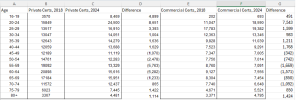
I had a copy of the 2018 airmen's statistics, and put together a comparison of 2018 vs 2024:
AirmenCerts-2018-and-2024.png

The FAA has statistics posted going back to 1999. Looking at them, it's very clear that for the most part, the boomers have mostly exited the hobby.

For the younger pilots, it looks to me that a lot of them started, probably thinking of making a career, but still have their private certs.
 
I had a copy of the 2018 airmen's statistics, and put together a comparison of 2018 vs 2024:
View attachment 143581

The FAA has statistics posted going back to 1999. Looking at them, it's very clear that for the most part, the boomers have mostly exited the hobby.
I don't know that the data I'm seeing above supports that... But I figured I'd look every 5 years so I'd be able to sort the Boomers out from the Silent Generation and GenX.

So, the number of Boomer Private Pilots was:
2000 (Boomers aged 35-55): 90,208 ATP, 49,754 Commercial, 132,102 Private, 35,110 Student, 317,742 total (Rotorcraft Only and Glider Only are excluded in this data)
2005 (Boomers aged 40-60): 90,166 ATP, 52,950 Commercial, 126,802 Private, 27,368 Student, 297,511 total (All aircraft)
2010 (Boomers aged 45-65): 83,314 ATP, 46,069 Commercial, 102,378 Private, 14,725 Student, 2,405 Sport, 248,987 total (Airline pilot age limit went from 60 to 65 on December 13, 2007 but some ATPs still would have aged out.)
2015 (Boomers aged 50-70): 77,050 ATP, 40,327 Commercial, 85,389 Private, 11,872 Student, 3,292 Sport, 217,996 total
2020 (Boomers aged 55-75): 65,845 ATP, 32,017 Commercial, 63,684 Private, 21,176 Student, 3,773 Sport, 186,554 total
2024 (Boomers aged 59-79): 47,608 ATP, 27,179 Commercial, 51,449 Private, 24,965 Student, 3,972 Sport, 155,209 total (I used the 60-80 age groups here.)

ATPs decreasing isn't too big of a surprise - Not many people get their ATP when they're older, and of course those aging out and not picking back up in GA, or simply becoming inactive for medical reasons at any certificate level, increases with age. Commercial certs were still going up from the first dataset to the second.

It's interesting that the Boomers had a hard upswing in Student pilot certificates there on the last couple of lines. Pandemic and retirement may have spurred that. Also, Sport pilots in the Boomer age groups are increasing.

Total-wise, the decline is pretty steady from 2010 on out at around 31K per 5 years, but there was a loss of 20K from 00-05 and then a loss of nearly 50K from 05-10. That economy really wrecked a lot of people.

In any case, Boomers in 2020 still represented 27% of pilots, and about 23% of the population. In 2024, Boomers still represent 18.2% of active pilots, but the number of active pilots increased from 691,689 in 2020 to 848,770 in 2024 :hairraise: with the wave of youngsters chasing the pilot shortage. If we instead look at the number of boomer pilots vs the number of total boomers, it's gone from 0.384% in 2000 to 0.306% in 2010 to 0.244% in 2020 while the total population of boomers has dropped by about 8%. There's been some attrition of course, but only about 1/3 of Boomers have "exited the hobby" so far.

For the younger pilots, it looks to me that a lot of them started, probably thinking of making a career, but still have their private certs.
For sure.
 
Last edited:
I don't know that the data I'm seeing above supports that... But I figured I'd look every 5 years so I'd be able to sort the Boomers out from the Silent Generation and GenX.

So, the number of Boomer Private Pilots was:
2000 (Boomers aged 35-55): 90,208 ATP, 49,754 Commercial, 132,102 Private, 35,110 Student, 317,742 total (Rotorcraft Only and Glider Only are excluded in this data)
2005 (Boomers aged 40-60): 90,166 ATP, 52,950 Commercial, 126,802 Private, 27,368 Student, 297,511 total (All aircraft)
2010 (Boomers aged 45-65): 83,314 ATP, 46,069 Commercial, 102,378 Private, 14,725 Student, 2,405 Sport, 248,987 total (Airline pilot age limit went from 60 to 65 on December 13, 2007 but some ATPs still would have aged out.)
2015 (Boomers aged 50-70): 77,050 ATP, 40,327 Commercial, 85,389 Private, 11,872 Student, 3,292 Sport, 217,996 total
2020 (Boomers aged 55-75): 65,845 ATP, 32,017 Commercial, 63,684 Private, 21,176 Student, 3,773 Sport, 186,554 total
2024 (Boomers aged 59-79): 47,608 ATP, 27,179 Commercial, 51,449 Private, 24,965 Student, 3,972 Sport, 155,209 total (I used the 60-80 age groups here.)

ATPs decreasing isn't too big of a surprise - Not many people get their ATP when they're older, and of course those aging out and not picking back up in GA, or simply becoming inactive for medical reasons at any certificate level, increases with age. Commercial certs were still going up from the first dataset to the second.

It's interesting that the Boomers had a hard upswing in Student pilot certificates there on the last couple of lines. Pandemic and retirement may have spurred that. Also, Sport pilots in the Boomer age groups are increasing.

Total-wise, the decline is pretty steady from 2010 on out at around 31K per 5 years, but there was a loss of 20K from 00-05 and then a loss of nearly 50K from 05-10. That economy really wrecked a lot of people.

In any case, Boomers in 2020 still represented 27% of pilots, and about 23% of the population. In 2024, Boomers still represent 18.2% of active pilots, but the number of active pilots increased from 691,689 in 2020 to 848,770 in 2024 :hairraise: with the wave of youngsters chasing the pilot shortage. If we instead look at the number of boomer pilots vs the number of total boomers, it's gone from 0.384% in 2000 to 0.306% in 2010 to 0.244% in 2020 while the total population of boomers has dropped by about 8%. There's been some attrition of course, but only about 1/3 of Boomers have "exited the hobby" so far.


For sure.

There's a footnote to that student pilot count that I think you missed. It's on the bottom of table 1, " Starting with April 2016, there is no expiration date on the new student pilot certificates, which generates a cumulative increase in the numbers." If you look at table 17, Original Certificates by Category, there were 31,000 total new Private certs earned, and 61,000 student certs handed out. I'm guessing the number of active student pilots is somewhere between those two numbers overall, but I'd also suspect the number of boomer student pilots is considerably lower than the 2015 count of 11,872.
 
Back
Top