MOSAIC Rule Today?

I haven't looked much at the repairman stuff, but I highly doubt that a Light Sport Repairman certificate would give any privileges for working on type-certificated airplanes. I think there's something in there about expanding what kind of things they can do, but unless I'm mistaken it's still all LSA and maybe EAB.
Changes nothing for non-LSA certified aircraft.
LSRM-A used to be able to work on & do condition inspections for E-LSA & S-LSA.
Now they can also do condition inspections on EAB aircraft.
 
I hope this encourages a lot of new LSA offerings from Technam, Flight Design, Super Petrol and others. I’m less interested in legacy aircraft than I am in unshackling existing LSA designs that were saddled with artificially low weights and stall speeds. Is there any speed restriction (I hope not)?
I bet Jabaru brings the 230 out with a 210 pound higher max weight. (The only practical difference between the 230 and the 430 is an additional seat in the back. 230 is LSA 430 is EAB, but otherwise identical. The 430 has a 210 pound higher max weight.)
 
Gotta be honest.... I just don't care anymore.

This isn't going to magically spur aircraft sales and manufacturing. And at my age and health, a medical isnt an issue. Great for guys that it is....I think. I dont know. My eyes glazed over a few pages ago
 
So, if I'm a BasicMed'er flying a 4-seat airplane with a PPL, I think nothing has changed for me as a pilot. Correct? Same if I'm flying a 6-seater, because it's just as it was before - a PPL is required, the plane is not considered an LSA.

However, question: my understanding of hte LSA rule was that LSAs could be designed and sold by manufacturers under an ASTM standard that was much easier to get approved than under the standard Part 23 requirements. Does this now mean that new LSAs could be designed under that same standard with as much as 4 seats, unlimited weight, flying up to 250 knots as long as their stall speed is less than the 61 knots dirty?

What would the maintenance requirements of such a plane be - repairman cert? condition inspection vs. annual?

Does the new Mosaic rule change anything about how and existing Part 23 aircraft has to be maintained (e.g. your average 172 still needs and annual signed off by an IA, right)?

Curious if this is going to cause a boom in the number and variety of 4-place planes, the way that LSA originally caused quite the expansion in 2-place planes?
 
I think you're right, but it seems strange that a PP with a medical can fly a MOSAIC airplane with VS0<61 knots, but if he doesn't have a medical the plane must have VS1<59 knots. WTH does a medical have to do with stall speed requirements for a pilot with a private certificate?

My baby Beech easily complies with VS0<61 knots, but not with VS1<59 knots, so I'll have to have a medical to fly it under MOSAIC but outside MOSAIC I only need Basic Med.
I'm sorry, did someone say these rules were supposed to make some sort of sense? :rofl:

Seriously, though... this is no different from all the rest of the SP rules. PP with a medical (2013 me) can fly whatever a PP can fly, whenever, wherever, yadda yadda. PP without medical (2014+ me) can only fly under SP privileges. That's the whole effing reason I'm flying an RV-12 instead of an RV-9, my friend.

And unless I'm misunderstanding, the 61 kt VS0 would only apply to airplanes in the Light Sport category. Not Standard or anything else. Those would have to be 59 kt VS1. So a person exercising SP privileges, regardless of their certificate, is limited to airplanes with a 59 knot clean stall, until Light Sport category airplanes are available that only have to meet 61 kt dirty.

It makes no sense to me, but there you have it. I'm sure there's some logic behind it, probably involving all the LS category rule stuff I haven't read yet (and may never read, to be honest).
Unless I'm missing something - does this mean that there can be LSA built that an airman holding only a sport cert can't fly? :dunno:
 
.....

I haven't looked much at the repairman stuff, but I highly doubt that a Light Sport Repairman certificate would give any privileges for working on type-certificated airplanes. I think there's something in there about expanding what kind of things they can do, but unless I'm mistaken it's still all LSA and maybe EAB.

.....
Mostly.

LSRM-A will not be allowed to work on Aircraft with a Standard Airworthiness Certificate (no change)

But will be allowed to work on EAB that meet the new limitations.

And new aircraft that are manufactured to the new standard and certified with a Special Airworthiness Certificate.

Current S-LSA may get new limits if the Manufacturer updates the Statement of Compliance with ATSM.

John
LSRM-A
 
Care to clarify?

Looking at the FAA’s pre-publication final rule, p.208, the SP limitation is passengers in the plane, not seats.

https://www.faa.gov/newsroom/MOSAIC_Final_Rule_Issuance.pdf https://www.faa.gov/newsroom/MOSAIC_Final_Rule_Issuance.pdf

Put differently, my understanding is the airplane can now have four seats instead of two but still limits an airman exercising Sport Pilot privileges to a total of two occupants in the aircraft, without regard to the certificate level held.

I’m less focused on the airplane and more so on the exercise of privileges.
Again what is the rationale here. Makes zero sense.
 
What would the maintenance requirements of such a plane be - repairman cert? condition inspection vs. annual?
https://www.kitplanes.com/light-sport-repairman-maintenance/
You can get a Light Sport Repairman Inspection certificate (LSR-I) which lets you do inspections on your own e-LSA, if you convert your LSA to an experimental-LSA. It's a 16-hour course. There are benefits to e-LSA at the moment, most notably that you can fly IMC. LSA do not allow IMC, only IFR, but there is talk of that changing.

There is also a Light Sport Repairman Maintenance certificate (LSR-M), which allows you to do annuals/100-hour inspections. It's a 120-hour course, and you can do annuals/for hire maintenance for other people. This is for standard LSA's, not experimental-LSA's.
 
Unless I'm missing something - does this mean that there can be LSA built that an airman holding only a sport cert can't fly? :dunno:

Yes, I believe that’s true. And to fly those LSAs, a PP will need a medical. So unless these new LSAs will be significantly cheaper than standard aircraft, I don’t see much point.
 
My understanding
PP with current Medical or BM - No impact other than maybe your plane might be worth a bit more (assuming it qualifies under MOSAIC)
PP without medical - Can operate more planes under SP privileges (and limits)
SP - More plane options - but subject to SP limits (e.g. #passengers)
Certified aircraft maintenance - Nothing
 
Unless I'm missing something - does this mean that there can be LSA built that an airman holding only a sport cert can't fly? :dunno:
Yes, if it has a 60kt stall speed. I suspect that nobody will build such an aircraft.
Again what is the rationale here. Makes zero sense.
It insures that those scary undertrained or medically deficient sport pilots can only kill one passenger.
 
I wonder if I would be able to get insurance for my nice DA40 if I no longer held at least a Basic Med certificate. In many cases Basic Med is probably not significantly better than meeting driver's license requirements but I don't know how insurers will consider risk for LSA pilots flying larger and more expensive aircraft.
 
I interpret the chart from the FAA that highlights the changes that the certificate of the pilot doesn't determine what can be flown, it's the aircraft. A certificated plane can have a 60 kts dirty stall. A light sport plane can have a 59 it's clean stall.
 
Disclaimer: This sii based on my understanding of what I've read in the PDF.
Unless I'm missing something - does this mean that there can be LSA built that an airman holding only a sport cert can't fly? :dunno:
Yes, I believe that’s true. And to fly those LSAs, a PP will need a medical. So unless these new LSAs will be significantly cheaper than standard aircraft, I don’t see much point.

No. A Sport Pilot (or person flying under SP rules) will be able to fly a NON-LSA (Standard, E/AB, etc.) with a 59 knot VS0. They would be able to fly an LSA with a 61 knot VS1, assuming those become available at some future date. There current'y is no LSA with that characteristic, but now an LSA with CS prop, retracts, and 61 kt VS1 will be possible (at least from a regulatory perspective).

I suspect there's some Euro "ultralight" (as they call them) that meets those specs.
 
"And new aircraft that are manufactured to the new standard and certified with a Special Airworthiness Certificate can be worked on by a LSRM-A."

To me, this is the biggest deal with this whole thing now and into the future: you'll be able to buy a *real* 4 place heavy and fast aircraft (no offense to current SLSAs), with no real arbitrary restrictions, manufactured by professionals, get your LSRM-A if you want to, and do your own maintenance/inspections.
 
So, if I'm a BasicMed'er flying a 4-seat airplane with a PPL, I think nothing has changed for me as a pilot. Correct? Same if I'm flying a 6-seater, because it's just as it was before - a PPL is required, the plane is not considered an LSA.

However, question: my understanding of hte LSA rule was that LSAs could be designed and sold by manufacturers under an ASTM standard that was much easier to get approved than under the standard Part 23 requirements. Does this now mean that new LSAs could be designed under that same standard with as much as 4 seats, unlimited weight, flying up to 250 knots as long as their stall speed is less than the 61 knots dirty?

What would the maintenance requirements of such a plane be - repairman cert? condition inspection vs. annual?

Does the new Mosaic rule change anything about how and existing Part 23 aircraft has to be maintained (e.g. your average 172 still needs and annual signed off by an IA, right)?

Curious if this is going to cause a boom in the number and variety of 4-place planes, the way that LSA originally caused quite the expansion in 2-place planes?
No, but it could continue the two-place boom up into much higher performance two-place aircraft.

EDIT: Now I am more confused. You can build new 4 place LSA aircraft, but you can only fly with two souls on board?
Is there now a hard line between LSA aircraft and Sport pilot?
OMG... I think you're right...
They can build 4 seat LSA aircraft.
Sport pilots can only fly with two souls.
PPL can fly with the seats full.
The two requirements have nothing to do with each other...
 
Last edited:
I'm sorry, did someone say these rules were supposed to make some sort of sense? :rofl:

Seriously, though... this is no different from all the rest of the SP rules. PP with a medical (2013 me) can fly whatever a PP can fly, whenever, wherever, yadda yadda. PP without medical (2014+ me) can only fly under SP privileges. That's the whole effing reason I'm flying an RV-12 instead of an RV-9, my friend.

And unless I'm misunderstanding, the 61 kt VS0 would only apply to airplanes in the Light Sport category. Not Standard or anything else. Those would have to be 59 kt VS1. So a person exercising SP privileges, regardless of their certificate, is limited to airplanes with a 59 knot clean stall, until Light Sport category airplanes are available that only have to meet 61 kt dirty.

It makes no sense to me, but there you have it. I'm sure there's some logic behind it, probably involving all the LS category rule stuff I haven't read yet (and may never read, to be honest).
This is an important point.
Can a sport pilot fly a 61 kt dirty plane if and when one is manufactured and certified as an LSA?
And in 3 months can a sport pilot fly a C172 (or other non-lSA) with a VS1 of 59?
The rule is confusing to me.

Screenshot 2025-07-22 at 4.38.45 PM.pngScreenshot 2025-07-22 at 4.40.25 PM.png
 
Reading through the FAA document...
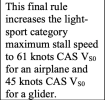
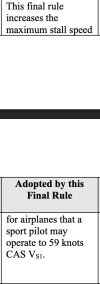
  • Increases the light-sport category maximum stall speed to 61 knots CAS VS0
  • Increases the stall speed for airplanes that a sport pilot may operate to 59 knots CAS VS1.
So... if I understand that correctly, a new LSA design can have a 61 knot dirty stall speed. A non-LSA flown by a SP or someone flying with SP privileges has to be at or below 59 KCAS VS1. I think that even includes things like Comanches, no?
So will there be LSA's that a sport pilot cannot fly in the near future?
 
https://www.kitplanes.com/light-sport-repairman-maintenance/
You can get a Light Sport Repairman Inspection certificate (LSR-I) which lets you do inspections on your own e-LSA, if you convert your LSA to an experimental-LSA. It's a 16-hour course. There are benefits to e-LSA at the moment, most notably that you can fly IMC. LSA do not allow IMC, only IFR, but there is talk of that changing.

There is also a Light Sport Repairman Maintenance certificate (LSR-M), which allows you to do annuals/100-hour inspections. It's a 120-hour course, and you can do annuals/for hire maintenance for other people. This is for standard LSA's, not experimental-LSA's.
The dashes go after the first four letters.
I'm an LSRM-A.
A Light Sport RepairMan - Airplanes.
 
…. Now they can also do condition inspections on EAB aircraft.
If anything, this may be the golden egg. A buyer (not builder) of an EAB may be able to take the LSRM-I and conduct their own Condition Inspection instead of needing an A&P to do so.

I haven’t read deeply into that section yet, so I’ll be interested to see if that only applies for aircraft that qualify in this ‘new’ category of aircraft or not.
 
250kts I believe.
Perfect. Build a 2 seat 200KTS airplane with a baggage area instead of 2 rear seats (roof doesn’t have to be as high). Give it a nice big baggage door and a flat floor for my two German Shepherds or a couple of bikes. A Corvette for the air. I am unusually optimistic today. Don’t need fancy avionics. Keep it under $500K.
 
To me, this is the biggest deal with this whole thing now and into the future: you'll be able to buy a *real* 4 place heavy and fast aircraft (no offense to current SLSAs), with no real arbitrary restrictions, manufactured by professionals, get your LSRM-A if you want to, and do your own maintenance/inspections.
It's a shame Blue Ridge Community College dropped their LSRM-A course when Fred Dyen moved to Alaska.
I wonder if he is going to start it up again in Anchorage.
I did mine at BRCC.

As far as I know, the only LSRM-A school is Rainbow, and they are a for profit school.
15 days/120 hours! Straight through with no days off.
 
If the rule is, regular certified airplanes must have a clean stall speed of 59 knots or less, then the Comanche 250 actually doesn't qualify. My POH says clean stall speed is 69 MPH which would be 59.9594 knots.
 
Again what is the rationale here. Makes zero sense.

In any Final Rule, the agency must explain its reason for how they got to their position and reply to comments why those comments weren’t incorporated; that’s why the rule is 700+ pages long.

This final rule makes significant changes to several major parts of 14 CFR; it’s going to take a while to digest.
 
If anything, this may be the golden egg. A buyer (not builder) of an EAB may be able to take the LSRM-I and conduct their own Condition Inspection instead of needing an A&P to do so.

I haven’t read deeply into that section yet, so I’ll be interested to see if that only applies for aircraft that qualify in this ‘new’ category of aircraft or not.

It is the "golden egg"...

"Therefore, this final rule expands the
privileges of a light-sport repairman certificate under § 65.109 to allow a certificate
holder, with either rating (inspection or maintenance), to perform the annual condition
inspection on an EAB aircraft issued an experimental airworthiness certificate under
§ 21.191(g).270
The changes adopted in § 65.109(a) and (b) of this final rule do not impose
additional restrictions but rather expand the privileges of a light-sport repairman.
Specifically, § 65.107(c) will allow a light-sport repairman with an inspection rating to
perform the annual condition inspection on an EAB aircraft that is owned by the
repairman and that is in the same category of aircraft for which the certificate holder was
trained.271 In addition, § 65.109(b) will permit a light-sport repairman with a maintenance
rating to perform the annual condition inspection on an EAB aircraft that is in the same
category of aircraft for which the certificate holder was trained.272
To emphasize, this final rule expands light-sport repairman privileges only to
aircraft issued an experimental airworthiness certificate under § 21.191(g) (operating
EAB aircraft) and the condition inspection required on those aircraft; the expanded
privileges do not extend to other aircraft issued an experimental airworthiness certificate
under § 21.191
"

That covers all EAB...
 
It's a shame Blue Ridge Community College dropped their LSRM-A course when Fred Dyen moved to Alaska.
I wonder if he is going to start it up again in Anchorage.
I did mine at BRCC.

As far as I know, the only LSRM-A school is Rainbow, and they are a for profit school.
15 days/120 hours! Straight through with no days off.
There are two different Light Sport Repairman certificates. The "maintenance" version, which is the 120 hour class, allows you to work on anybody's airplane, for pay. The "inspection" version is only 16 hours, and allowed you to do the annual condition inspection on an LSA (but not E-AB) certificated aircraft you own. The new rule, if I understand it correctly, expands the inspection privileges to E-AB certificated aircraft that meet the (new) LSA limits.
 
Last edited:
There are two different Light Sport Repairman certificates. The "maintenance" version, which is the 120 hour class, allows you to work on anybody's airplane, for pay. The "inspection" version is only 16 hours, and allowed you to do the annual condition inspection on an LSA (but not E-AB) certificated aircraft you own. The new rule, if I understand it correctly, expands the inspection privileges to E-AB certificated aircraft that meet the (new) LSA limits.
I don't read the "that meet the (new) LSA limits." part. I believe it covers ALL EAB...
 
I suspect this is what happened, and it makes sense in the wacky world of bureaucracy. The clean stall speed was the original restriction. And, originally it was 54. With all the comment, the FAA was actually kind enough to raise it to 59 clean.
But from an aircraft manufacturer standpoint, other countries have different LSA rules. IIRC, the Brazil LSA stall speed happens to be 61, though I don't know if it's with or without flaps. So maybe the FAA threw a bone to the airplane makers to make it easier to certify a plane as an LSA. But the FAA wasn't feeling generous enough to to give a uniform 61 speed for Both aircraft and airmen.

See, makes perfect sense, right???
 
Last edited:
If the rule is, regular certified airplanes must have a clean stall speed of 59 knots or less, then the Comanche 250 actually doesn't qualify. My POH says clean stall speed is 69 MPH which would be 59.9594 knots.
You have a POH? I only have a 10 page AFM. Will have to look at it when I get out to the airport.

Also it says 64mp dirty and then later in the POH says "about 5mph increase" when flaps are up. 4 is about 5. ;)
 
Last edited:
No. A Sport Pilot (or person flying under SP rules) will be able to fly a NON-LSA (Standard, E/AB, etc.) with a 59 knot VS0. They would be able to fly an LSA with a 61 knot VS1,...

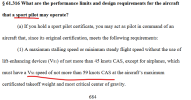
I don't think that's correct, but much of this is confusing. Here's what it says about airplanes that a SP may operate:


1753227627054.png​
 
Again, the difference is two different stall speed criteria. One for the airmen, and another for the aircraft.

For example, an RV14 has a Vso of 51, so Van's could theoretically sell RV14's as LSA's under the new rules, like the RV12.

But, the Vs1 is 62, so you still need class three or better to fly it, even though it was approved as an LSA.

It doesn't help you, the pilot, but it makes it easier for the manufacturer. The only other option would be to have it certificated (expensive...) or, experimental, as it is.

Still, seems like something like the RV9 (and likely the RV15, from what I can see) meet these criteria and should be able to be flown by sport pilots.
 
My Cherokee 140 POH states

VS1 64 MPH (55kts). :cool:

---SNORT----

With MOSAIC, the weight limitation is removed. GONE! In its place is a new set of limitations; the primary limitation will now be a “clean” stall speed (VS1) of 59 knots calibrated airspeed. Aircraft with up to four seats are now allowed, although sport pilots will still be limited to one passenger. Sport pilots are also now allowed to fly aircraft with controllable-pitch propellers and retractable landing gear, with the appropriate training and endorsements.

Equally exciting to the future of aviation is the aircraft certification reform included in the rule. New aircraft are on the way! The original LSA rule proved that safe, modern aircraft could be certified with a minimum of FAA oversight by using industry consensus standards and simple forms of validation. Now, LSA 2.0 is set to deliver far more capability. For years, high certification costs have been cited as a barrier to affordable ownership of new aircraft. LSA 2.0 substantially cuts these costs for any aircraft meeting the new definition: four seats, constant-speed propellers, retractable landing gear, and fewer restrictions on powerplants (including allowing electric power). For LSA (not to be confused with the definition of Sport Pilot eligible aircraft), the stall speed is 61 knots in landing configuration. The result is a lot of room for continued innovation.

The final MOSAIC rule will be discussed in more detail in a feature story running in the September 2025 issue of EAA Sport Aviation. You can read the final rule via the link here.

 
I don't read the "that meet the (new) LSA limits." part. I believe it covers ALL EAB...
Seems strange but I do believe you're correct.

§ 65.109 Repairman certificate (light-sport): Privileges and limitations.
(a) The holder of a repairman certificate (light-sport) with an inspection rating
may perform the annual condition inspection on an aircraft:
(1) That is owned by the holder;
(2) That has an experimental airworthiness certificate issued in accordance with
§ 21.191(g), (i), (k), or (l) of this chapter; and
(3) That is in the same category, and class as applicable, of aircraft for which the
holder has completed the training course specified in § 65.107(c) of this part.
(b) The holder of a repairman certificate (light-sport) with a maintenance rating
may -
(1) Approve for return to service an aircraft that has a special airworthiness
certificate in the light-sport category under § 21.190 of this chapter, or any part thereof,
after performing or inspecting maintenance (to include the annual condition inspection
and the 100-hour inspection required by § 91.327 of this chapter), preventive
maintenance, or an alteration (excluding a major repair or a major alteration on a product
produced under an FAA approval);
(2) Perform the annual condition inspection on an aircraft that has an
experimental airworthiness certificate issued in accordance with § 21.191 (g), (i), (k), or (l) of this chapter; and...
I suspect it's an oversight that will be corrected, but you never know.

...and for our reading pleasure...

The name is changing to: Repairman certificate (light-sport)

So I'm not sure what our acronym will be. (also LSRM-A)
It's now "repairman certificate (light-sport) with an inspection rating" or "repairman certificate (light-sport) with a maintenance rating". Repairmen are limited to an aircraft "That is in the same category, and class as applicable, of aircraft for which the
holder has completed the training course specified in §65.107(c) of this part."
 
What good is an LSA cert aircraft that you need a private to fly? Isn’t that just an aircraft?
 
There are two different Light Sport Repairman certificates. The "maintenance" version, which is the 120 hour class, allows you to work on anybody's airplane, for pay. The "inspection" version is only 16 hours, and allowed you to do the annual condition inspection on an LSA (but not E-AB) certificated aircraft you own. The new rule, if I understand it correctly, expands the inspection privileges to E-AB certificated aircraft that meet the (new) LSA limits.
I concur and I have the LSRM-A, 120 hour course, that I earned at Blue Ridge Community College back when Fred used to run the course there. They dropped it when he moved to Alaska.
 
Back
Top