mag drop too small

GeorgeC

Administrator
Management Council Member
Joined
Dec 5, 2010
Messages
6,581
Display Name
GeorgeC
Yes, it's a thing.

After last year's annual, I did a mag check and did not observe a mag drop at all. Wait, what? At first, I was incredulous; maybe a p-lead issue, or a problem with the ignition switch? A quick flip to "off" disproved that.

Maybe they dialed it in exceptionally well?

At this year's annual, it turned out that my timing was on the advanced side by more than a little. Thankfully, borescoping did not find any damage.

As ever, your engine tries to tell you things, but you have to know what to listen for.
 
On my lancair I am currently running one EMAG and one Light speed plasma ignition. On mag check the light speed alone has zero mag drop. I've read it is due to both a stronger coil and significant advance timing that light speed does at idle.
 
On my lancair I am currently running one EMAG and one Light speed plasma ignition. On mag check the light speed alone has zero mag drop. I've read it is due to both a stronger coil and significant advance timing that light speed does at idle.
That sounds backward. Variable ignition timing usually retards at idle and advances as RPM increase. If static timing (like a magneto) is set for cruise RPM (say 2400), then it's already advanced ahead of what is ideal for idle. This is why a magneto impulse coupler, which aids in starting, delays the spark timing (as well as boosts its energy).
 
That sounds backward. Variable ignition timing usually retards at idle and advances as RPM increase. If static timing (like a magneto) is set for cruise RPM (say 2400), then it's already advanced ahead of what is ideal for idle. This is why a magneto impulse coupler, which aids in starting, delays the spark timing (as well as boosts its energy).
As I understand it the light speed retards for starting, advances at idle, less advance at high power takeoff then more advance at cruise. I could be wrong...
 
As I understand it the light speed retards for starting, advances at idle, less advance at high power takeoff then more advance at cruise. I could be wrong...
That almost makes sense. Usually, the optimum spark timing monotonically increases with RPM until it reaches a max which it holds steady to redline. I've never heard of an engine that retards spark timing as RPM increases.

Conceptually (though over-simplified), the idea is that the mixture burns at a constant rate. So the time delay (call it latency) between spark and peak pressure is constant. That's not entirely true of course, but roughly so. As RPM increases, the piston moves a greater distance during that same latency, so as RPM increases, the spark needs to fire progressively earlier for the peak pressure to happen at the same cylinder position.

But maybe it's true that the SureFire spark timing is retarded for full power compared to cruise? Seems weird but not necessarily wrong. The only reason I can think of is this: Lean mixtures burn slightly slower than rich. Full power is usually full rich, and cruise is usually leaned. So in cruise the mixture is burning slower (compared to full power), so the spark timing may be more advanced in order to get a complete burn. And since the engine is not at full power, BMEP and thus the risk of detonation is lower.

But that is speculation/rationalization on my part. If the SureFire does this, it's the first time I've ever heard of spark ignition timing being more advanced at a lower RPM, or retarding with increasing RPM.

Older engines with mechanical advance often used spring-loaded weights. When the engine spins faster, the centrifugal force swings the arms outward to advance the timing. That means timing monotonically advances and retards as engine RPM increases and decreases.
 
I've never heard of an engine that retards spark timing as RPM increases.
When drag racing big-block Buicks, 3rd gear, retard timing by 6 degrees and pick up a ton of MPH.
 
On my lancair I am currently running one EMAG and one Light speed plasma ignition. On mag check the light speed alone has zero mag drop. I've read it is due to both a stronger coil and significant advance timing that light speed does at idle.
My former RV had one Light Speed and one mag. Same thing - zero RPM drop on the electronic ignition alone. Plus one gallon per hour less than book at 75% power.
 
Lack of “ drop” is not necessarily a good thing.

Just like going from BOTH to single mag causing an increase.
 
At this year's annual, it turned out that my timing was on the advanced side by more than a little.
So did the last mechanic set the timing wrong? Did he maybe think that all Lycomings get their mags set to 25°BTDC because that's all he's been working on, while it should have been 20°?

Other than that, unusually advanced timing can be due to accelerated points erosion. Slick had a serious problem with that some years ago when they used the incorrect silver alloy on the points. Points erosion increases the gap, and the cam then opens the points sooner. If the plastic cam was wearing, or if it's a Bendix/TCM mag and the plastic rubbing block on the points wore rapidly, the points would open later and retard the timing.

Either one shows up when the timing is checked. Slick had a Service Bulletin that warned that the mags should be checked internally if there's a more than 4° shift in timing in 100 hours. I can't find that SB or SL now.

And either one also shifts the mag's E-gap, weakening the spark.
 
Pilots should be educated as to what are normal parameters.

Too much carb heat drop can be indicative of a partially collapsed duct.

Too high Static RPM can be caused by a cut down or incorrect prop.

If it seems too good to be true etc etc.

Even if timing was correct at the time of the Annual the component wear

Dan referred to can cause issues. Those issues include damaged engines,

burned out Starters and worse.
 
A zero Mag drop can be caused by a failed capacitor in the magneto. That happened to my newly overhauled engine. Since my magneto was covered under warranty, it was replaced by the manufacturer and resolved the issue.
 
A zero Mag drop can be caused by a failed capacitor in the magneto. That happened to my newly overhauled engine. Since my magneto was covered under warranty, it was replaced by the manufacturer and resolved the issue.
A failed capacitor disables the magneto altogether. You had something else wrong there.

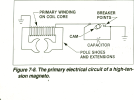
The capacitor, (condenser) is commonly thought to be there to prevent erosion of the points as they open and the current sparks across the gap. But there's much more to it than that. That condenser absorbs the current flow as the points open so that there is no continued arcing across the points, which would represent a slower decrease in current running through the primary. But we need an abrupt stoppage so that the magnetic field in the primary winding suddenly collapses through the secondary winding causing a high voltage to be generated to fire the spark plug. That condenser does that by absorbing the current until the points are far enough apart that arcing cannot start once the condenser is full. When the points close again, the condenser's charge is shorted through the points. In fact, just before the points re-close, that condenser's charge helps motivate the current flow to begin in the primary, in the opposite direction to the previous flow, since the magneto is an AC generator.
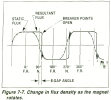
1776021094633.png

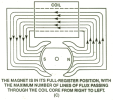
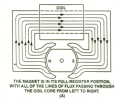
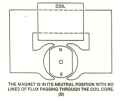
The Static Flux is that generated by the rotating magnet. The Resultant Flux is what is generated by the current flowing in the primary winding, generated by the magnet. Current and magnetism are interchangeable, see? The points open at the E-Gap angle so that the fall in flux is nearly the full distance between the positive and negative peaks of the Static Flux. That distance plus the speed of the collapse is necessary to get the spark voltage in the secondary. Now, take that capacitor out, or have it fail open, and that vertical fall becomes a slope, too gentle to make a useable spark. If the condenser shorts, it shorts the points so that the same thing happens. That is what your ignition switch does when you switch it. "L" or "R" shorts the opposite mag's points, i.e. "L" shorts the right mag's points to kill it. "Off kills both mags.

Here is the basic circuitry of the magneto:
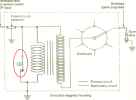
1776021522634.png

The points are shown with the cam that opens them in the red oval. That cam turns with the magnet.

The three bars between the primary and secondary windings are the iron core of the magneto's generator:
1776021642809.png


1776021679207.png

1776021702133.png

1776021735686.png

The old points-and-condenser ignitions systems used in cars up until the early 1970s used the same principles, except that the primary current controlled by the points comes from the car's battery and charging system (generator or alternator). Both generators and alternators are prone to failure, especially if they're not maintained but instead run until they quit. That doesn't fit aviation at all, does it? The magneto has its own generator so that the engine continues to run even if the airplane's electrical system goes dark, but that mag still need periodic internal inspections. Many don't get it, along with alternators and generators and vacuum pumps.

 
^^^^^^^^^^^ = Great explanation!


Slick mag? Perhaps misunderstanding as P-lead attaches to Capacitor?

Loose connection there would give zero or erratic low drop.

Glad warranty covered it though. Many folks are buying new mags with

Service Bulletins ( not AD’s ) that are not complied with at time of sale.

Suggest a pic of mag data plate and visit Slick or Aircraft Mag Service site

while still in warranty. Or cross your fingers!
 
A failed capacitor disables the magneto altogether. You had something else wrong there.
That depends on the failure mode. The pass thru is internal to the capacitor. An open or high resistance path internal to the capacitor feed through will cause the same symptom as a hot P lead. There won't be a magneto drop when testing the good magneto, because the other magneto is not being grounded through the P lead.
 
That depends on the failure mode. The pass thru is internal to the capacitor. An open or high resistance path internal to the capacitor feed through will cause the same symptom as a hot P lead.
Seems to me that Bendix had a problem with that quite a while ago. There was a service bulletin on it that I can't find now. I think it may have been related to overtightening of the nut on the P-lead stud.
 
Mag drop can be influenced by density altitude. In cold temps, high barometric pressure, and lower true altitude the density altitude and be less than sea level. Mag drop isn’t going to be much.
 
Back
Top