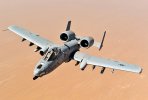
Let's make new A10 Warthogs

Sort of like building 1955 Chevy Bel Airs again? Sounds simple but it isn't.
It's not a bad analogy, and I kinda think it would be.


Design and manufacturing techniques have had some advances in the past 50 years. If you want to build the Chevy from scratch, you'd put it on a modern chassis, put an LS in it, put disk brakes on it, and add some radial tires.

If my memory and google skills are right, it took about 6 months to design and build the first P-51, more than 80 years ago. Now I don't like to think about it this way because it makes me feel old, but the first flight of the A-10 (and F-15) was in 1972, about 30 years after the first flight of the P-51, or more than 50 years ago. Roughly speaking, the A-10 and F-15 at about the midpoint between the Sopwith Camel and today.

My bet would be that if we wanted to build new A-10's today the most difficult part would be writing the requirements and getting them to stick. Don't drop the things it needs, and don't add anything new that it doesn't. Nobody wants to build a commodity for the military, because to do so means they can't try to sell their special brand of whatever for 10x the cost. For some things? Good plan. For others? A sedan is a sedan.
 
Agree. There's always a "well, we can't do that because....", but we can certainly come close to it if not do it exactly. A basic airplane these days should be a commodity, like a desktop PC, if we're talking about replicating a design from the 50's, 60's or 70's. The F-15 they can, and are, just building from the same airframe.
The B-52? Duplicate the same size fuse, same NACA whatever airfoil on the wing and tail, keep the same balance, and design it from scratch. It doesn't have to pass the same certification standards as a commercial airliner, it just has to fly...and if somebody can't design that, in 2026, where they know with certainty that the first one rolling off the assembly line will fly, then that company shouldn't claim to be in the aircraft design business. It's not commercial, so it doesn't have to be within 1% or whatever of the fuel economy and minimum possible weight...the original certainly was not. It's ok if it's a little heavy, and it's ok if it's not aerodynamically perfect. It just has to be sturdy and fly and be reasonably economical. Bid it out.

Same for the A-10. Put the specs and design of the A-10 out for bid. List some things as non-negotiable - the titanium tub, the gun mount, the backup cable system, and require that it use the same wing and tail shape. Bid it out. As for the drone mission, to me the best anti-drone weapon is another drone, but if we're going to have humans try to shoot them down 1v1 via gun, then make a different gun pod. In 197x they couldn't fit a gun pod to an F-4 that would shoot straight, but it's 2026 now, so I'm pretty sure they can now. Maybe drag out some 20mm ww2 era cannons and put prox fuses on them that'll work with drones, so the shells can self destruct, so it can be used more safely over friendly territory.

As far as using commercial airframes goes, I think the only people that is good for are the legacy commercial airframe builders. Those aircraft were just designed to be rugged enough and redundant enough to fly in civilian airspace. They're not DC-3's or even 707's that were stronger than they needed to be because they couldn't design to the ragged edge of structural safety like they can today.

We spend way too much money on cutting edge stuff where it just isn't needed. I wasn't born yet by a few years when Eisenhower made his farewell speech. For someone that had so much influence on the country in a positive way, and who faced problems that no one in that city today has the courage to even understand it's interesting that he used that time to speak about a center of evil that concerned him that most people weren't even aware of. Perhaps it was more Insidious then, and perhaps he was looking at the longer lens of history, and predicting where that could head for us.

Ok, that was too wordy. Maybe we just do the Bladerunner thing, and give defence contracting companies a 5 year lifespan, then scatter them to the wind.

All you have to do to debunk this line of thought is to consider how many counterfeit parts and assemblies there are, and how much they vary in quality. One does not simply build something to look like the original and expect to get the same quality of the original.
 
All you have to do to debunk this line of thought is to consider how many counterfeit parts and assemblies there are, and how much they vary in quality. One does not simply build something to look like the original and expect to get the same quality of the original.
I don't think anything I wrote precludes putting a QC standard in the spec, and the fact that parts are easy to counterfeit doesn't mean that manufacturing quality parts isn't either possible or easy. It just means that manufacturing parts is easy, and that quality might vary.

That's not intended as a smart a** answer. Small and large CNC systems are way more available and affordable than they were 30+ years ago, let along 50. Same with things like TIG welding, CAD, and I'd guess almost everything related to manufacturing.

Having worked for and around various manufacturing industries for a decent amount of time, there are only a couple of things that stand out as being more difficult than they were X decades ago: 1) Well, you can't dump chemicals in the river anymore, in this country. 2) Safety standards and expectations are higher. 3) There's more paperwork. 4) Labor costs are higher, and it's more difficult to find skilled employees in the trades.
I would argue that the procurement process is far more broken today than it was 50 years ago. The never-ending changes and "optimization" in the design/build/buy process (plus funding gamesmanship) lead to a long and tremendously expensive development process. Think about it. The F-22 took 16 years from when the initial ATF concept was put forward until the first production aircraft rolled out. The F-15 took about 4 years...

Point is, building airplanes is the same as its always been. Getting them through all the hurdles and into production is the problem.

As someone pointed out earlier, a "New A-10" would probably have tons of gee-whiz stuff, but you wouldn't get the first squadron for 20 years...
 
Small and large CNC systems are way more available and affordable than they were 30+ years ago, let along 50. Same with things like TIG welding, CAD, and I'd guess almost everything related to manufacturing.
And none of that currently exists in a state suitable for rolling A-10's off the line. You can't just snap your fingers and start CNC milling parts from paper drawings and you can't assemble CNC'd parts in fixtures that no longer exist (and would probably have to change to adapt to new methods if they did), you need a whole new production line and people to run both ends of it. You also need to source new systems and subsystems including software, unless your plan is to rob spares for the current fleet to support the new fleet, which does not net you more airplanes. Might as well rework/SLEP* the ones sitting in the desert at AMARC as has already been mentioned a couple times and is a better and more practical idea IMNSHO if you really are willing to accept nothing more than more A-10s with no new capability or survivability.

*Service Life Extension Program, i.e. "rehab/rejuvenation."

Nauga,
and that Ringo Starr song
 
Last edited:
The F-15 took about 4 years...
That's got to be from contract award to first flight or IOC or something like that*, but work on concept development was well underway long before that. The same could be said for the A-10, but I'll bet near production-ready plans, drawings, etc. were pretty far along when the proposals were submitted. That is currently not the case with the A-10.

*ETA: but even that is still pretty dang fast.

Nauga,
and an analog...
 
Last edited:
That's got to be from contract award to first flight or IOC or something like that, but work on concept development was well underway long before that. The same could be said for the A-10, but I'll bet near production-ready plans, drawings, etc. were pretty far along when the proposals were submitted.

Nauga,
and an analog...
Best I could tell, the 4 years came from what I'll call the "final spec" to the first flight. They had a number of concepts (starting with the F-111), and after years of refining the concept ultimately wound up with the F-15 spec. Once that was finalized, 4ish years.
 
Best I could tell, the 4 years came from what I'll call the "final spec" to the first flight. They had a number of concepts (starting with the F-111), and after years of refining the concept ultimately wound up with the F-15 spec. Once that was finalized, 4ish years.
According to Wikipedia (I know, I know) contract award was Dec 1969 and immediately went into full-scale development with first flight July 1972 from what was likely a production line or nearly so (Wiki doesn't say the part about the production line). It doesn't say when initial operational capability was reached, but that is a more relevant milestone for the fleet user. Still really fast - but I don't think many would argue that the cold war environment really accelerated things.

Nauga,
toeing the line
I got my "knowledge" from the same place. ;-)
 
The F-22, YF-22, YF-23 and F-15 took about the same time from contract award to first flight. I know because I was the USAF Chief Engineer of the first three and was involved earlier in the F-15 Program.

The Engines took about 7 years and the Avionics about 5.

Basically the same time lines from the 60’s till now for every USAF Aircraft program and I “touched” every USAF Tactical Airplane developed from 1964 til 2000.

The longest poles in the tent are defining what is wanted and convincing Congress to pony up the money which hasn’t changed since 1776 (I wasn’t there but I read history). All the hoo haw about contracting, regs, etc. is secondary and just adds cost, not time.

X3 Skier who didn’t need Wikipedia
 
Last edited:
I got my "knowledge" from the same place. ;-)
I get a good bit of my knowledge from people like @X3 Skier here on POA and another aviation web site I frequent.
Or I get it from my wife who knows more than all the pilots here combined. I know this because she told me so.
 
BTW, IOC is a flexible thing. In the USAF it is when AFOTEC says so but sometimes it was when TAC/CC said so or when enough airplanes are around to be useful or we send F-111’s to Vietnam before they were ready (I was involved with that) or when certain capabilities are pushed to the B Model or ……….
 
And as final observations

More money = less time (with a limit)

Less money = more time + more money (with no limit)

Engines take the longest time, followed by Avionics (primarily the Radar) then the Airframe (which is actually the simplest part of the problem but what people tend to focus on)
 
Last edited:
Good, Fast, and Cheap ... pick any two.
I have a corollary to that for a new sophisticated development. If you go Cheap, it likely will not be so good and it definitely you will not get it fast.

OTOH, Ukraine has clearly demonstrated that if you ask for “Good enough” you can get it REALLY Fast and RELATIVELY Cheap. Hopefully, DoD (AKA Fort Fumble) has finally learned this since they apparently have forgotten WW II and the Arsenal of Democracy.
 
OTOH, Ukraine has clearly demonstrated that if you ask for “Good enough” you can get it REALLY Fast and RELATIVELY Cheap. Hopefully, DoD (AKA Fort Fumble) has finally learned this since they apparently have forgotten WW II and the Arsenal of Democracy.

Mortal threats have a way of focusing the mind.

Ukraine has really embraced incremental development. The technologies they are focusing on lend themselves to that approach, especially drones. I have had some interactions with them and have great admiration for what they have accomplished.

The GO who just took command of the US/NATO assistance command for Ukraine worked for me when I was a company commander 25 years ago, and we have stayed friends. Very proud to see what he has accomplished, and proud to see him taking a lead role in such an important mission.
 
I have a corollary to that for a new sophisticated development. If you go Cheap, it likely will not be so good and it definitely you will not get it fast.

OTOH, Ukraine has clearly demonstrated that if you ask for “Good enough” you can get it REALLY Fast and RELATIVELY Cheap. Hopefully, DoD (AKA Fort Fumble) has finally learned this since they apparently have forgotten WW II and the Arsenal of Democracy.

:yeahthat:
Part of the problem is compartmentalization on the customer side. Each faction has one particular part of the problem that they care about, and it's hard to get any of them to see the big picture.

On a missile development I was leading some years ago (not going into details), I had several instances of trying to convince some Army expert that we had an approach that met (or beat!) the requirement, and their insistence on "better" would require a change order + change proposal, delay the schedule, and cost more money. More than once I heard the expert, who had to approve the design, say something along the lines of "I'm not worried about the cost; that's the PM's job." I, OTOH, did have to worry about cost and schedule, so when the impact was severe I bubbled it up to the Army CE or PM and achieved sanity, sometimes with the unfortunate result of pizzing off the customer expert that I still had to work with.

It only takes a handful of customer reps saying something like "I want to get the weight as low as possible" or "We need to increase the range" or "It needs to operate in XXX environment," when they don't have cost or schedule responsibility, to blow a program completely off the rails.

Certainly not the entire problem, but I've experienced it and it's definitely part of the problem.
This effect is not limited to the military, although they seem to have perfected the execution of project derailment.
 
This effect is not limited to the military, although they seem to have perfected the execution of project derailment.

Particularly the Army. I've seen the Army crash & burn on so many major projects it makes my head swim. FAADS, Comanche, Future Combat System, MULE, Armed Aerial Scout,......
 
:yeahthat:
Part of the problem is compartmentalization on the customer side. Each faction has one particular part of the problem that they care about, and it's hard to get any of them to see the big picture.

an "expert" that doesn't pay attention to cost and feasibility is an idiot, not an expert.
 
an "expert" that doesn't pay attention to cost and feasibility is an idiot, not an expert.
Agree but also might be an Engineer who has been drilled to make the $#%@%^ thing work like it's supposed to.
Agreed, but there are a bunch of them influencing contracts.
Having been asked on a few times to "Assist" on other Aviation Developments, I agree on your observation. The Army was the worst at that. The USAF and USN were about the same in doing minor "fiddling" with the design but usually controlled by the the Chief Engineer or PM.

Anytime one of my Engineers suggested an "Improvement", sometimes encouraged by their counterpart on the Contractor side, the first question was "Are we meeting the required performance?" If yes, then no change in plan unless it saves money or time. If no, then what needs to be done and how much management reserve do we have?
 
It only takes a handful of customer reps saying something like "I want to get the weight as low as possible" or "We need to increase the range" or "It needs to operate in XXX environment," when they don't have cost or schedule responsibility, to blow a program completely off the rails.
Scope creep and changing requirements. Aargh.

I'm a proponent of "Get the first 50 flying. We'll optimize the B model."
 
I would argue that the procurement process is far more broken today than it was 50 years ago. The never-ending changes and "optimization" in the design/build/buy process (plus funding gamesmanship) lead to a long and tremendously expensive development process. Think about it. The F-22 took 16 years from when the initial ATF concept was put forward until the first production aircraft rolled out. The F-15 took about 4 years...

Point is, building airplanes is the same as its always been. Getting them through all the hurdles and into production is the problem.

As someone pointed out earlier, a "New A-10" would probably have tons of gee-whiz stuff, but you wouldn't get the first squadron for 20 years...
That I agree with. But I do believe it's fixable. When the P-51 was designed in X months, I'm certain that part of that was because the stakes were high, and real. Even similarly with the F-15. The cold war was a real thing, and time was a factor.

We may all have different versions of what "easy" is. I'm going to oversimplify a bit...we know what that shape of the airfoils on the outside, we know what the control surface sizes and shapes and throws and forces are. We know where the engines go, where the gear is, where the pilot is, where the fuel goes, and what the weight and balances are. It's a bunch of different shaped boxes all connected together.

We're not quite at the point where we can pick up a mouse, talk into it, and say "computer, design me a functional duplicate of an F-15C that can be constructed out of steel and aluminum, using a minimum of forged parts and maximizing use of CNC and robotic welding of stock alloys and shapes; then do a stress analysis of it throughout its operating envelope", but we're closer than we were in 1972.

Now maybe if I turn it around and ask the question "can any current American aircraft manufacturer reasonably make a new A-10?" the answer might be no. But that's a different question. Kind of a darker question.
 
let's not forget to consider the additional complexity of the F-15 vs the P-51.
 
We may all have different versions of what "easy" is. I'm going to oversimplify a bit...we know what that shape of the airfoils on the outside, we know what the control surface sizes and shapes and throws and forces are. We know where the engines go, where the gear is, where the pilot is, where the fuel goes, and what the weight and balances are. It's a bunch of different shaped boxes all connected together.

We're not quite at the point where we can pick up a mouse, talk into it, and say "computer, design me a functional duplicate of an F-15C that can be constructed out of steel and aluminum, using a minimum of forged parts and maximizing use of CNC and robotic welding of stock alloys and shapes; then do a stress analysis of it throughout its operating envelope", but we're closer than we were in 1972


“oversimplify a bit” is actually understating a whole lot. As I mentioned earlier, the Airftame is the simplest part of the job. Might also ask AI to do the same things for the rest of the system like the engine, the landing gear, hydraulics, actuators, Radar, ECM, COMM, gun,……..

And ask AI how many engineers will it take how long to check the results since nobody is going to start making chips without that being done if they are sane.

Saying we’re closer than we were in 1972 to use AI to develop an aircraft is like saying we’ve closer to getting to London on a bicycle after we left Los Angeles and arrived in Lancaster CA.

OTOH, the intel guys are probably using AI to steal the plans for POS Chinese Fighters undergoing development right now.
 
Look how long it’s taking just to get a new trainer (T-7) going.
And that was supposed to be much “easier” because of CAD/CAM, Computational Fluid Dynamics and other related computational systems.
 
And that was supposed to be much “easier” because of CAD/CAM, Computational Fluid Dynamics and other related computational systems.
A trainer should be simple, reliable, and rugged. Not cutting edge.

Why in the world would one have a long development cycle?
 
A trainer should be simple, reliable, and rugged. Not cutting edge.

Why in the world would one have a long development cycle?
I'm not going to answer the programmatic side of that directly but an advanced trainer to adequately prepare pilots to transition to 5th generation airplanes with advanced systems and capabilities is likely to be far more complex than, say, a T-34. Meeting (perceived or otherwise) reliability and 'ruggedness' requirements with the level of technology required to be an adequate trainer may not shorten the development process either. Look at how the airplane (and rest of the system) is intended to be used.

Nauga,
with bells and whistles
I'd have thought the trainer would be to train flying skills and sim's would be to train on advanced systems, then off to fly the real deal. 'Cause its spendy to build a trainer that teaches F-xx, B-xx, and C-xx systems and tactics.
 
or how long it's taking to get a new Air Force One out.
Even with an existing Airframe and Engines. Granted that the Defensive and Secure COMM requirements plus the meddling of whoever is in the White House at the time.
 
Last edited:
I'd have thought the trainer would be to train flying skills and sim's would be to train on advanced systems, then off to fly the real deal. 'Cause its spendy to build a trainer that teaches F-xx, B-xx, and C-xx systems and tactics.
Basic flying skills are learned in the T-6 Texan 316 kts max speed and High Performance flying in the T-7 max speed almost Mach 1 and 8 g’s in what I remember as lead in fighter training. After learning to operate the T-7, the next step is Figher/Attack training Wing in Operational Aircraft like F-15’s and F-22’s and then Operational Squadrons.
 
Back
Top