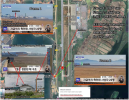
Jeju Air, South Korea

I haven't watched the latest video yet. Was there any evidence that a good engine was shut down? Lacking that, it would seem more likely that both engines were damaged by bird strikes.

My last bird strike took birds through both engines, the nose, and all three landing gear. Smaller birds, though, so no major damage. The airplane was back flying again, with its original engines, two days later.

Also, do we know why they initiated the go-around?
Apparently crew was warned of bird activity on final. Crew saw the enormous flock, started the go around and ended up flying through it.
 
There's no evidence the left engine failed/was shut down; I contend there might be evidence it didn't.

Based on the info available in the internet (iow, open to stand corrected on the data set):

-In the Hudson accident, they lost thrust at 2818ft and 250 knots, kept it clean, and flew for 3.5 minutes.
-Jeju hit the flock at measly 498ft and 161 knots 1.1 NM south of the point they would end up overflying, turning around and eventually exploding in. They were also dirty at the start of this unlimited acro sequence, whereas hudson was clean at start of sequence. Yet somehow Jeju managed to clean up, and still fly over 4 minutes. From 500'A..... *uncaps paint thinner can*

....Forget Occam, unless we're talking about a Schweizer wing STC I don't know about, that dog don't hunt.
 
There's no evidence the left engine failed/was shut down; I contend there might be evidence it didn't. ….
Juan contends the Sully/NTSB-esque sim recreations for Jeju demo’d #1 was producing at least 55% power. Less than that and the airport wasn’t made by the sim drivers who knew what would galoen.
 
There's no evidence the left engine failed/was shut down; I contend there might be evidence it didn't.

Based on the info available in the internet (iow, open to stand corrected on the data set):

-In the Hudson accident, they lost thrust at 2818ft and 250 knots, kept it clean, and flew for 3.5 minutes.
-Jeju hit the flock at measly 498ft and 161 knots 1.1 NM south of the point they would end up overflying, turning around and eventually exploding in. They were also dirty at the start of this unlimited acro sequence, whereas hudson was clean at start of sequence. Yet somehow Jeju managed to clean up, and still fly over 4 minutes. From 500'A..... *uncaps paint thinner can*
Juan contends the Sully/NTSB-esque sim recreations for Jeju demo’d #1 was producing at least 55% power. Less than that and the airport wasn’t made by the sim drivers who knew what would galoen.
I think you've got it backwards. #1/left engine was totally dead, #2/right engine was at 55%.

There is still the possibility that #1 was still producing thrust and got shut down inadvertently by the crew, though I find that somewhat unlikely.
 
I think you've got it backwards. #1/left engine was totally dead, #2/right engine was at 55%.

There is still the possibility that #1 was still producing thrust and got shut down inadvertently by the crew, though I find that somewhat unlikely.
The CVR and FDR apparently quit after both engines stopped producing enough thrust to power the electrical buss. There might be enough on those recordings to figure out how that happened.
 
The CVR and FDR apparently quit after both engines stopped producing enough thrust to power the electrical buss. There might be enough on those recordings to figure out how that happened.
The video that was above has an interesting piece with the last few things on the CVR and the checklists.
 
Reviewing the audibles with headphones has been elucidating. You can hear the belated acoustics of the tailstrike thump, given the distance from the camera (sounds like a bird cannon going off slightly after you see the tail scrape plume). Can also distinguish a scraping noise begin coincident with the settling on the nacelles. You can also make out the point down that scrape where the frequency shifts to include a lower-frequency throaty rumble we all associate with TR airflow deflection. Left engine TR remained stowed for the appreciable video angle's duration, before it becomes obscured by the fuselage. Right TR is appreciably deployed as the resolution of the video affords us a look when it gets close enough.

Most importantly, you can hear the baseline turbine "white noise" running through the whole thing. The entire acoustic signature is rich with the sounds of engine operation, even with scraping being added to the profile. That was an approach done under usable power. That is NOT the acoustic signature of an airliner with windmilling engines scraping on its belly.

I'm back to Occam. I still think they porked it by rushing a single-engine recovery with unecessary misconfiguration (clean) histrionics.

That dual AC loss will likely never be explained with the forensics available, since the FDR cut off. But I'm willing to conjecture it was NOT due to dual engine thrust loss, given the acoustic signature in evidence.

Q for the guppy drivers: Why no APU as a critical/memory action item for dual AC loss? Missed opportunity there, unless they tried it and just didn't work (again, another thing we will never know). We had 4 generators and no APU in the combat-obsolete memphis belle; yet it was a memory item for us to immediately get to and isolate/re-actuate those gen switches.... in an airplane with 8 engines. But with the benefit of an APU onboard, you bet I'd be skipping over checklists and on that APU start switch like white on rice, after I ensured I had at least one motor above flight idle thrust.

 
Q for the guppy drivers: Why no APU as a critical/memory action item for dual AC loss?
It is on the checklist, but not a memory item.

There is no memory item for loss of both generators as the airplane can continue to fly on battery power and backups while the Loss of Both Engine Driven Generators checklist is accomplished.

There are memory items for a Loss of Thrust in Both Engines, the most likely cause of the loss of both generators, but they focus on getting at least one engine re-started as that is far more critical than restoring the AC busses. The plane can fly for some time on battery power.
 
Most importantly, you can hear the baseline turbine "white noise" running through the whole thing. The entire acoustic signature is rich with the sounds of engine operation, even with scraping being added to the profile. That was an approach done under usable power. That is NOT the acoustic signature of an airliner with windmilling engines scraping on its belly.

I'm back to Occam. I still think they porked it by rushing a single-engine recovery with unecessary misconfiguration (clean) histrionics.
Did you watch the part of the video where you can see them going around moments *before* they hit the birds? That's why they cleaned it up.

Also, while I agree that you can hear engine noise throughout the landing slide, I don't think you can say that both engines were operating, nor that they are capable of full thrust. I think everything you're saying still fits with the left engine being completely inop and the right engine developing partial power.
 
I think everything you're saying still fits with the left engine being completely inop and the right engine developing partial power.
That's what I'm saying was probably the case, I never implied both engines were working. The video in the Korean Broadcasting newscast shows a frontal view where the #2 engine is clearly seen spewing jet wash, #1 trail is devoid of that characteristic jetwash light distortion we're all familiar with.

My "controversial" statement is that I argue the #2 engine was working better than the rest of the gallery is willing to believe.

In the absence of FDR, reddit! to the rescue lol:

1747687545122.png
(courtesy of friends of Reddit :biggrin: )

I'm on the camp of I don't buy the critically thrust deficient theory. Open to stand corrected, but the outcome at the end of that berm is hard to disprove.
 
I'm on the camp of I don't buy the critically thrust deficient theory. Open to stand corrected, but the outcome at the end of that berm is hard to disprove.
The video is saying they needed *at least* 55% thrust on the remaining engine to even do what they did do. So, I'm still confused as to what it is you're not buying. You think the right engine had 100% thrust?

I don't know how much thrust a B737 needs to stay aloft at landing weight, but obviously it's significantly more than 25% of what it started with. And given that they were originally planning to fly a full pattern it seems like they thought they had enough thrust to at least do that, but then realized otherwise and cut it in so they'd at least make the airport.
The original 737's had 14.5K lb of thrust/side and (by definition) could complete a single engine takeoff (V2 engine fail) at full gross.

Current 737's have 29K lb of thrust per side, so if one engine was at 50% it would still have as much thrust as the original 737 on one engine. Now we get into airframe growth issues, but the Jeju airplane was landing, so couldn't have been a crazy amount heavier than a grossed out -1 737.

Stringing all of that together (buncha assumptions, I know) I believe a clean late model 737 should be able to hold altitude on one engine at 55% power.
Hmmm... Interesting. However, the newer ones are WAY heavier so it's not quite so simple. The 737-100 was only 110,000 pounds MTOW, the 737-800 is 174,200 MTOW and 146,300 MLW. So, it's going to need a lot more thrust to stay airborne.

The worst thrust-to-weight ratio in the 737 series is the -200, at 128,100 lb/14,500 lbf = 8.83 lb/lbf on one engine, so we can assume it'd climb a little at that ratio. However, a -800 at 55% power on one side at max landing weight would be at 10.11 lb/lbf so it does seem plausible that they were barely able to keep it airborne at that level.
 
Hmmm... Interesting. However, the newer ones are WAY heavier so it's not quite so simple. The 737-100 was only 110,000 pounds MTOW, the 737-800 is 174,200 MTOW and 146,300 MLW. So, it's going to need a lot more thrust to stay airborne.
I thought about that, but the -1 can take off and climb away dirty on one engine. I figure the -8 can hold altitude clean.
 
Did the video say 55% power or 55% N1?

It says it in Hangul while auto captioning Jaun.
839f0656af0721d81a21d6aff63b9fdc.jpg
 
I'm trying to learn something from this needless tragedy.

To this low lime pilot it seems that, despite everything that went against them, the aircrew got themselves into position to land on 19. (Please correct any of my misunderstandings.) They were too fast (but also stuck with one working engine that was suffering compression stalls and liable to quit working altogether). They were too clean (but lacked the time required to lower the gear, which may have made the situation far worse had #2 quit). If anyone offered a way to lower the flaps without hydraulics, I missed it.

And, landing gear up on concrete, was unlikely to create enough drag to slow them down before they skidded over the upside down 1 painted at the opposite end of the concrete.

It seems to me that they floated too long in ground effect. And I wonder, what would have happened if they had maybe aimed at the actual threshold, or anticipating ground effect a point slightly short of the threshold. I will await the sage knowledge of those whose certificates have reached room temperature.
 
Last edited:
I'm a lowly ppl with several hundred hours, but also an aerospace engineer in the biz for 20 years. My thought is these pilots fought for their lives and of the passengers, and thought there was a good chance of many/ most surviving what they did until the antenna berm started rapidly blocking their view of the marsh/bay just beyond the airport boundary. They probably never knew that berm would kill them until after metal was grinding from the fuselage.
 
I'm a lowly ppl with several hundred hours, but also an aerospace engineer in the biz for 20 years. My thought is these pilots fought for their lives and of the passengers, and thought there was a good chance of many/ most surviving what they did until the antenna berm started rapidly blocking their view of the marsh/bay just beyond the airport boundary. They probably never knew that berm would kill them until after metal was grinding from the fuselage.
Hindsight, usually being 20/20, the reinforced concrete wall that localizer was on killed almost all of them. Skidding off the runway into a marsh or even the bay seems survivable. But, you can't change the cards you are dealt. I'm wondering if anything could have been done to get on the ground at a lower speed at the threshold and if that would have mattered.
 
I dunno, but back of the gum wrapper thoughts are they might have scrubbed 50-80 additional knots if touchdown on the numbers. Maybe the aft 1/3 have a chance? Remember, there ARE two survivors.
 
Further notes. If the #2 was producing 55% thrust but at full power, they probably didn't touch power levers until runway was made. Energy state would dictate making the landing environment before touching power levers. We do know reverse was selected on #2 at some point.

Imagine the #1 is completely fouled, and no thrust. #2 birdstrikes could very well, with these numerous small birds, take out all the bypass fan spool but allowed the core to continue producing thrust. Would suit this accident pretty well. Unfortunately.
 
Further notes. If the #2 was producing 55% thrust but at full power, they probably didn't touch power levers until runway was made. Energy state would dictate making the landing environment before touching power levers.
Something akin to maintaining blue line to the threshold even though blue line is 20 knots or more faster than landing speed?
 
Something akin to maintaining blue line to the threshold even though blue line is 20 knots or more faster than landing speed?
We don't have a blue line in jets. We use V2, on takeoff, or configuration-specific minimum maneuvering speeds in other phases of flight. A drift down airspeed is also available on the Cruise > Engine Out page. In the accident airplane, the minimum maneuvering speed for the current configuration is always displayed on the airspeed tape.

Landing speeds, Vref, is weight dependent and it found on the Approach page on the FMS. Pressing the Init/Ref button, while inflight, brings up that page. Double-pressing the landing flap configuration bugs Vref. With Flaps-15 or more, a wind additive is also entered on that page, the default is 5 knots. In the case of a flaps-up landing, clean maneuvering speed is used without a wind additive. That will be displayed without the need to take any action.
 
So sounds like they were focused on things other than airspeed awareness.
They had a lot going on. I fly the same airplane but still don't know how and why they ended up at the runway in the configuration and aircraft state that they did. Without the recorder data, it will be difficult to get those details.
 
They had a lot going on. I fly the same airplane but still don't know how and why they ended up at the runway in the configuration and aircraft state that they did. Without the recorder data, it will be difficult to get those details.

I think that is going to be the main summary of this accident. All we know for sure is that the aircraft did a go-around on the approach, at some point a bird strike occurred, then something interrupted quite a bit of the electrical power in the aircraft. Moments later the aircraft landed fast with gear and flaps up. No CVR, no data recorder, no other transmissions from the aircraft. Maybe the investigators will be able to tell something from the remains of the aircraft, but I don't think there is much left.
 
Just looked to me like they tried to do the lest damage to aircraft. Hold it off, hold it off hold it off. Push that B@$&/- down get some metal scrapping.
 
I didn’t watch all the details, but let’s use some hindsight in this situation. Yes, I know, not fair to look back knowing the outcome.

Say at or below 498’ AGL they hit the birds, and ‘flew through them’ to land. Just for discussion, what is the expected outcome? Do we need the equivalent of one engine at 75% power for 30 seconds, to complete the landing? Any engine will take a bit to wind down. Sometimes it’s better to be slow to react, or not react at all.

I see ORD, EWR, DEN, & LAX ATIS all mention caution for birds, seems to be a thing.

Off the top of my head I can recall 3 bird contacts in the 121 environment, 1 landing, 2 high speed on the takeoff roll. In all instances no change to the flight profile.

Just some light discussion, not saying anything about correct action. My idea of a retirement job is roving around the airport with a 12 gauge, 22-250, & a 308, to keep the critters away.
 
I had a 3 month period with 3 bird strikes, all took airplanes out of service, one for 3 days. Same 3 months had 3 medical diversions where the person didn't make it. Like most of aviation you just never know for sure what's going to happen on your flight that day.
 
Sounds like they might be leaning towards the pilots being responsible for this one.

I had also heard that they likely would have been more successful without the go-around attempt - Just try to land the already-briefed approach.

In both cases, it indicates that the "wind your watch" strategy can be useful for all of us.
 
Back
Top