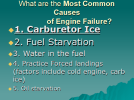
Is this carb ice?

Nikhiln25

Pre-takeoff checklist
Joined
Jan 16, 2024
Messages
307
Display Name
nikhiln25
Today, weather was 46/46 but clear no cloud in the sky.

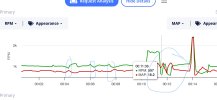
Upon start things seemed fine but a minute in I started noticing rpm’s dropping. They went from 1000->900. I added more power thinking my throttle lock wasn’t in place. I noticed rpm drop a few more times.

Then on idle I saw rpm’s drop into the 500s but that is way below what is normal for me (high 700s).
I didn’t immediately think this was carb ice. I did my run up, did turn carb heat on and during the idle check on run up in once again noticed rpm’s in the 600s touching 500.

I did a roll down the runway to see if engine was making full power. It was. I decided I’ll just do a lap in the pattern. I took off, did a lap. When I pulled MP back abeam I noticed RPM coming back with it even at 17/18mp. Usually it needs to be sub 13 for governor authority to be lost.

I turned carb heat on for landing, landed without instance and all symptoms have now gone away. Rpm’s are steady and normal during idle. I fly around the airport for a bit and everything seemed fine.

I feel like it was carb ice on ground but I’ve never experienced it before - wanted to make sure it was indeed that. Anyone have similar symptoms on ground? This is Cessna 182 O470U
 

Attachments

  • IMG_0395.jpeg
    IMG_0395.jpeg
    201.3 KB · Views: 16
Today, weather was 46/46 but clear no cloud in the sky.

Upon start things seemed fine but a minute in I started noticing rpm’s dropping. They went from 1000->900. I added more power thinking my throttle lock wasn’t in place. I noticed rpm drop a few more times.

Then on idle I saw rpm’s drop into the 500s but that is way below what is normal for me (high 700s).
I didn’t immediately think this was carb ice. I did my run up, did turn carb heat on and during the idle check on run up in once again noticed rpm’s in the 600s touching 500.

I did a roll down the runway to see if engine was making full power. It was. I decided I’ll just do a lap in the pattern. I took off, did a lap. When I pulled MP back abeam I noticed RPM coming back with it even at 17/18mp. Usually it needs to be sub 13 for governor authority to be lost.

I turned carb heat on for landing, landed without instance and all symptoms have now gone away. Rpm’s are steady and normal during idle. I fly around the airport for a bit and everything seemed fine.

I feel like it was carb ice on ground but I’ve never experienced it before - wanted to make sure it was indeed that. Anyone have similar symptoms on ground? This is Cessna 182 O470U
Sure sound's like carb ice to me.
I have it had happen on the ground and thought something was wrong.
Certain conditions can cause it especially if you are at a little high RPM warming up during one of those days.
 
What happened when you turned the carb heat on during runup?
 
What happened when you turned the carb heat on during runup?
There was the normal power/rpm drop and I added it back in. In hindsight I wish I kept it in longer to see if power came back higher. But at the time I didn’t suspect carb ice.

After that I checked prop/suction and then did idle check and that is when it dropped to like 550 rpm which is well below normal
 
There was the normal power/rpm drop and I added it back in. In hindsight I wish I kept it in longer to see if power came back higher. But at the time I didn’t suspect carb ice.
Exactly this. The carb heat check isn't just to see if there's a drop that verifies function, but to ensure that there isn't any carb ice built up during taxi. In my Citabria with a Continental O-200 (known to be susceptible to carb ice), I'd run up my engine in the usual check, and leave the carb heat on for usually 15-20 seconds to reassure myself that the carb was going to be ice-free for take-off.

For slow/minor RPM loss without obvious cause, my knee-jerk reaction is to put on carb heat first. If that doesn't fix it, then I'll look elsewhere.
 
There was the normal power/rpm drop and I added it back in. In hindsight I wish I kept it in longer to see if power came back higher. But at the time I didn’t suspect carb ice.
I taught my students to check the METARs before flight, and pay attention to the temp and dewpoint. A wise pilot really needs to know what the atmospheric conditions are, since they can present deadly risks, especially to small aircraft. Seeing temp and dewpoint so close, and not expecting carb ice, is a deficiency in training, or something similar.

Temp and dewpoint also affect cloud/fog formation. If you take off, especially in mountainous country, in the afternoon, and the temp and dewpoint aren't far apart, you could encounter clouds appearing out of nowhere as the sun descends and the air cools and meets the dewpoint. I've seen it happen. And I've seen fog develop on beautiful summer mornings on the prairies as the sun comes up higher, heats the ground and drives off the moisture that fell as rain the night before. That raises the dewpoint and it can meet a temperature that is too close. Fog.
 
Your next "to do" item is go purchase a carb temp gauge for that 182. A basic one is inexpensive, and no carbureted 182 should be without one, IMO. Don't guess. Know.
 
Your next "to do" item is go purchase a carb temp gauge for that 182. A basic one is inexpensive, and no carbureted 182 should be without one, IMO. Don't guess. Know.
I do have one. It was not in the yellow on the ground.. hence I didn’t initially suspect carb ice. I’ve since learned you can still have carb ice even if it’s not in yellow
 
I learned to fly in a 172S with IO-360 so carb ice was not talked about much.
When I started flying a 172N with a carb I still didn't use carb heat much. My CFII even down played carb heat I because his Cherokee didn't need carb heat in his opinion.
Well not too far down the road I started to experience it. At first I thought something was wrong. Called my AP and he came by and couldn't find anything wrong.
As time went by carb heat fixed it every time. So I learned the importance of carb heat on my own. Now I use it every flight and on every landing no matter what the weather conditions are. Especially on climb out my fingers are on the carb heat knob. I have had it happen on climb out, that get's your attention. Sometimes in cruise the engine will get just a little rough and I use the heat and it smooths out. Like I said above I have had it happen many times warming up in front of the hangar before I even go fly.
Now that I was forced into getting in the habit of using it I have not experienced it in a long time. I can almost predict when it'll will happen and I keep it at bay before it happens now with carb heat.
 
Last edited:
Another useful application for carb heat is during cruise flight to test the mixture. When you apply it, if you get a medium-large RPM drop, the mixture is on the rich side. If you get no change in RPM (or a very small drop), the mixture is on the lean side. Theoretically, you could get a rise in RPM if the engine were very lean, but most carbureted engines won't run that lean in cruise because they'll get rough first.

IME, if the engine can be leaned enough in cruise that applying carb heat doesn't drop the RPM, it suggests the engine has unusually equal/even mixture distribution across the cylinders.

Also, leaning the engine reduces the likelihood of carb icing. When fuel is vaporized in the carburetor throat, some of it evaporates which is endothermic. Lycoming's advice for typical engines (O-320, O-360) is to lean anytime you're below 70% power - even at sea level.
 
Your next "to do" item is go purchase a carb temp gauge for that 182. A basic one is inexpensive, and no carbureted 182 should be without one, IMO. Don't guess. Know.

I do have one. It was not in the yellow on the ground.. hence I didn’t initially suspect carb ice. I’ve since learned you can still have carb ice even if it’s not in yellow
I have not seen that those things are very accurate. I remember one that read the same temperature anytime the master was on. When it comes to carb ice, education is far better than some electronic substitute for knowledge. What will you do when you fly an airplane with the carb temp gauge?
When started flying a 172N with a carb I still didn't use carb heat much. My CFII even down played carb heat I because his Cherokee didn't need carb heat in his opinion.
CFIs are notoriously ignorant of the physics of carb ice. I once gave a presentation on carb ice to a groundschool class, and found that the two instructors present knew no more about it than their private students. Many even think it's a wintertime-only thing.

In my Aircraft Systems course I taught something that I found in an AOPA article that I can no longer find on the 'net:

1747331667533.png

Pilots worry about water in the fuel far more than about carb ice, yet it's the ice that's much more likely to shut down their engine.
 
Last edited:
I do have one. It was not in the yellow on the ground.. hence I didn’t initially suspect carb ice. I’ve since learned you can still have carb ice even if it’s not in yellow
Check the calibration on your gauge.
 
I have not seen that those things are very accurate. I remember one that read the same temperature anytime the master was on. When it comes to carb ice, education is far better than some electronic substitute for knowledge. What will you do when you fly an airplane with the carb temp gauge?
We have a digital carb temp as part of our engine monitor. I watch it like a hawk and when it gets to low 40's or less, I use partial carb heat (yes, on the ground too) to get the temps back to the mid 40s. While I won't take off with carb heat on, I will have the monitor set to carb temp and will quickly pull partial (or, if needed, full) heat soon after taking off. We have a 275 hp Pponk O470-50, so we have plenty of power to spare for climb with carb heat on. I have experienced carb ice at 400 AGL or less on takeoff - once in a PA28-160 with a carb ice detector (not temp gauge), and once in our 182 (0-470U) before we had the temp gauge. Only other time time I had carb ice was in cruise in the 182 under some unusual weather conditions at 8,000' where I thought the air was drier than it was.
 
We have a digital carb temp as part of our engine monitor. I watch it like a hawk and when it gets to low 40's or less, I use partial carb heat (yes, on the ground too) to get the temps back to the mid 40s. While I won't take off with carb heat on, I will have the monitor set to carb temp and will quickly pull partial (or, if needed, full) heat soon after taking off. We have a 275 hp Pponk O470-50, so we have plenty of power to spare for climb with carb heat on. I have experienced carb ice at 400 AGL or less on takeoff - once in a PA28-160 with a carb ice detector (not temp gauge), and once in our 182 (0-470U) before we had the temp gauge. Only other time time I had carb ice was in cruise in the 182 under some unusual weather conditions at 8,000' where I thought the air was drier than it was.
Check me on this. Carb ice depends on the moisture content of the air, which is related to the temp-dewpoint spread -- not the temperature of the air. Cold air is not necessarily, in and of itself, more likely to produce icing. It could be cold dry air, no icing. It could be cold moist air, likely for icing.

Given this, what is the purpose of selecting carb heat based on the temperature of the air in the carb? Are you comparing that to the known ambient temperature & dewpoint?
 
Given this, what is the purpose of selecting carb heat based on the temperature of the air in the carb? Are you comparing that to the known ambient temperature & dewpoint?
The idea is to see if that carb air temperature is close to freezing. It can get there even on a 100°F day, due to the pressure drop (and therefore temperature drop) through the venturi or around the edge of the closed or partially-closed throttle plate, and to the evaporation of the gasoline, which absorbs heat from the air.

And like you say, cold, dry air is unlikely to produce ice. In fact, at temps at or below -20°C you can often see ice crystals in the air that present no hazard UNTIL you pull the carb heat and melt them so they refreeze n the carb. Gotta watch for that.

It always requires moisture, which is reflected in the dewpoint. That carb temp gauge knows nothing about dewpoint. A carb ice detector will flash at you if it detects ice building up on its tiny optical probe. https://www.aircraftspruce.com/catalog/inpages/icedetect2.php?clickkey=11509826
 
Is there any benefit to temperature gauge if I get the carb ice monitor?
 
... It always requires moisture, which is reflected in the dewpoint. That carb temp gauge knows nothing about dewpoint. A carb ice detector will flash at you if it detects ice building up on its tiny optical probe. https://www.aircraftspruce.com/catalog/inpages/icedetect2.php?clickkey=11509826
Yeah, there are 2 assumptions that each individually is wrong - because you need both.
1. If the carb cools air to the dewpoint, you'll get ice. This is wrong because even if this happens, you'll get water vapor but you won't get ice unless the air is cold enough.
2. If the carb cools air close to freezing, you'll get ice. This is wrong because even if the carb cools air to freezing, you won't get ice unless that air has enough moisture in it.

In reality you'll get carb ice if the air is sufficiently moist and carburetor cools it sufficiently. It doesn't have to cool to the dewpoint, and it doesn't have to be freezing. But some combination of these two. Thus no simple rule to predict it, and the famous colored graph we've all seen. Because of this, the value of a carb temp gauge doesn't seem that great to me.
 
1. If the carb cools air to the dewpoint, you'll get ice. This is wrong because even if this happens, you'll get water vapor but you won't get ice unless the air is cold enough.
Cooling to the dewpoint produces liquid water. The water vapor is already there, in the air, in sufficient quantity to create the risk. That carb has no difficulty generating temperatures below freezing; as I said, it can drop the temp from 100°F to below 32°F.

In reality you'll get carb ice if the air is sufficiently moist and carburetor cools it sufficiently. It doesn't have to cool to the dewpoint,
It does have to cool it to the dewpoint. If it doesn't it can't form liquid water or frost. The water vapor just passes harmlessly through the engine. When the temp and dewpoint are close, it doesn't take much cooling, a lot less than the carb is capable of.
 
I recall from training that you're more likely to get carb ice at temps in 70s, 80s on a humid day than if temp is in 40s (although still possible of course). Training on day one was to always use carb heat when you reduce the throttle, and of course when configuring for landing.

Many even think it's a wintertime-only thing.
That..... is concerning.
 
... It does have to cool it to the dewpoint. If it doesn't it can't form liquid water or frost. The water vapor just passes harmlessly through the engine. When the temp and dewpoint are close, it doesn't take much cooling, a lot less than the carb is capable of.
Yes, but the dewpoint in the carb is different from the ambient atmospheric dewpoint. The venturi effect in the carburetor not only reduces temperature, but also reduces pressure, which changes the dewpoint. So to clarify I should restate: the atmospheric dewpoint we hear on the radio is not necessarily the temperature in the carburetor at which moisture will condense out of the air.
 
  • Like
Reactions: WDD
Yes, but the dewpoint in the carb is different from the ambient atmospheric dewpoint. The venturi effect in the carburetor not only reduces temperature, but also reduces pressure, which changes the dewpoint. So to clarify I should restate: the atmospheric dewpoint we hear on the radio is not necessarily the temperature in the carburetor at which moisture will condense out of the air.
Nonsense. The dewpoint of a given parcel of air is fixed, and the pressure and temperature changes in the carb do not change it. Dewpoint is related directly to relative humidity, and what is the carburetor doing to reduce the RH as the air goes through it? Nothing. It sure isn't making the water vapor disappear. It's still there, and the RH/dewpoint determine at what temperature that vapor will either condense into liquid and possibly freeze, or sublimate into frost. Either way, the air is choked off and the engine dies.

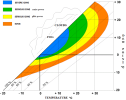
Look at the typical carb ice chart: it displays both dewpoint and relative humidity as well as ambient temperature:

1747414596861.png

All the way from 20% to 100% RH. Directly related to dewpoints. Note also that the worst ice risk occurs at or just under 10°C, or 50°F. Light ice is possible all the way to about 37°C, or 98°F, on this chart. Other charts may show the ice risk to as high as 100°F. It all depends on the particular engine and its installation configurations.
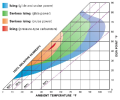
Like this one, that shows icing possible up to maybe 106°F:

1747414858222.png

Misconceptions about carb ice are what get pilots and their passengers killed.
 
Yes, but the dewpoint in the carb is different from the ambient atmospheric dewpoint. The venturi effect in the carburetor not only reduces temperature, but also reduces pressure, which changes the dewpoint.
Nonsense. The dewpoint of a given parcel of air is fixed, and the pressure and temperature changes in the carb do not change it. ...
Dewpoint depends on the pressure and water content of the air. All else equal, if the pressure changes, the dewpoint changes.
Ever seen a pressure dew point chart?
 
Dewpoint depends on the pressure and water content of the air. All else equal, if the pressure changes, the dewpoint changes.
Ever seen a pressure dew point chart?
Irrelevant. The carb ice charts are based on actual testing, not on theories about dewpoint shifts with pressure changes. You ignore the actuality at your own risk.
 
Irrelevant. The carb ice charts are based on actual testing, not on theories about dewpoint shifts with pressure changes. You ignore the actuality at your own risk.
I'm not saying the charts are wrong. I'm saying [to clarify my earlier comment] that the temperature at which moisture condenses in the carburetor is not necessarily the same as the dewpoint temperature we get on the radio. This is important to know, especially for folks who have a carb air temperature sensor.
 
I've flown multiple instances of an aircraft type that's known for carb ice, and I've flown a couple of different PA-28s, which aren't really known for carb ice, and have had carb ice with them in cruise. None of the situations I've been in, knock on wood, have resulted in either engine outage or significant engine roughness. Today, right now, the ground temp is 76 and the dew point is 63. That's the farthest apart they're predicted to be, on the ground, until Monday afternoon. This part of the country is a great place to get carb ice because it's almost always wet most months of the year.

I look at the temp/dew point spread. I'm least concerned on dry winter days. The charts are right. They're based on theory and confirmed with practical experience.

I've never used a carb temp gauge and don't want one. My indicator of carb ice in cruise is the tach. You want an airplane where the throttle doesn't move on its own. If you're in cruise and RPM drops on its own, there's a very good chance that's carb ice. To check, apply carb heat, wait for a bit, see if the RPM's come up with it on, and go from there. If there's ever a chance of carb ice, which is most of the time here, carb heat on descent into the pattern, and for certain on final. I've never used partial carb heat and don't believe it's a good idea.

If you don't catch carb ice quickly enough, especially on a little engine like a cub, you might not get enough heat out of it quickly enough to keep the engine running.

Very little reason to avoid carb heat on final. If you're landing where you don't think you'll clear the obstacles on a go around with carb heat on, I'd argue you're not going to clear it without it on during takeoff, at least in the aircraft I've flown. The main reason to me to have it off on the ground are to avoid unfiltered air when taxiing, as in some/many aircraft you're bypassing the air filter with CH on.

Just my 2 cents. I don't think it's either complicated, magical, or scary if managed properly, but you guys do you.
 
A quick question on technique-if you're operating at less than full throttle and get ice, would it help to go full throttle along with the carb heat? My understanding of the ice is that it forms on the butterfly, restricting the opening.
 
My 2 cents. If you have carb ice, applying carb will drop RPM initially. Then it will climb above where you started.

Remember to turn off carb heat after landing. Carb heat by passes the filter.
 
A quick question on technique-if you're operating at less than full throttle and get ice, would it help to go full throttle along with the carb heat? My understanding of the ice is that it forms on the butterfly, restricting the opening.
Not much help. You need heat energy to melt the ice. You’ll probably have already added throttle to make up for the power loss anyway.
 
A quick question on technique-if you're operating at less than full throttle and get ice, would it help to go full throttle along with the carb heat? My understanding of the ice is that it forms on the butterfly, restricting the opening.
Carb ice is caused by the throttle restricting airflow through the carb throat, which reduces pressure, increases velocity, reducing temperatures. So yes, opening the throttle reduces the likelihood of carb ice - put differently, the more closed the throttle is, the more likely carb ice is.

However, if you get carb ice, you need an immediate and aggressive action to eliminate it. That means applying full carb heat immediately. If you were operating at full throttle under the same conditions, you might not have gotten icing in the first place. But once icing happens, don't expect applying full throttle to eliminate ice.
 
  • Like
Reactions: WDD
A quick question on technique-if you're operating at less than full throttle and get ice, would it help to go full throttle along with the carb heat? My understanding of the ice is that it forms on the butterfly, restricting the opening.
Go full throttle. That removes the throttle plate from the equation, since it is no longer producing a pressure and temperature drop; just the venturi is. The air temp around that throttle plate will rise with the throttle open.

There are a LOT of pilots that get ice and never know it. It's light enough that it doesn't affect much. Many will take off with some ice, wondering why the airplane feels doggy today in the takeoff roll, and the ice disappears while the throttle is wide open.

I used to hear the airplanes start up out on the ramp. First flight of the morning. Summertime. I'd hear the engine idle speed fall off, then I'd hear it come back up as the pilot opened the throttle some to keep it running. I'd walk out, and much of the time it was an instructor and student. I'd knock on the window. They'd open the door. I'd tell them to pull the carb heat, and the RPM would fall, then rise to considerably higher than it had been when I went out there. Carb ice. Their eyes got real big, seeing that they were getting ice and didn't even know it and could have taken off with it. Airplanes have mushed along and crashed like that.

And those were Lycomings.

RPM drop in cruise is a fine indicator for a fixed-pitch prop. With a constant-speed prop you might not see it until it's almost too late. The MP will fall, airspeed will decrease, the airplane will want to descend, so the pilot might just crank in some nose-up trim. The situation continues to deteriorate, and when the RPM is finally falling the engine is cooling off and there might not be enough exhaust heat to clear the ice before it quits. So, if you're having to open the throttle more, or fool with the trim, wake up!
 
Last edited:
Check me on this. Carb ice depends on the moisture content of the air, which is related to the temp-dewpoint spread -- not the temperature of the air. Cold air is not necessarily, in and of itself, more likely to produce icing. It could be cold dry air, no icing. It could be cold moist air, likely for icing.

Given this, what is the purpose of selecting carb heat based on the temperature of the air in the carb? Are you comparing that to the known ambient temperature & dewpoint?
I mostly fly in the LA Basin. Except when the Santa Ana winds are blowing, there is usually enough moisture in the air for carb ice.

Your hang up about pressure in the carb changing the dewpoint/RH is misguided. Yes there is an effect, but it is small, because it isn't happening in a closed system.

Feel free to argue all you want, but I've twice experienced severe carb ice at full power on climb at less than 400' AGL. The only thing that saved me was quick recognition and action for a carb ice condition. My SOP now is to prevent carb ice, not react to it.
Where'd you get that idea? I never said carb ice was less likely because of the pressure change in the carburetor. My point is that if it does happen, it won't necessarily be at the atmospheric dewpoint temperature we hear the radio. That's why I don't think a carb air temp sensor is very useful - we don't actually know at what temperature the carb might ice up. It's more likely when temp/dewpoint is close together, as indicated by the charts we've all seen. So follow the standard guidance from the FAA and the airplane's POH. If you do have a carb air temp sensor, don't let whatever it says fool you into not applying carb heat when you should.

PS: I'm not trying to be argumentative. The question I originally asked: if a pilot already follows the FAA and POH guidance regarding carb heat, how does having a carb temp gauge change those procedures?
 
Last edited:
Maybe I'm missing something, but I don't know how you'd get carb ice on takeoff, unless you're not doing a runup. See above, I fly where there's a high potential for carb ice. During runup, the carb heat check is partly to make sure carb heat is working, but also to make sure you don't have carb ice. If it passes that test, and you're taking off a few seconds later, full throttle, I don't see time for carb ice to have formed. Really not trying to argue either, sincerely curious.
 
Maybe I'm missing something, but I don't know how you'd get carb ice on takeoff, unless you're not doing a runup. See above, I fly where there's a high potential for carb ice. During runup, the carb heat check is partly to make sure carb heat is working, but also to make sure you don't have carb ice. If it passes that test, and you're taking off a few seconds later, full throttle, I don't see time for carb ice to have formed. Really not trying to argue either, sincerely curious.
I could see this happening if someone develops carb ice during ground ops, does a quick runup, applies carb heat only for a second or two, not long enough to melt the ice, then back to idle waiting for a takeoff clearance, then takes off.

When people have done it a thousand times, it can get perfunctory and fast. Combine that with expectation bias and normalization of deviance.
I've seen that. The pilot pulls the carb heat, gets the drop, and immediately pushes it off again. I taught my students to pull it and wait a bit to see if the RPM rises after it drops, with the carb heat still on.

Way too many pilots are paranoid about the unfiltered carb heat air. Stop worrying about it unless you're in really dusty conditions, such as another airplane in front of you on a dirt strip doing a runup and kicking up lots of dust at you. Most airports have cleaner air than the highway.

Some old airplanes, like my Auster, had no air filters whatever.
 
Thanks...that makes perfect sense, think you guys are right. I caught myself doing the fuel pump thing on startup in a PA-28 as just a rote item a while back. Either realized or someone pointed out that the only time you get to check that the electric pump is working is before startup. Now I make a habit to listen for the sound, watch the pressure, and turn it off after start. Then at takeoff I know I have two running, working pumps. Love this forum.
 
In my case I believe my power flow exhaust system contributes to my carb ice.
There is no muffler just a collector with a heat shield around it and it is smaller and lighter than a stock muffler that is mounted in front of my carb. So there is less heated air flowing over the outside of the carb.
And with 4 tuned pipes and less back pressure it is possible to get ice when you first start up and idle a little high while there is no heat in the engine or exhaust system. It melts on its own and then runs great.

Yes one day last winter or two ago I took off a little early and got ice on the climb out. That time it did take longer than normal to melt because the exhaust was not all the way warmed up. I pushed the nose over and waited. Luckily I was plenty high.

Like I said above I use the heat a lot and haven’t had ice in a while.

I love the power flow, helps greatly.
 
Last edited:
In my case I believe my power flow exhaust system contributes to my carb ice.
There is no muffler just a collector with a heat shield around it and it is smaller and lighter than a stock muffler that is mounted in front of my carb. So there is less heated air flowing over the outside of the carb.
And with 4 tuned pipes and less back pressure it possible to get ice when you first start up and idle a little high while there is no heat in the exhaust system. It melts on its own and then runs great.

Yes one day last winter or two ago I took off a little early and got ice on the climb out. That time it did take longer than normal to melt because the exhaust was not all the way warmed up. I push the nose over and wait.

Like I said above I use the heat a lot and haven’t had ice in a while.

I love the power flow, helps greatly.
The Cherokees are a bit less ice-prone because their carbs are surrounded on all four sides by exhaust piping. Heat everywhere.
 
Back
Top