Interesting Development

Status
Not open for further replies.

UTLonghorn_1979

Line Up and Wait
Joined
Jun 11, 2024
Messages
706
Display Name
UTLonghorn_1979
For those who haven’t seen this. Curious how FAA will respond to having to explain operating under their own universe of medical opinions.

 
Hmmm, not a lawyer, but know a lot about medicine. Practically speaking, Remeron is much more sedating, as are all the members of TCA's, than the average SSRI. Medically speaking, it would be easy to justify not approving Remeron and TCA's as their sedation risk is notably higher than that of SSRI's. So, I suspect the FAA just did a poor job in making their case. I would not hang my hat on the FAA losing this one in the end. I mean, the courts do funny things, but it won't be hard for the FAA to show that the TCA's are indeed more sedating...
 
Yep, it was a nothing burger. They remanded it back to the FAA. The FAA will make a more detailed and specific to the petitioner argument as why Remeron is disqualifying and that will be that.
 
Hmmm, not a lawyer, but know a lot about medicine. Practically speaking, Remeron is much more sedating, as are all the members of TCA's, than the average SSRI. Medically speaking, it would be easy to justify not approving Remeron and TCA's as their sedation risk is notably higher than that of SSRI's. So, I suspect the FAA just did a poor job in making their case. I would not hang my hat on the FAA losing this one in the end. I mean, the courts do funny things, but it won't be hard for the FAA to show that the TCA's are indeed more sedating...
The court just said the FSA has to give a more full explanation of why airmen on TCAs are categorically intelligible rather than being considered for SI.

"The key missing piece of information here is how the agency determined that those other medications, which apparently also carry some risk of drowsiness in some people, need not bar the pilots taking them from consideration for Special Issuance whereas mirtazapine does impose a categorical bar," the court wrote. "We do not—and cannot—substitute our judgment about the content of these studies for the FAA's own. But it is our duty to identify material gaps in the agency's articulated rationale."

So either the FSA will provide the airman a satisfactory explanation, or it won't. If this guy "wins," it just means he gets to go through the SI process. I wonder who thinks it would be beneficial to allow many more airmen to apply for SIs that will ultimately be denied.
I guess I read it as the FAA can no longer hide behind “because we said so,” but rather has to explain why certain meds are okay and others a not and when the treating physicians that actually prescribe and monitor the applicant say otherwise.

If anything, it’s additional scrutiny to the FAA’s practices, and that’s a good thing.
 
unfortunately i think the faa has extremely wide latitude in deciding what is and is not prohibited. the issue here it seems to me is that they didn’t sufficiently articulate why they had excluded them. in which case i think it’s a one off that changes nothing. dr. chien will correct me if i am wrong i think
 
It’s an arbitrary and capricious case, to which the FAA is a repeat offender. And yes…they love to play the “because I said so” card and do every chance they get. Cases like these shine the light on that fact.

The FAA is on thin ice with their punitive measures and antiquated stance on much of mental health. Lots of things are coming out about the doctors with no qualifications in addiction medicine deciding the fate of pilots (*cough* Dr *cough* Dumstorf *cough*).
 
I guess I read it as the FAA can no longer hide behind “because we said so,” but rather has to explain why certain meds are okay and others a not and when the treating physicians that actually prescribe and monitor the applicant say otherwise.
I think that's really the point. They didn't do their do-diligence and come up with a set precedence. They "arbitrarily" allowed certain people on certain drugs and "arbitrarily" denied others.

I don't know this, but guessing it had a lot to do with the Doc and how they wrote up the paperwork! "Oh, this Doc seems to know what he's talking about so we'll okay the pilot..."
 
for those who use this med, it is the most sleep generating of all the antidepressants and is commonly used "for sleep". This is a nothing burger....they can let the applicants go through all the evals and let them flunk the neurocog; a rare one who can pass with that stuff onboard, would then get certified.
 
I think @UTLonghorn_1979 has it right.
Hmmm, not a lawyer, but know a lot about medicine. Practically speaking, Remeron is much more sedating, as are all the members of TCA's, than the average SSRI. Medically speaking, it would be easy to justify not approving Remeron and TCA's as their sedation risk is notably higher than that of SSRI's. So, I suspect the FAA just did a poor job in making their case. I would not hang my hat on the FAA losing this one in the end. I mean, the courts do funny things, but it won't be hard for the FAA to show that the TCA's are indeed more sedating...
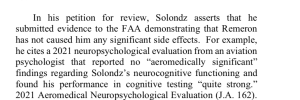
that part the FAA did. They argued a blanket ban because of those side effects. What was different here is;
1751992724620.png
(J.A. means “Joint Appendix”. When cases are on appeal, the parties file an Appendix of the portions of the court record they consider relevant to the issues on appeal. Often, even if they don’t agree on the result, opposing parties often agree on the appendix and file a joint one.)

IMO, the decision (not the reports of the decision) doesn’t read as a nothing burger. It reads to me more as a statement that when considering an SI when medication is a factor, the FAA needs to consider the individual unless it can articulate and support reasons for a categorical ban. That may not be huge, but it’s definitely something the FAA has historically not done. It’s very similar to what the FAA does in non-medical cases - make up a rule so they don’t have the cost and workload of proving facts.

What will happen on remand? Dunno. If the FAA ultimately issues the SI, we may hear nothing. If they don’t, the pilot may or may not bring the case back to the court. If they don’t, we may never know whether the final denial was due to a justified categorical ban or the result of tests.
 
Last edited:
The problem of course, is that unless a drug test is done the morning of the test, or directly observed therapy occurs the night before, what's to stop the applicant from just holding the remeron for 3-4 days before cognitive testing? I mean, can we take the applicant's word for it that he took it the night before and was taking it regularly?

And, even if the person passes cognitive screening, I don't know... I mean I can make the argument that I can fly fine on 50mg of Benadryl. Just give me a cog screen 4 hours after and if I pass, everything's cool, right? Like Bruce said, we use this to sedate folks, and, by and large, it is very sedating.

Having written for a lot of Remeron, I personally would not board a plane if I know the PIC had just taken 30 mg of Remeron the night before. Irrespective of any cognitive screening results.
 
And we do not know when he last took his Remeron when he had his "reportedly" strong neurocognitive eval.....

.....& I can't drive for SH_T on 50 mgms of benadry. Let alone fly......
 
Last edited:
The problem of course, is that unless a drug test is done the morning of the test, or directly observed therapy occurs the night before, what's to stop the applicant from just holding the remeron for 3-4 days before cognitive testing? I mean, can we take the applicant's word for it that he took it the night before and was taking it regularly?

And, even if the person passes cognitive screening, I don't know... I mean I can make the argument that I can fly fine on 50mg of Benadryl. Just give me a cog screen 4 hours after and if I pass, everything's cool, right? Like Bruce said, we use this to sedate folks, and, by and large, it is very sedating.

Having written for a lot of Remeron, I personally would not board a plane if I know the PIC had just taken 30 mg of Remeron the night before. Irrespective of any cognitive screening results.
So instead of the FAA just saying, "You're on an unapproved drug, so you're denied," the FAA will be required to tell airmen to go ahead and jump through all of the hoops at a cost of thousands of dollars, and then deny them on an individual basis for the reasons described above. That will of course cost FAA resources and airmen money. But some here consider that a win.
 
So instead of the FAA just saying, "You're on an unapproved drug, so you're denied," the FAA will be required to tell airmen to go ahead and jump through all of the hoops at a cost of thousands of dollars, and then deny them on an individual basis for the reasons described above. That will of course cost FAA resources and airmen money. But some here consider that a win.
Yes. Because airmen in the US are entitled to due process. Even if it means a denial in the end. The decision to go through the process is the airman’s decision to make. Not the FAA’s.
 
Yes. Because airmen in the US are entitled to due process. Even if it means a denial in the end. The decision to go through the process is the airman’s decision to make. Not the FAA’s.

I’m not sure regulatory (admin/civil) processes are subject to the same due process that criminal accusations are subject to.
 
Yes. Because airmen in the US are entitled to due process.
Can you show me where we’re entitled to due process for administrative actions related to a privilege (to have a pilot’s license) and not a right? Just curious.

I don’t disagree that would be nice - but it’s not actually a part of the Bill of Rights, in my non-lawyer reading of them.
 
Can you show me where we’re entitled to due process for administrative actions related to a privilege (to have a pilot’s license) and not a right? Just curious.

I don’t disagree that would be nice - but it’s not actually a part of the Bill of Rights, in my non-lawyer reading of them.
One could argue that the FAA also isn't in the Constitution... but that wouldn't "fly" would it? It violates the spirit of the Bill of Rights, if not the letter.
 
Can you show me where we’re entitled to due process for administrative actions related to a privilege (to have a pilot’s license) and not a right? Just curious.

I don’t disagree that would be nice - but it’s not actually a part of the Bill of Rights, in my non-lawyer reading of them.
I'd ask him first to define "due process."
 
Why isn't it a right? As long as you meet all the qualifications.
 
I’m not sure regulatory (admin/civil) processes are subject to the same due process that criminal accusations are subject to.
There are levels of due process. Your county can’t take 3 feet of your frontage to build a new road without due process. But it is not subject to the same level of protections or proof burdens as a criminal prosecution.
 
Last edited:
Can you show me where we’re entitled to due process for administrative actions related to a privilege (to have a pilot’s license) and not a right? Just curious
How far back to you want to go? The 1970 Goldberg v Kelly SCOTUS decision (termination of a persin’s welfare benefits) isn’t the first, nor the last, but it’s a decent starting point for the proposition that “The constitutional challenge cannot be answered by an argument that public assistance benefits are "a privilege,' and not a 'right.'”
 
How far back to you want to go? The 1970 Goldberg v Kelly SCOTUS decision (termination of a persin’s welfare benefits) isn’t the first, nor the last, but it’s a decent starting point for the proposition that “The constitutional challenge cannot be answered by an argument that public assistance benefits are "a privilege,' and not a 'right.'”
Legislated public assistance benefits are a bit different than medical qualifications for a license to fly (which is a privilege, not a legislated entitlement, I think).

Nonetheless, in this case, it seems a court sided with the pilot. How is that not “due process” in action?
 
How far back to you want to go? The 1970 Goldberg v Kelly SCOTUS decision (termination of a persin’s welfare benefits) isn’t the first, nor the last, but it’s a decent starting point for the proposition that “The constitutional challenge cannot be answered by an argument that public assistance benefits are "a privilege,' and not a 'right.'”
The problem is that some people seem to not understand that "due process" is not one thing. The process that's due isn't the same in every situation.
 
The problem is that some people seem to not understand that "due process" is not one thing. The process that's due isn't the same in every situation.
I agree with that, but I think from a different point of view. The issue with the FAA, in my opinion, is they have a one size fits all approach. Different people respond to medications differently, that's why they list all possible side effects, not everyone will have those side effects or any at all (i.e. drowsiness). It's the same wat that people with ADD respond differently to stimulants vs. others.

Another reason your GP should be used for SI medicals vs. some faceless, unknown bureaucrat in DC that's completely unfamiliar with your medical history.
 
Legislated public assistance benefits are a bit different than medical qualifications for a license to fly (which is a privilege, not a legislated entitlement, I think).
You asked. I answered. I guess we read court cases a wee bit differently. I guess I could give you list of the about 200,000 federal cases on the subject :D
 
You asked. I answered. I guess we read court cases a wee bit differently. I guess I could give you list of the about 200,000 federal cases on the subject :D
Would you agree it’s kinda moot in this case? I mean - there was an appeal heard by a judge who ruled for the pilot. “Due process” doesn’t mean “I get what I want all the time” - it means there’s a fair, predictable way to have our situation managed, as apparently happened here, in my non-lawyer mind.

Now - there sure seem to be some situations outside of aviation reported lately that stretch credibility with regard to that interpretation but going any further would probably get the ban hammer swinging.
 
The problem is that some people seem to not understand that "due process" is not one thing. The process that's due isn't the same in every situation.
There's a couple of things. I agree with you that most people's understanding of due process is similar to their understanding of legal and administrative process generally. But there's also the difference between "substantive" and "procedural" due process.

We start with the 5th and 14th Amendments' requirement that no person shall "be deprived of life, liberty, or property, without due process of law." The case law looks at two different aspects. One is whether the law or regulation itself infringes on some fundamental right. That's referred to as "substantive" due process. The other is whether the process being used to enforce the law or regulation is fair in the sense of providing
notice, an opportunity to be heard, and a neutral decision-maker.

Many cases involve both to some degree, but they are often separated as well.
 
Would you agree it’s kinda moot in this case? I mean - there was an appeal heard by a judge who ruled for the pilot. “Due process” doesn’t mean “I get what I want all the time” - it means there’s a fair, predictable way to have our situation managed, as apparently happened here, in my non-lawyer mind.
Maybe. No one was arguing the FAA was violating rights by having medical standards for certification, so no one raised a substantive due process issue. And, as you point out, the pilot in this case had notice, an opportunity to challenge the government's action, and a neutral decision-maker through the court, so basic procedural due process was there, win or lose.

Ultimately though, the court said hat the FAA's action in not considering the pilot's evidence on the medication was "arbitrary and capricious." "Arbitrary and capricious" is a due process standard.
 
Flying may not be a right, but due process is.

Of course, keeping in mind what Midlifeflyer wrote, what constitutes due process is often not a simple determination.
 
Flying is more of a right than y'all realize. If that weren't true, we wouldn't have a Pilot's Bill of Rights, which was enacted by Congress, who governs the FAA.


Y'all need to stop acting like the FAA owns the stadium and the football, because they don't. They like to operate as if they do, but they don't. If they did, BasicMed wouldn't exist. Believe me, the FAA was taking great measures to bury it. Fortunately, it was brought to Congress, who then said "This is what you're going to do, this is how you're going to do it, and you have ninety days to make it so."
 
Last edited:
Can you show me where we’re entitled to due process for administrative actions related to a privilege (to have a pilot’s license) and not a right? Just curious.

I don’t disagree that would be nice - but it’s not actually a part of the Bill of Rights, in my non-lawyer reading of them.
We have a little something called the Pilot's Bill of Rights, which was enacted by Congress, who governs the FAA.


Are you so sure it's a privilege? Driving is a privilege. We don't have a Driver's Bill of Rights. Yet we do have a Pilot's Bill of Rights.
 
We have a little something called the Pilot's Bill of Rights, which was enacted by Congress, who governs the FAA.


Are you so sure it's a privilege? Driving is a privilege. We don't have a Driver's Bill of Rights. Yet we do have a Pilot's Bill of Rights.

Problem is, the pilots bill of rights was never proposed or ratified as an an amendment to the consitution. Calling it "the bill of rights" doesn't instantly ratify it as the 28th amendment...

And, my nonlawyer interpretation of this congressional act is that it doesn't really provide pilots with sweeping new inalienable rights...but your interpretation may vary.

So yeah, we're back to flying is a privilege... Congress owns the stadium and, like it or not, the FAA is the starting QB...
 
So instead of the FAA just saying, "You're on an unapproved drug, so you're denied," the FAA will be required to tell airmen to go ahead and jump through all of the hoops at a cost of thousands of dollars, and then deny them on an individual basis for the reasons described above. That will of course cost FAA resources and airmen money. But some here consider that a win.
The process for airmen is far more expensive than it has to be. That is a fixable problem.
 
We have a little something called the Pilot's Bill of Rights, which was enacted by Congress, who governs the FAA.


Are you so sure it's a privilege? Driving is a privilege. We don't have a Driver's Bill of Rights. Yet we do have a Pilot's Bill of Rights.
I didn’t see any mention of due process in the PBOR you attached.

Besides, I’m not seeing anything in the story suggesting a violation of something in the PBOR. And again, it seems pretty clear there WAS (no - IS) due process being followed in this case.

Given the inputs above by physicians far more familiar than I with this medicine, it seems completely reasonable for the FAA to exercise a good deal of caution.
The Pilot's Bill of Rights enhances due process protections for pilots during FAA investigations and enforcement actions. It ensures pilots have access to information relevant to their case, including air traffic control recordings and NOTAMs, and extends the right to appeal FAA decisions to federal court.

Before the Pilot’s Bill of Rights, pilots would struggle to understand enforcement actions and couldn’t access information that would help their defense. As a result, pilots and FAA certificate holders often got the short end of the stick if they find themselves in trouble with the FAA.

It doesn't need to be part of the Constitution. Congress drafted the law and passed it.

Just because something is a privilege doesn't mean they don't have to play fair. All laws, regulations, procedures, etc have to be fair and just. That's one of the core principles of the rule of law.
 
49 cfr 44703

Says faa SHALL issue a cert if qualified. Somewhere else it says the same for airmen med certs.

That seems like an entitlement to me…
 
“…shall issue a cert IF QUALIFIED”. A med that causes this much drowsiness seems to reasonably raise the issue of being qualified to fly while on it.

Still not seeing where due process wasn’t followed, regardless of whether it’s an inalienable right or just a norm in this case.
 
Status
Not open for further replies.
Back
Top