
How safe are aerobatics?

That makes perfect sense; I did not know it was a zero lift maneuver.
Only if you put the elevator in the zero G/AOA position during the roll, meaning actual slight forward pressure if you're trimmed for normal cruise flight. Most pepole don't actually do true zero G ballistic rolls because dirt/FOD etc. will start floating around the cockpit and you can possibly dump a little oil if you don't have a slobber pot. Carb'd engines will stumble.

Most people who do flop around fun acro do like post #36 above - pull the nose up a bit, put the elevator back in the trimmed hands off position (1G), and throw the ailerons over without moving the elevator until the roll is complete and you raise the nose back to level flight. The roll is 1G the whole way around, meaning not zero lift. You use rudder only as needed to counter adverse yaw of the aileron input, which in RVs is minimal due to the differential ailerons. It's almost literally the easiest maneuver you can do in an airplane. Rolling on a precise level line as required in competition is a different matter.
 
Last edited:
Well-stated.
Any roll which does not require belts to keep you in the seat is a barrel roll. If the airplane is trimmed for 1g level flight, it will naturally maintain that load regardless of the attitude. The Air Force teaches aileron rolls in training. It's basically a continuous 1g maneuver. However, you start losing the vertical lift component as soon as the wings are not level. Inverted, you get 1g of acceleration down, in addition to gravity. That's why the nose has to be raised in order to avoid turning a bunch of your altitude into airspeed. This gets less important in a plane with a fast roll rate. The T-38 was 720 degrees per second!
A big diameter barrel roll (big corkscrew) is a slow affair that takes some practice to do nicely. A small diameter barrel roll (small corkscrew) can be accomplished with just a bunch of aileron input. A bit of rudder coordination sometimes helps.
 
A barrel roll ranges from a slightly positive g aileron roll with minimal back pressure all the way to a slightly corkscrewy loop with lots of back pressure. Usually when you say, "barrel roll" it means a maneuver where you're pitching as much as rolling, or more.

If you use an appropriate entry speed, pitch up sufficiently, and neutralize the elevator before rolling, an aileron roll is hard to botch.

And when people don't pitch up sufficiently and/or neutralize the elevator, that's when they get burned. Another place where they screw up is forgetting to hold the aileron deflection all the way through the maneuver.
 
I've done hundreds of hours of acro, but I doubt I've done more than 3 barrel rolls. It's somewhat of a problematic maneuver from a consistency standpoint.
True barrel rolls are one of my favorites. Lots of things to manage, a big vertical component, and plenty of time to watch the world go around in the meantime. I'd probably get laughed out of the airshow if I did one in front of people, but they are really enjoyable. I think of them as the slightly edgier cousin of lazy 8's.
 
The T-38 was 720 degrees per second!
I know the manual says it, but this claim is pretty well-known BS. :) Same claim is made about the A-4.
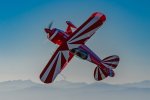
Nobody has ever witnessed or captured video of this mighty roll rate from either inside or outside the cockpit. For reference, this is what 720 deg/sec ACTUALLY looks like...

 
Last edited:
I've done hundreds of hours of acro, but I doubt I've done more than 3 barrel rolls. It's somewhat of a problematic maneuver from a consistency standpoint.
I love throwing one in now and then. Also like to do them at displays, as it's presenting the aircraft well. We actually used them as a coordination exercise during training.
With different reference points up to 90⁰ heading change at the inverted position. Stopping the roll at 90⁰ heading change and pulling through makes for a nice quarter cloverleaf.
Barreling around a C182 here.
 

Attachments

  • 850_2289.jpg
    850_2289.jpg
    640.7 KB · Views: 8
I know the manual says it, but this claim is pretty well-known BS. :) Same claim is made about the A-4.

Nobody has ever witnessed or captured video of this mighty roll rate from either inside or outside the cockpit. For reference, this is what 720 deg/sec ACTUALLY looks like...

Just going by what the Dash One states. (That's the operating manual for non-AF folks).
I remember (from 40 years ago!) my instructor demonstrating why continuous full aileron rolls were prohibited. The pilots sit above the centerline of rotation. As soon as the roll rate wound up, I found myself hanging from the straps as if under negative g. Pretty disorienting. Whatever the roll rate was, it was astonishingly fast. Never felt the need to see it again. I rarely saw the need for full roll rate in my Pitts.
 
Stopping the roll at 90⁰ heading change and pulling through makes for a nice quarter cloverleaf.

Once in a while the IAC Sportsman known will include a quarter cloverleaf. That is a lot of fun over an airfield, but make sure you get a practice flight before a contest if the airfield is one of those WW2 triangular bomber bases. Very easy to pick up the wrong runway while inverted. Ask me how I know.
 
I know the manual says it, but this claim is pretty well-known BS. :) Same claim is made about the A-4.
One of the exercises at the Naval Test Pilot School used to be measuring roll performance, including both maximum and steady-state roll rates, in T-38's and TA-4's*. The academic side covered the legend of the 2 per second rolls, and the flight test exercise laid it to rest. The legend will outlive the useful life of both airplanes.

*Yes, they operated both, and at the same time.

Nauga,
and his drill bits
 
Last edited:
One of the exercises at the Naval Test Pilot School used to be measuring roll performance, including both maximum and steady-state roll rates, in T-38's and TA-4's*. The academic side covered the legend of the 2 per second rolls, and the flight test exercise laid it to rest. The legend will outlive the useful life of both airplanes.

*Yes, they operated both, and at the same time.

Nauga,
and his drill bits
If only the technology existed to capture such a claim. :)

I rarely saw the need for full roll rate in my Pitts.

Pitts' roll rate is never enough in the upper levels of competition though. :)
 
Last edited:
Which is depressingly common when an untrained pilot tries a roll for the first time, then panics when he loses sight of the horizon and pulls "up".
This is the most common thing I see when training never-done-acro-pilots a few basic maneuvers in the T-6. Same thing when giving incentive rides in the F-15. People roll well until inverted then either freeze or get nervous and start to pull. Never made sense to me, but flight-or-fight manifests itself in strange ways.

wha.....the airline guys are gods and don't requrie any training.....

I resemble that remark....

But seriously, I know the stigma is there about airline guys - I just wonder how many "airline guys" are really doing this vs other fairly wealthy people that are also pilots. Most of the guys I fly with ask "where do I get a checkout?" when we start talking about backcountry or warbird flying. Maybe it's because I'm in the cockpit with them but I've only run into a couple of guys that were "SkyGod's" that thought they didn't need training because "I've got 30,000 hours". I couldn't roll my eyes hard enough!
 
Most of the guys I fly with ask "where do I get a checkout?" when we start talking about backcountry or warbird flying. Maybe it's because I'm in the cockpit with them but I've only run into a couple of guys that were "SkyGod's" that thought they didn't need training because "I've got 30,000 hours". I couldn't roll my eyes hard enough!

I'm sure that's true for those contemplating warbirds or landing on ice. Where folks seem more likely to get bitten is when they think nothing of flying some simple bird like an LSA or UL without instruction. There have been many instances of very experienced pilots cracking up LSAs, which can be quite tricky to land in winds due to the light wing loading.
 
I'm sure that's true for those contemplating warbirds or landing on ice. Where folks seem more likely to get bitten is when they think nothing of flying some simple bird like an LSA or UL without instruction. There have been many instances of very experienced pilots cracking up LSAs, which can be quite tricky to land in winds due to the light wing loading.
There are definitely those that do.

I've more often heard "man, I'd kill myself in a GA plane" when talking to other pilots at work. Of the ones that seemed at all interested, I never heard one say that they would just buy one and start flying. They all usually ask me if I can give them a checkout and I refer them to a local CFI/FBO/etc that needs the work.

I'm not saying it doesn't happen; I'm saying that from the inside (of the airlines), my experience has been surprisingly positive WRT the safety-minded attitude that pro pilots have shown towards GA.
 
I'm not saying it doesn't happen; I'm saying that from the inside (of the airlines), my experience has been surprisingly positive WRT the safety-minded attitude that pro pilots have shown towards GA.

All the airline guys I've encountered in the aerobatic and tail wheel crowds have been very safety minded. But I am not surprised. I would expect the professional process to weed out the idiots.
 
Not always. You'd be amazed at how effective pilot unions are at protecting a pilot's job.
 
Great thread. The Decathlon study in post #3 is solid data — and it confirms what most of us know intuitively: the airplane and the training aren't usually the problem. It's the decision-making.

I'd add one thing that doesn't get talked about enough: aerobatic training makes you a dramatically safer pilot even if you never do acro again. The confidence that comes from having been inverted, having recovered from unusual attitudes under instruction, having actually felt what a developed spin looks like — that stays with you every time you fly. Most GA pilots who encounter an upset for the first time are encountering it in an emergency. That's backwards.

The comparison to driving is apt. Nobody thinks twice about highway driving at 75 mph with oncoming traffic separated by a painted line. We accept that risk because we're familiar with it. Aerobatics feels dangerous because it's unfamiliar, not because the physics are inherently more hostile. A well-maintained Decathlon in a proper aerobatic box with a trained pilot is arguably safer than scud running VFR into deteriorating weather — something pilots do every week without a second thought.

If you're on the fence: go take a discovery flight with a good aerobatic instructor. Worst case, you'll have a blast and walk away with better upset recovery instincts. Best case, you'll find a corner of aviation that makes everything else feel routine.
 
Back
Top