High EGT on one cylinder

dcat127

Pre-takeoff checklist
Joined
Jun 30, 2020
Messages
205
Display Name
Electro
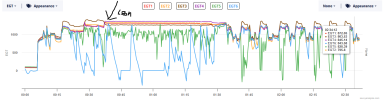
I made my second flight in my new to me Saratoga today, first cross country where I was running it under power for any amount of time. And I noticed high EGT on cylinder 3. I initially thought this was likely an indication of something causing that cylinder to be running lean...i.e clogged injector, etc. However I was also getting erratic readings from 5 and 6, and decided it is likely a malfunction of the sensors or the engine monitor. After coming home and reviewing the log, I am once again concerned that I may have an issue other than just an indication. Clearly 5 and 6 have a sensor error... But 3 the EGT goes up when it is throttled back and leaned, which means that it was already lean of peak, right?

1738798454927.png

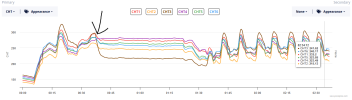
Perhaps more importantly the CHT, shows The same thing, it is hottest cylinder before leaning, yet the coldest after, again an indication that it is running lean of peak.
1738798585233.png

Am I missing something?
 
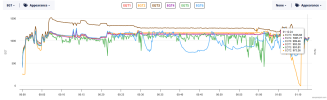
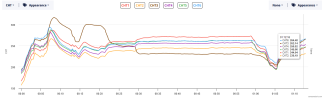
Here is the return flight, I think the issue is less obvious here, the main difference being that I was running at a higher throttle, less lean.
1738798824787.png
1738798852732.png
 
Post some pics of the cylinder in question. Sometimes we can spot a problem by looking at the baffling and other obvious installation issues.
 
I don't think its an issue other than you have a slightly higher cylinder temp. CHT's don't get troubling until you get close/over 400F

High EGT means lean so check for intake leaks on the runners. If its an injected engine check the fuel spider for flow... but for such a marginal temp difference I don't think a flow test would be positive proof. EGT is not affected by cooling air, but how late (lean) the fuel charge is... the fuel is still burning as it exits the cylinder because the flame front is not propagating at the normal speed
 
One cylinder running that much hotter than the others, and being the same cylinder that has a high EGT, implies that detonation is occurring in that cylinder. Detonation causes high CHTs.

#2's EGT is misbehaving at both ends of the flight. Might be a sensor problem.

It's also interesting to note that whenever #1 and #6 EGTs spike, #3's drops.
The dirty secret is that air cooled engines are always detonating. Its just not at a frequency that it causes any damage. A 20F rise for a few seconds is no reason to tear into an engine. Maybe boroscope it and look for something that might create a hotspot?

Lycoming says:

For a mechanic, the number one cause of detonation would be any issue that would cause a cylinder to run unexpectedly lean. This is most commonly caused by a partially clogged fuel injection nozzle or an intake air leak. Any time fuel nozzles are removed, they should be cleaned and flow checked. During inspections, the mechanic should be looking for signs of an intake leak; usually noted by blue fuel staining on intake pipes. Any anomalies should be corrected before further flight.

As for a boroscope:
  • While it may not look good, lead build-up or combustion deposits are normal in Lycoming engines. The lack of these deposits is not necessarily a good thing, either. The cylinder head and piston should be inspected for a “sand-blasted” look. Lack of deposits or a clean head and piston face could indicate detonation has occurred. When using unleaded fuels the deposits should be…
  • Detonation damage usually shows in the edges of pistons and on the cylinder head between the spark plug ports and valves.
 
The dirty secret is that air cooled engines are always detonating.
Now, that is baloney. Detonation is destructive. A "little" detonation just takes longer to destroy the engine, that's all. Plenty of research has been done on it, and in the typical lower-compression aircooled aircraft engine detonation is rare unless the mixture is run too lean at higher power settings or, in boosted engines, the boost is not controlled well enough. Or if the pilot has a habit of banging the throttle open, or runs well outside the POH power setting charts.

Normal combustion involves a flame front travel of about 100 feet per second across the cylinder. Detonation flame front travel is closer to 5000 feet per second and creates sharp pressure spikes that rip stuff apart. It cracks pistons and rings and cylinders and pounds the daylights out of bearings. In the college where I taught Aircraft Systems I had an IO-520 cylinder that had blown its head right off. Tore the aluminum apart just above the threaded section that screws to the cylinder. Detonation did that. Someone abused that engine.

Normal combustion is a chain-reaction, with each burning molecule igniting the others around it so that it spreads in a controlled fashion. Detonation is a different animal entirely: The pressure wave ahead of the flame front compresses the unburnt molecules and heats them so that they break down and then spontaneously ignite almost all at once without waiting for the ignition from the adjacent molecules. This happens more easily in overheated cylinders, or if the induction air is too hot, or if the induction pressures are high, or at low RPM and high manifold pressures, or with low-octane fuel. It's why we still used leaded fuels, since it's difficult to create an unleaded fuel with an octane rating of 100 or better. Warbirds of WW2 used 115/145-octane gasoline because of the needs of those engines, especially the aircooled radials.
Just because you don't hear it and don't bend a rod or pop off a cylinder doesn't mean detonation is not occurring. Even Lycoming states that there is 'light' detonation

"Light detonation may not show any indication in the cabin of the aircraft." https://www.lycoming.com/tips/detonation

So go tell Lycoming that they are also wrong.

Also Mike Bush agrees:

"Contrary to what your CFI or A&P may have told you, detonation is not necessarily harmful. Many engines operate in light detonation quite regularly, and some can withstand moderate detonation for extended periods of time without damage. Detonation is not an optimum situation, but it’s not necessarily destructive." https://www.savvyaviation.com/detonation-and-pre-ignition/

An intake leak, the plastic timing gear on your mag is worn or out of time, injector clogged.... just a few of the ways your engine can be pushed into light detonation without your knowledge. As OP had a digital engine monitor he could see a slight (20F is not a huge jump) increase in temps.. but was it just lean? was it light detonation? that's why I said boroscore the cylinder and see if there are any signs.

I'm sorry you are not well informed on this issue, please read the cited articles and let me know if there is anything I can do to clarify things for you.
 
the plastic timing gear on your mag is worn or out of time, injector clogged.... just a few of the ways your engine can be pushed into light detonation without your knowledge.
I see you don't understand mags either. A worn gear does not change the timing. If it's worn bad enough it will skip and send the spark to the wrong cylinder and that could really bust things up.
"Light detonation may not show any indication in the cabin of the aircraft." https://www.lycoming.com/tips/detonation

So go tell Lycoming that they are also wrong.
Maybe you should re-read that Lycoming article. That sentence you posted does not approve of light detonation. Other excerpts from that article:

To review Lycoming’s recommendations, reference the current revisions of the appropriate Lycoming Operator’s manual and Service Instruction 1094. If the pilot believes the engine may be detonating, he or she could take the following actions.

  • Increase the engine mixture.
  • Reduce power to a lower setting.
  • Reduce or stop climb and increase forward speed for greater cooling.
Does that sound like they want detonation to continue? Even light detonation?

Another one:

Lycoming engines meet or exceed the FAA guidance for detonation margin. Therefore, if an engine is maintained and operated in accordance with our published guidance, the engine should never experience detonation.

"The engine should never experience detonation." Now YOU go argue with Lycoming.

Oh, there's more:

Detonation has negative effects throughout the engine. Light detonation may cause premature wear on bearings and bushings. Severe or prolonged detonation can cause damage to the cylinder head and pistons. In some extreme cases, the connecting rod can be bent or broken, the cylinder head may crack or fail, or the piston ring lands may break.

Again, that sure does not approve of ANY detonation. "Light detonation may cause premature wear on bearings and bushings," Lycoming says. Since they designed those engines and have to deal with failing engines returned for warranty. I think they know considerably more about it than you do.

Mike Busch isn't always right, either. I have read some of his stuff. He had an article on detonation, and tests showed that very light detonation can occur in some situations. We already knew that. We operate according to the POH/AFM instructions and avoid those scenarios. None of us want our engines to wear out before their time. They're far too expensive for that.

Just how much flight experience do you have?
 
Last edited:
I made my second flight in my new to me Saratoga today, first cross country where I was running it under power for any amount of time. And I noticed high EGT on cylinder 3. I initially thought this was likely an indication of something causing that cylinder to be running lean...i.e clogged injector, etc. However I was also getting erratic readings from 5 and 6, and decided it is likely a malfunction of the sensors or the engine monitor. After coming home and reviewing the log, I am once again concerned that I may have an issue other than just an indication. Clearly 5 and 6 have a sensor error... But 3 the EGT goes up when it is throttled back and leaned, which means that it was already lean of peak, right?
View attachment 137875

Perhaps more importantly the CHT, shows The same thing, it is hottest cylinder before leaning, yet the coldest after, again an indication that it is running lean of peak.
View attachment 137876

Am I missing something?
I'm not gonna jump into the pi$$ing match, just make some observations. Maybe they'll be wrong enough to get the other guys back on track. ;)

First, I'm presuming that you took off, flew for about an hour and a half, and then made a few trips around the pattern at the end?

I'm seeing EGT3 higher in the climb, and then it's going down when you lean. That indicates that either it's already quite lean, or that you have a problem with one mag/plug that is causing a slower burn in that cylinder and the fuel/air mixture is still burning as it exits the cylinder past the EGT sensor.

If you do a runup and EGT3 doesn't drop a bunch on one of the mags, that should rule out the ignition problem. You should expect EGTs to rise a little on all cylinders when running on one mag during a normal runup. It might be worth pulling out the plugs to inspect them and check resistance too.

That leaves us with either an induction leak or a partially clogged injector. I agree with @pfarber that it doesn't look like a big enough difference that you'd see a significant difference in fuel flow between cylinders if you tested that.

What were your power settings on the first and second flights? Does your engine monitor log MP/RPM? Is it connected to other things to log altitude/airspeed and such too? Those are often helpful traces to add to the graph if you can.

Now, it looks like on both flights once you leaned, CHT3 was significantly lower than the rest. During the second flight, however, it was much higher in the climb. Did you do something different with your climb power settings between the flights?

Finally, there's always the chance of measurement error. You obviously have some issues with EGT5 and EGT6, and while the readings for cylinder 3 would appear to correlate "something" going on between EGT3 and CHT3, it's worth testing to ensure that your sensors and wiring aren't wacky.

Good luck, and let us know what you find out!

 
Your thoughts to closely match what I was thinking.
I had my mechanic check the probes and they found loose/improperly installed connections on the EGT probes. I also had them clean the injector and spark plug on #3. They reported that after this EGT and CHT on #3 appear normal during a runup. I'm away on a trip right now, when I get back I will fly it, which will be the real test on whether the issue is resolved.
 
What were your power settings on the first and second flights? Does your engine monitor log MP/RPM? Is it connected to other things to log altitude/airspeed and such too? Those are often helpful traces to add to the graph if you can.
My engine monitor logs most everything except for rpm....which is another discussion. I didn't add those other items to the graph because I basically remembered what they were, but yes I can see how they may be helpful for others to understand what was happening.
Now, it looks like on both flights once you leaned, CHT3 was significantly lower than the rest. During the second flight, however, it was much higher in the climb. Did you do something different with your climb power settings between the flights?
The flight logs as I presented are actually in reverse. The one where it is much higher during the climb was the first flight, and the climb was conducted at full power, the second flight I was suspecting something was wrong, and therefore reduced power as soon as possible after take-off. On that flight I reduced power to probably about 50%
 
I was able to do a quick test flight today. The temperature issue seems to be resolved. I of course have no way of knowing whether it was an indication issue caused by loose connections, or dirt in the injector. But I suppose it doesn't matter that much as long as it works.
 
Back
Top