High BP during exam

  • Thread starter Thread starter Scared exam taker
  • Start date Start date
S

Scared exam taker

Guest
I went last week and had my second class exam. I take no medication and have nothing to report, knock on wood, a clean bill of health.

Anyway, we got to the point of the exam of taking blood pressure and it was elevated. 150/75… the limit is 155/80. I felt very calm and relaxed given the situation. I told her, no way it’s that high. Never is when I take it at home. She chocked it up to white coat syndrome and I passed just fine. I went home later that evening and took my BP 5 different times and it was all within the normal range, ~115/78.

I really question if the doc’s equipment was accurate. Anyway, will the FAA look into me over this? It was within range per their guidelines for a second class, albeit at the upper end. With nothing else interesting to note, are they likely to take notice? I don’t have high blood pressure and I can confirm it when I test at home all the time.
 
Always do BP after you’re in the office for 15 minutes, close your eyes and drop your shoulders and breathe slow and calm.
 
I always get significantly higher readings when using the automatic pumps. I ask for a manual test with a large cuff and my readings are well within the normal range.

Nauga,
who can't think of a good tagline using "sphygmomanometer."
 
Yeah, but has anyone ever known the FAA to start looking at these when they see someone tested near the top of the acceptable range and then could revoke a medical out of the blue until testing is completed?

The fact that I’m always in range at home multiple times in a row tells me the reading in the exam room was a farce.
 
I'm not sure why they'd revoke your medical for BP that's within the acceptable range unless there are compounding factors.

Nauga,
and his uncertainty band
 
Consider that your home tester may not be accurate. Mine became inaccurate, and we need to replace the cuff. If you are worried that there is a problem, go to plain doctor for a BP test only, and pay cash.

The possibility that you have rising real BP may be an early warning, and there are more important things than a Class 2 medical.

I am taking the smallest dose of an FAA legal medication to hold mine in the desirable range.
 
I'm not sure why they'd revoke your medical for BP that's within the acceptable range unless there are compounding factors.

Nauga,
and his uncertainty band
I agree, what might you consider to be compounding factors?
 
BP is often taken incorrectly. To be reasonably accurate, the cuff must be properly sized (most important), the arm resting relaxed at roughly heart level, feet flat on the floor, and the person should be resting comfortably for at least a few minutes (not taken immediately after jumping up on an exam table). "White coat hypertension" is difficult to characterize absent reliable home readings with a known-accurate cuff that differ significantly from a known-accurate clinic cuff. If there's doubt, (such as in your case), trying with a manual cuff or different automatic cuff is completely reasonable.

In this situation, you met standards (so nothing to worry about with the exam) and it seems that your BP is probably within normal limits at baseline via home testing. Absent symptoms of excessively high blood pressure or a history of cardiovascular disease, I would personally not lose any sleep over this. If you're concerned about the accuracy of your home BP measurements, I'd wander into a CVS and get a blood pressure check there to see what the delta is. Bring your home BP cuff to compare.
 
White coat syndrome is a thing. I show borderline high BP at the AME's office, but never at home or at my PCP's office.
 
Find someone who knows how to take blood pressure. In all the years I've been going to providers of various sorts, I've found exactly two times when they've actually measured it with the proper technique. The errors all tend to pile up on making the readings erroneously high.
 
Are you using the same arm at home and in the doctor’s office? My BP varies a fair amount between arms.
 
Find someone who knows how to take blood pressure. In all the years I've been going to providers of various sorts, I've found exactly two times when they've actually measured it with the proper technique. The errors all tend to pile up on making the readings erroneously high.
Do you mean like when they keep asking me questions about things like my medications and allergies and any little think they can think of while the machine is trying to do it's thing?
I just shut my eyes and try to breathe, but it is annoying when the nurse is asking questions while letting the stupid machine take my BP.
 
I went last week and had my second class exam. I take no medication and have nothing to report, knock on wood, a clean bill of health.

Anyway, we got to the point of the exam of taking blood pressure and it was elevated. 150/75… the limit is 155/80. I felt very calm and relaxed given the situation. I told her, no way it’s that high. Never is when I take it at home. She chocked it up to white coat syndrome and I passed just fine. I went home later that evening and took my BP 5 different times and it was all within the normal range, ~115/78.

I really question if the doc’s equipment was accurate. Anyway, will the FAA look into me over this? It was within range per their guidelines for a second class, albeit at the upper end. With nothing else interesting to note, are they likely to take notice? I don’t have high blood pressure and I can confirm it when I test at home all the time.
"white coat syndrome" is real. So don't worry that your sphygmomanometer or the one in the office are broken or inaccurate. When push comes to shove, your personal device is irrelevant, the FAA has zero interest in your home device.

My Dr office knows to wait until the end of the appt to take my BP. A few years ago I was in the hospital for knee surgery. I could watch the BP monitor over my shoulder. While they were inserting the line in my arm, the BP shot up to 260/? and the staff were panicking. I told them to stop causing pain, the BP will come right back down. Sure did. Right back down below 130/x.
 
As a fellow 'White Coat Syndrome' guy, I use the technique of asking the initial examining MA or RN to let the AME take my BP at the end of the session. Having a strange to me person, usually a woman, usually young, often attractive, push a BP machine suddenly toward me that makes funny sounds, in a room that could make one think of one's mortality? Nope, request the Doc do it after a developing short relationship usually works much better for me. And using a home BP device a couple times daily prior to the exam can provide assurance.
 
As a fellow 'White Coat Syndrome' guy, I use the technique of asking the initial examining MA or RN to let the AME take my BP at the end of the session. Having a strange to me person, usually a woman, usually young, often attractive, push a BP machine suddenly toward me that makes funny sounds, in a room that could make one think of one's mortality? Nope, request the Doc do it after a developing short relationship usually works much better for me. And using a home BP device a couple times daily prior to the exam can provide assurance.
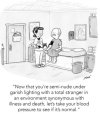
1760350629937.jpeg
 
...and that cartoon shows the BP incorretly being taken. The arm needs be supported, and also be at the level of the heart...
 
White coat syndrome is real, and it's also a sign of hypertension. So it should be checked out, not dismissed.
 
...and that cartoon shows the BP incorretly being taken. The arm needs be supported, and also be at the level of the heart...
At my Dr. Office, they do it one of two ways:
Either as shown in the picture,
Or they have me rest my arm on the basket on the pole under the BP machine (where they store the cuffs and other stuff). The bad part about that is that it is a wire basket and with you arm resting on the basket, it hurts, and it is probably restricting blood flow.
Plus, it's always the second thing they do, right after putting you on their scale that always seems to read high.
 
I think large cuffs really help if you are looking for an honest reading.

-Skip
I always ask for the larger cuff. They comply, but lately they have been telling me that the larger cuffs read low.
 
I had an Aunt that died at 96, two months after falling and breaking her hip.

She always said "If I had known I would have lived this long, I would have taken better care of myself".

She was my favorite Aunt. Ever since I was 18, till she died, she would let me join her in her evening tonic.
She would put two ice cubes in a water glass. She'd fill the glass with Gin til "almost" full. Then she splashed a little tonic water on top.
She said the tonic water made her feel better. I think she had two of these the night she fell.
 
I always ask for the larger cuff. They comply, but lately they have been telling me that the larger cuffs read low.
How do they know that? Just tell them that they have it backwards! The standard cuffs read high on a big arm. -Skip
 
Do you mean like when they keep asking me questions about things like my medications and allergies and any little think they can think of while the machine is trying to do it's thing?
I just shut my eyes and try to breathe, but it is annoying when the nurse is asking questions while letting the stupid machine take my BP.
No, I'm talking about bad technique:
1. Not centering the bladder over the artery.
2. Limiting the inflation to stopping the palpated pulse.
3. Supporting the arm during the test.
4. Doing the test only once per arm.
and probably a few mores.
 
A popular AME here in town has a big comfy recliner that you get to relax in before the nurse takes your BP. But none of this technique stuff matters at the AME as long as you can come up with a reading that's below 155/95. And if you can't, you have much bigger problems.
 
I'd suggest taking your home BP monitor with you on your next Doc visit and check it against their machine.
Start there. Use same arm and within a few minutes of the physician's office BP reading. Readings should be close but will probably differ by +/- 5 mmHg even if the home cuff is accurate. Check both arms to verify no significant difference in BP and use highest BP arm consistently.

I usually ask my patients take blood pressure at home 2-3 times a week for a few weeks at different times of the day after relaxing in a chair for 15 minutes to establish baseline, and after all BP med changes. If you have been exercising wait at least 3-4 hours. If you are under emotional or physical stress your numbered may be higher than normal so wait a day or so. If your average systolic BP is over 140 many docs will prescribe a BP medication.
 
Old Thread: Hello . There have been no replies in this thread for 365 days.
Content in this thread may no longer be relevant.
Perhaps it would be better to start a new thread instead.
Back
Top