Foreflight sells to private equity

In contrast, PE (at least my understanding of it) tends to have a very, very short-term perspective, seeking to maximize near-future profit potential with little thought to long-term sustainability. This manifests as rapid price increases, gutting of personnel, focus on short-term productivity at the expense of long-term investments in people and equipment, and--in some cases--loading the business with new debt. The goal of PE seems invariably to be a sale or a bankruptcy following the extraction of maximum value.

That is a caricature of PE methods and intent. Much of it is a holdover from the political campaign against Mitt Romney, who is no longer evil BTW.

The real goal of PE is growing their money. There are many ways of doing that.

Sometimes with a poorly run business, the best way to do that is run the business better so it produces a better bottom line. In many cases, that does involve cutting costs and tightening up operations, because those areas have been neglected. As long as businesses are valued at multiples of EBITA, the bottom line matters, and the difference between 5% net and 10% net is mostly attention to detail by management.

In other cases, the business has strategic growth potential that can best be realized with the injection of capital, combining technologies, or merging with other companies. I see this a lot in my industry, defense contracting. It is very difficult to compete against the big guys: Lockheed, Boeing, General Dynamics, etc. Many businesses start under the small biz umbrella, but get stuck when they try to make the jump from small to full/open bids. Try being a $50M business bidding against multi-billion dollar businesses. Ask me how I know.

Anyways, a common strategy is for PE to buy 5 mid-size businesses for $100M each and bolt them together, hoping to turn the result into a billion dollar business. My personal view is anyone that uses the word "synergy" is full of BS, but there are plenty of guys with plenty of money sloshing around trying to make that work.

Finally, some very poorly run companies are just waiting to be dismantled and parted out, but the founders don't have it in them. Guys who do this are no more evil than vultures (the actual birds), which do the rest of us a favor by cleaning up carcasses from the road.
 
Last edited:
May be I am being optimistic, but I think roll-your-own flight planners are not too far off in the future. These EFB apps are just displaying the information that is already out there for free. Sure, presentation is important, but we've been treating foreflight as if they are creating the content being displayed.
 
May be I am being optimistic, but I think roll-your-own flight planners are not too far off in the future. These EFB apps are just displaying the information that is already out there for free. Sure, presentation is important, but we've been treating foreflight as if they are creating the content being displayed.
I was always put off that in order to be IFR certified using, e.g., a Garmin GPS navigator, I had to buy a recurrent data card subscription from them; the data on that card was validated by the FAA using public funds and was given to Garmin (et al.) for essentially nothing more than the cost of storage or transmission.
 
This manifests as rapid price increases, gutting of personnel, focus on short-term productivity at the expense of long-term investments in people and equipment, and--in some cases IN EVERY CASE EVER--loading the business with new debt (because that's their business model). The goal of PE seems invariably to be a sale or a bankruptcy following the extraction of maximum value.
FIFY: PE relies entirely on debt. In fact, you could say nearly their entire business model and their success over the last 40 years was owed to declining interest rates and increasing equity multiples (hard for them to fail in that environment). Now that they're in a higher rate environment and money isn't free, they're doing *ahem* not so hot. Same for CRE guys. Private equity also shifted from acquiring underperforming companies, whipping them into shape and then exiting a more operationally efficient company, to their new form of treating every single portfolio company as an ATM to be exploited. And over the past 10 years (at least) they've really taken advantage of volatility laundering as an attractive trait to boost their AUM.

One of the things that ****es me off most about PE is when they take a company that is surviving, though maybe struggling (not Jeppesen), and then heaps a ton of debt on them just to pay themselves a special dividend. That'd be fine if you're just taking advantage of idiot investors who don't do their due diligence and buy into the leveraged loans ("a fool and his money soon part ways" and all). But the people who really pay the price are the employees who are now left working for an employer that can't pay their bills and is in a total financial straight jacket. In many of these scenarios the owners don't give a **** because they've already used the borrowing capacity of the company to pay themselves. Perverse, IMHO.

The one caveat I will say that is that PE typically does not want to see bankruptcy and they're not super short term, they usually hold for 5+ years. Granted, they don't care about bankruptcy if they've already exited the business and no longer have a stake. Then they could care less if the company suffers violent economic convulsions brought on by their completely unsustainable leverage ratio. This has played out so many times that it's ridiculous. But while they own it -- bankruptcy is usually a bad option because it ruins their equity stake.

However, there are hedge funds that will actively attempt to drive companies into the ground for quick profit. Usually for really good reasons (gross mismanagement, completely failed business, fraud, etc). Occasionally for bad reasons.
 
The real goal of PE is growing your money. There are many ways of doing that.

Indeed. And I certainly don't claim to have experience or knowledge of PE beyond what I've gleaned from various podcasts and other sources, so I'll defer to folks such as yourself and @ArrowFlyer86 who appear to have more understanding. I recall a few interesting Freakonomics episodes regarding how PE was affecting things like the veterinary industry and of course the Toys R Us saga. Perhaps PE does indeed benefit some underperforming companies, but I'm not sure I've ever heard anyone rejoice that PE bought their company.

One of the things that ****es me off most about PE is when they take a company that is surviving, though maybe struggling (not Jeppesen), and then heaps a ton of debt on them just to pay themselves a special dividend. That'd be fine if you're just taking advantage of idiot investors who don't do their due diligence and buy into the leveraged loans ("a fool and his money soon part ways" and all). But the people who really pay the price are the employees who are now left working for an employer that can't pay their bills and is in a total financial straight jacket.

Yeah, I agree that's pretty evil. Not sure how such people sleep at night, although perhaps that's why I'm not driving a Ferrari and they are.
 
Do you have any personal experience running a business and making business decisions, or did you get all that from the OWS website?

Take the charger example. Do you really think the change from lightning to USB-C was an insidious plot by Apple to sell more 5 dollar cables? If so, that's hilarious.
35 years running one of the most successful businesses in my industry. along with a Harvard MBA. but sure, a minor reconfiguration of the wire was necessary to facilitate quantum improvement in technology. and a wire that costs 15-20 cents to produce should sell for $30
 
One of the things that ****es me off most about PE is when they take a company that is surviving, though maybe struggling (not Jeppesen), and then heaps a ton of debt on them just to pay themselves a special dividend. That'd be fine if you're just taking advantage of idiot investors who don't do their due diligence and buy into the leveraged loans ("a fool and his money soon part ways" and all). But the people who really pay the price are the employees who are now left working for an employer that can't pay their bills and is in a total financial straight jacket. In many of these scenarios the owners don't give a **** because they've already used the borrowing capacity of the company to pay themselves. Perverse, IMHO.
The PE sells the company in any case: the only question is whether the buyer knows what they are getting when they are at the closing table. PE owners can cash out company value by levering up the debt burden you describe; in which case the "buyers" thought they were getting a bond, but end up with equity via BK.
 
@Ed Haywood I used to go into a lot of companies as a consultant, and I've seen a bunch of my clients bought by PE. My experience with PE is much closer to @AvNavCom's than yours. It's why I always say "PE ruins everything."

That said, Thoma Bravo appears to at least have a clue what they're doing in terms of software, and their strategy does have some potential with ForeFlight if they also make some additional industry acquisitions.
 
It’s a pity that all of that competition hasn’t made any of them not suck.

I can order stuff on the Internet and 1 to 3 days later it shows up on my doorstep, without fail. I can track it online at any point in that journey. Shipping is usually free if you pay any attention to terms. That is nothing short of miraculous. But yeah, booo, everything sucks.

Except the USPS. They still manage to lose my stuff.
 
Last edited:
I can order stuff on the Internet and 1 to 3 days later it shows up on my doorstep, without fail. I can track it online at any point in that journey. Shipping is usually free if you pay any attention to terms. That is nothing short of miraculous. But yeah, booo, everything sucks.

Except the USPS. They still manage to lose my stuff.
Yeah, yeah. Everything's amazing and nobody's happy.

But it's not really wrong. I have pretty good luck with UPS, but I know others have trouble with them. I have all kinds of trouble with FedEx, but others do OK.

USPS has come a long way, they haven't lost anything of mine in a long time. They've also added a lot of services.

But the only ones who are getting things to your doorstep without fail in 1-3 days? Amazon... And they're doing most of their own shipping now.
 
What a terrible example. Package delivery is one of the most competitive markets in the world right now.

At least 3 competitors is generally considered the definition of a non-monopoly. In the US we have FedEx, UPS, USPS, and DHL. Not to mention Amazon and Walmart for drop shipping.

Why didn't they raise their prices 30%?
DHL doesn't do domestic anymore. USPS won't do hazmat. You're back down to 2.
 
FIFY: PE relies entirely on debt. In fact, you could say nearly their entire business model and their success over the last 40 years was owed to declining interest rates and increasing equity multiples (hard for them to fail in that environment). Now that they're in a higher rate environment and money isn't free, they're doing *ahem* not so hot. Same for CRE guys. Private equity also shifted from acquiring underperforming companies, whipping them into shape and then exiting a more operationally efficient company, to their new form of treating every single portfolio company as an ATM to be exploited. And over the past 10 years (at least) they've really taken advantage of volatility laundering as an attractive trait to boost their AUM.

One of the things that ****es me off most about PE is when they take a company that is surviving, though maybe struggling (not Jeppesen), and then heaps a ton of debt on them just to pay themselves a special dividend. That'd be fine if you're just taking advantage of idiot investors who don't do their due diligence and buy into the leveraged loans ("a fool and his money soon part ways" and all). But the people who really pay the price are the employees who are now left working for an employer that can't pay their bills and is in a total financial straight jacket. In many of these scenarios the owners don't give a **** because they've already used the borrowing capacity of the company to pay themselves. Perverse, IMHO.

The one caveat I will say that is that PE typically does not want to see bankruptcy and they're not super short term, they usually hold for 5+ years. Granted, they don't care about bankruptcy if they've already exited the business and no longer have a stake. Then they could care less if the company suffers violent economic convulsions brought on by their completely unsustainable leverage ratio. This has played out so many times that it's ridiculous. But while they own it -- bankruptcy is usually a bad option because it ruins their equity stake.

However, there are hedge funds that will actively attempt to drive companies into the ground for quick profit. Usually for really good reasons (gross mismanagement, completely failed business, fraud, etc). Occasionally for bad reasons.

I've worked for a company that was bought by a PE firm. We could tell things were getting really bad when they didn't restock the toilet paper or paper coffee cups in the breakroom. Everyone was searching for a different job in a down job market, multiple rounds of layoffs happened... We found out how much they bought the 400+ employee company for, and we could've passed the hat between the employees and bought it ourselves. Of course the c-suite got a nice payout from the PE firm, everyone else got the boot. PE firm closed the company within a year and sold off all the assets.

Can also look at what happened to the coal industry. Pensions stay with the main company, all assets move to a sell company, main company goes bankrupt. Pensions gone. But they can work as contractors at the shell company in their old jobs... good times.
 
Ed Haywood said:
The real goal of PE is growing your money. There are many ways of doing that.

No, the real goal of PE is growing THEIR money.

Interesting story about Jo-Anne Fabrics. 97% of their stores were profitable, yet they're declaring bankruptcy. PE bought them out, borrowed lots of money, hollowed out the shell and put the carcass into bankruptcy.

Back floating debt, and all.
 
Last edited:
I think Garmin transponder owners/foreflight users will feel what it’s like to drop the soap in a prison shower.
 
Last edited:
Couldnt disagree more. Private equity is and always has been a mechanism for stripping companies of their value, screwing over the other stakeholders and cashing out and leaving wreckage.

Yes, there have been glaring examples of such behavior. However, the majority of PE groups do not act as raiders. I have personal experience with partnership with PE groups and currently invested as a limited partner in one fund. Your statement that I quoted above could not be further from the truth, in my experience.
 
Ed Haywood said:
The real goal of PE is growing your money. There are many ways of doing that.

No, the real goal of PE is growing THEIR money.

Interesting story about Jo-Anne Fabrics. 97% of their stores were profitable, yet they're declaring bankruptcy. PE bought them out, borrowed lots of money, hollowed out the shell and put the carcass into bankruptcy.

Back floating debt, and all.

2 minutes on Google is enough to verify your story is wrong. PE bought JoAnn in 2010 and continued to build the company for 12 years. They went public in 2022 after a huge sales year during the pandemic. Two years after that sales plummeted and they went bankrupt twice, closed down, and had their carcass sold to another PE company for liquidation. The main reason for their demise is simple: selling the same stuff as Amazon and Walmart is a bad business model.
 
Yes, there have been glaring examples of such behavior. However, the majority of PE groups do not act as raiders. I have personal experience with partnership with PE groups and currently invested as a limited partner in one fund. Your statement that I quoted above could not be further from the truth, in my experience.

Exactly. It makes no sense to buy a business just to tear it down. PE groups seek to buy companies to make MORE valuable, not less.
 
2 minutes on Google is enough to verify your story is wrong. PE bought JoAnn in 2010 and continued to build the company for 12 years. They went public in 2022 after a huge sales year during the pandemic. Two years after that sales plummeted and they went bankrupt twice, closed down, and had their carcass sold to another PE company for liquidation. The main reason for their demise is simple: selling the same stuff as Amazon and Walmart is a bad business model.
 
That sounds like IBM to me.
"No one ever got fired for buying IBM." -- Conventional Wisdom

If you take a flyer on an unknown vendor to save money, and the project goes TU, your head is on the block for making a bad decision. If you pay top dollar to "buy IBM", and the project goes TU... well, "HoouKoodaNode!?" and you live to cash another paycheck.
 
Exactly. It makes no sense to buy a business just to tear it down. PE groups seek to buy companies to make MORE valuable, not less.
You can't say that as a blanket statement. One of (not the only, I agree, but "one of") the playbooks that PE uses regularly is to buy companies whose assets are worth more than their business. The profession of profitably dismantling a company absolutely does exist.
 
You can't say that as a blanket statement. One of (not the only, I agree, but "one of") the playbooks that PE uses regularly is to buy companies whose assets are worth more than their business. The profession of profitably dismantling a company absolutely does exist.
I don't disagree. But that's not the only play in the playbook, or even the dominant one. The caricature of all PE as heartless villains twirling their dastardly mustaches is facile, and a clear sign of someone who knows little about the topic other than what they read on the Internet.
 
They have the reputation as heartless villains cause their is so much evidence of it and they’ve done such incredible damage to society and to the economy. of course there are some competent outfits that add value but the overwhelming evidence od the destruction they’ve wrought is undeniable
 
They have the reputation as heartless villains cause their is so much evidence of it and they’ve done such incredible damage to society and to the economy. of course there are some competent outfits that add value but the overwhelming evidence od the destruction they’ve wrought is undeniable
I'm unclear. Are you talking about PE, IBM, Andrew Carnegie, or Boeing?
 
I don't disagree. But that's not the only play in the playbook, or even the dominant one. The caricature of all PE as heartless villains twirling their dastardly mustaches is facile, and a clear sign of someone who knows little about the topic other than what they read on the Internet.
Nope. I'm the guy who writes the stuff on the Internet. ;) Like I said, I used to go into many companies as a consultant, and I've seen my clients get bought out by PE. Every single time it has been an absolute disaster, at least for the employees in the company. PE either chunks the companies up into little tiny silos to try to sell them off, or pulls in those silos or whole other companies to merge in and try and make it look like it's experiencing huge growth when it's really not. In every case, morale drops through the floor, the best (ie most productive) employees head for the exits while the most loyal ones stick around and become part of what is being wrung, being forced to do multiple jobs without a pay raise, working insane hours, or both.

I have yet to experience a single case where it turned out well. I've heard it can happen, but I've never seen it myself. That said, I have no experience with Thoma Bravo in particular and there is some optimism from employees that I know, which bodes well for success. So, I'm going to remain cautiously optimistic... But let's not pretend that anyone but the investors are better off after the majority of PE acquisitions.
 
Look at FedEx And UPS. Neither one of them are really trying to outdo the other.
When two companies provide the same basic service the cost structure is going to be the very similar. While they may be able to provide certain unique services the overall cost structure of those services are still going to be relatively equal.

also some businesses are not really viable for dozens of companies to operate in. Even for something like package delivery I can think of UPS, USPS, FedEx, DHL, Uber also has a package delivery service plus there are private carriers so right there is at least six businesses that all do the same thing that are competing with each other, but have similar cost structures.

take something as specialized as orbital delivery services, I can think of SpaceX, the government / NASA, Russia, ESA, India and China all can get payloads into space. none of them are monopolies and they all charge wildly varying prices because they all provide varying services based on weight altitude / height and what orbit you need.
 
Last edited:
Sporty's take on the Sale. Sporty's was a early supporter and there's marketing in the article but it is encouraging.

 
Sporty's take on the Sale. Sporty's was a early supporter and there's marketing in the article but it is encouraging.

Given Thoma Bravo’s track record, many in the industry are optimistic this move could accelerate ForeFlight’s innovation roadmap.
I wish that the article had listed a few items from Thoma Bravo's track record, since it's a mystery to me.
 
Sorry I'm trying to sort out which of these provide the optimism in the Sporty's article. They're pretty opaque to me.

Something like "hey here's a company that they were able to 10X after acquisition" would help me share the vibe.

View attachment 140537

You would probably have to dig through the references at the bottom to get to that level of detail, if it exists.
 
Sorry, small tangent but related to my monologue a page or two ago.

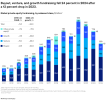
Speaking of PE not doing so hot
(leverage on leverage on leverage on leverage, what could go wrong?)
1746134621989.png

It's no surprise that while fundraising has been dropping and trillions of dollars of backlogged exits aren't happening that... (see below)
1746134734854.png

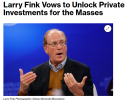
... Now we have heads of major asset managers saying:
"hey, after locking the public out of Private Equity during the boom times when money was being minted, why don't we finally discover our passion to unlock the private markets for the public!"
1746135019696.png
1746135060751.png

That's called looking for a bagholder, err I mean, "alternative sources of liquidity" because you know you're in a bit of a pickle.
 
Back
Top