For Checkride: Which checklists do I need to physically reference and which ones are OK to rely on memory?

DCR

Pre-takeoff checklist
Joined
Jun 14, 2023
Messages
129
Display Name
rudy
Up until the moment I take off, all of my flows are backed up by a physical checklist I have in my hand / on kneeboard. However, after takeoff I don't always do so. Sometimes due to task saturation, sometimes the checklist is just very simple.

Would I get a disapproval on my checkride if I run my climbout, cruise, landing, etc. checklists without looking at my physical checklist?

What about EPs? Sometimes I feel quite busy searching for a landing spot and keeping my speed at whatever speed and I don't get time to back up my flow. Is this acceptable for a checkride? (I know the answer in a real emergency, just wondering if a DPE expects the checklist to be referenced since this is "staged").

I suspect this might be DPE-dependent, but I'd like to hear any experience y'all have regarding this. Thanks.

PS: I did find a few threads on this topic but I was wondering specifically about the checkride. I know "teaching to the checkride" isn't best practice but sometimes you gotta know.
 
What does the ACS say?
And where it says, “Complete the appropriate checklist(s),” it means using the physical checklist.
I know "teaching to the checkride" isn't best practice
Best practice is using the checklist in real life the way it’s proscribed for the checkride. While I’m sure I’ll get someone indicate disagreement with that statement, note that nowhere does the FAA recommend anything else.
 
And where it says, “Complete the appropriate checklist(s),” it means using the physical checklist.

I guess this was my real question... I wasn't sure if just saying "pitch, power, trim, mixture, lights... cruise checklist complete" is sufficient or if I'm required to read it back on my list too.

Sounds like the readback is required!
 
Am not a DPE, but I would think NOT looking at a check list in the pattern and doing a flow would be preferred **OR** if it was thought to be critical, hold the checklist up vertical near glare shield and glance at items while still keeping "head on a swivel" for conflicting traffic. Tell the DPE everything verbally that you are thinking so they don't have to guess what the heck you're up to ...
 
My last checkride, I used the checklist for non-moving items like pre-start, Start, and Runup.

I did the moving items like take off, climb, etc, as a flow, then when the workload was lower, looked at the checklist list for that phase of flight.

I also had a self-made checklist for approaches and Garmin switchology. I taped that to the panel and referred to it when setting up for each approach.

After we landed, I did the Cleanup after exiting the runway and coming to a complete stop. Then I looked at the checklist to confirm.

At shutdown, I pulled out the checklist and touched everything during shutdown, verbalizing Mags cold and master switch off.

It must have worked...
 
Am not a DPE, but I would think NOT looking at a check list in the pattern and doing a flow would be preferred **OR** if it was thought to be critical, hold the checklist up vertical near glare shield and glance at items while still keeping "head on a swivel" for conflicting traffic. Tell the DPE everything verbally that you are thinking so they don't have to guess what the heck you're up to ...
When I took my CFI checkride, the examiner told me I was not using the checklist in the pattern. I asked him to clarify, because I had clearly enunciated each item on the landing checklist. He said I should be using the written checklist and that I should teach my students to do the same.
 
When I took my CFI checkride, the examiner told me I was not using the checklist in the pattern. I asked him to clarify, because I had clearly enunciated each item on the landing checklist. He said I should be using the written checklist and that I should teach my students to do the same.

So he preferred "head down" in a target rich environment ... ok:rolleyes:
 
While I’m sure I’ll get someone indicate disagreement with that statement
That's my queue to enter! :p (joking)


For a check ride I'd keep the checklists handy so you can glance at them and make sure you're not forgetting anything, but I would want to have all that **** memorized well enough that there's zero doubt you could fly the plane 100% competently w/o the checklist.
You're not flying the space shuttle, just a little tin can, so there's really not that much to commit to memory.

Disclaimer: I'm a non-CFI PPL who has taken precisely 1 checkride, so my advice should be weighted accordingly ;)
 
  • Like
Reactions: DCR
Am not a DPE, but I would think NOT looking at a check list in the pattern and doing a flow would be preferred **OR** if it was thought to be critical, hold the checklist up vertical near glare shield and glance at items while still keeping "head on a swivel" for conflicting traffic. Tell the DPE everything verbally that you are thinking so they don't have to guess what the heck you're up to ...

Good point... I never reference my (written) checklist in the pattern. I honestly think it is safer that way.

What does the ACS say?

Apparently the ACS does give a little "slack"... I thought I knew but apparently I didn't read the full text (for my own reference, I know it was a rhetorical question):

"In some situations, reading the actual checklist may be impractical or unsafe. In such cases, the evaluator should assess the applicant's performance of published or recommended immediate action “memory” items along with their review of the appropriate checklist once conditions permit."
 
…
Apparently the ACS does give a little "slack"... I thought I knew but apparently I didn't read the full text (for my own reference, I know it was a rhetorical question):

"In some situations, reading the actual checklist may be impractical or unsafe. In such cases, the evaluator should assess the applicant's performance of published or recommended immediate action “memory” items along with their review of the appropriate checklist once conditions permit."

Does your POH/AFM contain published or recommended memory items?
 
There are options, and each DPE probably has their own opinion of each. In general the DPE is there to make sure your not an idiot and not to kill yourself and others.

On checkrides, depending on the aircraft and situation, I have used:

Written checklist
Checklist printed on the panel (Cherokees often have Takeoff and Landing checklists on the panel)
Mnemonics (GUMPS, etc.)
Flows

Now if the DPE asks, did you miss anything, that is probably a prompt to whip out a checklist to find what you probably did skip, or at least he/she wants you to verify.

Just remember, a checklist is not a to-do list, and is not step by step how-to-fly an airplane. It is a way to verify you have indeed completed the necessary tasks for safe flight.
 
I did the moving items like take off, climb, etc, as a flow, then when the workload was lower, looked at the checklist list for that phase of flight.
Hence the term “checklist” rather than “do list.”

Using the before landing checklist should take your eyes away from outside for about 5 seconds, as everything SHOULD be done (or, “flaps to go.”) Its purpose is to simply verify that everything is done. If you can’t find 5 seconds to do that, you shouldn’t be in that pattern.
 
When I took my CFI checkride, the examiner told me I was not using the checklist in the pattern. I asked him to clarify, because I had clearly enunciated each item on the landing checklist. He said I should be using the written checklist and that I should teach my students to do the same.
That might be where you simply pull out the checklist to give it a quick look, or fake it, I dunno, at least the DPE sees it in your hand.
 
Am not a DPE, but I would think NOT looking at a check list in the pattern and doing a flow would be preferred **OR** if it was thought to be critical, hold the checklist up vertical near glare shield and glance at items while still keeping "head on a swivel" for conflicting traffic. Tell the DPE everything verbally that you are thinking so they don't have to guess what the heck you're up to ...
There have been plenty of arguments about this, but most seem to agree that reading checklists once in the pattern when our head should be in a swivel is not a good idea. Most at this point tend to agree that it may be one of the worst times to switch tanks. But no one says you have to wait until you are in the pattern to review the landing checklist.

I might be unusual because I began flying multiple makes and models from the time I earned my private (I seem to be a bit above 30 now). The variety of Vrefs (I have horrible number retention), carb heat on or off, fuel pump on or off, fixed or retractable, cowl flaps or no, means the before landing briefing from the written checklist during descent to the airport was alway essential to me.

I’ve told this one before (it’s a copy paste).

Here's the problem with not using them. You end up with a habit pattern that actively prevents using a checklist when you need it. Example:

I was doing transition training for a pilot moving from a 172 to a 182. One of the easiest transitions around because of the many similarities. But, again and again and again, the pilot neglected to adjust cowl flaps. Two things were going on.

His "flow" was actually a memorization of, say, the two main items on the before landing checklist, not a true flow considering everything changeable. So his hand would go right past the cowl flap lever but never stop there.

The other was, despite repeated "you are missing something" prompts from me, he not once went to the checklist for his answer. The checklist was sitting on the glareshield in his line of sight but his habit of not using it had internalized to such a degree that it did not exist for him.

Consider the effect of that no use habit in a stressful emergency situation in a less than familiar aircraft.
 
There have been plenty of arguments about this, but most seem to agree that reading checklists once in the pattern when our head should be in a swivel is not a good idea. Most at this point tend to agree that it may be one of the worst times to switch tanks. But no one says you have to wait until you are in the pattern to review the landing checklist.

Yes, checklist items should ideally be reviewed before entering the traffic pattern. The complication arises when an aircraft remains in the pattern for repeated takeoffs and landings. In such cases, should you perform the “after takeoff” and “pre-landing” checklists? A purist would say yes, but in practice, limited time and higher-priority tasks - such as maintaining situational awareness of other traffic - can reduce these actions to mindless routines. Insisting on written checklists during rapid pattern work can turn checklist usage into a rote exercise, and that habit that could carry over into other phases of flight. So, relying on memory for these quick cycles is often acceptable. Yet the opposite concern is also valid: normalizing memory items in the pattern can build habits that bleed into other flight segments where checklist usage is more critical. So there is no clear answer to this.

Personally, I believe written checklists are most valuable when transitioning between sustained phases of flight - such as moving from cruise to approach, or from climb to cruise - as they help refocus your attention for the new phase. The pre-flight checklist, for example, marks the shift from ground-mode thinking (like driving a car) to a more deliberate flying mindset.

Ultimately, the most important thing is to be intentional and methodical in whatever process you adopt. Don’t just do something because someone else says you should, unless it’s an examiner, in which case, just nod, comply, and pass the checkride.
 
Yes, checklist items should ideally be reviewed before entering the traffic pattern. The complication arises when an aircraft remains in the pattern for repeated takeoffs and landings. In such cases, should you perform the “after takeoff” and “pre-landing” checklists? A purist would say yes, but in practice, limited time and higher-priority tasks - such as maintaining situational awareness of other traffic - can reduce these actions to mindless routines. Insisting on written checklists during rapid pattern work can turn checklist usage into a rote exercise, and that habit that could carry over into other phases of flight. So, relying on memory for these quick cycles is often acceptable. Yet the opposite concern is also valid: normalizing memory items in the pattern can build habits that bleed into other flight segments where checklist usage is more critical. So there is no clear answer to this.
I don't disagree but, in my example of the 182 transition, those cowl flaps were invisible for multiple touch & goes.

There's a secondary and related problem. Many checklists simple have too much in them. Like you, I don't pull out my takeoff and landing checklists for repeated patterns. but they are short enough that I could. In terms of a private checkride or transition training, that may be more of an indictment against touch & goes as an effective training tool than an argument against checklist use.
 
But no one says you have to wait until you are in the pattern to review the landing checklist.

Do the flow. Verify with the checklist. Every phase of flight.

Yes, checklist items should ideally be reviewed before entering the traffic pattern. The complication arises when an aircraft remains in the pattern for repeated takeoffs and landings. In such cases, should you perform the “after takeoff” and “pre-landing” checklists? A purist would say yes, but in practice, limited time and higher-priority tasks - such as maintaining situational awareness of other traffic - can reduce these actions to mindless routines. Insisting on written checklists during rapid pattern work can turn checklist usage into a rote exercise, and that habit that could carry over into other phases of flight. So, relying on memory for these quick cycles is often acceptable. Yet the opposite concern is also valid: normalizing memory items in the pattern can build habits that bleed into other flight segments where checklist usage is more critical. So there is no clear answer to this.


I don't believe this has to be an all-or-nothing matter.

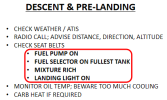
Granted that I fly a very simple, fixed gear, fixed prop plane, so what I do might not work as well with more complex checklists, but I suspect the idea is valid. In my case, for my baby Beech, I have the descent/landing flow as a subset of the checklist. The flow items are bolded and circled in red. Like this:

1752763636869.png​

Before I enter the pattern, I run the checklist, doing the flow items from memory and then verifying with the list. If I'm staying in the pattern for multiple T&Gs, I'll repeat the flow from memory while in the pattern but keep my eyes outside. For me, nothing in the flow changes with takeoff, so doing the flow while in the pattern is simply a confirmation but that might not be the case in a more complicated airplane.

The overarching philosophy is to select items which are to be done in the pattern and make them part of the memorized flow.
 
As Mentioned it seems various DPE interpret this differently but most and the best DPE's read it the way it says.
“Complete the appropriate checklist(s),”
Meaning if the checklist says turn on the carb heat and you don't, that is a fail item, i.e. you did not complete an item on the check list.
This can either be because you didn't use a physical check list
or because you used a check list and didn't "complete" and item on the checklist. (More common that it should be).

Brian
CFIIG/ASEL
 
Granted that I fly a very simple, fixed gear, fixed prop plane, so what I do might not work as well with more complex checklists,
I separate my "Descent/In Range" from my "Landing Brief." Other than including reference speeds, the landing brief portion for a high performance complex is only four items. It would have six if the airplane required boost pump on and had cowl flaps, but one item doesn't apply to touch & goes, so it's back down to 5.

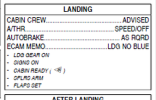
I forget who originally posted it, but this is the Landing portion of an Airbus normal procedures checklist. Checklists do not have to be complicated. Especially Landing checklists.
1752769936180.png
 
What does the ACS say?
Hmmm . . .

"Gross 882, Empty 485, Useful 397, CG 366 mm to 540 mm aft of LE, Vs 56, Vne 170, Va 120, Aero 120, Auto 90, Best Angle 17.5:1 at 78: 240 fpm, Best Rate 17:1 at 62: 200 fpm, 16:1 at 100: 340 fpm, 11.5:1 at 120: 560 fpm."

Printed on a 3x5 card . . .

With the "Schwerpunktlage" and "Gleitflugpolare" on the reverse.

Ah, 1960 . . ..

Edit: (Yeah, I misread ACS as AFM.)
 
Last edited:
Back
Top