Engine Maintenance Stand - Mounting

N1230k

Pre-Flight
Joined
Jul 11, 2025
Messages
52
Display Name
Roy Reeves
I a looking at an engine stand, the 3-legged kind on casters. Can someone explain to me how to mount an O-235 to the stand? I want to store the engine and it takes up too much room in a crate + it is difficult to move. I am thinking if I mount it vertical, on casters (a la engine stand). But, I simply cannot locate instructions how to bolt the engine to the stand after it gets here.

Does anyone have simple instructions and maybe some photos? And how long can an engine be stored vertical? Should I fog the engine, spin it, or do anything? I bought it removed from another plane @ TBO. I just don’t want rust to set in while I restore the airframe.
 
Well, the answer to the first question is some bolts of an appropriate length and the same thread as your prop bolts. The bushings will sit down in the flange of the stand, which is basically simulating a prop. Best to do this with the engine up on a table on its sump. Bring the stand to the engine horizontally, bolt it on, and then rotate the whole thing up onto its wheels. Takes a couple guys. I had 3 to do my 540, and we wished we had another.

My 540 was scary on the stand. It would've taken a good hit to knock it over, but I was nervous the whole time. That's a lot of weight and money up in the air. A 235 would be a lot better, but personally, I wouldn't want to store an engine that way for any length of time. I also don't think you're going to save much, if any, space comparing the footprint of a 4 cylinder and an engine stand.

Personally, in your situation, I'd build a wooden cradle and put casters on it if you want to move it. Id also fill the crankcase up with oil to protect it. Whatever clean oil you can buy cheap. Probably super tech or something. Of course it will probably leak, so you'll need some pig blankets under it.

A better solution would probably be to disassemble it and pack whatever parts that will be reused in grease. I'm not convinced you could fog it well enough to protect the cam, but I've not tried. You definitely dont want to rotate it, and need to re-fog it if you do. Which is another negative of the stand... every time you move it you'll probably wind up rotating it a bit.

Not worrying about it is option 3. The crank will probably be fine with the oil trapped in the bearings, and you'll likely have to replace the cam & tappets anyway.

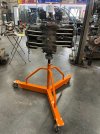
This is the best shot I could find. If you zoom in you'll see that my bolts were way too long and I had to use a bunch of washers and bushings to make them work. I also used some rubber spacers between the crank flange and stand. This was probably a mistake as it introduced some wobble. I had planned to use a 3d printed plastic shim but it didn't quite fit on the day so I made do. Metal on metal probably was the better option. We had it sitting up on that bench on the right and rotated it down onto the floor.

20250228_174935.jpg
 
And how long can an engine be stored vertical? Should I fog the engine, spin it, or do anything? I bought it removed from another plane @ TBO. I just don’t want rust to set in while I restore the airframe.
Is your plan to overhaul engine prior to installing it your aircraft?
 
Is your plan to overhaul engine prior to installing it your aircraft?
Yes. Overhaul will be done, I was advised to plan that so it is done just before I am ready to hang it. I don’t like the idea of moisture rusting up a fresh engine. We all know that engines that run often run a long time. Engines that sit are the ones that break.

Plus - and I know this could happen, what if I end up selling the project? It is not my intent, but I bought as an project, and I got it at a price I really can sell the project and get my $ back, as long as I haven’t OH engine.

As for how long? I wish I knew the answer. I bought the project almost a year ago, and I haven’t done anything yet except dream, plan, revise the plan, shop, think about it some more . . . .
 
Last edited:
Well, the answer to the first question is some bolts of an appropriate length and the same thread as your prop bolts. The bushings will sit down in the flange of the stand, which is basically simulating a prop. Best to do this with the engine up on a table on its sump. Bring the stand to the engine horizontally, bolt it on, and then rotate the whole thing up onto its wheels. Takes a couple guys. I had 3 to do my 540, and we wished we had another.

My 540 was scary on the stand. It would've taken a good hit to knock it over, but I was nervous the whole time. That's a lot of weight and money up in the air. A 235 would be a lot better, but personally, I wouldn't want to store an engine that way for any length of time. I also don't think you're going to save much, if any, space comparing the footprint of a 4 cylinder and an engine stand.

Personally, in your situation, I'd build a wooden cradle and put casters on it if you want to move it. Id also fill the crankcase up with oil to protect it. Whatever clean oil you can buy cheap. Probably super tech or something. Of course it will probably leak, so you'll need some pig blankets under it.

A better solution would probably be to disassemble it and pack whatever parts that will be reused in grease. I'm not convinced you could fog it well enough to protect the cam, but I've not tried. You definitely dont want to rotate it, and need to re-fog it if you do. Which is another negative of the stand... every time you move it you'll probably wind up rotating it a bit.

Not worrying about it is option 3. The crank will probably be fine with the oil trapped in the bearings, and you'll likely have to replace the cam & tappets anyway.

This is the best shot I could find. If you zoom in you'll see that my bolts were way too long and I had to use a bunch of washers and bushings to make them work. I also used some rubber spacers between the crank flange and stand. This was probably a mistake as it introduced some wobble. I had planned to use a 3d printed plastic shim but it didn't quite fit on the day so I made do. Metal on metal probably was the better option. We had it sitting up on that bench on the right and rotated it down onto the floor.

View attachment 148382

Thank you. Until now I haven’t seen one on the stand and… I see your point that that’s a lot of money standing straight up. Maybe I would be better off taking it apart, putting the crank, cam, and cylinders into vacuum pack bags. At least that way I could put it on a shelf out of my way where I don’t have to worry about moving it.
 
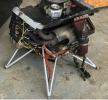
Here's one way to store a engine. I used to store engine parts submerged in old motor oil.
7ddaba79-0d5f-48e2-a8e4-5dc207c24275.jpg
 
And how long can an engine be stored vertical? Should I fog the engine, spin it, or do anything? I bought it removed from another plane @ TBO. I just don’t want rust to set in while I restore the airframe.
Optimally, if you have an idea who will overhaul the engine ask them for input. If not, given you appear to have no time frame on when your restoration will be completed, I've always recommended to buy some plastic totes, pull the mags, carb, vac pump, gov, etc and store separately. Then starting with the core engine assembly, pull the cylinders, coat in appropriate preservation oil and store in totes. Then do the same for the remaining engine assy in a larger tote without any further disassembly. Monitor and reapply oil as needed.
 
Here's one way to store a engine. I used to store engine parts submerged in old motor oil.
7ddaba79-0d5f-48e2-a8e4-5dc207c24275.jpg
That is just too easy. The Engine Mount is taking up space too, I could take some plywood, reinforce with 2x4 and put it on casters too. And doggy pee pads are cheap and perfect for catching oil drips, put one on the plywood under the engine.
 
Optimally, if you have an idea who will overhaul the engine ask them for input. If not, given you appear to have no time frame on when your restoration will be completed, I've always recommended to buy some plastic totes, pull the mags, carb, vac pump, gov, etc and store separately. Then starting with the core engine assembly, pull the cylinders, coat in appropriate preservation oil and store in totes. Then do the same for the remaining engine assy in a larger tote without any further disassembly. Monitor and reapply oil as needed.
That is an idea I had not thought about. It would appear I am overthinking this problem.
 
The big advantage to disassembling now is that you improve the odds of some small part getting misplaced.
Or, when your ladder gets knocked over, there are more targets for it to land on.
And, there is no greater joy in life than having to re-assemble something that someone else took apart. Even if you have the manual.

 
And, there is no greater joy in life than having to re-assemble something that someone else took apart. Even if you have the manual.
Except the preservation method you linked requires the engine to be run every 90 days. Most stored engines are unable to comply with that requirement. And while I agree in part on the reassemble issue, when the disassembly is minimal and properly documented, I've found assembly issues to be minor or non-existent in my experience.
 
when the disassembly is minimal and properly documented, I've found assembly issues to be minor or non-existent in my experience.
Yes. If. Mark / tag. Put fasteners back in holes.
Plus piston aircraft engines tend to be reasonably straight forward. No variable cam timing, adjustable rockers, no effing bucket lifters that the other guy just left in a pile. That one was fun. Assemble random parts, measure, pull it back down and play musical buckets, rinse, repeat.

The link had a reference to the lycoming and conti instructions for storage.
 
My 540 was scary on the stand. It would've taken a good hit to knock it over, but I was nervous the whole time. That's a lot of weight and money up in the air. A 235 would be a lot better, but personally, I wouldn't want to store an engine that way for any length of time. I also don't think you're going to save much, if any, space comparing the footprint of a 4 cylinder and an engine stand.

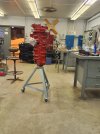
Yeeeeesh, I'm scared on your behalf by that photo. I built a stand for my O-235 and gave it a wide stance* and slung it low on the casters.
*hat tip to Larry Craig

IMG_8151.jpeg
 
Yeeeeesh, I'm scared on your behalf by that photo. I built a stand for my O-235 and gave it a wide stance* and slung it low on the casters.
*hat tip to Larry Craig

View attachment 148396
Yeah, that looks a lot better than mine.

Looking back at my picture, I'm wondering why I put one cylinder on upside down o_O
 
Engines that sit are the ones that break.
Engines that get ground-run without flying, or go for really short flights, are the ones that rust out. Engines that sit undisturbed, especially indoors, are fine for a very long time.
 
1766614206149.png

Sitting it like that puts outward stress on those mount legs and they can bend. The mount relies on the firewall to prevent such distortion. If storing it like this, bolt it to a sheet of plywood.
 
^. I agree, 3/4 inch at least, then put wheels on other side.
 
Find a red tagged engine mount. Build a plywood platform with one wall and brace the wall diagonally to the platform. Bolt the engine onto the mount and support the sump to the base. Roll it under a bench until needed.
 
I think after all the suggestions, packing stuff into totes seems best idea.

On a collateral note - guy at local airport just offered me a 1500 hr O-235C1 for $2K. Said it was running, compressions “good” but he was close enough and wanted to up the power, and had found an O-320 for his bird. I am very tempted to have “spare parts” in case something does not check on my engine (O-235C1B). I’ve read somewhere only difference is the mags.

Is it worth it to have two engines? If I am really lucky my case, crank, and cam will pass inspection for overhaul and the second one sitting in my garage would just be an oversized weight I can hope to get my $ back. But, if I need it, another crank easily cost me as much as this second engine. But I can also end up with two cracked cases or two bad cams or two bad cranks and still need to go hunt down a replacement part and be left with the remainder of the second one sitting there in my way with knowledge it is scrap.

Pros? Cons?

For reference, N1230K is a Luscombe 8A converted to an ‘E’ circa 1962, the STC as I understand allows install of any O-235 or O-290
 
Last edited:
One other thing… There are zero hangers available near me so I’m having to do the restoration in the garage. So space is kind of a premium.
 
View attachment 148397

Sitting it like that puts outward stress on those mount legs and they can bend. The mount relies on the firewall to prevent such distortion. If storing it like this, bolt it to a sheet of plywood.
^. I agree, 3/4 inch at least, then put wheels on other side.


Expert advise...priceless.

I took the picture at my flight school. I soloed in this 172 and took my check
ride in it for my PPL. It only sat like this for a week or so as the lower firewall was replaced.
I might have helped the need to replace the lower firewall during training ?
https://hosting.photobucket.com/2a6...a242/81fef71f-6fd4-440b-b31e-fafd63a2314a.jpg
 
Last edited:
Is it worth it to have two engines?
Maybe. But I've found you only get ahead if its any engine model where spares are not readily available.

the STC as I understand allows install of any O-235 or O-290
Are you replacing an existing O-235 on this aircraft or will you be replacing a different engine as part of a new STC install? Most STCs I'm familiar with do not state "any" but rather specific models like a C1 or C1B. And to note there has been a number of engine upgrades on Luscombes over the decades so you need to make sure your existing airframe configuration can accept the O-235 STC without additional modifications.
 
Maybe. But I've found you only get ahead if its any engine model where spares are not readily available.


Are you replacing an existing O-235 on this aircraft or will you be replacing a different engine as part of a new STC install? Most STCs I'm familiar with do not state "any" but rather specific models like a C1 or C1B. And to note there has been a number of engine upgrades on Luscombes over the decades so you need to make sure your existing airframe configuration can accept the O-235 STC without additional modifications.
Replacing another O-235.

The original A65 was swapped for an O-235 when the STC was done in the early 60’s. I have to go look at logs again but I seem to recall it said “Lycoming O-235/O-290” and did not specify C, C1, C2, L, or any other particular variant of the engine.

Former owner sold engine & Prop so I don’t have those logs and Airframe logs say “O-235 conversion per STC . . .” There may have been an engine serial number in the pages of logs that detailed the STC install, which I could use to figure out which was used. I received a conical engine mount with the airframe and another reference in the air frame logs had the propeller model in one entry, so when I found a C1B with that particular propeller removed from a Piper, I bought both.
 
Another good reason to disassemble the engine you have is that you can measure everything. Get a copy of Lycoming ssp-1776 and your micrometers and go to town. You'll want the lycoming "direct drive overhaul manual" as well. You'll know then what you have and what you'll need to build an engine. If you find any surprises then you have the option of picking up a second engine, or at least more time to search for what you need.

The crank is generally the only part that's not economically replaceable. If it's okay, everything else you can get fairly reasonably for most engines. If it's bad, that's the time you might need a second engine.

The only caution to disassembly is that it makes your core essentially worthless in terms of resale. It's hard to sell parts unless they're yellow tagged by a shop. If there's any chance you might not move ahead with this project and need to sell it, it might be better to leave it together.
 
  • Like
Reactions: WDD
The original A65 was swapped for an O-235 when the STC was done in the early 60’s. I have to go look at logs again but I seem to recall it said “Lycoming O-235/O-290” and did not specify C, C1, C2, L, or any other particular variant of the engine.
Whats the STC number?
 
Yeah, that looks a lot better than mine.

Looking back at my picture, I'm wondering why I put one cylinder on upside down o_O
Doesn’t putting them upside down on one side help eliminate right turn tendency?
 
Whats the STC number?
This is what is says in the log books in an entry dated 08/23/1965:

"Aircraft converted to 8E per CAA specification A-694-5 (copy enclosed)" with details for installation of the wing tanks, dish pan in firewall, and new mixture control, etc.

The next entry - same date says:

"Aircraft converted Per S.T.C. – SA4-173 (O-235-C1, O-290-D, O-320) & (SA4-642 (O-290-D2)"
It then takes three pages to detail what was done to accomplish the conversion installing an O-235C1 with a Sensenich M76AM-2 prop.
 
Aircraft converted Per S.T.C. – SA4-173 (O-235-C1, O-290-D, O-320) & (SA4-642 (O-290-D2)
Okay so the STC does call out the specific engine variant vs what was originally thought in Post 23. And just to note the original alteration to the 8E via the CAA aircraft specification authority actually put a C-85 on the aircraft. Then the STC removed the 85 and installed the C1. Since this will be an STC re-install of a 235C1 you should look in your documentation for the McKensie install instructions referenced on the STC certificate as they should be used to complete the inspection. Here is link to the certificate.
 
Okay so the STC does call out the specific engine variant vs what was originally thought in Post 23. And just to note the original alteration to the 8E via the CAA aircraft specification authority actually put a C-85 on the aircraft. Then the STC removed the 85 and installed the C1. Since this will be an STC re-install of a 235C1 you should look in your documentation for the McKensie install instructions referenced on the STC certificate as they should be used to complete the inspection. Here is link to the certificate.
Thanks for the guidance. I may have a copy of the STC in the folder - seeing it at the link you provided, it looks a little familiar, but then maybe I just saw another STC during one of my many “google walk-a-bout” excursions. But I will certainly download and save this.
 
Now my stupid question 101… Since I acquired a C1B, I guess I have to get field approval to install it? According to all the information I can locate the difference between the C1 and the C1B are magnetos in the C1B are made by slick. I mean other than just paperwork and being uber technical what is to stop someone from taking a C one, installing for this STC, and then converting it to a C1B by changing the magnetos?
 
Since I acquired a C1B, I guess I have to get field approval to install it?
Not quite. Technically, you'll need a higher approval method than a field approval. And given the STC is a pre-FAA one, I doubt anyone will address any modification to it. Your best bet to salvage the -C1B is to contact Lycoming and see if they can provide approved data to convert the C1B to a C1 which will also provide a legal method to replace or modify the engine data plate to a C1. Short of that, I don't see a cost-effective route to install the C1B on the aircraft per the STC.

I mean other than just paperwork and being uber technical what is to stop someone from taking a C one, installing for this STC, and then converting it to a C1B by changing the magnetos?
Legally? The approved data and associated cost to convert it and change the data plate. Might also need a different accessory case for the mag swap and maybe some other items as well???
 
Last edited:
Sounds like I may need to snatch that spare engine before someone else does. It is a C1.
 
Back
Top