Engine driven fuel pumps

flyingcheesehead

Taxi to Parking
Joined
Feb 23, 2005
Messages
28,184
Location
UQACY, WI
Display Name
iMooniac
Home Airfield
KUES/KMKE
Hi all,

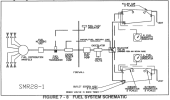
I need to learn more about engine driven fuel pumps. Specifically, the one on my IO-550-G. For reasons (below), I'd like to know more about exactly how it works, and if anyone has pictures of the pump and its innards, that would be awesome. The fuel system in my plane is set up like this:
Screenshot 2025-06-28 at 12.10.52 PM.png
I've noticed that if I go way too long between flights (weeks at least), shortly after I start the engine, if I cut off the boost pump (while still at idle), the engine quits. This normally resolves itself in a minute or so. I did replace the pump a few years ago, and I believe this behavior existed both before and after the replacement.

Yesterday, after not flying for two months (:(:(:() it did not resolve in a couple of minutes. I spent a lot of time on the ground with the engine running attempting to troubleshoot, and I found that if I went up to a couple thousand RPM, it would keep running - But if I pulled it back to idle, it'd quit again. I also went to full power and it seemed like the fuel flow was *maybe* a little low regardless of whether the pump was on or off.

Then, just for the sake of thoroughness, figuring I'd be pulling the data card in the engine monitor to see the exact parameters that'd cause it to quit, I started at full throttle, turned the pump off and on, backed it off to about 20" MP, cycled the pump, etc etc... But, getting down to the 1000 RPM range again, expecting it to quit, it didn't. And then I went all the way down to idle, and it didn't quit. I messed with it a while longer, and couldn't get it to quit.

So, I went and flew around. Landed, shut down for a while (maybe 1/2 hour), started back up, worked fine. Flew to get fuel, shut down, fueled, started back up, worked fine.

There were no obvious indications of trouble from the engine monitor except fuel flow dropping when the engine would quit.

So... What could be causing this? Is the pump going bad? Is there any additional troubleshooting that can be done without waiting weeks to start it up again?

I do see that the engine maintenance manual says to disconnect the inlet line from the engine driven fuel pump and run at least a gallon out using the boost pump and then hook it back up prior to running the engine for testing purposes, so maybe this is perfectly normal? If so, I may simply use a normal hot-start fuel line purge to get everything primed up next time it sits for a while. (Right tank, door open, mixture ICO, throttle full, pump on, wait for the spitting noises to start and then stop in the tank, pump off.)
 
So... What could be causing this? Is the pump going bad? Is there any additional troubleshooting that can be done without waiting weeks to start it up again?
This could also be an airframe fuel system issue.

What model aircraft?

What is the AFM/POH procedure for electric boost pump use?
 
yeah, conti specific fuel routing nuance (return lines) wrt that mechanical pump. I agree, your best generic answer is to just proceed with the line purge (hot start for injected contis) procedure, which essentially primes the mech pump in the process of routing fuel back to the tank, even though the intent of the procedure is to purge it of vapors during a hot start.

I'm attentive but not persnickety (which persnickety people often smear as "complacent", yeah well.. happy mother's day to their dads lol). Which is to say, your anecdote neither troubles me nor indicates to me impending mech pump failure. But we all fly within our own threshold for risk tolerance (with a lot of placebo and religious dogma included, both of which I finally shed for good when my Lycosaurus cracked in flight lulz).

This discussion is of course, not applicable to the Lycoming NA injected variant system, wrt the mech pump.

Nothing you don't already know wrt to hot start procedures in return line systems, but I add the video because the first minute shows schematics of the two types of injected NA conti fuel delivery systems, inclusive of the fuel pump discussion you're interested in. That may give you a good start in studying the innards of the mechanical fuel pump for your 550. I'm sure there's some mx literature out there for your actual fuel pump schematic to study.
 
"if I cut off the boost pump (while still at idle), the engine quits."

At idle fuel pumps don't generate much flow, that's why you need the boost pump. You'll need to check fuel pressure and fuel flow at idle and adjust the

I did find this snippet in the Continental engine maintenance manual for cold starts:

Follow the AFM/POH instructions, using the same procedure as for a normal start. After
the engine begins running, it may be necessary to operate the boost pump intermittently to
prevent the engine from stalling.
 
At idle fuel pumps don't generate much flow, that's why you need the boost pump. You'll need to check fuel pressure and fuel flow at idle and adjust the
That is baloney. They will idle just fine. The idle adjustment is to get the idle mixture right, and therefore smoothness, for the average DA that airplane is flown in.
I did find this snippet in the Continental engine maintenance manual for cold starts:

Follow the AFM/POH instructions, using the same procedure as for a normal start. After
the engine begins running, it may be necessary to operate the boost pump intermittently to
prevent the engine from stalling.
That is for COLD starts. No different than for some carbed airplanes where you might need to pump the throttle a bit or work the primer to keep it running until the engine warms up enough to vaporize the fuel better.
 
No mechanic worth their salt is going to even start investigating a problem involving fuel flow on a large bore continental until the fuel setup procedure in manual M-0 has been completed successfully.
(It was previously known as the various iterations of SID97-3X, until CAT (Continental) incorporated it into Manual M-0.)
The most recent version is usually on the csob (cheap son of a Beech) website under pdf downloads.
 
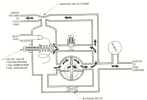
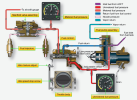
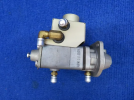
The Continental engine-driven injection fuel pump looks like this:

1751161140715.png

It has a vane-type pump driven by the engine so that more RPM means more fuel. The fuel is piped into that cylinder on the left so that it spins and any vapor goes to the center and is drawn off and sent to the header tank by the venturi on its top. Fuel that the pump moves but the engine doesn't need is sent back to the pump inlet or to the header. The relief valve on the left closes at lower pressures to keep the engine idling, and this may be sticking in the OP's pump.

The whole system looks like this:
1751161453191.png
 
This could also be an airframe fuel system issue.

What model aircraft?
Mooney M20R Ovation.

What is the AFM/POH procedure for electric boost pump use?
Low boost for priming & start, high boost only if needed for an emergency - High boost is a red switch under a fully enclosed guard because under normal circumstances it'll put so much fuel into the engine it'll quit.

Neither is normally used for takeoff/landing, it significantly changes the mixture.

The Continental engine-driven injection fuel pump looks like this:

View attachment 142370

It has a vane-type pump driven by the engine so that more RPM means more fuel. The fuel is piped into that cylinder on the left so that it spins and any vapor goes to the center and is drawn off and sent to the header tank by the venturi on its top. Fuel that the pump moves but the engine doesn't need is sent back to the pump inlet or to the header. The relief valve on the left closes at lower pressures to keep the engine idling, and this may be sticking in the OP's pump.
Dan, thanks for the information!

Would the relief valve stick for some reason that is always relieved after it's unstuck? It's pretty consistent that this issue only happens when the plane hasn't been flown in a few weeks, and also that once the engine driven pump is working, it continues to work until it's had a long break again.

Thus, I am leaning toward it being likely that we just need to get everything primed up better prior to starting. Relative to that theory, how likely do you think the relief valve sticking is? Where is the relief valve located?
 
Thus, I am leaning toward it being likely that we just need to get everything primed up better prior to starting.
Some systems also use check valves to maintain certain internal static pressures. Since this appears only after extended periods of no use, you may have a check valve leaking down or some other anomaly that causes a loss of "prime." As mentioned above, a good place to start is to check the fuel pressures and see what is going on then go from there. Below is an older revision link to the TCM manual with the procedure, Section 6-4.7.4. It will take some gauges, lines, and fittings to into the fuel system.
TCM Standard Practice Maintenance Manual, Revision JAN 2017
 
Would the relief valve stick for some reason that is always relieved after it's unstuck? It's pretty consistent that this issue only happens when the plane hasn't been flown in a few weeks, and also that once the engine driven pump is working, it continues to work until it's had a long break again.

Thus, I am leaning toward it being likely that we just need to get everything primed up better prior to starting. Relative to that theory, how likely do you think the relief valve sticking is? Where is the relief valve located?
The relief valve is inside the pump assembly. I have never had one apart. My experience with the TCM injection system is in cleaning or changing injectors and calibrating the system in accordance with the data mentioned by Let'sgoflying. Or replacing fuel fittings: there is one on the pump that the alternator or generator drive belt misses by a hair and I found it chafed halfway through by a belt as the alternator sagged due to a bunch of wrong alternator mounting parts.

The adjustment is the screw on the left end of the pump in this picture:

1751209511105.png

DON'T GO FOOLING WITH IT. This is work for someone that knows what they're doing. Dismantling and repairing that thing is considered Specialized Maintenance here in Canada, restricted to shops and personnel trained and licensed for it. It is not a carburetor. Talk to a shop that overhauls this stuff to get their much more informed opinion on your problem.
 
At one time I met an Agwagon with issues. On Final the IO-520 would stop

when the Throttle was brought back to Idle. Pilot action was to activate

Low Boost. Not easy when flying out of short strips.

This led to research and discussion with the Continental folks.

My Takeaways:

1. The Pump is simple and it is rarely the culprit. As Dan said; DONT FOOL etc.


2. There are external adjustments though. These adjustments can be

accomplished by someone that has the knowledge and CALIBRATED

equipment for the task. It is not just a tweak. You MUST have an

accurate Tach as slight differences in RPM will affect the pressure.

Same is true for the pressure gages. A caveat is to assure the gages

are level with the pump when adjusting. The long nose AgWagon

had me standing in the cockpit during the process. btw These

gages are external and not the aircraft gage.


3. “Jaws” was in theatres at time. It was my first time with this task

so the phone bills were insane. I question if you would get assistance

like that now.


4. Some early versions of the Pump used a fixed orifice. There is a Screen

that was loaded with crud like it was never checked. The Rep told me

that Pump could move garbage. Cleaning downstream was essential though.


5. If the Pump is not adjusted for proper output there is no “ bandaid”.

Knowledge and CALIBRATED INSTRUMENTS are needed periodically.
 
Yep, I'm very familiar with the adjustment process. We've had it done more than a few times.

Flew today, no issues. I was paying extra attention and noticed that the fuel flow sat on 0.0 for a few seconds after turning the boost pump on for the first start of the day. Now, multiply that 3-day break by 20 and you get where I was the other day.

Thanks for all the insights, everyone!
 
Back
Top