Does anyone know about the Wheeler Express?

Sorry to resurrect a necro thread.

I am looking at buying one of these. I’m not concerned for myself; at over 15,000 hours TT and almost every rating there is I plan to gently push the envelope in every regime until I fully understand the aircraft.

To that end if those who have posted before, AnOldMan (like me - ha!), 49EX, and others, have anything you can share that would help I would greatly appreciate it.

N49EX I absolutely agree based on my Aerospace Engineering background and years as a pilot just LOOKING at the design it appears obvious low speed regimes with aggressive late elevator up inputs the wing would almost certainly airstream blanket the tail. Anyone with any experience would likely come to the same conclusion and plan exits for such regimes (or avoiding them completely). Anything you’d like to share privately will remain private if you’d care to?

I planned on letting my son build some time in this after adding a BRS chute - he’s finishing his PPL. Those who have flown this if you have any input into this I would appreciate it. Once he has his time he will be off to the airlines and it’ll be me just taking it for fun trips.

TIA
Read the flight test report posted by Ron W earlier in the thread. It might make you reconsider your plan. A BRS ain't gonna help if the airplane does something off-the charts weird at 200' on approach.
 
One person’s flight report followed by several posts later in the thread by people with years and hundreds of safe hours in them. Isn’t exactly “definitive”.

I’ve flown all sorts of squirrely aircraft from original Mark II wing 20 series Lears to MU2’s and typically if you don’t get slow you don’t have a problem unless YOU do something “weird” at 200’ on the approach. Certainly if you were to get slow in anything with an unforgiving nature such as a Lancair IV-P it’s not going to go well. They hold the record I believe for worst percentage by fleet total of fatal crashes.

To be fair I wouldn’t put my kid in a IV-P although I’d happily fly one myself if the price were right. Fly it like the high wing loaded airfoil that it is and respect the aircraft you’ll be fine.

I’m more interested in the opinions of people with several hundred hours and years of flying them quite honestly. Not to disregard one person’s personal experiences or one accident, but as a fleet their hull loss percentage doesn’t seem abnormal. The question seems to be how does that break down by operating hours comparably (which I believe is how accidents should be measured).

That’s how we do it in the airline industry: how many accidents per block hours per aircraft. Takes out the “how often does that type of airplane really fly” out of the equation, but the NTSB hasn’t really figured that out yet.

For instance, if this airplane has a hull loss every 10,000 flight hours across the fleet and the average for other airframes is more like one every 100,000 operating hours, that would point more to the aircraft being a problem, whereas if the accident rate vs hours flown is within 2-3%, that’s an error of margin that says one airframe is no better or worse than the other.

Like anything else, if you want safe, there’s plenty of Cessnas and Cherokees out there with fairly forgiving wings. If you want speed and efficiency you’ll have to get more modern and with that speed comes more critical wings. It’s all a trade off, just have to find a middle ground. Nothing is without risk, just important to make risk decisions at the right level.
 
That’s how we do it in the airline industry: how many accidents per block hours per aircraft. Takes out the “how often does that type of airplane really fly” out of the equation, but the NTSB hasn’t really figured that out yet.

For instance, if this airplane has a hull loss every 10,000 flight hours across the fleet...
Not so easy to figure when the "fleet" size is only a few aircraft. Statistics get meaningless when the sample size is too small.
 
One person’s flight report followed by several posts later in the thread by people with years and hundreds of safe hours in them. Isn’t exactly “definitive”.
The test pilot is unbiased and tested the airplane. The owner may or may not have tested around the margins and certainly isn't unbiased.
 
Not so easy to figure when the "fleet" size is only a few aircraft. Statistics get meaningless when the sample size is too small.
And then I go back to how many of these are flying and how many accidents do they have? Same story basically.

I can’t label an airplane as a “bad design” if others are routinely flying them without incident. The only one I heard of recently is one last year that a guy stalled on takeoff and luckily was so close to the ground it just settled back down hard on the nose, folded the nose, and he walked away from it.

There are plenty of aircraft with small tails that are blanketed at high AoA stall regimes. There are also plenty of aircraft that are uncontrollable in a stall when placed aft of CG limits. There are also plenty of aircraft that are pitch and yaw sensitive and require finesse to fly and not crash - the original Mk II Lear 23 and 24’s were not friendly but we flew them without problems for years, half the time single pilot with a wet CMEL copilot who was basically only good for running the radios and the checklist. Going so fast they were completely behind the plane most of the time until you reached cruise.

One person’s input is taken into account; not dismissing what he said, just seeing others post they haven’t had issues over *YEARS* of ownership with hundreds of hours flown and wondering why two different stories. It’s too easy to say an “owner is biased”. Quite honestly I’d expect that if someone was trying to SELL their plane; if an owner had been scared by an airplane he’d have sold it. I therefore don’t see bias painting a picture when an owner likes his plane, isn’t selling his plane, and has no reason to tell people of his happiness with his aircraft other than just sharing his experience.

As an unbiased 3rd party MYSELF, I see two competing beliefs from two different people and want to hear more before I believe one over the other.
 
Not so easy to figure when the "fleet" size is only a few aircraft. Statistics get meaningless when the sample size is too small.
Perfectly true, and something I keep butting my head into when analyzing homebuilt accidents. As of January 1st, there were about 55 Wheeler/Aurigas in the US registry. Accident rate averages less than one per year.

Couple that with the fact that there is no official estimate of the annual flight time for individual homebuilt types. The FAA issues only a blanket average of ~50 hours/year for the overall homebuilt fleet.

Ron Wanttaja
That seems to be a pretty small accident rate.

I re-read the PDF of the flight testing and I really don't see what others are seeing in its negativity or "unsafe" claims. Both test pilots had overall positive things to say other than saying it should be looked at further for a few areas.

Specifically the ONLY negatives I found in that article were: Adverse yaw at high angles of attack when stalled. Not surprising, you blanket the tail, have p-factor and torque rolling the aircraft left and consequently right yaw as the right wing comes up until you speed back up enough for the horizontal stab and more rudder to come back into the slipstream and it straightens back out. Not surprising from this design and it isn't listed as a "critical problem". They do recommend limiting rudder travel to 20" instead of 26, which appears reasonable to prevent over-controlling the tail, but overall who is going to be jamming rudder in hard when you're in a stall?

This goes back to the "Unless you do something *weird* when you stall the airplane; solution: don't do that. Just recover with normal control inputs.

If I'm missing something from the "report", please someone quote the page and paragraph that's worrisome?
 
Just curious but is this example you're looking at flying or still an uncompleted kit? In either case is a scorching deal? I have nothing whatsoever against the design (in fact it was on my short list back in the day until the RV-10 rumors became fact) and I find it interesting this model has piqued your interest.
 
That seems to be a pretty small accident rate.
Depends on how you calculate it.

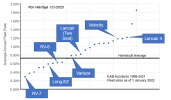
I do calculate accident rates for common homebuilt aircraft. I use a rough system that I think provides a good comparison of accident rates between types. It takes the average number of accidents per year over the 1998-2022 time period and divides them by the number of registered aircraft at the end of that date period. Like I said, it's a rough approach, doesn't compute a valid absolute value, but I think it's of value when comparing type-to-type.
1738951101903.png
All the types shown have more than 50 accidents in the 1998-2021 time period. The Wheeler Express/Auriga isn't included because all the types in the figure have 50 or more accidents in the time period covered, and the Express doesn't meet that threshold.

*If* I run the same process on the Wheeler, I get about 1.5%. That's not what I would consider "small", relative to other homebuilt aircraft types.

But, again, the sample size is low.

Looking at the causes doesn't help much, since each accident for the Wheelers accounts for over 4% of the total. But ten of the Wheeler accidents were due to Pilot Miscontrol (e.g., stick-and-rudder mistakes) for 45% of the total, compared to 40% for the overall fleet This may indicate pilots are having problems with handling the aircraft, but, again, if there had been just one fewer accident the rates would have been about the same.

Ron Wanttaja
 
Depends on how you calculate it.

I do calculate accident rates for common homebuilt aircraft. I use a rough system that I think provides a good comparison of accident rates between types. It takes the average number of accidents per year over the 1998-2022 time period and divides them by the number of registered aircraft at the end of that date period. Like I said, it's a rough approach, doesn't compute a valid absolute value, but I think it's of value when comparing type-to-type.
View attachment 137924
All the types shown have more than 50 accidents in the 1998-2021 time period. The Wheeler Express/Auriga isn't included because all the types in the figure have 50 or more accidents in the time period covered, and the Express doesn't meet that threshold.

*If* I run the same process on the Wheeler, I get about 1.5%. That's not what I would consider "small", relative to other homebuilt aircraft types.

But, again, the sample size is low.

Looking at the causes doesn't help much, since each accident for the Wheelers accounts for over 4% of the total. But ten of the Wheeler accidents were due to Pilot Miscontrol (e.g., stick-and-rudder mistakes) for 45% of the total, compared to 40% for the overall fleet This may indicate pilots are having problems with handling the aircraft, but, again, if there had been just one fewer accident the rates would have been about the same.

Ron Wanttaja
That's a great graph, thank you. It's interesting that the Wheelers are higher than the L-IV. From everything I had seen documented they were by far the worst loss by percentage of fleet of anything like your graph shows but again there's so few Wheelers it may skew the numbers by sample size as has been mentioned.

Either way it's a good discussion.

The aircraft does look like it's going to have tail effectiveness at low speed issues; heck you can see that just looking at it really. It bears out in them adjusting Vx and Vy. Climbing out less than 95 to 100 kts wouldn't even occur to me with a big bore 6 cylinder aircraft with a slicker design. You'd need the cooling anyway and you'd get better tail effectiveness at higher speeds and the lower AoA.

It makes you wonder how much people were expecting a more docile, slower airplane and thus simply flew it slower as originally recommended (70 Kt Vy) and were close to stall speed, slow with less effective and smaller tail, then over-controlled the yaw?

It doesn't *appear* from the flight test PDF you posted earlier that it's inherently more unstable when flown within a normal envelope. Or did I miss something?
 
Just curious but is this example you're looking at flying or still an uncompleted kit? In either case is a scorching deal? I have nothing whatsoever against the design (in fact it was on my short list back in the day until the RV-10 rumors became fact) and I find it interesting this model has piqued your interest.
There's a salvage bird I'm thinking of buying. Stalled right after liftoff and settled down hard on the nose wheel, folded it up under the plane and hit the prop. Nearly zero belly damage as it skidded on the prop and folded nose gear.

Still negotiating on price - wish I'd seen the Ritchie Brothers salvage auction I'd have bid on it there. Guy who got it wants to make a ton of money and isn't really pricing how much it's going to take to fix as the crank flange is bent, block is likely cracked, etc. I happen to have a TSIO520BE from a Malibu (ironically tornado damaged from the same John Tune tornado that took out the Wheeler earlier in this thread) just sitting here pickled in a box I think would pair nicely with this fuselage. Run it at 65% LoP and have lots of power into the low teens with o2 for a better cross country traveler.

Again if it handled adversely I could just keep it for myself as a family hauler, stick a BRS on it and call it a day. My wife won't get back in a GA plane without a 2nd engine anyway so it's mainly for me and my son. Ha!
 
That's a great graph, thank you. It's interesting that the Wheelers are higher than the L-IV. From everything I had seen documented they were by far the worst loss by percentage of fleet of anything like your graph shows but again there's so few Wheelers it may skew the numbers by sample size as has been mentioned.
Yes, you picked up the main problem...the small sample size. A couple fewer accidents over that 26-year period would have had a good drop in the percentage. This is why I normally don't look at homebuilt types with fewer than 50 accidents.

Other factors are involved as well. Pilot experience is one. Some types, typically the simpler aircraft, attract those with less flying time. This can skew the results. The median pilot total time for the PIC in homebuilt accidents is a thousand hours....in Cessna 172 accidents, it's about a quarter of that.

The mission of the plane is a factor, too. Normally, in the plot I posted, I would not have flagged the higher-rate aircraft like the Lancair IV. But I *knew* people would look at the worst-case dot and assume it was the Lancair. It was actually a small homebuilt....an AMPHIBIOUS homebuilt. Several accidents involving hidden logs, etc. in the water. Not really something the Lancair encounters. Similarly, the Zenair CH-701 scores above average...but it's a STOL plane, and you find a lot of accidents with less-experienced pilots.
It makes you wonder how much people were expecting a more docile, slower airplane and thus simply flew it slower as originally recommended (70 Kt Vy) and were close to stall speed, slow with less effective and smaller tail, then over-controlled the yaw?

It doesn't *appear* from the flight test PDF you posted earlier that it's inherently more unstable when flown within a normal envelope. Or did I miss something?
It's all down to the fundamental nature of homebuilt aircraft. Almost every one of us here learned to fly on an aircraft certified to Part 23 or its CAR equivalent. The regulations specify a lot of details on how the plane should react to the controls. Switching from a Cessna to a Piper is mostly just a matter of learning where the switches are and what the airspeeds should be. When you manipulate the controls, all the aircraft respond in a reasonable, expected fashion.

Not so (mostly) in the homebuilt world. There was once a homebuilt on the market (think it was actually an ultralight) where the pedals were connected to the ailerons and the yoke to the rudder. Yet, if the airplane had crashed, the NTSB would probably have put the blame on the pilot's handling of the plane.

There's NOTHING that requires a homebuilt handle like the planes we're used to. Good designers try. Others...well, they figure if THEY could get used to it, anyone else should be able to. One homebuilt designer was interviewed about his plane's stall characteristics. "I've never stalled it," he said. "In fact, I doubt it can recover from a spin."

The usual pushback I get is this: "But we don't WANT our homebuilts to handle like trucks. We want sporty handling, not like driving a stodgy old Cessna.

The Pitts Special is an aircraft fully certified under Part 23. No one ever accused a Pitts of stodgy handling.

In contrast, about 30 years ago, one man posted about his experience in a demo ride with another new homebuilt design:

“I got a chance to fly in the prototype at Tullahoma in 1980. I have flown in a number of homebuilt aircraft, but this is the only one that I refused to allow any other member of my family fly in... The demo pilot was supposedly an airline pilot with tens of thousands hours experience, yet he seemed to have his hands full with this little monster.”

Now, this is a classic example of homebuilt Darwinism: Prospective builders would go for a demo flight, and get scared away. Only ~45 of these airplanes were ever built, and only two remain on the registry. Many were modified to try to tame their characteristics.

In contrast...look at the Vans series. Thousands built, thousands flown. Back in the '90s, I went to the company to test fly the then-new RV-8 for a review in Kitplanes (from the back seat, I hasten to add). Met Dick Van Grunsven. He was fretting a bit. The RV-8 was not meeting the stick-force-per-G requirement of Part 23. Note that it didn't HAVE to meet the requirement. But Vans wanted handling to match a certified airplane.

Most homebuilts, even the successful ones, fall somewhere between the RVs and the Polliwagons. Generally their handling is good...but, sometimes, there's a corner of the envelope where it'll bite. 99.99% of the time, you may never encounter it. Until you do.

Pinky: "Are we going to go to the edge of the envelope?"
The Brain: "No, but we might reach the sticky bits."

And that, I think, is the basic issue with the Express. Does everything right, until you reach the sticky bit of the envelope.

Finally, I should note: The RV-8 I rode in for the article eventually crashed fatally. Apparently, the pilot getting the demo ride pulled the stick too hard and ripped the wings off. Makes one wonder about that stick-force-per-G.....

Ron "Narf!" Wanttaja

 
Excellently stated, thanks.

My question comes from why people got “the airplane is dangerous” from that article you posted. I read it and felt both pilots generally liked the airplane but wanted to know why specifically left roll and right yaw doesn’t want to return to stable flight and ends up pitching down with little rudder authority until speed comes back up. That’s not a flying coffin per se, just a quirk to know about.

Put a Beech Duke in a deep stall and roll left and put right rudder in and stall it, it will probably go inverted flat spin and you die. Happened a couple times over the years yet no one accuses the Duke of being dangerous in handling - it’s a flying tank.

Not having excess rudder authority on this plane might help you not get to the edge of that envelope and otherwise it doesn’t seem dangerous outright otherwise? Again am I missing something?

The alternatives are buy an RV6A for him to fly (not even getting near a tail wheel until he has about 200 hours or so and about 100 hours of free time to get used to it), or a Rans or even a 701 to burn holes in the sky but none of those are planes I’d rather keep long term. This one might be. Just making sure it’s not hiding something really nasty in its handling.

And seriously if you get low, slow, with left aileron and right rudder, you’ve really screwed something up along the way. If you need to slip the plane you do so with a good bit of extra airspeed. Lots of people didn’t live to learn about it doing that low and slow even in Cessnas and Pipers.
 
Finally, I should note: The RV-8 I rode in for the article eventually crashed fatally. Apparently, the pilot getting the demo ride pulled the stick too hard and ripped the wings off. Makes one wonder about that stick-force-per-G.....

Ron "Narf!" Wanttaja
 
Interesting discussion of crash statistical analytics. There are also times when anecdotal evidence should be viewed more seiously. Your mention of RV-8 wing departures reminds me of one such anecdote that was ignored by the designer, the EAA and the NTSB; much to the probable grief of several families.

Several wings popped off early RV-3's. I bought one in the early 1980's. After what was probably 100 hours in that delightful aircraft, I got whacked in head by the bulkhead immediately aft of pilotseat during a slow aileron roll. When stars cleared, I was looking at the roof of the baggage compartment, which is located immediately behind the single pilot seat. I climbed out and landed without benefit of the seatback (youthful abs). Some experimentation revealed the three flimsy tabs on the seat back to easily pop thru the aft bulkhead, the interaction of which provided the sole seatback support. This was a casual 1G roll without a firm grip on the stick (i.e. not a white-knuckle maneuver), but still I pulled 3.5G's before my hand came off stick (G-meter displayed high mark). The multiple previous wing failure accidents had occurred during more stressful maneuvers such as loops or high speed buzzing ... all fatal.

I called the RV designer, who discredited my experience and conclusions. Much to my disbelief, Van told me that I, (and presumably some or most of the wing busters) did not possess the ability to fly the aircraft safely because, not being buiders, we did not understand its design limitations. He said such pilots are pulling way too many G's on his plane. If I recall correctly, the designed limit was somewhere between 4&6G's and that had been confirmed by static physical experimentation. He also mentioned the possility of faulty wing installation by builders. I asked him to at least describe my experience in his news letter without my conclusions regarding wing failures. He declined. Interestingly, he had previously highlighted me in his publication as the "first long distance IFR flight" in an RV... Salt Lake City to Wells, NV in winter of '82 or '83.

A few weeks later Sports Aviation published a report of a mysterious accident during an Oshkosh air show where an RV-3 participating in a formation flyby abruptly flew into the ground in front of the spectators during a high speed turn. The accident was attributed to, "pilot must have had a stroke". The wing departures were labeled, "pilot must have pulled too many G's" (like 10G's or so).

I wrote a letter to the Sports Avuation editor describing my experience and how a pilot seat failure could easily explain both the high-G-force wing failures and the Oshkosh accident. Obviosly, the stick is severely yanked aftward when the pilot falls backward. Instead of publishing my letter, the editor called me with Van on the phone, who made similar remarks as in my prior call with him. The EAA magazine declined to publish my letter to its editor.

After 2 or 3 more RV-3 fatal accidents, I wrote a letter to NTSB explaining my experience and thoughts. They wrote back thanking me for my input but noted that none of their RV-3 crash examiners had mentioned a problem with the pilot seat.

Eventually, and without mention of possible catastrophic design consequences, Van sent out a recommended to more effectively secure the back of the pilot seat to its aft bulkhead. To my knowledge, no unexplained RV-3 accidents occurred after that recommendation.

Needless to say, I had long before rigged a more effective support for my seatback and enjoyed another hundred hours in that little airplane before selling it. It was an absolute joy to fly, but I needed more carrying capacity. Van's design from a flight performance perspective is a wonder to to behold. But this seatback issue and the failure to appreciate the significance of my experience has left me with an enduring disappointment in both the designer and the EAA.

That's why your mention of wing departures on an RV-8 got my attention. Hopefully, such a physically simple explanation is not applicable here as well.
 
Thank you for posting that. I’m in the middle of putting a Mustang II back together after its original builder flew 70 hours in it, didn’t like the ground handling, and hangared it for 15 years. Someone bought it for the engine and avionics and I got a bare hull for $10k that is 95% done.

One thing I’ve noted, like you, is how poorly the seat is designed. I’m borrowing Piper’s side hinge design for a folding side seat that also has those hinge stops as a reinforcement for the back brackets so it will have two rear stops and the two side hinge stops on top of that so hopefully this doesn’t have the same problem, given the Mustang II is +4 to -2 G’s in Normal category and an eye watering +8 to -6 in Utility (no way I’d push it that hard, there’ve been two accidents from high speed low level aerobatic pulls in these and there’s just no reason for it).

I have noticed a certain hubris among the people who design these aircraft. Not the builders, but rather the designers, believing that they were so intelligent they could design an aircraft that hundreds if not thousands of pilots would want to copy and build, and not make a single design choice that could be improved upon for safety. It’s an interesting thing to take note of.

The Mustang II has a couple weaknesses of design issues that were addressed by SB; one of them we’re replacing the vert stab transverse doubler with a plate 3x as thick and one of them on measuring toe (I could see even with my bare eyes once I knew it was a potential issue that the toe-in on the right main on this airplane is way too far inward and the left is slightly toe-out, no wonder he was having ground tracking issues). Makes me wonder how many accidents and incidents it took for the manufacturer to issue a service bulletin.

Once this is done and I send my son off to school with it to fly on the side (he’ll have over 100 hours at that point and 15+ in this plane) and build time I’ll be selling my Cherokee and looking at one of the 90% finished Wheelers around the country. There’s one in particular I have my eyes on but the original builder sold it without AW or Bill of Sale for Liability purposes and I may have to see if I can get a DAR that will let me buy just the fuselage and do wings and engine and mount myself for 51% and call it a one-off of my own build. Not certain of any other way to accomplish it and that kit is the closest to being ready to fly, maybe a year or work.
 
Watch the gear on that Mustang 2.
My experience with that plane in a strong crosswind was less than optimal.
Might have been the builder rather than the design, but I swear that bugger would dart off in the wrong direction (away from the wind) as soon as the upwind main gear touched down. Was borrowed from the builder/owner and never got final followup, but I figure it was a toe-in/out adjustment issue, which could hopefully be remedied.
 
Richard,

Sorry for the disconnected comments here.
Am trying to learn when PoA transforms my draft text to a permanent post, but have yet to master that bit of knowledge.

My Mustang 2 gear comment was crafted in response to your, "its original builder flew 70 hours in it, didn’t like the ground handling, and hangared it for 15 years."

And regarding your reference to a Beech Duke as "a tank: Because twins are built for transport, I think that bird is the best GA piston twin ever built. I lost an engine in a Duke over the Sierras at flight levels in IMC a while back. It found some clear air and practically put itself down on a back country ranch strip while near VMC all the way down. So yes a tank, bur your inverted spin scenario is a streatch. It flies real sweet in a pinch.

Larry
 
The Mustang has a service bulletin out for exactly that and there were quite a few that were built without attention to that detail since it wasn’t in the instructions. Even then the community recommends landings be done as a 3 pointer for the first 50 hours or so of experience in it and it’s still not a good crosswind airplane over about 12-15 kts. Most tail wheels aren’t in general though.

Yes I found the Duke to be a straightforward handling airplane. I would hope in an engine-out scenario it would do better than Vmc on a drift-down and make it to a better place to get services. I had to limp a Bonanza 50 minutes across the Sierra-Nevadas on only 2 working cylinders 6 years ago into Double Eagle at stall speed plus about 5 kts because it wouldn’t go any faster and hold altitude. Thought that was the end of my life for the first 20 minutes where there weren’t any plateaus or valleys.

The inverted spin isn’t my scenario, it’s based on actual accidents. Once a stall (usually from people losing an engine and not responding correctly) develops into a FULL stall, it rolls and spins and that’s the end of that. If you’re uncoordinated in the stall in a Duke it’s adios muchacho. Otherwise it’s a fantastic plane, just requires you to bring your A game. Some planes do so more than others.


Larry Kinder here. I have over 2600 hours in my Mustang II and Paul Cox my neighbor has over 4500 hours of Mustang II time. We have landed our Mustangs in 30 to 40 Knot cross winds. The airplane is excellent in cross winds due to the wing loading, wide gear stance, stiff gear, and small side area of the tailcone. You wheel land it with plenty of speed in these conditions and may need to drag a brake to stay straight as you slow until you can put the tail down and have tailwheel steering. Note: the Mustang II is not a trainer with its thin laminar wing. Richard VanGrunsven (RV aircraft) was asked if he would buy the rights to the Mustang II and produce its kits. He replied “NO, the airfoil is too aggressive”.
 
Wow that's a lot of time in them! Very cool.

The wing has the same loading as the Mooney but being a much lighter airframe and a shorter wingspan I can see how it would be quite a bit sportier.

There are quite a few ground incidents in these and with the service bulletin it seems people are having trouble with the toe adjustment and shimming to match. If you have any tips on that I would greatly appreciate it; that's the last thing on the airframe I have to do besides mounting the elevator for flight before moving to powerplant.

Excellent tip on dragging the downwind brake a bit to keep it from weathervaning on landing in a crosswind. A lot of people were giving opposite advice, to avoid wheel landings and do 3-point to have quicker tailwheel control, so it's great to hear from someone with your flight experience in it before going up myself when I'm done and getting re-acquainted with tailwheel flying. That said I can see how the brake dragging technique would get lower time pilots in trouble. That's a pretty advanced maneuver as the application of brake would have to be quite precise...?
 
I don’t agree with “most tailwheel are not good in crosswinds.”

I’m aware it’s a statement based on anecdotal knowledge but it’s contrary to my experience in tail draggers.
 
I don’t agree with “most tailwheel are not good in crosswinds.”

I’m aware it’s a statement based on anecdotal knowledge but it’s contrary to my experience in tail draggers.
It's just been my experience that a conventional gear airplane takes more work and requires more skill in a gusty crosswind than a tricycle gear.

From watching the insurance auctions every week there are a LOT of ground handling accidents from gusty winds claiming tailwheels and the insurance rates are climbing because of it.

Perhaps the blame is partially on pilots who are not as good of stick and rudder pilots as they once had to be in aviation? Maybe... it's an interesting discussion if yes a little anecdotal.
 
Not sure if you’ve read the CAFE Foundation APR’s evaluation on the Wheeler Express . About as objective and complete listing all its weak points.
 
Not sure if you’ve read the CAFE Foundation APR’s evaluation on the Wheeler Express . About as objective and complete listing all its weak points.
It was linked on Page 1. Some quirks to handling but nothing that was severe or an issue that constituted them condemning the aircraft, rather saying it needed more investigation to consider the yaw characteristics at high angles of attack and in the stall. All were controllable once sufficient airspeed was regained.
 
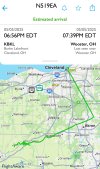
Looks like one of these went down yesterday evening. I don’t think I know the owner, but it was registered here locally.

IMG_7080.jpeg
 
That’s really sad.

His final course was REALLY erratic down there by Polk. Wonder if he had a flight control malfunction or a medical issue.

Appears he stalled it at the end. 3,000 feet altitude down to 31 Kts ground speed then end of track as it started descending. Several high speed descents in the seconds before that as well.

 
Last edited:
That’s really sad.

His final course was REALLY erratic down there by Polk. Wonder if he had a flight control malfunction or a medical issue.

Appears he stalled it at the end. 3,000 feet altitude down to 31 Kts ground speed then end of track as it started descending. Several high speed descents in the seconds before that as well.


Weather in the area was really nasty at the time he went down, with a line of severe thunderstorms spanning east - west and multiple tornado warnings.


Sent from my iPhone using Tapatalk
 
That’s really sad.

His final course was REALLY erratic down there by Polk. Wonder if he had a flight control malfunction or a medical issue.

Appears he stalled it at the end. 3,000 feet altitude down to 31 Kts ground speed then end of track as it started descending. Several high speed descents in the seconds before that as well.

The weather was reported to be severe thunderstorm/tornado warnings. Looking at the horizontal path as the vertical profile, looks like he was caught in an updraft and was a passenger at that point. VFR pilot in conditions no one should have been flying in. Sad.

Edit- @Yellowbird beat me to the punch.
 
I didn't see the weather overlay. That starts to paint a clearer picture. As my son gets closer to finishing his PPL I already told him he's immediately getting 10 hours of hood time and 10 hours on the home sim and a lot of review of accidents like this as a primer to "thunderstorms will kill you". Lots of those accidents to draw from, no matter the final conclusion of this one. :(
 
I didn't see the weather overlay. That starts to paint a clearer picture. As my son gets closer to finishing his PPL I already told him he's immediately getting 10 hours of hood time and 10 hours on the home sim and a lot of review of accidents like this as a primer to "thunderstorms will kill you". Lots of those accidents to draw from, no matter the final conclusion of this one. :(
And...have him work towards an instrument rating. One thing my instructor did on a couple of occasions was to have me slow down to maneuvering speed in my 182 and cross through a cumulus cloud that was just beginning vertical development. It was impressive how the much updraft was present in the infant towering cumulus. We would only be in it for about 15-30 seconds but it impressed upon me to avoid any clouds with vertical development that I can't see through, no matter how benign they seem. I was once caught in an outflow boundary in IMC under dual instruction preparing for my checkride; that was a wild ride for about 2 minutes. How we got in that position is another story...one about standing my ground if something doesn't feel right.
 
Absolutely, he starts Florida Inst of Tech for a 2-year R-ATP program in August, although he's got all his first semester stuff done once he finishes his PPL this month or early next. They do some weird hybrid CSEL / Instrument curriculum over two semesters (probably for time building purposes) but I'll make sure he starts with a bunch of instrument time just in case.

Good example there of good instruction, however you got in that position. That said my favorite word is "No". I may phrase it differently based on the scenario but I can't count how many times I've simply told ATC or someone else "No" or "Unable".

The most fun one was with Asheville departure trying to point me in an old E-series Bonanza directly at the tallest point on the Eastern Seaboard and saying "Just out-climb it but you can't turn right there's military aircraft there". I did turn right and he of course yelled at me to call them when I got on the ground. I did turn right, cited "safety of flight for the tapes" and they did NOT like it. I was very direct and told the *I* was calling the FAA for gross negligence for the tower controllers to even let me depart knowing I couldn't fly my cleared route with those aircraft inbound and nowhere else to go.

The FAA got a chuckle out of it since I had pictures of the massive thunderstorm the only other exit vector, my plane, my location, and after listening to the tapes. I don't tolerate stupidity well and it showed. Never heard another word. Stand your ground. Always. They're in the comfy chair.
 
10hrs of extra hood time is almost 1/3 of the time for an IR at a141 program. If your gonna invest that much effort might as well go full Monty at that point and he’ll be better pilot for it.
 
10hrs of extra hood time is almost 1/3 of the time for an IR at a141 program. If your gonna invest that much effort might as well go full Monty at that point and he’ll be better pilot for it.
He's starting a 141 program, but I agree for sure about the instrument rating. I've been instructing since 1990 and after all the crashes over the years making sure people have at least a chunk of instrument time if not their instrument rating has been a big personal thing for me for a long while.
 
He's starting a 141 program, but I agree for sure about the instrument rating. I've been instructing since 1990 and after all the crashes over the years making sure people have at least a chunk of instrument time if not their instrument rating has been a big personal thing for me for a long while.
I’d like to talk to you about what you’ve discovered about these Richard, but can’t seem to pm you. Curtis. 775-722-6342
 
For anyone interested this appears to be a youtube video by Kristen Rose:
 
I know this is an older thread, but I am considering buying one and would really appreciate talking with some of those experienced with these. Please get in contact if youre willing to chat about them. thanks Curtis 775-722-6342
PS...I haven't figured how to PM anyone here
 
I didn't see the weather overlay. That starts to paint a clearer picture. As my son gets closer to finishing his PPL I already told him he's immediately getting 10 hours of hood time and 10 hours on the home sim and a lot of review of accidents like this as a primer to "thunderstorms will kill you". Lots of those accidents to draw from, no matter the final conclusion of this one. :(
I think that is a great idea!
However as a quite seasoned pilot and current airline captain, I wish some of these new guys had more seat of the pants flying skills as well.....for example for the first many of hours of instruction I used to give in the 80's I put my coat over the instruments and had my new students learn to listen, to the air flow and the engine and look at the horizon and learn to fly, stall, slow flight, land, take off etc. without the need for instruments. Now it seems we crank out button pushers and train them to fly bomber patterns that theyd never make it to the runway if the engine quit. And good crosswind skills are often lacking.
 
PS...I haven't figured how to PM anyone here
Not sure but it might require getting to a minimum of 5 posts or something like. In any event within a few more posts you should gain full site functionality.
 
Back
Top