Disappearing brake fluid

Gone Flyin

Pre-takeoff checklist
Joined
Nov 30, 2020
Messages
147
Display Name
Gone Flyin
My Cessna 150M has the right brake pedal going to the floor, again. I see no fluid anywhere and I'm thinking the issue is in the brake cylinder for that side.

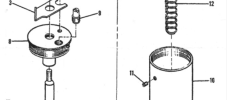
What I think might be happening is the fluid in the reservoir is bypassing the rubber O ring, #18 in the diagram, and moving up into the top of the cylinder when the pedal is pressed.

Can anyone confirm this is a possibility or offer some other ideas?
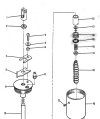
brake cylinder.jpg
 
Did you actually verify fluid is disappearing?

Suggest clean caliper and put white pad underneath and let sit to see if a

leak.

Repeat with brake ON.

Vented plug#9?

Seals bypassing can be the issue but diagnose first?
 
Is the fluid level in the reservoir going down? I get the impression that it is not? That would tell you if the problem i disappearing fluid or an internal leak in the master cylinder(s). Does the pedal go down on both sides?
 
Did a full brake service on both sides 2 months ago and plane has not moved.
What does this mean? Were the master cylinders opened up and overhauled?

If not, here's a tip that will save you time and money: go to ebay aviation and get yourself a new-to-you set of master cylinders. Get new flex hoses made up. While you're at it, check the pedals; see if they have bushings or not.

This is one time I wish I had just used the parts shotgun instead of trying to do things incrementally:
www.pilotsofamerica.com/community/threads/chronically-dragging-brakes.125814/

Oderwise ist easy to think "I probably just need the $10 overhaul kit with washers and orings!" until you find der springenwerk ist geschnappen and your "flex" hoses (the ones inside, too) are as stiff as rebar.
 
My Cessna 150M has the right brake pedal going to the floor, again. I see no fluid anywhere and I'm thinking the issue is in the brake cylinder for that side.

What I think might be happening is the fluid in the reservoir is bypassing the rubber O ring, #18 in the diagram, and moving up into the top of the cylinder when the pedal is pressed.

Can anyone confirm this is a possibility or offer some other ideas?

View attachment 152168
#17 in your parts diagram is a washer. The un-numbered thing underneath it is a tiny o-ring. Those two pieces come as an assembly called a Lock-O-Seal. It acts as a reservoir shutoff when the pedal is depressed so that pressure can be built up. If the nut #14 is not adjusted as per service manual that tiny o-ring can jump out of the washer and now the pedal is dead. I have also found that nut wound up tight so that pressure would not relieve when the fluid got hot and expanded. Dragging brakes, then.
 
#17 in your parts diagram is a washer. The un-numbered thing underneath it is a tiny o-ring. Those two pieces come as an assembly called a Lock-O-Seal. It acts as a reservoir shutoff when the pedal is depressed so that pressure can be built up. If the nut #14 is not adjusted as per service manual that tiny o-ring can jump out of the washer and now the pedal is dead. I have also found that nut wound up tight so that pressure would not relieve when the fluid got hot and expanded. Dragging brakes, then.
My IA is coming by today and I will run all this by him. Thanks for all the suggesitons.
 
What does this mean? Were the master cylinders opened up and overhauled?
No, I meant the calipers were removed, cleaned and new seals installed. Then brake fluid was replaced. The cylinders have not been touched in the 5 years I've had the plane. Maybe never, I'd have to go back into the logs.
 
Is the fluid level in the reservoir going down? I get the impression that it is not? That would tell you if the problem i disappearing fluid or an internal leak in the master cylinder(s). Does the pedal go down on both sides?
I do not know for sure but since I find no fluid on the floor I assume the latter.
 
My Cessna 150M has the right brake pedal going to the floor, again.

No, I meant the calipers were removed, cleaned and new seals installed. Then brake fluid was replaced. The cylinders have not been touched in the 5 years I've had the plane. Maybe never, I'd have to go back into the logs.
Assuming you are not loosing fluid, the level is the same, then my out of the box suggestion is improper bleeding. Air in the lines after they drained and refilled the brake fluid would cause this symptom.

My initial hunch is a however you just have a bad master that needs to be cleaned and new seals installed.


Assuming you are not loosing fluid, the level is the same, then my out of the box suggestion is improper bleeding. Air in the lines after they drained and refilled the brake fluid would cause this symptom.
Those systems need to be bled from the bottom up. There is too much height difference between the masters and calipers to easily get the air out.
 
  • Like
Reactions: WDD
My initial hunch is a however you just have a bad master that needs to be cleaned and new seals installed.
That was my hunch too. So you spend the $17. Then, assuming you are able to find an A&P willing to O/H your master cylinders (GLWT, btw), you may open them up and find them full of used pinball machine parts and/or damaged and/or just totally wrong, and then you have to replace them anyway.

The way to mitigate this risk is to show up with known good parts that can be dropped in; then you can deal with getting the cores overhauled separately, and you move an entire system from the "unknown/sketchy" column into the "good for the next 20 years" column.
 
  • Like
Reactions: WDD
That was my hunch too. So you spend the $17. Then, assuming you are able to find an A&P willing to O/H your master cylinders (GLWT, btw), you may open them up and find them full of used pinball machine parts and/or damaged and/or just totally wrong, and then you have to replace them anyway.

The way to mitigate this risk is to show up with known good parts that can be dropped in; then you can deal with getting the cores overhauled separately, and you move an entire system from the "unknown/sketchy" column into the "good for the next 20 years" column.
But make sure that the A&P has the service manual and follows it. These masters are not intuitive and the stuff has to go together exactly as shown and described, or the system acts up or won't work. More money down the hole for no good reason.

The later version of that cylinder used a different, simpler internal arrangement that got rid of the tiny bits inside it. The parts are not interchangeable.
 
If you don’t have it already, get a copy of the maintenance/service manual. It might be a PDF download and you take it to kinkos to get a hard copy printed. Size of a phone book, but very valuable for plane ownership.


Side note: Few people today know what a phone book was……
 
Or a Kinkos, since they have been gone for two decades. ;)
I remember Kinkos, but also a song on the Dr. Demento show: "Kinko, Kinko, the kid loving clown. The parents want to lock me up and throw me out of town!"
 
I agree with Dan on “ bottom up” bleeding.

Couple hints:

Before connecting fluid source wipe dirt off bleeder fitting; then open

slightly and tap brake to purge any dirt in the fitting.

You can bleed up w/o removing the Filler Plugs. Best with an observer

though.Put a rag over plugs or you’ll have 5606 on radios!

If you pull Filler Plugs I suggest you put rags around the cylinders to

prevent the plugs from dropping down below. If you do drop one it’s likely

you’ll find others there.
 
If you don’t have it already, get a copy of the maintenance/service manual. It might be a PDF download and you take it to kinkos to get a hard copy printed. Size of a phone book, but very valuable for plane ownership.


Side note: Few people today know what a phone book was……
Remember the movie the Jerk?
I agree with Dan on “ bottom up” bleeding.

Couple hints:

Before connecting fluid source wipe dirt off bleeder fitting; then open

slightly and tap brake to purge any dirt in the fitting.

You can bleed up w/o removing the Filler Plugs. Best with an observer

though.Put a rag over plugs or you’ll have 5606 on radios!

If you pull Filler Plugs I suggest you put rags around the cylinders to

prevent the plugs from dropping down below. If you do drop one it’s likely

you’ll find others there.
I removed the vent plug in the master, screwed this barbed fitting into the master cyl. I didn't spill a drop inside the plane when I flushed my brake system.
67eb56f1-43d2-4d1e-8807-a32ff3f40fb2.jpg

ddbcf144-328a-4cc8-9cc5-e43c4bc46b32.jpg

0e7f2fa1-bbd0-491e-b56e-efe8a8f01c47.jpg
 
Brakes need to be bleed - mushy as you start pushing - you can often "pump them up" - give the pedal a few quick pumps and the feel should improve.
Leak somewhere - Solid as you first push, but pedal slowly goes down (Usually. A big leak will let the pedal go right to the floor)
Not enough fluid in the reservoir - feels like it needs to be bleed - start by checking before you do anything else.
Leak at a wheel cylinder - eventually you will see fluid near the wheel - but that doesn't happen right away, fluid can stay in a puddle in the wheel - can take fair amount of fluid leaking before it makes a puddle on the floor.
 
The fluid in the reservoir needs to be checked at regular intervals.

A good pedal is not indicative of fluid level if it is above a minimum.

As brake pads wear the level in the reservoir will drop. If the level

has not been maintained the brake will be soft or fail.
 
The fluid in the reservoir needs to be checked at regular intervals.

A good pedal is not indicative of fluid level if it is above a minimum.

As brake pads wear the level in the reservoir will drop. If the level

has not been maintained the brake will be soft or fail.
If you top off the brake fluid during use, then won't it over flow when you press the caliber pistons back in during brake pad replacement?
 
If you top off the brake fluid during use, then won't it over flow when you press the caliber pistons back in during brake pad replacement?
Yup. So one needs to check the level first, and let some out of the caliper if it's too high. I made a tiny dipstick out of aluminum, scuffed it up to make it dull, used that to gauge the level through the filler hole in the master.
 
I removed the vent plug in the master, screwed this barbed fitting into the master cyl. I didn't spill a drop inside the plane when I flushed my brake system.
That doesn't always do the trick. The cap of that master has no seal on it and it can leak fluid. BTDT.

1779482586795.png

The cap screws into the cylinder, and the setscrew #11 locks it. No seal. They should have machined a seal land above the threads in the cylinder, and an O-ring groove in the cap just under the top flange. There is also no seal around the pushrod where it passes through the cap.
 
I agree with Dan on “ bottom up” bleeding.

Couple hints:
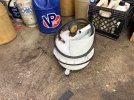
Well, my AI has this very old bottom up brake bleeding tank.

IMG_2576.jpg

He fills it up to 40lbs PSI with an air compressor.

Connects it to the bleeder valve. Done in just a few seconds.

Right now the right brake is perfect. Still holding after 24 hours. I'll check again in a day or so. Maybe that will be that, we shall see.
 
Last edited:
Another trick to chase any remaining bubbles out is to keep pressure on the break pedal overnight. Can’t tell you exactly how it works, but worked like a charm on my motorcycle.
 
Last edited:
Well, my AI has this very old bottom up brake bleeding tank.

View attachment 152218

He fills it up to 40lbs PSI with an air compressor.

Connects it to the bleeder valve. Done in just a few seconds.

Right now the right brake is perfect. Still holding after 24 hours. I'll check again in a day or so. Maybe that will be that, we shall see.
I have been using this brake fluid pressure bleeder since 1980 or so.
Not on aircraft but cars and light trucks. It has a diaphragm to separate the air pressure and the brake fluid, since brake fluid is hydroscopic.
I have overhauled this pressure bleeder 4 times in the last 40 years. I just did it again last year. Inspect the diaphragm, strip, repaint, replace the hardware, hose and connectors.
I have a 40 year collection of master cylinder adaptors to pressure bleed from the master cylinder to the wheel cylinders.

40 psi is high, typically I use 10-20 psi to pressure bleed brake lines and calibers.

I don't see a diaphragm in your mechanics pressure bleeder. I bet I am missing something and looking to learn. Not criticize.
IMG_6681.jpeg
IMG_6680.jpegIMG_6679.jpeg
 
Last edited:
I don't see a diaphragm in your mechanics pressure bleeder. I bet I am missing something and looking to learn. Not criticize.
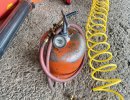
The 5606 used in aircraft brakes isn't hygroscopic. Air pressure on it is no big deal. It's basically just refined mineral oil. I used an old 20-pound propane tank as a bleeder tank for 5606.

Now, if one put lots of pressure on it for several hours, you might get air dissolving in it, causing foaming as the pressure came off. But at 20 psi or so for the time it took to bleed the brakes it was never a problem.
 
I just use a pump oil can to fill from the bottom.
 
I just use a pump oil can to fill from the bottom.
Done that, too, on the Cessnas. But on the Pipers, especially the retracts, there are so many high spots in the lines that you can't get the air out unless you get that fluid flowing real good.
 
Can't vouch for your plane, but in mine when I used to keep it in an unheated space, when we had temperature changes in the spring and fall, I'd end up having to top the fluids up a lot. (Navions have hydraulic flaps and gear).
Had the same issue with the clutch in my old Nissan.
 
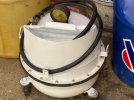
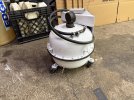
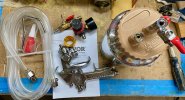
I'm looking to build one from a paint pressure pot. Have one on order from Ebay for $45.

I have a way to secure the hose to the bleeder fitting and not have to hand hold it, which will make it easy for one person to do it.
Will share my design, here.
 
Here is the kit as it comes from Ebay.

IMG_2629.jpg

After I removed what I will not need for this project, here is what's left.

IMG_2631.jpg

There are a few more parts I will need to add...
 
Good news and bad news. And even the bad news is good news.

The law of “I’ll buy this special tool”. Once you do, the problem will go away and you’ll never see it again. But.. “the problem will go away and you’ll never see it again” is also the good news. :cool:
 
Good news and bad news. And even the bad news is good news.

The law of “I’ll buy this special tool”. Once you do, the problem will go away and you’ll never see it again. But.. “the problem will go away and you’ll never see it again” is also the good news. :cool:
I've had to bleed my brakes several times. Replaced the shoes, replaced the caliper seals, etc. This will get used and... I'll have lots more friends now at the hangar.
 
Why does the instruction pamphlet state "Powder Coating Machine?"
 
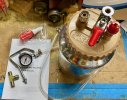
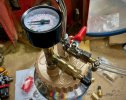
Added the needed fittings.

Think this arrangement works best with the pressure gauge facing up so you can see it as you fill via the Schrader valve right underneath it. I'll start off with the 20lbs someone suggested is sufficient.

Now to work on the bleeder end.

IMG_2644.jpg
 
I can add one more suggestion from someone that has dealt with several c172 brake issues ... there are a couple of inspection plates on the belly below the brake pedal area and aft near struts.. open them up and feel around for fluid...if there is it could be from over servicing fluid, or spilled while filling, or a external leak under floor. if u find any, clean it up then recheck periodically or if brakes go soft again.
 
Back
Top