Conflicted. Would you report?

  • Thread starter Thread starter Report it?
  • Start date Start date
Ed H - I may send you a PM. You and I are somewhat aquatinted here on POH and I value your acro experience.

Sounds good, happy to talk off line.

Here is a thread I posted a year ago about my traffic concerns flying acro near class B.

 
Acro under a class B shelf is legal, but as a bunch of airways usually converge at B airports and their satellite fields, finding a place not within 4 miles of one of those airways might be problematic. Not to mention the ground congestion usually found around cities large enough to warrant a class B.
 
Acro under a class B shelf is legal, but as a bunch of airways usually converge at B airports and their satellite fields, finding a place not within 4 miles of one of those airways might be problematic. Not to mention the ground congestion usually found around cities large enough to warrant a class B.

Agreed on all. But take a look at the map I posted at the end of the other thread linked above. The red box is under Bravo, >4nm from all airways, and over a remote area. Literally uninhabitable; it is a toxic settlement pond for mining.
 
IDK some pilots get hissy fit if you get within a mile of them. Then you got something like a Sun N Fun where everyone it head to butt by merely 500 feet apart and it's all cool. OP did you die?
 
Agreed on all. But take a look at the map I posted at the end of the other thread linked above. The red box is under Bravo, >4nm from all airways, and over a remote area. Literally uninhabitable; it is a toxic settlement pond for mining.
That is a small playground you play in
 
I spent some time chatting with the OP looking about the specifics of the location. It's pretty tight. However, I think from a FAR perspective, this particular acro pilot found a little patch of ground and airspace that works. As long as he stays in his box, I think he's legal.

Safety is a different question. I don't know enough about instrument approaches and local traffic flows to consider whether that location is smart or stupid.

But as far as the FAA is concerned, IMO there is nothing to report.
 
OP - last call. In the immediate aftermath, I lacked the perfect vocabulary to describe what I was looking for. I turned to a forum that I trust. That’s why we communicate. To process and learn.

I posted anonymously in consideration of the other pilot. I was trying to process and learn, not blame. A thanks to this community for some helpful education and improvement of my SA. No, bonefish, I did not die. No mandm, I was not excited to see an ejection handle pulled.

The acro was diving from within the class B shelf and climbed back into it in the roll. Something which I thought was prohibited. They were also flying in an area where there is a published and active STAR, which I thought fell into the definition of Airway and would also be prohibited. Always expect the unexpected…but I would have told you I would be more likely to meet Elvis, than to have an acro near miss where I did.

The bottom line is it was less about them, and more about me being VERY surprised up there because I encountered something that I did not expect. I don’t like surprises. I did not expect it because I had a blind spot from thinking that I knew and understood the regs. A good ILAFFT moment.

Lessons learned or re-enforced:

• Acro flight is not prohibited in or beneath a class B as I previously believed.
• The definition of Airway applies only to radio navigation corridors, not inclusive of SID, STAR and other published RNAV procedures. I knew that, but my mindset has shifted so heavily to GPS navigation that my thinking about the regs morphed. Good reminder of what happens when you assume.
• ADSB is not perfect, and certainly not reliable for spotting or alerting to Acro flight. Eyes out, always.
• We have many areas of regulation that are subject to interpretation. Congested area being one of them. Talking to pilots who do different types of flying from you increases your SA.
• Acro pilots have very limited spaces they can fly - and those spaces may not be where you expect. In this case, a little green island in a sea of suburban sprawl.
• Always expect the unexpected.
 
That is a small playground you play in

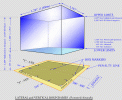
The IAC competition box is small. Basically a 3000 foot cube. A key objective of practice is staying in the box, and refining positioning within the box to best present your figures to the judges.

Aerobatic Box.gif


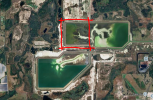
The key to practice is finding some ground landmarks that approximate box dimensions. A runway is best if you can find it, because then you can stay aligned on the X axis, and you can have someone spot from the judges' box. Our runway is too close to two federal airways, but there is a square lake at a mine about 5 miles away that perfectly matches the box footprint.

box lake.PNG
 
One reason for a waivered area IS because you are less than 4 miles from an airway. My home field has a box over it for this reason. In this case, the bottom of the waivered airspace is 1500 feet AGL, which puts it 600 feet above pattern altitude. But right at the altitude of someone crossing over to enter the pattern at 2000 MSL.
 
The key to practice is finding some ground landmarks that approximate box dimensions. A runway is best if you can find it, because then you can stay aligned on the X axis, and you can have someone spot from the judges' box. Our runway is too close to two federal airways, but there is a square lake at a mine about 5 miles away that perfectly matches the box footprint.
You could apply for a waivered airspace over the airport.
 
IDK some pilots get hissy fit if you get within a mile of them. Then you got something like a Sun N Fun where everyone it head to butt by merely 500 feet apart and it's all cool. OP did you die?

The only thing I worry about being within 2 miles of, a nuclear bomb detonation and one particular ex-girlfriend. I might choose vaporization by nuke over her.
 
Last edited:
Sounds like it was a practice guns run. Must have been pucker inducing. I have nothing to add here. But one time I flew with an instructor who wanted me at least 500 below the bravo shelf. He was a retired airline guy and told me that being too close to the shelf can cause an RA for someone in the Bravo. I did what he wanted for that flight.
 
The IAC competition box is small. Basically a 3000 foot cube. A key objective of practice is staying in the box, and refining positioning within the box to best present your figures to the judges.

View attachment 140158


The key to practice is finding some ground landmarks that approximate box dimensions. A runway is best if you can find it, because then you can stay aligned on the X axis, and you can have someone spot from the judges' box. Our runway is too close to two federal airways, but there is a square lake at a mine about 5 miles away that perfectly matches the box footprint.

View attachment 140159
I looked at your box from the link you posted. Was unaware of the competition box. So that makes sense now. Appreciate how the faa interprets class b surface area as I thought but meant lateral limits. I didn't report my rv4 neighbor as I'm clearly not familiar with acro regs. There wasn't anyone in the pattern after all and I didn't think it was unsafe. Was more miffed at him parking the car well beyond the hold short line on the taxiway to the ramp.

That said, if I was a revenue pilot like he was. I'm not sure I'd be tempting fate with low level aerobatics near a populated area.
 
Was messing around yesterday under the Bravo and rolled inverted for about 30 seconds. When I rolled upright, there was a C-130 in my windshield. He was 1500' above me and on reciprocal heading. He passed right over my head. Even at 1500' a C-130 looks pretty big.
 
Greetings from Europe! I completely understand your hesitation—it's a universal pilot dilemma, no matter which side of the pond you're flying on.

Over here under EASA rules, we talk a lot about the concept of 'Just Culture' and non-punitive reporting for this exact reason. From a Safety Management (SMS) perspective, the question I always ask myself is: 'If I don't report this, is the next guy going to face the exact same hazard and maybe not be as lucky?' I know you guys have the NASA ASRS system in the US, which seems perfectly designed for this kind of scenario. It feeds valuable data into the system so the community can learn from the risk, without you having to play the 'aviation police' calling the FSDO.

Glad you and everyone else are safe. Good decision-making!
 
Over here under EASA rules, we talk a lot about the concept of 'Just Culture' and non-punitive reporting for this exact reason. From a Safety Management (SMS) perspective, the question I always ask myself is: 'If I don't report this, is the next guy going to face the exact same hazard and maybe not be as lucky?' I know you guys have the NASA ASRS system in the US, which seems perfectly designed for this kind of scenario. It feeds valuable data into the system so the community can learn from the risk, without you having to play the 'aviation police' calling the FSDO.
I'm a big fan of SMS, having used it not only as a pilot but as the Director of Safety receiving the reports. ASRS is somewhat like an SMS... Unfortunately, it seems that most people are told/trained that it's really only there for when you screw up inadvertently and need to protect your certificate, so it's not used nearly as much as it could be.

Also, in a situation such as in the original post, it wouldn't fix the problem, as long as the problem was actually an aerobatic pilot doing something illegal. If the pilot wasn't doing anything illegal, if there were enough reports maybe the FAA would place additional restrictions on aerobatics near cities or airports or whatever, but who wants more restrictions? Really, I think the OP wants the pilot they encountered to consider their surroundings and fly in such a way as to not be a danger to others entering the pattern.
 
Back
Top