Confessions of a new CFI

This may be aviation heresy, but I didn't find Langewiesche transformative. FWIW, I'm also a B.S. in mechanical/aerospace engineering, though not nearly the voracious reader OP's student seems to be (nor left-handed). Maybe he and I are distant cousins in that regard.

If we're doing heresies, I couldn't get past page 3 of "Fate is the Hunter" despite being told by several pilots it was written on stone tablets and brought down from the mount.

I'm an engineer and try to over-prepare for upcoming challenges like OP's student, but giving them the JO is mean (funny, but mean) :D -- I'd have had them study something practical like Say Again, Please or maybe one of Sparky Imeson's mountain flying books to trigger discussions about radio comms scenarios, *air* dynamics instead of aerodynamics, and get them thinking that the plan can change and one needs to be flexible and ready.

Still, glad to see an engaged CFI instead of the usual time-building heroes out there. Kudos. :)
 
I fell asleep during One Six Right. I'd call it garbage, but at least garbage can be recycled into something useful.
 
Why not strive to fly maneuvers as precisely as possible and master them beyond the ACS standards? I can think of 2 reasons one might want to. First, fun, curiosity and personal satisfaction. The second is more pragmatic. During a checkride you shouldn't depend on your best performance, but only your average. A pilot who can barely fly them to ACS standards is risking a failure. If you can get your steep turns or lazy 8s to +/- 50 feet or even better, you give yourself a margin. You're got the skills to meet the standard even on a bad day, not just on your best or average day.
I wonder why the PPL and Commercial ACS steep turns have the same +/-100ft limit. I mean you are a professional pilot but you still get 200ft of wiggle room? PREPOSTEROUS!!!! 1mm tolerance or you do not deserve the title 'commercial' pilot. Also the ACS says the roll to 'approximately 50 degrees'. How to you master approximately?

Its things like this that reinforce my belief that most CFIs are just bad at 'I'-ing.

Its one thing for a person to train to a higher standard. Its another thing for a CFI to hold back a student becuase THEY thing the ACS is to loosy goosey.

If a student can perfrom the ACS standard (again, it not a minimum. That's just symantics) then a CFI should not hold them up and move on to the next training item
 
Last edited:
Why not strive to fly maneuvers as precisely as possible and master them beyond the ACS standards? I can think of 2 reasons one might want to. First, fun, curiosity and personal satisfaction. The second is more pragmatic. During a checkride you shouldn't depend on your best performance, but only your average. A pilot who can barely fly them to ACS standards is risking a failure. If you can get your steep turns or lazy 8s to +/- 50 feet or even better, you give yourself a margin. You're got the skills to meet the standard even on a bad day, not just on your best or average day.
because, unless @pfarber is playing "word games," he's saying you shouldn't. You should strive for a pass; anything more is silly.

Sorry, but that's what you sound like to me.

Its one thing for a person to train to a higher standard. Its another thing for a CFI to hold back a student becuase THEY thing the ACS is to loosy goosey.

I have absolutely no idea how you got to CFIs holding students back from the statements that the ACS sets a minimum standard for passing a checkride.
 
Last edited:
1mm, huh. I suppose the ATP tolerances in a pfarber world are what, a gnat's eyelash? 3 atoms? 1.25 quarks?

I think the message may have been lost in the hyperbole :)
 
1mm, huh. I suppose the ATP tolerances in a pfarber world are what, a gnat's eyelash? 3 atoms? 1.25 quarks?

I think the message may have been lost in the hyperbole :)
When at least part of the argument is based on somebody being wrong for saying something they didn’t say, it tends to go that way.
 
I'm sorry, but I can't resist...

"As previously discussed, the ACS and PTS require an applicant seeking a certificate or rating to complete specific tasks and maneuvers to a minimum prescribed standard to obtain the applicable certificate or rating."​

– Final Rule, Airman Certification Standards​
and Practical Test Standards for Airmen; ​
Incorporation by Reference​
89 FR 22482 (April 1, 2024)​
 
Right now I have him reading the FAA JO Order 7110, since he has already studied everything he can at this point.

What part of the ACS requires understanding the math of reading FAA JOs?
You did not read and understand the quote I put above that. He had already read and mastered everything else, Some people are like that and have an enormous appetite for more, and so you give it to them. It will vastly improve their skills and understanding. They are the opposite of the folks that just want to barely squueze past the written test and refuse to study any more than they absolutely have to. Within a year of getting their PPL, they've forgotten half of the critical stuff they "learned." They're dangerous.
Your job is to teach the ACS to a level of proficiency to pass the check ride and get the Private pilot certification.
No. Training to check standards is not giving the student value for money and time, especially if he wants to fly commercially someday. Most employers don't want the marginal pilot; they want the best they can get. Our flight school trained to standards far above the government minima, and they easily got the jobs they wanted and did well in them.

Would you want to be operated on by a surgeon that graduated at the bottom of his class? Just barely passed the written and practical exams?

No, it represents the STANDARD.
The standard is a legal minimum. Can't you see that?
You’re playing word games. The performance of maneuvers is pass/fail. You can’t do steep turns more better (get an A+ ) that negates a Deficiency in say turns around a point.
You can pass the steep turn test within the tolerances, or you can nail that altitude and airspeed and be far more skilled and safer pilot. If you can't nail altitudes and airspeeds, you get into trouble on approach and landing. Way too many PPLs can barely get that airplane down without bending it. When they start IFR training they have to learn to fly all over again.
 
I'm sorry, but I can't resist...

"As previously discussed, the ACS and PTS require an applicant seeking a certificate or rating to complete specific tasks and maneuvers to a minimum prescribed standard to obtain the applicable certificate or rating."​
​
– Final Rule, Airman Certification Standards​
and Practical Test Standards for Airmen; ​
Incorporation by Reference​
89 FR 22482 (April 1, 2024)​

Selective copypasta much? Here is the NEXT SENTANCE:

As such, if an applicant does not perform a task to the standard in the applicable ACS or PTS, the applicant cannot obtain the applicable certificate and rating.


Here is the full paragraph... for context:

While FAA did not originally consider the content of the ACS and PTS to contain regulatory requirements, as stated in the 2018 final rule,use of the ACS and PTS by the FAA impose requirements on all persons seeking an airman certificate or rating in parts 61, 63, and 65. As previously discussed, the ACS and PTS require an applicant seeking a certificate or rating to complete specific tasks and maneuvers to a minimum prescribed standard to obtain the applicable certificate or rating. As such, if an applicant does not perform a task to the standard in the applicable ACS or PTS, the applicant cannot obtain the applicable certificate and rating. Unsatisfactory performance results in a notice of disapproval and/or denial of the certificate or rating.

This is really just a lesson in poor choice of words. The inclusion of the word 'minimum' obfuscates the actual specific tolerances as laid out in the ACS.

Most ACS maneuvers have specific parameters. No one has made a case of how +/- 100ft altitude is a MINIMUM standard. There is no maximum, its pass / fail. In the PPL/SEL ACS maneuvers the word minimum is never used. There is ALWAYS a defined tolerance for performance numbers. The only glaring exception is that bank angles are 'approximate'... which further muddies the water... if you roll to 35, or 55 degress, is that 'approximately' 45? The FAA clearly set speed, heading and altitude STANDARDS (no, not minumums, but exact specific tolerances) but bank angles? Meh, we can't be bothered.

Can someone please show me, in the ACS, what the 'minimum' is for any in flight maneuver? WHats the magic number?

Next question: If a student can consistently perform the steep turn maneuver within the +/-100ft tolerance, should the CFI force them to keep practicing until they perform the manuever to the CFI's made up tolerance of +/- 25ft? This is the issue I have with CFIs. There is a CLEAR STANDARD of +/-100ft, not some made up CFI number becuase they think its better.
 
Last edited:
the ACS and PTS require an applicant seeking a certificate or rating to complete specific tasks and maneuvers to a minimum prescribed standard to obtain the applicable certificate or rating.
There it is. MINIMUM PRESCRIBED STANDARD. What is it about this that you don't get? It's a minimum, and nobody should be satisfied with minima. What woudl you think of a university student that spent four years achieving a 2.0 and being satisfied with that when he/she could have easily hit a 3.5 or better? Bottom of the class?
The only glaring exception is that bank angles are 'approximate'... which further muddies the water... if you roll to 35, or 55 degress, is that 'approximately' 45? The FAA clearly set speed, heading and altitude STANDARDS (no, not minumums, but exact specific tolerances) but bank angles? Meh, we can't be bothered.
Many training airplanes have VFR panels, and have no attitude indicator. The angle of bank therefore must be estimated by observing the horizon against the top of the panel or whatever. There has to be some tolerance there; not everyone is an engineer or draftsman that can pretty much nail a 45° angle visually.
Can someone please show me, in the ACS, what the 'minimum' is for any in flight maneuver? WHats the magic number?
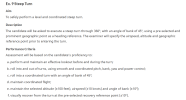
In Canada the Private Pilot Flight Test Guide has details on various maneuvers. In some cases the Guide refers you to the airplane's POH/AFM for the numbers, and tolerances are then applied to those numbers.

For steep turns, this is what it says:

1747885791833.png

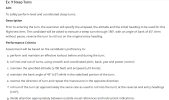
For the Commercial test, it's a bit more complicated and the angle of bank tolerance is tighter:

1747885927181.png
 
Next question: If a student can consistently perform the steep turn maneuver within the +/-100ft tolerance, should the CFI force them to keep practicing until they perform the manuever to the CFI's made up tolerance of +/- 25ft? This is the issue I have with CFIs. There is a CLEAR STANDARD of +/-100ft, not some made up CFI number becuase they think its better.
You are literally the only person in this thread who has even remotely suggested that. Are there bad CFIs out there? Sure, but they are more typically bad at their jobs generally and don’t know much above those standards either. I don’t doubt they might exist but I haven’t come across one who insisted, to use your example, “no solo until steep turns are within 2 feet.” Show a trainee how to do even better? Make the skill and knowledge connections between different tasks? Absolutely! Withhold progress until they do? No.

But thanks for confirming in your long post that it’s a set of minimum standards.

And I’m truly sorry you had such a horrible instructional experience. It must’ve been tough.
 
As such, if an applicant does not perform a task to the minimum prescribed standard in the applicable ACS or PTS, the applicant cannot obtain the applicable certificate and rating.


FIFY
 
Next question: If a student can consistently perform the steep turn maneuver within the +/-100ft tolerance, should the CFI force them to keep practicing until they perform the manuever to the CFI's made up tolerance of +/- 25ft? This is the issue I have with CFIs. There is a CLEAR STANDARD of +/-100ft, not some made up CFI number becuase they think its better.
There is no CFI out there "forcing" their student +/- 25ft. You should smack yourself for saying such a preposterous thing.
 
There is no CFI out there "forcing" their student +/- 25ft. You should smack yourself for saying such a preposterous thing.
I won't sign a student off for a check ride until they are consistently at 1/2 the tolerance for the maneuver.
 
Can someone please show me, in the ACS, what the 'minimum' is for any in flight maneuver? WHats the magic number?
Magic minimum numbers. A few excerpts of details from the Canadian PPL flight test guide:

All of the flight test items required by the flight test report and described in this guide must be completed and the minimum pass mark for the Private Pilot Licence of 62 (50%) must be achieved.

Provided that the applicable pass mark has been achieved, there are no more than two failed air flight test items and there are no more than five (5) combined exercises assessed either a “1” and/or “2”, the skill requirement for licence issue may be met by completing a partial flight test of the item or items assessed “1”. A Letter of Recommendation for Retest must be signed by the holder of a valid Flight Instructor Rating who conducted the remedial training.

The candidate will be required to successfully perform the air item(s) assessed as “1” on the complete flight test. Flight test items not associated with the items(s) to be retested, but repeated for the purpose of the second flight, may be re-assessed as “1” if their aim is not achieved or safety is compromised.

The partial flight test must be completed within 30 days after the date of the failed test [408.18(2)]. No more than one partial flight test will be allowed for each complete flight test.


Errors​

Error: means an action or inaction by the flight crew that leads to a variance from operational or flight crew intentions or expectations.

Minor Error​

A minor error is an action or inaction that is inconsequential to the completion of a task, procedure or manoeuvre, even if certain elements of the performance vary from the recommended best practices.

Major Error​

A major error is an action or inaction that can lead to an undesired aircraft state or a reduced safety margin, if improperly managed; or an error that does not lead to a safety risk, but detracts measurably from the successful achievement of the defined aim of a sequence/item:

Critical Error​

A critical error is an action, inaction that is mismanaged and consequently leads to an undesired aircraft state or compromises safety such as:

  • Non-compliance with CARS or non-adherence to mandated standard operating procedures;
  • Repeated improper error management or uncorrected and unrecognized threats that risk putting the aircraft in an undesired state; or
  • Repeated major errors or the non-performance of elements prescribed in the Performance Criteria* that are essential to achieving the Aim* of a test sequence/item.

Deviations​

Deviation: means a variance in precision with respect to a specified limit published for a test sequence/item, as a result of pilot error or faulty handing of the aircraft.

Minor Deviation​

A minor deviation is a deviation that does not exceed a specified limit:

Major Deviation​

A major deviation is a deviation that exceeds a specified limit or repeated minor deviations without achieving stability:

Critical Deviation​

A critical deviation is a major deviation that is repeated, excessive or not corrected, such as:

  • Repeated non-adherence to specified limits;
  • Not identifying and correcting major deviations; or
  • More than doubling the specified value of a limit.

4-Point Marking Scale​

When applying the 4-point scale, award the mark that best describes the weakest element(s) applicable to the candidate’s performance of the particular test sequence/item demonstrated.

4​
Performance is well executed considering existing conditions:
  • Aircraft handling is smooth and positive with a high level of precision.
  • Technical skills indicate a thorough knowledge of procedures, aircraft systems, limitations and performance characteristics.
  • Situational awareness is indicated by continuous anticipation and vigilance.
  • Flight management skills are exemplary and threats are consistently anticipated, recognized and well managed.
  • Safety margins are maintained through consistent and effective management of aircraft systems and mandated operational protocols.
3​
Performance is observed to include minor errors:
  • Aircraft handling with appropriate control input includes minor deviations.
  • Technical skills indicate an adequate knowledge of procedures, aircraft systems, limitations and performance characteristics to successfully complete the task.
  • Situational awareness is adequately maintained as candidate responds in a timely manner to cues and changes in the flight environment to maintain safety while achieving the aim of the sequence/item.
  • Flight management skills are effective. Threats are anticipated and errors are recognized and recovered.
  • Safety margins are maintained through effective use of aircraft systems and mandated operational protocols.
2​
Performance is observed to include major errors:
  • Aircraft handling is performed with major deviations and/or an occasional lack of stability, over/under control or abrupt control input.
  • Technical skills reveal deficiencies either in depth of knowledge or comprehension of procedures, aircraft systems, limitations and performance characteristics that do not prevent the successful completion of the task.
  • Situational awareness appears compromised as cues are missed or attended too late or the candidate takes more time than ideal to incorporate cues or changes into the operational plan.
  • Flight management skills are not consistent. Instrument displays, aircraft warnings or automation serve to avert an undesired aircraft state by prompting or remedying threats and errors that are noticed late.
  • Safety margins are not compromised, but poorly managed.
1​
Performance is observed to include critical errors or the Aim (objective) of the test sequence/item is not achieved:
  • Aircraft handling is performed with critical deviations and/or a lack of stability, rough use of controls or control of the aircraft is lost or in doubt.
  • Technical skills reveal unacceptable levels of depth of knowledge or comprehension of procedures, aircraft systems, limitations and performance characteristics that prevent a successful completion of the task.
  • Lapses in situational awareness occur due to a lack of appropriate scanning to maintain an accurate mental model of the situation or there is an inability to integrate the information available to develop and maintain an accurate mental model.
  • Flight management skills are ineffective, indecisive or noncompliant with mandated published procedures and/or corrective countermeasures are not effective or applied.
  • Safety margins are compromised or clearly reduced.

Lots of magic numbers there for you. The examiner assigns a number to the candidate's performance of each flight test item, adds them up, and sees if a score of 62 is achieved. If too many (more than 5) 1s and 2s show up, the exam is a total failure and must be repeated. Up to 5, partial retest is in order after remedial training.

If a total retest is required, that candidate should not have been signed off by the instructor for the exam in the first place.

https://tc.canada.ca/en/aviation/pu...private-pilot-licence-aeroplane-tp-13723e#g18

I imagine the FAA has a similar system.
 
Back to the OP, I was one of those students that would overthink and "overmath" everything, and I knew I'd be likely to do that going in. That was one of the reasons I wanted to learn tailwheel first, in a plane with fewer gauges. Fewer gauges = fewer distractions = faster to learn by feel. It worked pretty well. My overthinking and focusing on the wrong things was enough that even in a cub, to the point that the CFI sometimes blocked out all the dials except the skid ball on downwind. Learning to land just fine without airspeed or altimeter was helpful and I think it's good for everyone to learn that. Kind of like the inverse of foggles - your eyes are outside only.

Like another poster, I flew a lot of RC first, so I figured that would help in flight, and it did. Except that it didn't help much for landing. I really missed the outside view of the aircraft and clear distance above ground that you get from RC.
 
I really think I was getting close to breaking her of that, just ran out of time before I left :(
Had a career nearly retired operating room nurse… she’d analyze, say it looks like we’re slow and gonna stall, I should add power… is it ok if I add power?

Y e s

OP: Good for you catering to the way of the student. I think that’s the fun, what will it take for THIS person’s light to come on?
 
I'm willing to bet that a lot of people who start flight training have gone through life up until that point being very successful at what they've done, and were able to prepare for most new challenges mentally so that it was easy. Then they get the controls of the airplane, and suddenly they're not any better than anyone else at it, and it completely throws off their game. Sometimes they might look for an external thing to blame.

Guessing here...I figured out I wasn't special long before I started flying. (Well, maybe special in the riding the little bus sense...)
 
My opinion is that flying is taught like a science. Pitch and Power, Weight and balance, angle of attack, P-factor and E6B (slide rule) seem right out of engineering books. I’ve found it to be more of an art. Updrafts, Downdrafts, wind shear, Flaring, Cross-wind correction and ground effect. An engineer will attempt to calculate that. A pilot just does it.
 
Hello All!

Wanted to post a little update on my flying career so far. Last December is was bestowed the honor of being a flight instructor. Something that I genuinely enjoy as I love teaching and talking to people about airplanes. After moving around the country getting all of my ratings done *long story* I am finally settled into my place of employment as a CFI.

My first student is a Private Pilot candidate. He is an older gentleman, an engineer, who now has the time afforded to him to pursue his lifelong dream of flight after postponing it due to starting a family. When I say this guy is a brainiac, he really is. In fact I think he overthinks some of the material. I feel like I have to break out the (Di = CDi12ρV^2S =2L2ρSπAe1V^2) formula on explaining induced drag. He is a left handed person, and I can clearly see they think about flying from a completely scientific perspective. Right now I have him reading the FAA JO Order 7110, since he has already studied everything he can at this point. He is literally reading it without distraction as we speak.

I am looking forward to taking on many more students and get to ATP mins by this time next year!

As someone who looks at these topics from a similar engineering perspective, I’d recommend not dismissing these questions as irrelevant. It's natural for engineers to take a technical approach, but part of your job is guiding them in understanding what’s truly important and what can be overlooked. Using analogies can help clarify your point, and there’s no shame in admitting that you don’t have all the mathematical answers—just like a musician doesn’t need to know linear systems, wave propagation, or digital signal processing, and a cook doesn’t need to be versed in biochemistry, thermodynamics, or botany.
 
Hello All!

Wanted to post a little update on my flying career so far. Last December is was bestowed the honor of being a flight instructor. Something that I genuinely enjoy as I love teaching and talking to people about airplanes. After moving around the country getting all of my ratings done *long story* I am finally settled into my place of employment as a CFI.

My first student is a Private Pilot candidate. He is an older gentleman, an engineer, who now has the time afforded to him to pursue his lifelong dream of flight after postponing it due to starting a family. When I say this guy is a brainiac, he really is. In fact I think he overthinks some of the material. I feel like I have to break out the (Di = CDi12ρV^2S =2L2ρSπAe1V^2) formula on explaining induced drag. He is a left handed person, and I can clearly see they think about flying from a completely scientific perspective. Right now I have him reading the FAA JO Order 7110, since he has already studied everything he can at this point. He is literally reading it without distraction as we speak.

I am looking forward to taking on many more students and get to ATP mins by this time next year!
It has nothing to do with being left handed. He is an engineer. You have to convince him the instruments are indicators not micrometers.
 
I’d recommend not dismissing these questions as irrelevant.
yup…dismissing questions as irrelevant, quite frankly regardless of whether or not they ARE irrelevant, is one of the fastest ways to prove to someone that you’re a lousy instructor, again, regardless of how good or bad you actually are.
 
yup…dismissing questions as irrelevant, quite frankly regardless of whether or not they ARE irrelevant, is one of the fastest ways to prove to someone that you’re a lousy instructor, again, regardless of how good or bad you actually are.
Not doubt.

I had a couple way smart students. Whenever they brought this stuff up I would just shrug and tell them I could teach them how to fly the thing, not design it. I moved all the rabbit hole engineering conversations to a designated time after the lesson when I could have a cold coke and smoke. Learned a lot from those guys.

It seemed to work well. Kept the lesson priorities on the practical and reinforced the mindset that in the cockpit there was a limit to the benefits of analysis mode.
 
You added a word that didn't exist, how is that fixing anything?

It's just more of his usual ****ting on instructors drivel.
Because they deserve it. CFIs have an 80%+ failure rate. Students get their PPL because they have more cash than most CFI's have ability. I have CFI horror stories than I can tell for days. The CFI system sucks. How is it that 5&6 year Medical School students only have a 4-6% drop out rate, yet CFIs have 80%+ First time College students only have a ~30% drop out rate. Is flying harder than Med School? Or any run of the mill Uni? Air Traffic Controller trainies only have a 30% drop out rate.

Perhaps its becuase the CFIs are treuly, statisitcally, and objectively just trash. They are not the 'gatekeepers'. They are the problem.

Lets consider the USAF pilot trainee drop out rate is only 20%. So it can't be 'flying is hard'.

A few excerpts of details from the Canadian PPL flight test guide:
OP is a US CFI. I agree that in a few respects the Canadian system is a little better (esp regarding maintenance), but for this discussion only the FAA ACS matters.
 
How is it that 5&6 year Medical School students only have a 4-6% drop out rate, yet CFIs have 80%+ First time College students only have a ~30% drop out rate. Is flying harder than Med School? Or any run of the mill Uni? Air Traffic Controller trainies only have a 30% drop out rate.
In fairness, I think you're ignoring that medical school (and presumably ATC and many universities) have a weed-out process that begins before people even arrive. For Medicine in the USA, at least, a more apt comparison would see how many first-year "pre-med" college students subsequently make it to medical school graduation. I don't know the number myself, but I'd be willing to bet that 80%+ of "pre-med" students never end up becoming a physician, and most of them will never darken the doorway of a medical school (the drop-out rate once accepted is somewhere in the region you cite or even lower). Organic chemistry courses in particular are famous for ending that particular aspiration!

In contrast, anyone waving some cash in their hand can show up for flight training, irrespective of talent, motivation, time-commitment, or academic ability. This sets the stage for an inevitable high rate of attrition, because learning to fly (as you well know) involves both physical, mental, and academic commitment and ability. Perhaps a better comparison would be the number of students declared ready by their CFIs compared to the pass rate from DPEs. Were I looking for a quality assessment, that would be my focus. Indeed, I've heard some DPEs lamenting that the quality of student applicants has fallen over time, so there may be some issue with instructional quality (or student quality, for that matter), but I'm not sure we can lay the attrition rate itself at the feet of CFIs.
 
Indeed, I've heard some DPEs lamenting that the quality of student applicants has fallen over time, so there may be some issue with instructional quality (or student quality, for that matter), but I'm not sure we can lay the attrition rate itself at the feet of CFIs.
I'm wondering where this oft cited 20% failure rate is coming from? Puppy mills? For-profit schools? Students taking out loans to attend U programs?

I was well prepared by the CFIs at my first club (-G) and flight school (-ASEL). On the < - interested - - fascinated - - obsessed - > spectrum, I am right of center. And, because I was always waiting on the calendar, I was always over minimums and ready. But, I did not know anyone I was in the club, or school, with who did not pass the Private first time.

I certainly have heard, not from DPEs or CFIs but from some of the older and more experienced pilots, that in their opinion, those around my age tend to lack focus and dedication to anything that involves delayed gratification. That people expect "easy" and society "dumbs it down" to accommodate. So, perhaps those of us who sought out an individualized path, rather than taking an overpriced, all-inclusive, everything all choreographed for you in advance route were somewhat self-selecting.
 
I certainly have heard, not from DPEs or CFIs but from some of the older and more experienced pilots, that in their opinion, those around my age tend to lack focus and dedication to anything that involves delayed gratification
That's just the standard whining about the younger generation that's probably older than Socrates' famous quote about it.

I think @AvNavCom has the right answer. Many dream of or are attracted to the idea flying but it's not for everyone. Nothing to do with age. So they try and ultimately quit.

I don't do certificate/rating training anymore but I do get rusty pilots. In some cases, even after a long layoff, the basic mindset is there and skills only need a few tweaks (refreshing and updating knowledge and transition to new avionics are much bigger deals). At the opposite end, there are those for whom it's like they've never even taxied an airplane before and one wonders how they ever earned their certificate to begin with.

One of my friends decided to do a free private pilot ground school. More than half the class quit after they learned they would not receive a pilot certificate at the end of the ground course.
 
Because they deserve it. CFIs have an 80%+ failure rate. Students get their PPL because they have more cash than most CFI's have ability. I have CFI horror stories than I can tell for days. The CFI system sucks.
What is that 80% failure rate based on? Are 80% of the aspiring CFIs failing their training and not achieving their ratings? Or are 80% of licensed CFIs moving on to commercial or ATP flying once they have the hours to qualify? Instructing is a common way for a pilot to accumulate hours toward a much better paycheck. Not the best system, and it sometimes leads to problems, but there it is. Not many CFIs make a career of instructing.

The number of private pilots students dropping out before completion is 80%, too. Several factors are involved, but the reality is that it's expensive, time-consuming, and lots of work. One really has to want to do it. I encountered too many students who figured they could buy that ticket; they were shocked at the amount of study and practice required. They figured it was more like getting a driver's license.

https://pilotinstitute.com/reasons-why-student-pilots-quit/

Some other sites list the success rate as low as 12%.

The numbers vary, as there doesn't seem to be any real tracking of them, but I see that about 50% of PPLs are not flying two years after they get that ticket. They never show up for a biennial. And 70% are no longer flying after five years.

Those are ugly numbers. 20% get the license, and 30% of those are still flying five years later. That works out to 6% of the starting students still flying five years after completion of training.

Aviation costs a lot of money and work and time. It doesn't fit into everybody's budgets or family or work life.
Perhaps its becuase the CFIs are treuly, statisitcally, and objectively just trash. They are not the 'gatekeepers'. They are the problem.
I have heard that before, and it was always from the most difficult, arrogant, self-worshiping or unteachable students. Too many people just don't realize that the attitudes and words they project will be reflected back at them in the reactions of their targets.
 
I'm a bit like your student and recently got my CFI - so I think I kind of understand both sides of it. I found some of the commercial maneuvers - especially steep turns to be one of the best ways to force myself to get outside of the cockpit and fly by reference to the other side of the windshield instead of looking at the gauges and getting stuck inside my own head.
 
Perhaps its becuase the CFIs are treuly, statisitcally, and objectively just trash. They are not the 'gatekeepers'. They are the problem.
I've had good CFIs. To the point of showing me, as a newly minted Commercial Pilot, why I should not be trying to emulate them without more experience. I have heard of those who just go through the motions and log the hours en-route to something better. But, I've never experienced it.
 
that in their opinion, those around my age tend to lack focus and dedication to anything that involves delayed gratification. That people expect "easy" and society "dumbs it down" to accommodate.

It's not generational. People have been seeking low water lines to get-money-quick since Cristobal Colón got on those rented carabelas and started stealing minerals for the literal welfare queens.It's also not unique to aviation. My wife deals with that transactional no-effort, lazy RNs all day long, complete with the inquiries about how's the quickest way out of bedside that, and how to get into six figures this, what's the least amount/quickest school that etc etc. Complete with the boo boos, oversights, and the stuff I'm too scared to share in public, cuz if I was a patient family, I'd be suing for malpractice. The level of transactional apathy towards externalities in every manner of economic interaction in this country is frankly scary.

At any rate, the promises of airline flying in times where people hear things like the 2021-2024 hiring spree, invites similar easy come easy go demographics. And with it, come the rushing of time builder CFIs I call, the mall parking lot dent repair tent operators, the morning after a Texas supercell hails the suburbs. Easy come, easy go.

All that said, just because I say I'm not a time-builder, doesn't disprove the actions that make me one. To insist in that misdirection, yeah that's called virtue signaling.
 
I won't sign a student off for a check ride until they are consistently at 1/2 the tolerance for the maneuver.
This. Often times I train Private Pilot students to the Commercial standard, or at least attempt to, for two reasons.

One, there’s no reason not to train someone to a higher standard and secondly, when they’re on their check ride, they’ll naturally perform not as well as they do with me or another CFI due to nerves/anxiety around the check ride.
 
I've had good CFIs. To the point of showing me, as a newly minted Commercial Pilot, why I should not be trying to emulate them without more experience. I have heard of those who just go through the motions and log the hours en-route to something better. But, I've never experienced it.
I will say there are plenty of good CFI’s out there, but there’s an equal amount of bad CFI’s floating around. It doesn’t help that young kids are trying to hurry and get time for an airline job who have no interest in teaching. Those kinds of instructors do not put out a good product.
 
Back
Top