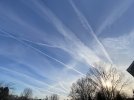
Cloudless sky minus contrails - what's up (or not)?

Rick A

Line Up and Wait
PoA Supporter
Joined
Sep 25, 2019
Messages
828
Location
Lancaster, Pennsylvania
Display Name
Rick A
Home Airfield
KLNS
The last four days on the east coast have been cloudless and beautiful. Very out of character for much of the east coast.

No contrails to be seen. None. Nada. WTH? Where did they all go? It reminds me of the week following the 9/11 attacks where the sky didn't have any contrails because air traffic was all grounded.

I'm wondering why it took me four days and two cross country flights to finally notice. Does anybody have an explanation?
 
According to Wikipedia, contrails form starting at altitudes ranging from 25,000 to 40,000, depending on the temperature and humidity at altitude. There are some airliners that can cruise at 40,000+ altitudes, but the majority of flights are below that. Might have just been a period with a high contrail level.

Or the Chemtrails material has been held up by tariff issues.....

Ron Wanttaja
 
Some States, like Florida are prohibiting chemtrails.
A lot of your posts have those X’s. Is there something you can do so we can see them?

 
Today Sunday October 25th makes it 7 straight days without seeing one single contrail over Southeastern PA. They were also missing from view Tuesday and Thursday during clear days flying between Charlotte NC and Lancaster PA. These two flights included segments listening to Washington Center working plenty of jet traffic descending out of the flight levels into the Washington Class Bravo.

I live exactly 1.5 miles from the high-power Lancaster VOR (LRP), which is well within viewing distance from the ground as multiple high-altitude IFR J and Q airways pass overhead, and nearby.

Contrails have been visible on VFR days with a sky view for the decades I've lived here, regardless of season, humidity and OAT's levels present on the ground, and at flight level altitudes. Having them missing from view for one straight week is very unusual (except following the 9/11/01 attacks).

Wondering if contrails have recently disappeared from view in other regions of the country (or world), and if so, why?
 
Contrails occur when the atmospheric conditions are favorable to their formation. More often then not, there are no contrails. If every airliner at cruise was producing a contrail, the sky would be covered with them.
 
I've seen days where different altitudes had differing levels of contrails. The time they stay visible seems to also be highly variable. Some trail a few thousand feet behind the plane and dissipate, some stay for a long time after the plane is gone. Not surprised to see a day with none.
 
I confused a center controller the other day when I requested a 360 turn while cruising in the mid 30s in my plane. I just wanted to see my own contrails but they made a huge thing of it to coordinate a huge block of airspace for me. After all that they were a bit underwhelming from the same altitude to be honest.
 
Contrails are ice crystals that form from the water vapor in the engine exhaust. As Wanttaja says, If the surrounding air is dry, those crystals evaporate rapidly. If it's warm, they don't form readily.

Cloudless skies, meaning not even high cirrus, indicate dry air. The upper winds charts will give temperature. Right now, above us in southern Saskatchewan, it's -54C at 39,000 feet. Contrails are assured, though they might be short.
 
So it’s funny, I am sitting outside as I read this and looked up to see a Lufthansa 747 flying over at 36,000. It was leaving a contrail but it quickly evaporated. It’s just an indication of dry air aloft. Nothing superstitious about it.
 
So it’s funny, I am sitting outside as I read this and looked up to see a Lufthansa 747 flying over at 36,000. It was leaving a contrail but it quickly evaporated. It’s just an indication of dry air aloft. Nothing superstitious about it.
Wrote a short post here about contrails. I don't usually push FAA weather education, but I thought this page was pretty spot on.
 
Last edited:
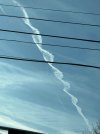
Thanks Scott your weather insights are well appreciated! What causes these curly contrails we see every now and then?
IMG_1495.jpeg
 
According to Wikipedia, contrails form starting at altitudes ranging from 25,000 to 40,000, depending on the temperature and humidity at altitude. There are some airliners that can cruise at 40,000+ altitudes, but the majority of flights are below that. Might have just been a period with a high contrail level.

Or the Chemtrails material has been held up by tariff issues.....

Ron Wanttaja
I assumed it was due to the Strait of Hormuz problem. ;)
 
Well after 8 days of cloudless (with no contrails) skies, short patches of contrails are finally showing up. Longest length of their absence I can remember ever having.

So, the humidity level in the low to mid-30 thousand foot MSL range must finally be increasing. The temperatures forecast aloft for the times I've checked at those altitudes are in the 45 Cto 55C ranges which is where they supposed to be most prevalent. Must be a humidity thing for the last 8 days.

Dry cold air with high-humidity must be it!!
 
Saw this in France for nine days due to a volcanic ash cloud… zero jets up there.
 
Thanks Scott your weather insights are well appreciated! What causes these curly contrails we see every now and then?
Sure, no problem...get in your weather questions in now...will be retiring at the end of the year. ;)

This depends on many factors. Wind shear is likely the major reason contrails develop these bends and twists. Wind speed and direction can change with altitude. When different portions of a contrail are exposed to different winds, the trail gets stretched and distorted. Keep in mind that wind shear doesn't always imply turbulence, that is, on the scale we can feel it in the cockpit.

Gravity waves and other atmospheric disturbances often exist in the vicinity of the jet stream and can produce repeating waves in the air. When a contrail passes through these regions, it can take on a wavy appearance. These waves can also affect temperature and humidity, causing parts of a contrail to persist while adjacent sections dissipate. That can make the pattern look even more irregular.

Of course, wake turbulence is also a possibility. These wingtip vortices from other aircraft can deform a fresh contrail. That's much less likely.
 
Last edited:
Back
Top