Cessna flap tracks - lube

ateamer

En-Route
Joined
Dec 19, 2007
Messages
2,981
Location
Port St. Lucie, FL
Display Name
ateamer
Home Airfield
FD88
Trying to figure out what exactly is the lubrication requirement for Cessna flap tracks. The plane came to me with grease on the rollers and tracks. Unless I am missing something, the service manual for my 175 does not address it, which implies that they should not be lubed at all.

I have read and heard different suggestions: grease on both, oil the rollers and grease the tracks, oil the rollers and keep the tracks dry, LPS2, and probably a few more. Those suggestions have all been from A&Ps.

I’ve read that lubricant on the tracks tends to hold dirt, and also keep the rollers from rolling, leading to wear on the tracks and eventual replacement.

What do you all do? I want to take care of this plane as well as possible. But it seems to me that if the engineers at Cessna intended for the flaps to be oiled or greased, it would be on the lubrication chart in the service manual.

Opinions, experiences?
 
No grease on tracks and the bearing are pre-packed. Don't spray any lube on them. Everything should roll freely.
 
Like you said and Clip4 said no grease or oil on the tracks or the outside of the roller bearings so they roll not slide.
The only way to inspect and oil them is to take them out.

9999472f-0b02-4050-b39c-dcd7e3c12e91.heic

They were sliding and chattering when I put the flaps down in the hangar. That's why I took them out for service.
After cleaning the old one's they were loose and clearly worn out. Got new McFarlane rollers. McFarlane recommends light oil for lube.
b810c5c0-8066-4336-b8ed-d2c4415d9535.heic

Luckily my tracks were still serviceable. In that picture above, note the new bearing and washers are the same width as the original roller bearing.
5d965412-0688-4e1b-98ff-f76f681eca77.heic
 
Last edited:
The old and the new roller appear to be different diameters. Is this the case, or optical illusion?

How difficult is it to remove the flap rollers?

If a person has old, gunked up rollers, is it possible to use a solvent such as carb cleaner to clean them up (including the internal bearing surfaces) without removal from plane, and then reapply light lube to the cleaned roller (relying on wicking to allow the lube to get into the bearing surfaces) since they were prelubed at factory 50 years ago?
 
It takes a couple special tools and lot's of patience. I was able to do it by myself, just barely. 3rd hand would be much easier but I didn't have any help in town the weekend that I did mine.
c408c581-982b-4c22-9fe0-aa5ddd7cd6e9.heic
 
The old and the new roller appear to be different diameters. Is this the case, or optical illusion?

How difficult is it to remove the flap rollers?

If a person has old, gunked up rollers, is it possible to use a solvent such as carb cleaner to clean them up (including the internal bearing surfaces) without removal from plane, and then reapply light lube to the cleaned roller (relying on wicking to allow the lube to get into the bearing surfaces) since they were prelubed at factory 50 years ago?
All the same diameter, just different widths.
It's difficult to remove and reinstall especially for first timers.
No not very effective to try to service them on the plane, they must come out to lube them properly. This is what happens after 40years of spraying it with light lube.
38cded74-c3b5-4c16-94ee-95ca4877746c.heic

1c858ca1-030a-4afc-b7db-90f7799f4613.heic

Hope that the flap supports are not damaged.
5b34e89f-6cc4-44f0-a399-bb9b4c4eea83.heic

This ladder was my third hand. All this work satisfied (SEB) 95-3 issued by Cessna in 1995.
7834cfad-a27b-40cf-9df2-22a3e9fcad39.heic

Used the grease to get the hardware to stick to the wrenches putting it back together.
41424781-809e-483b-84b1-2edaa9447a7b.heic

It was a good time to get all the mud daubers nests out of the flaps. And get all the dead bugs off. Also replaced some of the nylon buttons that keep the flaps from contacting the wing.
3259c2d8-2dc5-4ee4-a0f5-3d07c6579213.heic
 
Last edited:
Unless I am missing something, the service manual for my 175 does not address it,
Most Cessnas call for a light Mil-Spec oil on the tracks and bearings and is usually called out in the lubrication section of the mx manual. When done properly, it sometimes looks like no lube is there.
 
Looks like the Flap Arms were not damaged? The SB Gary reffed is checking

for wear and installing protective washers. IMHO it is a very low cost way

to preserve your aircraft if you don’t pay for labor.

IIRC - the Flap have a plug in the end to allow use of a ratchet and long

extension when working on the bolts.
Not all of them have the plug, mine did not.
 
Most Cessnas call for a light Mil-Spec oil on the tracks and bearings and is usually called out in the lubrication section of the mx manual. When done properly, it sometimes looks like no lube is there.
I’ll find a manual for the newer models. Mine is for the earliest years.
 
I’ll find a manual for the newer models. Mine is for the earliest years.
There should be no difference. However, I just looked at a 172 and 182 manual and I'm not seeing what I remember. PM @Dan Thomas and ask him. He'll remember the specifics.
 
No where in my 77-86 172 service manual does it say to lube those roller bearings and tracks.
Only lube for the flaps is light oil on the jack screw.

Definitely don't want to use oil on the tracks if you operate in dusty conditions.
A few drops of oil in that roller bearing when new will last years unless you fly in extreme conditions.
The axle seals the oil in when you slide it in.
So spraying any thing at it is not getting inside that roller bearing.
Most like mine are 40+ years old, can't complain about that. I think that is a good service interval.
Just put new ones in and protect those expensive to replace flap tracks.
 
Last edited:
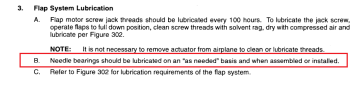
I can find no Cessna manual that gives instructions on flap roller lubrication other than this in the '96 and on C172R/S manual:

1743719053753.png

Figure 302 refers to lube for the aileron system, and has this:

1743719204324.png

Aeroshell 22 has that MIL-G-81322 spec (actually upgraded to MIL-PRF-81322). It is a good grease, and we used it for wheel bearings as well as for the flap rollers. WE DID NOT GREASE OR OIL THE FLAP TRACKS. Any lubricant there will attract dust and grit, and accelerate wear of the track. Grit that finds its way into the roller's needle bearings will stop those needles from rolling, and the roller stops rolling, and the track slots gets mushroomed as the roller drags over it. Lubing the track also makes it easier for this to happen. By simply leaning out the old grease from the roller, and relubing with a bit of Aeroshell 22, we had excellent track life. Even at 12,000 hours they weren't worn to limits.

Later, in another shop, I often found that mechanics (or maybe even owners) had gobbed grease on the rollers and tracks. What a gritty mess. Dirt and oil everywhere.


This Cessna FLyer Association document has things to say on it: https://www.cessnaflyer.org/magazin...essna-flap-tracks-inspection-replacement.html

1743718957788.png


One has to watch for wear on the flap support arms. Those are the parts that carry those rollers. The roller is an industrial needle bearing with no seals, and Cessna presses a steel (stainless?) sleeve over it to roll in the tracks. That sleeve can work its way sideways, partially off the roller, and cuts a circular groove into the flap support arm. Left long enough, that groove results in a disc of aluminum tearing out, and the roller cocks and jams and the flap motor is powerful enough to twist the flap and wrench the tracks loose. Damage to the wing's rear spar can result. Before we got that SB we had such a failure. McFarlane sells all the right stuff to fix that. You need shorter rollers for the aft locations. Stainless washers are fitted on either side of the roller to prevent that arm wear. The SB: https://media.mcfarlaneaviation.com/documents/doc-seb95-3.pdf

Be aware that the roller's needles roll on a bushing that is clamped by the roller bolt between the flap support arms. If that bolt/nut is left loose, the bolt will wallow out the holes in the arms. Expensive. Read the manuals.
 
And I’ve had several A&P/IAs say that the rollers and tracks have to be greased. Really frustrating when crap like this happens. It’s not the first time that an A&P has told me, or done, something that’s in direct conflict with the manufacturer’s instructions.
 
And I’ve had several A&P/IAs say that the rollers and tracks have to be greased. Really frustrating when crap like this happens. It’s not the first time that an A&P has told me, or done, something that’s in direct conflict with the manufacturer’s instructions.
Yup. They don't read the manuals, however in this case the manuals don't say much. But anyone thinking about grease on the tracks and outside of the rollers can imagine what will eventually happen.

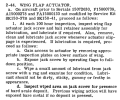
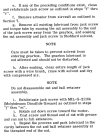
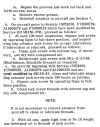
Cessna used three different types of electric flap actuators. The oldest used a moly disulfide grease on the jackscrew threads, which ran in a plain nut. As an example, we see the different lube treatments for the C150:

1743722282970.png
1743722317196.png

1743722354624.png

Take note of paragraph (c). That's where things change from Moly grease to #10 non-detergent oil.

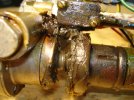
Moly grease can plug up the recirculating-ball nut mechanism and cause wear of the jackscrew. This was on a newly-purchased airplane:

1743722786618.jpeg

That one is supposed to get the #10 oil wiped on the jackscrew, nothing more.

1743722845477.jpeg

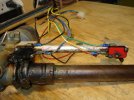
It had found its way into both of the travel limit microswitches.

1743722907056.jpeg

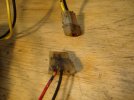
And into the connector plugs, including into all the crimped terminals, contaminating the contact between the wire and crimp.

1743722953776.jpeg

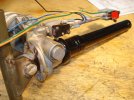
After several hours of cleanup.
 
my c172k had the flap chattering as well..... I could easily see the rollers were not rolling but skipping in track. I simply removed the rollers and took inner bushing out. nothing but old hardened grease between inner and outer.

simply used brake cleaner and rag to clean them then added synthetic grease, worked as good as new. I would inspect the shoulder of bolt that goes through inner bushing...mine was scored and replaced it. should take you 40 min to do all rollers.
 
Is it possible to remove, clean, and replace one roller at a time, without having to remove the flap?
 
Some folks just want the experience to last. And last!
 
Back
Top