ateamer
En-Route
- Joined
- Dec 19, 2007
- Messages
- 2,982
- Location
- Port St. Lucie, FL
- Display Name
- ateamer
- Home Airfield
- FD88
I’ll take the Cessna 100 times out of 100. Easier to load, more comfortable, better ventilation.


I hate necro threads for the reminder of those who have flown west. Although I suppose it's not a bad thing.
Two doors isn’t a big deal when you are …(under 60, have original knees, whatever) but someday it’s a really big dealI’ll take the Cessna 100 times out of 100. Easier to load, more comfortable, better ventilation.


Dakota is a taperwing 235. May be a little longer, I’m not sure, but all PA28s are the same width. 182 is much more comfortableIs the Dakota's cabin bigger/wider than a Cherokee 235? I was told the Dakota is a better comparison to the 182

It’s longer. Makes a difference in rear seat legroom.Is the Dakota's cabin bigger/wider than a Cherokee 235? I was told the Dakota is a better comparison to the 182

Get a turbo aircraft and fly above the bumps.When you say stable in flight are you referring to turbulence in the moving around aspect?
Probably a silly question....but I guess my initial thought was 'susceptability' to jarring and bumps. My girlfriend hates the bumps.
Wing loading on Cessna is 17.8 and Dakota is 17.6 would that make them about even in that respect?

But then you'd have to breathe through a tube and start shopping for a pressurized aircraft.Get a turbo aircraft and fly above the bumps.
Bumps or hose........But then you'd have to breathe through a tube and start shopping for a pressurized aircraft.

You must be new here. 2018 is recent compared to some of the necroposts we get. Like the time Lindbergh necroposted on a thread that Orville himself had started about what kind of flight controls would be used on the first Atlantic crossing, and nobody replied to at first. And then another newb re-necroed it during the pandemic.Wasn't this thread started when both types were new?
All the speed of a fixed gear, with all the maintenance of a complex.
You mean put the 200 hp engine in the fixed gear 23 series? They did for a year or two. All it does is improve take off distance and climb rate. As do most horsepower changes in airplanes. V^2 does that to you. It's a wide, slab-sided, easy to fly, SLOW airplane. All of them. Even the Cherokee and Arrow beat it, and they are not screamers at all.Point taken.... I often wonder why they didn't put that engine/prop configuration in the Sundowner.
They'll accommodate very wide people, that's for sure. No small (SEP) aircraft is comfortable after three hours for the most part. Most training is in 1-2 blocks, so the aircraft really doesn't matter.But they are super comfortable. Did my commercial in one.
They'll accommodate very wide people, that's for sure. No small (SEP) aircraft is comfortable after three hours for the most part. Most training is in 1-2 blocks, so the aircraft really doesn't matter.
But they are sort of annoying from an engineering efficiency standpoint, since they are up to 15 knots slower than other aircraft with the same 180-200 hp. They also have some interesting sealing/bonding techniques at some places that seems to make them occasionally corrode at places where it can be hard to address.
In their favor, they do not wallow like the Cherokee.
I cruse in the low to mid 140s in my 1973 182P. but I have the PPONK engine. I haven’t seen a stock 182 that could curse much over 135.I want to know who the hell is *honestly* doing 143 knots in a straight legged, non-turbo 182???
11.1 is my longest day in my 182. Very comfortable airplaneThey'll accommodate very wide people, that's for sure. No small (SEP) aircraft is comfortable after three hours for the most part. Most training is in 1-2 blocks, so the aircraft really doesn't matter.
But they are sort of annoying from an engineering efficiency standpoint, since they are up to 15 knots slower than other aircraft with the same 180-200 hp. They also have some interesting sealing/bonding techniques at some places that seems to make them occasionally corrode at places where it can be hard to address.
In their favor, they do not wallow like the Cherokee.
MeI want to know who the hell is *honestly* doing 143 knots in a straight legged, non-turbo 182???

Me too, usually 142 kts at 9,000-11,000’ and have seen 145 kts in cooler temps aloft. (182-S), mid weight.
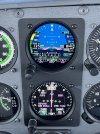
I have an R. Basically the same airframeMe too, usually 142 kts at 9,000-11,000’ and have seen 145 kts in cooler temps aloft. (182-S), mid weight.
View attachment 141508

What's funny is when you pull their tail numbers, look em up on your adsb website of choice, and look up winds aloft, they rarely/never show the claimed speeds.I want to know who the hell is *honestly* doing 143 knots in a straight legged, non-turbo 182???
In addition to the aerodynamic cleanup, 182S/182T Lycomings are de-rated so book MCP is 80%.S is a restart and is faster by a few knots with the Lyc. T even more so. Higher fuel burn typically than Continental versions by 1-3 gph.
It's actually cube root rather than square root, so the math works out to be closer to 141 kts.For a P-Ponk, basically a carbureted 520, and worth maybe 270 hp, then increase in possible (providing fuel is provided for the hp demand) speed goes roughly as square root of the ratio of available hp. So root(270/230) ~8% increase for the same power percentage. If the stock gives 134 ktas at 70% power, then a p-ponk should run in the 142-144 ktas range, which seems to be what is being reported.
