Carb Enrichment Circuit / WOT

BigghHauss78

Pre-Flight
Joined
Aug 15, 2025
Messages
55
Display Name
BiggHauss
POA,
Aircraft is 1981 Cessna 182R, O-470-U, JJA STC, Powerflow Exhaust STC. I've been wondering this for quite sometime and was hoping somebody might be able to explain/confirm. From what I understand, when the throttle is at WOT (FULL THROTTLE), this opens up an 'Enrichment Circuit' in the carb to help add additional fuel, to keep it cooler during HP operations. Further, I also keep my throttle WOT during most phases of my climb, and cruise, and adjust RPM/MIX accordingly depending on phase of flight. For example: Takeoff- WOT, 2625 RPM, Full Mix. Cruise Climb-WOT, 2400 RPM, Reduce Mix above 5000'. Cruise- WOT, 2200 RPM, lean out to manage CHT's, EGT's and FF around 11.2gph. I only get back to throttle when I'm descending or in the pattern.

Here's my question: Does this 'Enrichment Circuit' ALWAYS come at at WOT as a mechanical function of the throttle position itself, or is their something else that has to happen in order for this circuit to be engaged? Is it a function of the MIX position??

Where I'm going with this is: Say at Cruise I'm at WOT, but leaning aggressively. Does the throttle itself being physically in the WOT position mean that this enrichment circuit is ON, thus opening up more fuel and that I'm trying to lean it out via the MIX? Or does this circuit drop off as MP lowers and is no longer in the equation at some point? I've always noticed my mix is super sensitive and very touchy. Like it goes from hardly making a dent in fuel flow, to cutting fuel flow back REALLY quick and I'm wondering if I'm somehow fighting this enrichment circuit because of the physical throttle position (if thats even true) as I'm leaning at WOT. I'm wondering, if I were to slightly close the throttle, at what point does this circuit turn off, if it IS on? Or is this circuit driven by the MIX, and only comes on if I'm Full Rich???

Anyways, just trying to understand it better.
Thanks!
Suggestion: figure out the model number of your carburetor, and find the carb operator's/maintenance manual. It should have a pretty good description of how it works. For example, I used to own an airplane with a PS5BD pressure carb. While the Beech manuals did a decent job of explaining how that complicated carb works, the manual that Bendix put out itself was significantly more descriptive, with really good diagrams and drawings.
 
I doubt that that carb even has an enrichment circuit. Never seen the linkage for one on a 470's carb.
 
I've already done that and really couldn't seem to deduce what I was after. That carb does have the circuit. Commonly referred to as 'Economizer'. I'm more into practical application and understanding with my question above. I did find some additional things online that does suggest slightly backing it off will turn off that circuit, which also seems to be a good recommended way to operate, and help with fuel distribution.
 
If you have a way to monitor fuel flow, that should answer your question. Furthermore, performance charts are based on proper leaning. If that weren't possible WOT, that fact would be prominently noted.
 
It's a non-issue. As highlighted, the second you start leaning with the mixture knob, it makes the existence of that throttle-controlled bleed air pin moot, at all mixture positions except full-rich.

Bringing up poor induction balance on engines like the O-470, and the back and forth about cracking the throttle plate so it creates "turbulence" and other assorted homebrew topics, is a conflation of topics.
 
Let's unpack a couple of questions here. I don't know which carburetor you have or the exact inner working of it, but this principle applies to them all. Most aviation carburetors and fuel injection systems have a means of making the mixture extra rich for high load demand and a way of making the mixture less rich for lighter load demand. That system works as intended as long as the mixture control is at the Full Rich setting. Once you pull the mixture control back from full rich, you have final control over how much LESS fuel the carburetor delivers, even down to zero fuel delivery. There may be a couple seconds of delay for the new fuel flow to stabilize, but it will.

>>>>> For example: Takeoff- WOT, 2625 RPM, Full Mix. Cruise Climb-WOT, 2400 RPM, Reduce Mix above 5000'. Cruise- WOT, 2200 RPM, lean out to manage CHT's, EGT's and FF around 11.2gph. I only get back to throttle when I'm descending or in the pattern. >>>>>>

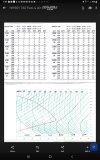
I fly similar this too when I am on a long XC. I take note of EGT at 500 AGL and monitor the hottest CHT. As altitude increases and EGT drops I lean slightly to bring it back to the 500 AGL reading as long as CHT is good. At cruise I target 8-8.5 GPH at 140 kts TAS. I have a TAS chart and a Red Fin Fuel & Air graph to help with this, I target 25-75°F Lean-Of-Peak at any Cruise and any altitude. If I am just practicing at at low altitude I tend to do a short loop between three local airports at 2000-2500 feet, part throttle, 2050 RPM 20.5 MP (41 MR) and 6 GPH. At 10,000 feet I usually cruise WOT, 140 kts TAS, 2550-2600 RPM 20-21 MP (45-47 MR) and 8-8.5 GPH. That puts me about 40-60°F LOP on the graph, prducing 60-64% load. I also lean aggressively during ground operations after warmup.

I have a 200HP IO-360 Lycoming. Your O-470 my not run as well LOP as mine does, but learning more about leaning is a good idea even if you prefer not to. I spent almost a year in research before I was comfortable running LOP, and I still am very careful with load management when I do. Your POH will tell you how much horsepower is required for the TAS and altitude you are flying, then pick a low HP cruise setting and experiment. As long as you are making 60% or less power, you can run any mixture setting that allows the engine to run smoothly. The easiest place to start is the run-up. It is at reduced power and you can see how lean your engine can run smoothly without harming it. Monitor CHTs to keep them below 400°F at all times if you can. Mine tend to go up a little above during the climb, so I keep a watchful eye. During cruise they drop down below 360°F or less

I didn't mean to get as deep into this as I just did. Hope you got something you can use out of it.

Have FUN!. Fly SAFE! Pete
 

Attachments

  • Screenshot_20260922-070756_Photos.jpg
    Screenshot_20260922-070756_Photos.jpg
    491.7 KB · Views: 5
Back
Top