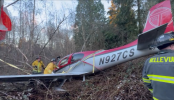
CAPS saves another

I'll have to talk to the guys here in Bellevue about this.
 
Good lord. Why be a passenger when you can be a pilot?
I'd use my training and fly it to the nearest airport.
If I can't glide to a runway, I would bet I can kick the rudder back and forth fast enough to propel me like a fish to wherever I need to go.

Sorry. I am not a Cirrus pilot anymore so I have 10 years of bashing on them built up inside.
What was super cool was the local news coverage was POSITIVE and they were absolutely enamored with the CAPS. it was refreshing to see.
 
What was super cool was the local news coverage was POSITIVE and they were absolutely enamored with the CAPS. it was refreshing to see.
I mean I know it is polarizing amongst pilots, but it is tough to argue in certain cases that CAPS saves peoples lives no doubt. I am sure if my engine went out, I would be happy to have a chute as a backup.
 
I mean I know it is polarizing amongst pilots, but it is tough to argue in certain cases that CAPS saves peoples lives no doubt. I am sure if my engine went out, I would be happy to have a chute as a backup.
I don't think it's tough to argue. With CAPS is always better than without. It's like airbags and seatbelts. The arguments against just don't stand the test of time & experience.
 
Good lord. Why be a passenger when you can be a pilot?
I'd use my training and fly it to the nearest airport.
If I can't glide to a runway, I would bet I can kick the rudder back and forth fast enough to propel me like a fish to wherever I need to go.

Sorry. I am not a Cirrus pilot anymore so I have 10 years of bashing on them built up inside.
It's been a long time since Bellevue had an airstrip. Maybe Renton was out of gliding range.
 
Why would you buy an aircraft with a chute if you don’t plan on using it,in an emergency?
 
What was super cool was the local news coverage was POSITIVE and they were absolutely enamored with the CAPS. it was refreshing to see.

Hopefully no politician sees that and gets the great idea to introduce language requiring all aircraft to be equipped with CAPS.
 
Seems like it's a lot more possible when the engine is largely intact after a CAPS landing, no?
 
If I can't glide to a runway, I would bet I can kick the rudder back and forth fast enough to propel me like a fish to wherever I need to go.
This is brilliant! We will hereby refer to this as the "Guppy protocol".
 
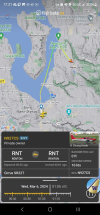
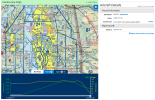
Based on FlightAware data, the plane was still on the initial climbout from RNT when it started losing altitude at 2250 MSL, and it had only been in the air a little more than two minutes at that point. It looks like it was between 3.5 and 4 miles from the airport, and started a turn back to the southeast. The ground speed started dropping about three minutes into the flight. Here's the immediately preceding METAR. I don't know the glide performance of the airplane.

KRNT 060053Z 33009KT 10SM CLR 07/M02 A3003 RMK AO2 SLP174 T00721017


N927CS.png
 
Last edited:
Final is out https://data.ntsb.gov/carol-repgen/api/Aviation/ReportMain/GenerateNewestReport/193887/pdf

The flight crew reported that shortly after leveling off, the engine rpm surged a few times, followed by the sound of a loud bang and subsequent total loss of engine power. Unable to restart the engine, they successfully deployed the Cirrus Airframe Parachute System (CAPS) and descended under the parachute into a wooded wetland area adjacent to a residential neighborhood.

Examination of the engine revealed that the crankshaft was fractured between the No. 2 main bearing journal (M2) and the No. 3 connecting rod (C3) journal. Fretting was observed on the parting surface of the No. 2 main bearing saddle. The No. 2 main bearing saddle remained in place and was deformed, consistent with a rotating main bearing. Damage to the interior engine case was observed throughout. The crankshaft near the M2 journal and the No. 3 connecting rod journal was fracture separated.

Metallurgical examination of the crankshaft fracture revealed fatigue cracking that initiated at multiple sites along the radius of the web with the C3 journal. As this crack propagated aftward, a second smaller fatigue crack began along the radius of the aft M2 bearing. It is likely that as the crack continued to grow in depth, it allowed the remainder of the crankshaft to fracture from overstress and subsequent failure. The postfracture damage was due to the fractured surfaces of the crankshaft, between the C3 and M2, that continued to make contact with each other during the accident sequence. Due to the damage to the M2 bearing, the No. 2 main bearing saddle, and the fracture surface of the crankshaft on the M2 bearing side, it could not be determined if bearing slippage was the initiating event. The fatigue fracture of the crankshaft likely led to the total loss of engine power.
 
Love reading stories where people walk away to tell the story.

So what makes a crankshaft crack - prop strike earlier in it's lifetime?
 
Love reading stories where people walk away to tell the story.

So what makes a crankshaft crack - prop strike earlier in its lifetime?
Possibly, and/or or a defect in the crank that finally grew enough, and/or (if this engine has them), cylinder(s) with through-studs were removed for (?) reasons and proper stretch wasn’t achieved on reinstall, allowing the bearing to spin due to inadequate preload on the bearing. Likely a few other possibilities I’m not thinking of as well.
 
Are spun bearings something that can be caught on an annual, or do you need to crack the engine to check them?
 
Ground dweller view of CAPS, I would rather an aircraft descend vertically onto my house, than glide in.

Landing on the roof of most houses would produce inexpensive damage.


edited to add

If we are home, multiply that by 100.

If the plane has fuel in it, infinitively bad to be at home ae it glides in.


;
 
Last edited:
Are spun bearings something that can be caught on an annual, or do you need to crack the engine to check them?
When it happens, failure is the end result rather quickly.
The main problem isn't that the bearing is spinning, but that it obstructs the oil flow in the process. As such, a spun bearing is starved of oil, and things go wrong fast.
 
I mean I know it is polarizing amongst pilots, but it is tough to argue in certain cases that CAPS saves peoples lives no doubt. I am sure if my engine went out, I would be happy to have a chute as a backup.
I don't think it should be polarizing at all , not anymore than, say wearing seatbelts or having air bags installed in your car - unless you prefer to rely on your superior driving skills alone …
 
Why would you buy an aircraft with a chute if you don’t plan on using it,in an emergency?

Great question, and a real head-scratcher.

I park my plane in a hangar that was previously occupied by a Cirrus that was picking up ice as he reached the Pennsylvania mountains. After 10 minutes decided to turn around (below freezing ground temperatures and clouds everywhere), announced his predicament to ATC, and was being vectored to the closest airport with an ILS. While intercepting the localizer, stalled and crashed, killing the two occupants.

Investigators discovered the safety pin was never removed to activate the CAPS.
 
A mistake is not the same as "Planning to not use it".
 
Examination of the engine revealed that the crankshaft was fractured between the No. 2 main bearing journal (M2) and the No. 3 connecting rod (C3) journal. Fretting was observed on the parting surface of the No. 2 main bearing saddle. The No. 2 main bearing saddle remained in place and was deformed, consistent with a rotating main bearing. Damage to the interior engine case was observed throughout. The crankshaft near the M2 journal and the No. 3 connecting rod journal was fracture separated.

That finding sure makes the "why be a passenger when you can be a pilot?" remark pretty stale :)
 
I feel like pilots with CAPS are like F1 drivers with the Halo. When they first introduced it, every driver and their mother was against it and how “it was ruining the sport” and “real drivers don’t need the Halo.” After a few obvious saves (most notably Grosjean in the Bahrain GP), you would be hard pressed to find anyone in F1 still against the Halo. So unlike in F1 I suppose, we somehow still have a pilot contingent insisting that CAPS isn’t valuable and denying it can be a tool in improving safety.
 
Great question, and a real head-scratcher.

I park my plane in a hangar that was previously occupied by a Cirrus that was picking up ice as he reached the Pennsylvania mountains. After 10 minutes decided to turn around (below freezing ground temperatures and clouds everywhere), announced his predicament to ATC, and was being vectored to the closest airport with an ILS. While intercepting the localizer, stalled and crashed, killing the two occupants.

Investigators discovered the safety pin was never removed to activate the CAPS.

He stalled it. Don’t stall an airplane.

Calling every chute deployment a Save is a little ingenious. Plenty of pilots lose power and land engine out without dying.
 
He stalled it. Don’t stall an airplane.

Calling every chute deployment a Save is a little ingenious. Plenty of pilots lose power and land engine out without dying.

Very true. In the case of my hangar's previous renter, knowing then following the procedures of; keep airspeed high enough not to stall, use no flaps, keep turns very shallow, and don't reduce any power unless over the runway, may have saved their lives without the parachute. But only if he was confident he'd make the runway where it meets the ILS glide slope.

In the event of a parachute deployment, I have no idea what the descent rate of floating down would be with a load of ice. But assuming he wasn't confident he'd make the runway, it was too bad he didn't pull the chute and try.
 
My argument is not against CAPS, it is however against assuming every engine out results in a fatality.
 
Back
Top