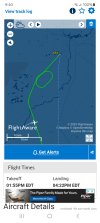
Bonanza Down in Greenville, NC (PGV)

definitely not missed approach buttonology.
Duh. I was making just one example of AP buttonology and its importance in knowing how to use your equipment. We all know it was on departure. This flight lasted 2 minutes. Yes, two minutes. The sequence of events happened quickly, very quickly.
 
Screenshot_20250316_094013_Samsung Internet.jpg

Understanding your buttons and avionics in hard imc is crucial. Just last week flying in hard imc with moderate turbulence my AP started doing stupid stuff. Twice it started doing things I wasn't expecting. Ended up flying the HILPT and the whole final by hand.
 
Mark, correct me if I am mistaken…the GFC500 will not activate below 800’ agl. It appears that the aircraft was turning well before that altitude was reached. Possibly in trouble before that point and, if he was putting eyes on the GMC507 vs the ADI and focusing on wings level, climb attitude, SD resulted. Unfortunately, at that point in the flight, you would have mere seconds to input corrective actions. RIP
 
Mark, correct me if I am mistaken…the GFC500 will not activate below 800’ agl. It appears that the aircraft was turning well before that altitude was reached. Possibly in trouble before that point and, if he was putting eyes on the GMC507 vs the ADI and focusing on wings level, climb attitude, SD resulted. Unfortunately, at that point in the flight, you would have mere seconds to input corrective actions. RIP
It will activate on the ground. The flight manual supplement says not to engage it below 800'.

Lots of good discussion about knowing your autopilot, but I'd go one step further. If you need the autopilot to fly imc, you shouldn't be flying imc.
 
It will activate on the ground. The flight manual supplement says not to engage it below 800'.

Lots of good discussion about knowing your autopilot, but I'd go one step further. If you need the autopilot to fly imc, you shouldn't be flying imc.
I never engage it until approximately 1000’ AGL and assumed the operating limitation implied it wouldn’t engage until above 800’AGL. Thanks.

I do utilize TO mode to have the FD bars aid in holding pitch until I clean up; I find that very helpful as a cross check to the VSI / altimeter tape and AS.
 
If you need the autopilot to fly imc, you shouldn't be flying imc.
I would rephrase and say if you are DEPENDENT on an AP to fly in IMC, stay on the ground.

They are huge work load savers and a great safety net. I like as many safety nets as I can have when I fly. Even on CAVU days. I've been in too many situations where for one reason or another I ended up needing every tool in my toolbox.

Now, I will say that I believe (translate... my opinion) too much flying today is done on AP, and most of the IMC flying is. The tech has gotten so good, equipment is readily available to most budgets, and more and more have implemented. This impacts decision making and adds a degree of confidence that isn't reflective of the operators stick, rudder, and tech proficiency. This would also include IFR abilities.

It's worth noting last week the pilot spent time with a CERTIFIED Bonanza instructor doing training on both the plane and the new glass panel. This was not a friend CFI - this was someone from the BPPP program, and if not familiar, these instructors are top-notch. He was doing the right thing.


Is this per the son on BT?
 
View attachment 139097

Understanding your buttons and avionics in hard imc is crucial. Just last week flying in hard imc with moderate turbulence my AP started doing stupid stuff. Twice it started doing things I wasn't expecting. Ended up flying the HILPT and the whole final by hand.
George is a great in flight workload reducer, but I don’t trust him near the ground and would rather hand fly an approach. On departure, no George until at least 2000AGL.
 
I never engage it until approximately 1000’ AGL and assumed the operating limitation implied it wouldn’t engage until above 800’AGL. Thanks.
As mentioned it’s a limitation that the pilot is required to obey. And, with the GFC500, you can use it on the missed even below 800.
 
As mentioned it’s a limitation that the pilot is required to obey. And, with the GFC500, you can use it on the missed even below 800.
Yes, I use it on MAP’s. I didn’t realize it could be engaged immediately after TO, if one was so inclined…which I am not.
 
I didn’t realize it could be engaged immediately after TO
Makes the point. The AP has lots of features and capabilities. Refresher training for everything in your panel should be a regular part of our currency actions.
 
Yes. Certain avionics and versions of ADS-B out and Mode-S can broadcast several parameters besides location. This is known collectively as downlinked aircraft parameters (DAPs).
Cool! I was not aware of that. I figured they only used that capability to telemeter the number of cans of coke in the aft beverage cart...
 
Final Report for N566C

Within the wreckage that was examined, there was no indication of a preimpact mechanical malfunction or failure that would have precluded normal operation of the airframe or engine.

The airplane’s erratic flight track on the accident flight, which included arrested climbs, descents, and low altitude turns that culminated in a tightening turn and high-speed descent was indicative of the known effects of spatial disorientation, specifically the somatogyral illusion (graveyard spiral). During the initial climb, once the pilot entered the clouds and lost all outside visual cues, it would have been difficult to recognize and respond to spatial disorientation unless he was confident and assertive in his use of the airplane’s avionics package and flight instrumentation.

A review of FAA airworthiness records revealed that on August 7, 2024, about 7 months before the accident flight, a new autopilot and avionics package was installed on the airplane. This included but was not limited to the Garmin G3X system and a Garmin GFC 500 Autopilot. The pilot’s previous airplane, a Mooney M20, had a Garmin 530W installed.

NTSB probable cause: The pilot’s loss of airplane control shortly after climbing into instrument meteorological conditions due to spatial disorientation (somatogyral illusion).
 
The take-away on many of these instrument departure LOC's seems to be stop punching buttons and twisting knobs... keep proficient in hand-flying skills. And don't be afraid or late to use them.
I think there are two takeaways. One is, as you say, keep proficient in hand-flying skills and use them. Autopilots have a minimum altitude for engagement, typically 800 AGL. Here we had a 300' ceiling and it sounds like things went to hell fairly quickly all while the pilot was required to hand-fly.

But the other is to become and keep proficient on those button pushing, knob-twisting, and other avionics skills. In that sense, it reminds me a little of the JFK Jr crash, where pressing a button or two might have saved the day. This airplane had a GFC 500 autopilot, together with a G3X, GTN750xi, and GTN650xi. That's a lot of ability to rescue someone from spatial disorientation if set up properly before and at takeoff (who cares about that 800 AGL if you're feeling disoriented? The GFC will work quite well at lower altitudes). Unfortunately, ESP doesn't engage until 500 AGL or it may have saved the day even if the avionics were not set up properly.
 
I hadn't
I think there are two takeaways. One is, as you say, keep proficient in hand-flying skills and use them. Autopilots have a minimum altitude for engagement, typically 800 AGL. Here we had a 300' ceiling and it sounds like things went to hell fairly quickly all while the pilot was required to hand-fly.

But the other is to become and keep proficient on those button pushing, knob-twisting, and other avionics skills. In that sense, it reminds me a little of the JFK Jr crash, where pressing a button or two might have saved the day.

Yes, agree!

I wasn't aware that some of the newer autopilots can't be engaged at low altitudes. Would it be a good rule of thumb that if any autopilot (i.e., the GFC 500) have a go-around button, they can also be engaged at any AGL, even down to the ground?

A long time ago aviation magazine writer Richard Collins commented that flying instruments is like balancing a broomstick on the tip of a finger, and never to let the cat out of the bag, because it's hard to put it back in.

There is a clear line that separates hand-flying from autopilot skills. It's easy to get lazy and let hand-flying proficiency grow stale as electronic operating skills become more comfortable, easier and routine. Which works out amazingly well until the SHTF. LOC accidents have an exponentially higher percentage of fatalities than the rest of them.

A logged approach for proficiency by either hand or electronic doesn't care how it was done, or if the pilot is really locked and loaded for surviving a future flight in low IFR conditions.
 
I wasn't aware that some of the newer autopilots can't be engaged at low altitudes.
That's a flight manual limitation, not a mechanical one. Don't think there's an altitude at which it won't engage.
 
How come POA talked about AP usage but this report did not?
 
How come POA talked about AP usage but this report did not?
Don’t know. Might be difficult to confirm in an official sense? But the autopilot data output from the ADS-B reference way upthread are in the official data table in the docket.
 
wasn't aware that some of the newer autopilots can't be engaged at low altitudes. Would it be a good rule of thumb that if any autopilot (i.e., the GFC 500) have a go-around button, they can also be engaged at any AGL, even down to the ground?
It's a regulatory limitation for the pilot, not a system limitation. In fact it really only applies to the initial departure. SOP for the missed with a GFC500 is to press TOGA, add power, and clean up the airplane for the climb. In this sequence, the autopilot does not disconnect. On an ILS or LPV, that means the AP is climbing out from the DA which may be as low as 200 AGL.

Yes, TOGA can be engaged on the ground before takeoff. In fact, I encourage my clients who fly with a TOGA to engage it on every takeoff and every go-around. There's no reason not to and the "law of exercise" suggests it will make it less likely to forget it when it's really needed.

Let's understand what TOGA does. It creates a wings level, ~7° nose up climb on the flight director, basically giving you a safe enroute climb profile. In that situation, the FD directs you - the pilot hand flying - in TOGA mode until you select a different lateral (HDG or NAV) and vertical (IAS or VS) mode.

When you push the AP button, the FD starts directing the AP.
 
How come POA talked about AP usage but this report did not?
A guess: I took a quick look at the data so I may be off a bit. It looks like he took off with the AP not engaged, but engaged it . But it looks like he engaged the AP for about 15 seconds around 300' and again for about 15 seconds around 900-1000 AGL, but then switched it off. Perhaps the lack of clarity is why it wasn't discussed in the report.
 
Both sedating.
Agreed, but without accompanying blood level information there's no way to assess their affects on the pilot's actions. Taking a 25 mg Benadryl isn't going to make someone somnolent.
 
Agreed, but without accompanying blood level information there's no way to assess their affects on the pilot's actions. Taking a 25 mg Benadryl isn't going to make someone somnolent.
Yes. Which is why the NTSB said neither quantity nor timing could be determined and did not include it as even a contributing cause.

Besides, I think “Oh, it was the Benadryl,” takes away from lessons that can be learned from this accident. If I am going to speculate anyway, I prefer to speculate on the far more common accident themes of proficiency, personal minimums, including departures in conditions close to approach minimums, spatial disorientation, avionics knowledge, missionitis, etc.
I don’t think “it was the Benadryl”; I absolutely do think people take Benadryl far too lightly as a contributing or complicating factor. You read a LOT of accident reports with pilots taking Benadryl.
 
You read a LOT of accident reports with pilots taking Benadryl.
You do, but in how many was there evidence that it was a contributing factor? I haven't looked through all of them, but many of them are like this one, with language like (from a fatality in a 172) (emphasis added)

The results of postmortem toxicological testing indicated that the pilot had used the sedating antihistamine medication diphenhydramine, but provided no clear evidence that impairing effects of that medication were impairing the pilot at the time of the accident.​

Here's one that is a bit closer:

The toxicological results for the flight instructor indicated use of the medication diphenhydramine which has a potential to cause sedation and cognitive psychomotor slowing. Although the pilot may have experienced impairing effects of this medication at the time of the accident, no more specific conclusion of this impairment was drawn.​

So was it the Benadryl or the engine quitting on initial climb out due to a mechanic's improper torquing of a fuel pump bolt? Can you say, "if only the instructor hadn't taken Benadryl, the emergency landing in the field would not have resulted in a bounce and a crash."

I'm certainly not minimizing the dangers of Benadryl. I might take it from time to time as a sleep aid, but never when I'm going to fly because I know the effect it has on me the next day. But I don't find its presence without more concerning enough to make a correlation-to-causation jump when there are so many other factors that are far more universal to pilots. Pull up an accident where it was a factor to take lessons about the dangers of its use. They do exist.

 
Last edited:
You do, but in how many was there evidence that it was a contributing factor? I haven't looked through all of them, but many of them are like this one, with language like (from a fatality in a 172) (emphasis added)

The results of postmortem toxicological testing indicated that the pilot had used the sedating antihistamine medication diphenhydramine, but provided no clear evidence that impairing effects of that medication were impairing the pilot at the time of the accident.​

Here's one that is a bit closer:

The toxicological results for the flight instructor indicated use of the medication diphenhydramine which has a potential to cause sedation and cognitive psychomotor slowing. Although the pilot may have experienced impairing effects of this medication at the time of the accident, no more specific conclusion of this impairment was drawn.​

So was it the Benadryl or the engine quitting on initial climb out due to a mechanic's improper torquing of a fuel pump bolt? Can you say, "if only the instructor hadn't taken Benadryl, the emergency landing in the field would not have resulted in a bounce and a crash."

I'm certainly not minimizing the dangers of Benadryl. I might take it from time to time as a sleep aid, but never when I'm going to fly because I know the effect it has on me the next day. But I don't find its presence without more concerning enough to make a correlation-to-causation jump when there are so many other factors that are far more universal to pilots. Pull up an accident where it was a factor to take lessons about the dangers of its use. They do exist.
Part of ADM you say?

This pilot had new avionics, knew the day before he launched the weather forecast was going to be tough, plane will be fully loaded supplies and fuel, wife on board, and he had a tight schedule. Aka get-there-itis.

With all of this on the table he knew his A-game was gonna be required. Must be rested, attentive, responsive, prompt, and thorough. But yeah, it's OK I take these meds.
I'm with you on missionitis being a factor. A big one. Although it's interesting he called a mechanic before of fuel leaking from the overfill vent. The other ADM we can look at: taking off into a 300' ceiling.

The new avionics? We don't know what type or degree of training he had on them, but I do know that even pilots who pass their instrument rating checkride in TAAs have very rudimentary knowledge about how to use them.

We can add basic ADM and proficiency for even taking off into a 300' ceiling. How many of those do you think he's done

The meds? Very bad idea if in fact he took Benadryl to get a good night's sleep the night before flying. I think I said that. Could it have been a factor? Maybe. Is it something I would take as lesson-learned from an accident where the NTSB could not determine whether it was causative when there are accidents where they did? Not so much when there are better choices. Maybe that's a "that's just me" thing. It's just way too easy to blame the drugs.
I don't "blame" drugs. Just interesting that as a Dentist he took them. Better ADM would have prevented this. That is the very unfortunate lesson we can all learn from.
 
Very bad idea if in fact he took Benadryl to get a good night's sleep the night before flying. I think I said that. Could it have been a factor? Maybe. Is it something I would take as lesson-learned from an accident where the NTSB could not determine whether it was causative when there are accidents where they did? Not so much when there are better choices.
It’s not either/or.
 
No, but it is prioritizing. I guess my desire for clearer evidence is just my bias against the zero tolerance world. I just don’t get your lesson from this accident.
Simply that we see diphenhydramine in not a small number of accidents and tend to discount or ignore it. I think being a bit groggy is very relevant here.
 
Back
Top