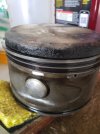
Continental O-200, all cylinders removed due to oil analysis and found 1 broken ring. All cylinders, valves, guides, bushings, pistons, etc., within normal limits so degreased, bead blast as needed, honed and new rings and used Continental breakin procedure with Type M oil. Compression check at 18 hrs and #1 and #3 showed low 50's. Take #1 and #3 off again and both pistons which were clean at reassembly now have heavy black coating. Cylinders appear normal, no scoring marks. FYI I am not an A&P, I do owner assist where I do all the disassembly and the A&P does the reassembly and since it is Sunday and he has a family I will not bother him until tomorrow but I am really curious about this. Any ideas on what went wrong?

You are using an out of date browser. It may not display this or other websites correctly.
You should upgrade or use an alternative browser.
You should upgrade or use an alternative browser.
Black Carbon coated pistons - only 18 hours use
- Thread starter MRSpad
- Start date

Ed Haywood
Final Approach
Improper break in procedure?
Steamflyer
Line Up and Wait
- Joined
- Mar 23, 2022
- Messages
- 954
- Display Name
- Steamflyer
Any chance one/some rings were put on upside down?Continental O-200, all cylinders removed due to oil analysis and found 1 broken ring. All cylinders, valves, guides, bushings, pistons, etc., within normal limits so degreased, bead blast as needed, honed and new rings and used Continental breakin procedure with Type M oil. Compression check at 18 hrs and #1 and #3 showed low 50's. Take #1 and #3 off again and both pistons which were clean at reassembly now have heavy black coating. Cylinders appear normal, no scoring marks. FYI I am not an A&P, I do owner assist where I do all the disassembly and the A&P does the reassembly and since it is Sunday and he has a family I will not bother him until tomorrow but I am really curious about this. Any ideas on what went wrong?
Any chance one/some rings were put on upside down?
That was my guess too.
What were the compression readings prior to removal?Continental O-200, all cylinders removed due to oil analysis and found 1 broken ring.
What was in the analysis that led you to remove the cylinders?
Which cylinder had the broken ring?
Bead blasted with what blast media?bead blast as needed,
By honing, to do mean they were re-cross-hatched per the OH manual?honed and new rings and used Continental breakin procedure with Type M oil.
Were the cylinder dimensions measured after clean up?
Have you verified the rings are the correct part number, have the proper gaps, and are installed in the proper location?

Dan Thomas
Touchdown! Greaser!
- Joined
- Jun 16, 2008
- Messages
- 12,389
- Display Name
- Dan Thomas
That piston doesn't look healthy. The top land is rough and eroded, and there appears to be excessive clearance between the top ring and top land. The wear on the top ring sure looks like a lot more than 18 hours' worth.

Dan Thomas
Touchdown! Greaser!
- Joined
- Jun 16, 2008
- Messages
- 12,389
- Display Name
- Dan Thomas
From the original photo:
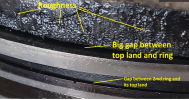
The roughness is bad enough. If that was carbon it would have been removed during overhaul 18 hours ago. The clearances between the rings and lands is concerning. The table of limits here:
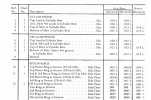
Line 10: Clearance for the O-200, top ring, is .006" to .010". That's the thickness of two or three sheets of printer paper. The second ring's clearance is from .0045" to .009", one-and-a-half to three sheets. The gaps I see there are at least two or three times that. That hurts compression and oil control.
The roughness is bad enough. If that was carbon it would have been removed during overhaul 18 hours ago. The clearances between the rings and lands is concerning. The table of limits here:
Line 10: Clearance for the O-200, top ring, is .006" to .010". That's the thickness of two or three sheets of printer paper. The second ring's clearance is from .0045" to .009", one-and-a-half to three sheets. The gaps I see there are at least two or three times that. That hurts compression and oil control.
Very good info, I talked to A&P this a.m. and he said that rings were all installed with the top side up, as they should be. The rough black crud on side of piston head above top ring is burnt oil/carbon and can be cleaned off. He did not say anything about ring clearances, just that he would clean them up and get back to me.From the original photo:
View attachment 144034
The roughness is bad enough. If that was carbon it would have been removed during overhaul 18 hours ago. The clearances between the rings and lands is concerning. The table of limits here:
View attachment 144035
Line 10: Clearance for the O-200, top ring, is .006" to .010". That's the thickness of two or three sheets of printer paper. The second ring's clearance is from .0045" to .009", one-and-a-half to three sheets. The gaps I see there are at least two or three times that. That hurts compression and oil control.
There are 3 separate rings and 1 oil control ring at the bottom of the piston. They are the right part #'sSo, what I thought was stacked rings was just a single ring with a massive clearance.
Incorrect rings?
On the 2 cylinders in question the readings were 70 and 70 prior to disassembly, analysis showed hi chromium (chrome cylinders), normal ferrous, and #1 had 1 broken ring, bead blasted with glass bead and they were very clean, honing as in crosshatch with overhaul manual specific hone depth, measured bore diam. before reassembly, rings per Superior guide for chrome cylinders, all gapped 1 inch into cylinder and installed with TOP side to crown of piston.What were the compression readings prior to removal?
What was in the analysis that led you to remove the cylinders?
Which cylinder had the broken ring?
Bead blasted with what blast media?
By honing, to do mean they were re-cross-hatched per the OH manual?
Were the cylinder dimensions measured after clean up?
Have you verified the rings are the correct part number, have the proper gaps, and are installed in the proper location?

Gary Ward
En-Route
- Joined
- Jan 16, 2020
- Messages
- 3,639
- Location
- Lawrenceburg, Indiana
- Display Name
- Challenger1
- Home Airfield
- I67
I don’t use glass beads on aluminum pistons because there is a possibility of shattering the glass beads and lodge them into the aluminum.
What do the ends of the broken ring look like? Did they ever touch ?
I bet chrome cylinders are harder to seat rings?
What do the ends of the broken ring look like? Did they ever touch ?
I bet chrome cylinders are harder to seat rings?
Dan Thomas
Touchdown! Greaser!
- Joined
- Jun 16, 2008
- Messages
- 12,389
- Display Name
- Dan Thomas
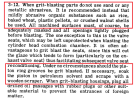
Yup. From the Continental O-200 overhaul manual:I don’t use glass beads on aluminum pistons because there is a possibility of shattering the glass beads and lodge them into the aluminum.
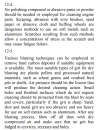
They tell you that sand is too sharp. They don't mention glass bead, but I can tell you that glass is harder and more aggressive than sand. Sand breaks down rapidly in a bead blaster; bead lasts a lot longer. Ground copper slag (black stuff) is the worst: hard, sharp, long-lasting. And cheap. Certainly not for aircraft stuff. It eats the bead blaster itself, too.
From the Lycoming manual:
Gary Ward
En-Route
- Joined
- Jan 16, 2020
- Messages
- 3,639
- Location
- Lawrenceburg, Indiana
- Display Name
- Challenger1
- Home Airfield
- I67
I agree "ground copper slag" is some mean stuff. It does eat my blaster valves and hoses. Here we used to call it coal slag. It is Black. It was the replacement for silica sand when they stopped selling it for health reasons I believe? There's different grades of it coal slag and the course stuff is mean. Unfortunately I used to blast skids of silica sand.
I do have and use urea plastic blasting media that I used on a car outer body. The bottom I did with a fine grade of coal slag after it was steamed cleaned of all under coating.
The way I used to clean up old carboned up pistons, is to stick them in carb cleaner. The stuff that came in metal 5 gallon buckets with a built in strainer basket. It had water on top to seal the chemicals in and not evaporate. Worked good after a day in there.
Last edited: