Basic Med Ethics

Regarding the study I posted above and the reasons to use Basic Med - if Basic provides as much safety as a Class 3 (it does), and if Class 3 requires unneeded and onerous tests and doctor visits (it does), and if Basic doesn't require me to maintain an SI (it doesn't), and if Basic will allow me to do everything I need/want to do (it does), and if there's no risk of "failing" a Basic Med exam (there isn't) but there is a risk with with Class 3 (there is), and if I can have any doc do Basic Med (I can) without having to hunt up an AME, why on earth would I ever play FAA Medical roulette again?
International flights.
 
Why else would someone elect to use BasicMed instead of Class 3?

Both require a visit to the doctor. If you believe you are fit to fly, why wouldn't you expect to be able to pass a Class 3 exam?

I use Basicmed instead of a Class 3 (even though have passed one as recently as 2019) because I can.

I can also pass a Class 1 tomorrow with nothing but a CACI for hypothyroidism and a current note from my derm re-affirming I haven’t had a recurrence of melanoma in 16 years.

I don’t see a reason to buy a Class 3 every other year.
 
Back before basic med and sport pilot the closest we had to the "medical less" thing was examining glider stats compared to power planes. The issue is that sudden incapacitation is a rare event to begin with. But there were plenty of people with medicals (even first class) who keeled over and moreso than glider pilots. So you can argue the current medical process is a lousy screen, it either is worthless and should be abolished or made more rigorous. In my neigborhood of about ten airline pilots, three of had at least one major coronary event including one who suddenly died.
 
Back before basic med and sport pilot the closest we had to the "medical less" thing was examining glider stats compared to power planes. The issue is that sudden incapacitation is a rare event to begin with. But there were plenty of people with medicals (even first class) who keeled over and moreso than glider pilots. So you can argue the current medical process is a lousy screen, it either is worthless and should be abolished or made more rigorous. In my neigborhood of about ten airline pilots, three of had at least one major coronary event including one who suddenly died.

It's not surprising that when there is a medical incapacitation event, it's more often than not in a 121 cockpit by a very experienced pilot holding a first class medical. That makes sense, since a commercial pilot spends more than 10% of their life in the cockpit. Compare that to the typical GA pilot, that spends about 1/2 of 1% of their time in the cockpit. While it's true that the flight environment is often more demanding than the remaining 99.5% of our lives.

The key with medical eligibility standards is tailoring them to the risk and impact of the operation. A single seat light sport and an 787 airliner have a very different calculus.
 
It's not surprising that when there is a medical incapacitation event, it's more often than not in a 121 cockpit by a very experienced pilot holding a first class medical. That makes sense, since a commercial pilot spends more than 10% of their life in the cockpit. ….
And they’re typically older with a history of disrupted circadian rhythms.

I’d like to see a breakdown of medical incapacitation by age, medical held, type of operation, and years and hours flown in that type of operation.
 
It's not surprising that when there is a medical incapacitation event, it's more often than not in a 121 cockpit by a very experienced pilot holding a first class medical. That makes sense, since a commercial pilot spends more than 10% of their life in the cockpit. Compare that to the typical GA pilot, that spends about 1/2 of 1% of their time in the cockpit.
Also, a revenue pilot may feel more pressure to fly than a GA pilot who can cancel if he's feeling a bit off.
 
I am a physician, and I have done some basic med forms. I had a patient that I am following for complex cardiopulmonary disease ask me if his diagnos(es) would allow him to renew his class III. I told him given the severity and complexity of his diagnoses, that I did not think it was very likely that he could renew his medical, and even if he could the special issuance process would be pretty horrible. I told him to think about basic med. And then he asked if I would do his basic med.

I thought about it.

I would have no problem with this guy driving a car, during the day, on shorter trips, in good weather, as long as he self assessed every drive, and was realistic. I also would have no problem from a pure medical standpoint, him flying a basic med appropriate aircraft, VFR, VMC, during the day, on shorter trips, at lower altitudes, in good weather. But unlike a driver’s license, where you can set limits, like Day VFR, must wear oxygen etc. there are no limits on basic med. He could theoretically take a small light jet up to 18,000, at night, in stormy weather, loaded with pax, and make a long trip. Now knowing this patient, I don't see that happening, but pilots are pilots, and we sometimes fly near the edges. So the basic med is a pretty unrestricted medical if I sign it, but he should not (IMHO) be an unrestricted pilot.

Just contemplating if I might be setting the guy up for failure with unknown consequences for him and others nearby.

FAR 61.53 prohibits a person from acting a Pilot in Command that would make the person unable to operate the aircraft in a safe manor.

But, the physician’s instructions on the FAA 8700-2 form state, “The physician completes the “Physician’s Signature and Declaration” if the physician determines that he/she is not aware of any medical condition that, as presently treated, could interfere with the individual’s ability to safely operate an aircraft.”

When your doctor says drive only during the day, short trips and good weather, it’s time to quit flying.
 
Last edited:
Thanks for all the input. A lot to think about. To one of the posters above, I am not worried about personal liability, I have lots of insurance and good lawyers, but more concerned about the pilot and any others that could be affected by medical deterioration during flight.

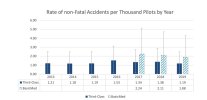
I found that FAA study interesting. As a medical scientist, I can say that the study does not answer the question as to whether pilot flying basic med are as safe as those on class III's. The main reason is that the study has many flaws. It is way underpowered due to insufficient numbers of pilots, insufficient hours to have the appropriate power to see a very meaningful difference. The other big problem is that there is no denominator to give a real rate. Their denominator was number of pilots, not number of flight hours. Do basic med pilots that are on average quite a bit older, fly as many hours as the average pilot with a class III? I don't know. The FAA doesn't know. We need accidents per flight hours to understand the risk better.

These graphs are very interesting. Basic med pilots had about twice the rate of fatal and non-fatal accidents per pilot (numerically), but within the context of lies, damn lies and statistics, that 2-fold increase in rate per pilot was non-significant, because of the low power of the study. This is a common farce that someone may use to prove something is equivalent to something else, by under powering the study. It will take many more years, and better data collection to answer the question proposed, and to clean up the data with a better denominator. Thanks for all the feedback.

Basic med fatal rate.jpg

Basic med accident rate.jpg
 
Why else would someone elect to use BasicMed instead of Class 3?

Both require a visit to the doctor. If you believe you are fit to fly, why wouldn't you expect to be able to pass a Class 3 exam?
Because some of us have to jump through some ******** expensive ass'd hoops to be issued under our Special Issuance Authorization.

Also to avoid the FAA's new "instant denial" protocol (not sure if that's still been postponed or not, but they were trying to enact this end of last year when they were met with massive opposition to it) if their medical gets deferred (which would take BasicMed off the table). The FAA CAMI office has a reputation for abusing pilots through their medical issuance, pulling it/deferring for trivial stuff, resulting in months and years of super expensive medical testing that may end up in a denial, which, again, takes BasicMed off the table.

BasicMed is just an alternate health standard you have to meet in order to operate certain small aircraft without a medical certificate. It's not a "loophole" or "because you have something to hide" measure.
 
Thanks for all the input. A lot to think about. To one of the posters above, I am not worried about personal liability, I have lots of insurance and good lawyers, but more concerned about the pilot and any others that could be affected by medical deterioration during flight.

I found that FAA study interesting. As a medical scientist, I can say that the study does not answer the question as to whether pilot flying basic med are as safe as those on class III's. The main reason is that the study has many flaws. It is way underpowered due to insufficient numbers of pilots, insufficient hours to have the appropriate power to see a very meaningful difference. The other big problem is that there is no denominator to give a real rate. Their denominator was number of pilots, not number of flight hours. Do basic med pilots that are on average quite a bit older, fly as many hours as the average pilot with a class III? I don't know. The FAA doesn't know. We need accidents per flight hours to understand the risk better.

These graphs are very interesting. Basic med pilots had about twice the rate of fatal and non-fatal accidents per pilot (numerically), but within the context of lies, damn lies and statistics, that 2-fold increase in rate per pilot was non-significant, because of the low power of the study. This is a common farce that someone may use to prove something is equivalent to something else, by under powering the study. It will take many more years, and better data collection to answer the question proposed, and to clean up the data with a better denominator. Thanks for all the feedback.

View attachment 141977

View attachment 141978
This also doesn't state whether these incidents were medically significant. Clearly they weren't because Congress lifted a couple of restrictions after 8 years of being in play (MGTOW increased to 12,500 lbs from 6,000 lbs, and 6 pax instead of 5 pax).
 
Stats from the FAA and NTSB on this:
  • FAA (2009–2023): In-flight pilot incapacitation was cited in <0.5% of fatal accidents.
  • NTSB Review: About 1 in 200 GA fatal accidents list a medical cause as contributing or probable cause.
Pretty insignificant.

The number of obese pilots I see flying is insane. That seems more acceptable to the FAA, even though that lifestyle is prone to diabetes, heart disease, stroke, etc.

Same reports showed in fatal crashes ~10–13% of autopsied pilots had cardiovascular disease, that's double the ~5% had toxicology findings (illicit or impairing drugs). Yet the FAA focuses on the latter like it's the number one cause of accidents.

Really, the FAA should be looking more at flight proficiency and training vs. being so laser focused on health. Pilot error is still the vast majority of accidents, 70-80% of all accidents.

While both are important, I think the FAA is focusing on the wrong part. Better training would also better inform pilots to make safer and more sound decisions to assess personal health and go/no go decision making.
 
This very forum seems to indicate that the assertion is true.

I don't see how anecdotes on this forum support an assertion that a large segment are flying on BasicMed because they can't get a medical. That would be tens of thousands. My own anecdote, everyone I know flying BasicMed (can count on one hand) had a current medical before BasicMed...
 
Last edited:
I went Basic Med because of the requirement to look at my anus. I want to make sure if I do something stupid it puckers properly.

Seriously it is just easier. My doctor knows me better. I don't have to worry about some paper work fowl up, coding error or false positive on a test (it happens ask me how I know) possibly taking me out of the game for good or costing me a lot of money to prove I am OK to fly. I also am much more likely to go to the doctor when I have an issue instead of putting it off.
 
Old Thread: Hello . There have been no replies in this thread for 365 days.
Content in this thread may no longer be relevant.
Perhaps it would be better to start a new thread instead.
Back
Top