B17 crash at Dallas.

What is even more troublesome is that the P63 appears to have been heading to the 500' line, indicating he must have lost sight of his lead.
Yeah, I guess we may never really know. He may have been trying to head where lead was supposed to go. It only takes one second, one missed communication, one glance at your instruments... they were moving fast enough for the P-63 to cut a B-17 in half. Things happen in a hurry in formation.
 
What is even more troublesome is that the P63 appears to have been heading to the 500' line, indicating he must have lost sight of his lead.
I don't think he lost sight of lead at all. I'm pretty sure he flew the 500' line multiple times during the Tora show in the "Hawk" replica, followed by a short acro demonstration and I believe he knew exactly where the airboss told the fighters to be. Ironically, his own general competence may have contributed to the accident. I still wonder if he was thinking, "why isn't lead headed for the 500' line?" and there seems to be a little hesitation in his track and that little bit of extra mental thought might have been a little extra keeping him from seeing something in the periphery.

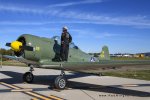
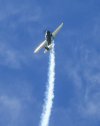
Attached are my photos from his preflight before the Tora show, during Tora, and the acro demonstration.

If you look at the ADS-B about 4:52 in the NTSB video, he flew a pretty straight track as he spaced to #3 from the trail, then went slightly right, and then arced left just before the collision.


Attachments

  • C0037T01.jpg
    C0037T01.jpg
    173 KB · Views: 11
  • DSC_7611.jpg
    DSC_7611.jpg
    337 KB · Views: 11
  • DSC_7672.jpg
    DSC_7672.jpg
    825.7 KB · Views: 11
Last edited:
See and avoid works for the lead, but the trailing airplanes are watching the lead, so if the lead fails to follow the direction he's given, which is what this article says, then everyone else is doomed at that point.
Sounded to me more like the article said the Air Boss gave an ambiguous instruction to the fighters of the "outside edge of the runway" which is neither the 500 nor 1000 foot line, after (much) earlier telling them to be on the 500 foot line in a very long and ambiguous instruction that the fighter lead asked for clarification on.

The P-63 pilot had no way to crane his head around and see the B-17, except for maybe a few seconds, and even then it was in the ground clutter.
According to the visibility study, the B-17 was visible to the P-63 for 16 continuous seconds, but in ground clutter, and would have disappeared under the wing four seconds prior to impact.

What is even more troublesome is that the P63 appears to have been heading to the 500' line, indicating he must have lost sight of his lead.
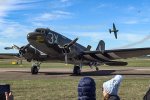
...or he understood the instruction to the fighters and went where he thought lead went. They weren't in a tight formation by any means, they were in trail and a fair bit apart.
 
I think that's a little goofy. Most of those planes involved were also using ADS-B, and that was also inadequate, clearly.
The article differentiates between visual separation and procedural separation, and makes the point that visual separation alone is more vulnerable to human error. That's a pretty succinct summation of what went wrong with the recent midair in DC.
 
Tora tora is an approved maneuver that is pre-orchestrated. It’s not the same as an air boss controlled formation flight. The briefing was for the fighters to fly formation, not do whatever they each thought the air boss said. It’s not called the lead position simply because they are ahead of the rest. The non-lead pilots job was to follow the lead. When you’re in formation, anything else is dangerous.

Perhaps I have no proof, but I want to believe the p63 pilot was an exceptional pilot and would not have left his lead intentionally. I prefer to think he briefly lost his lead and felt the safest course of action was to continue to where they were supposed to be going. Perhaps he was just about to call knock it off, we’ll never know. This is totally speculative, but it’s what I choose to believe happened.
 
...or he understood the instruction to the fighters and went where he thought lead went. They weren't in a tight formation by any means, they were in trail and a fair bit apart.
This is pretty much the same as what I am saying.
 
Definitely doesn't paint a good picture.
 
Tons of kids have followed in their father’s footsteps successfully. If he started when he was 14 or 18, it took, what, 22 years for this mistake to happen? That’s not a rookie mistake, it’s something else.
 
Tons of kids have followed in their father’s footsteps successfully. If he started when he was 14 or 18, it took, what, 22 years for this mistake to happen? That’s not a rookie mistake, it’s something else.
It's a demonstration that the backups like looking out the window saved his butt every time... Until they didn't. Normalization of deviance at work. Everything is fine 999 straight times, and then on the 1000th time you have dead people and everyone standing around wondering how this could have happened because it seems so stupid in hindsight.

The fact that his dad was saved from the same kind of accident by big sky theory just a couple of weeks before tells you it's not a safe way of operating.
 
By his own words he doesn’t believe in using vertical separation. He believes it distracts the pilot from looking outside. He believes visual separation is the best tool.

It worked for a long time, largely due to good pilots.
 
By his own words he doesn’t believe in using vertical separation. He believes it distracts the pilot from looking outside. He believes visual separation is the best tool.

It worked for a long time, largely due to good pilots.

What goes unsaid is that is dissimilar, maneuvering formations that are intended to merge, require multiple layers of separation to merge safely.

Best doesn’t mean s- -t if it means only.

As for using ADS-B as a separation / SA tool in this kind of environment, that’s laughable, too.
 
Tons of kids have followed in their father’s footsteps successfully. If he started when he was 14 or 18, it took, what, 22 years for this mistake to happen? That’s not a rookie mistake, it’s something else.
1741218963963.jpeg

Following footsteps is a time honored career path. But it’s also a time honored way to accept normalization of deviance without even knowing it to be deviance.
 
Following footsteps is a time honored career path. But it’s also a time honored way to accept normalization of deviance without even knowing it to be deviance.
Deviance, from what? Sometimes the norm is what needs to be deviated from. That's more what I was trying to say. Were the airshows safer 25 years ago?
 
Deviance, from what? Sometimes the norm is what needs to be deviated from. That's more what I was trying to say. Were the airshows safer 25 years ago?
It’s deviation from *safe* practices and procedures, not deviation from the *normal* practices and procedures.

You ask an interesting question, I’m curious about the answer. But, it’s also possible that we have been normalizing unsafe procedures for more than 25 years.
 
I don't have time right now, but can anyone find ADS-B tracks from Oct. 30, 2021 for Dallas Executive?

I'm really curious what all it would show.
 
According to the visibility study, the B-17 was visible to the P-63 for 16 continuous seconds, but in ground clutter, and would have disappeared under the wing four seconds prior to impact.
This has no bearing on anything. As a formation pilot, being able to see another plane doesn't mean you were, or should have been, looking for it. You're looking at the plane in front of you only.
 
As a formation instructor for both the US Navy and US Air Force, I teach to scan the entire plane both as good technique to find positional errors AND spot traffic.

ESPECIALLY during phases where you’re not actually joined up, as in this case. It’s worth some scrutiny in this case, albeit it’s a last chance item, not really causal.

Saving money is what started this chain of events. Poor pilot technique was the last link in the chain.
 
Deviance, from what? Sometimes the norm is what needs to be deviated from. That's more what I was trying to say. Were the airshows safer 25 years ago?
I don't know enough about running, performing in, or even watching air shows to answer the questions of what the ideal safety rules should be, what the actual safety rules in general use are, and whether air shows were safer 25 years ago. All I'm saying is that a kid whose only driving instructor is a dad who never wears a seatbelt or uses a turn signal might never learn that his safety norms deviated from ideal or generally accepted safety norms before he inherited them.
 
Sooooo…. Pretty probable an air boss issue.

But you have to ask what/why more than once to get to the root cause.

What happened? Fighter flew into a bomber.
Why? Loss of situation awareness.
Why did he lose it? Bad plan on the fly.
Who? Air boss.
WHY? Inexperienced?

Thence… how could he be air boss? Selected by air show organizers.

WHY?

That answer will get us closer to root cause.

This post aged well.
 
I don't have time right now, but can anyone find ADS-B tracks from Oct. 30, 2021 for Dallas Executive?

I'm really curious what all it would show.

globe . adsbexchange . com would quite likely turn it up.

I find the playback feature a bit flaky but it works well quite a lot of the time. I think it loads 30min of data and then plays it and then stops and loads ... ...

Here is an example URL that you might find useful. It has TWO aircraft. It is about the moment of the B-17 crash. You can change the date and icao ids or whatever to make a URL that meets your needs.

There is no time in this URL. It displays the last data point available - in this case the crash.


There is a direct relationship between the icao hex id and the registration.

The easiest way I have to get the icao id from the reg is to use adsbexchange.

will put the icao id in the URL.

Here is one with a time too.


A few seconds earlier - looks like the timestamp resolution is a second.
 
Last edited:
Back
Top