
You are using an out of date browser. It may not display this or other websites correctly.
You should upgrade or use an alternative browser.
You should upgrade or use an alternative browser.
Another Rob….
- Thread starter Wedge74
- Start date

Kenny Phillips
Final Approach
- Joined
- Jul 29, 2018
- Messages
- 6,570
- Display Name
- Kenny Phillips
Sounds as if the end of a control tube pulled out (unless that was a consequence of the crash, but I doubt that.)
bonefishpete
Cleared for Takeoff
- Joined
- Nov 10, 2024
- Messages
- 1,360
- Display Name
- Bonefishpete
Lantana is kind of salty.

Brad Smith
En-Route
- Joined
- Nov 26, 2017
- Messages
- 3,575
- Display Name
- Brad Smith
Very sad. There’s a good chance that after the last blade tracking procedure, the nuts weren’t tightened properly. It would be interesting to know when the last blade tracking was accomplished. Of course, the corrosion present is another matter entirely.
bonefishpete
Cleared for Takeoff
- Joined
- Nov 10, 2024
- Messages
- 1,360
- Display Name
- Bonefishpete
Not quite the Jesus nut but close enough.
My take is that failure was during the accident sequence given the servos are mounted to the airframe and the main xsmn/blades got stuck in the roof structure. Nor is a clevis failure one of those instances where a pilot would first state "we’re going to be landing out here in one of these fields, we’ve got something going on with the helicopter.” Given it was only about 1 hour out after its last 100 hour my guess is something else was going on and they elected to attempt a precautionary landing but didn't make it.Sounds as if the end of a control tube pulled out (unless that was a consequence of the crash, but I doubt that.)

wilkersk
En-Route
Grainy photo. But that lower end of the push-pull tube looks like it's in pretty bad shape. That and the fact that the threads on the rod-end that separated appear to be undamaged tells me that if it wasn't the cause of the crash, it likely could have been in the very near future.
Also, I wonder why they use those cheap stamped steel nuts on control tubes instead of AN315s?
Also, I wonder why they use those cheap stamped steel nuts on control tubes instead of AN315s?
The rod end is steel and the control tube is aluminum. Whats missing from the picture is the tube threads still attached to the rod end threads which may have been lost or cleaned before the pic was taken.That and the fact that the threads on the rod-end that separated appear to be undamaged tells me that if it wasn't the cause of the crash, it likely could have been in the very near future.
AN315 nuts are plain and not self-locking, but if they had been an AN363 or similar self-locking nut, the installed NAS679 "stamped" nut or a MS21043 nut would have been the next higher assembly replacement for it.Also, I wonder why they use those cheap stamped steel nuts on control tubes instead of AN315s?

FlightmechH3
Line Up and Wait
- Joined
- Dec 30, 2021
- Messages
- 527
- Display Name
- FlightmechH3
Jam nuts didn't have safety wire?!
wilkersk
En-Route
The rod end is steel and the control tube is aluminum. Whats missing from the picture is the tube threads still attached to the rod end threads which may have been lost or cleaned before the pic was taken.
AN315 nuts are plain and not self-locking, but if they had been an AN363 or similar self-locking nut, the installed NAS679 "stamped" nut or a MS21043 nut would have been the next higher assembly replacement for it.
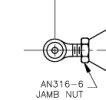
I'm used to seeing rod-ends secured with an AN-316 jam nut and safety wire. Those PAL nuts are not something I've ever seen on a flight control. And those threads don't look all that clean to me.
Attachments
Last edited:
Jam nuts didn't have safety wire?!
You'll find in most non-rotating control tube installs there will only be a single torqued jam nut on the clevis or rod end with no secondary safety like on a B206 or AS350 below the swashplate. And in the report pics above it shows a single jamnut with a palnut plus mentions the required torque seal strip.I'm used to seeing rod-ends secured with an AN-316 jam nut and safety wire.
When the control rods or tubes are rotating like above the sw/plate or have one end that is not "captured" then you start to see safety wire or a lock tab secondary safety. Or in the case of Robbies, palnuts. They have been the primary secondary safety device since day one. And they use them everywhere to the point where most think it the only thing that holds a Robbie together.
Last edited: