Altitude chamber training locations

Let'sgoflying!

Touchdown! Greaser!
Joined
Feb 23, 2005
Messages
21,872
Location
west Texas
Display Name
Dave Taylor
Home Airfield
KMRF
I am not finding any that are open, for civilian pilots.
Looks like ‘mine’, Holloman, no longer does.
(It was closest, years ago) (Texas)
Maybe Tempe?
 
The FAA runs a program in OKC with a chamber.


There's an alternative, known as PROTE. Doesn't change the pressure but reduces the O2 for a similar effect. Check with the local 99s chapter, as they frequently host the program.

 
cool, thanks.
Wondering if PROTE qualifies as the Hi Altitude endorsement.
 
It’s usually not done in an airplane, done in a ‘chamber’.
But thanks for the info.
The PROTE may (and I repeat may) cover some of the requirements. Details here:
Ground training must cover the topics outlined in 14 CFR 61.31(g), which includes aerodynamics, respiration, hypoxia symptoms and effects, high-altitude sickness, supplemental oxygen use, and more
 
IIRC, and just checked. You do not need an altitude chamber ride or PROTE experience for the requirements of 61.31(g). But all of the academics outlined in 61.31(g)(1) are part of the chamber or PROTE experience. You will need an aircraft or appropriate simulator to emulate a pressurized aircraft for 61.31(g)(2).
 
Yep big takeaway. If in flight it's not the takeoff warning horn. Put on your mask.
 
Having done a few PROTE sessions, I highly recommend it.
It's quite the eye opening experience, and everyone turns a different kind of stupid at 25k ft. My personal experience seems to be that people react the same way as they do after moderate to heavy drinking.
Some are very exuberant, flailing their arms and laughing for no reason, some mentally check out and some realize what's going on as their brains slow down, and struggle to maintain function with varying degrees of success.
 
In the way back I was visiting a number of military bases. I never realized the chamber was free and literally at the other end of the building I was in. Face palm.
 
I am not finding any that are open, for civilian pilots.
Looks like ‘mine’, Holloman, no longer does.
(It was closest, years ago) (Texas)
Maybe Tempe?
It used to be that you could do this at any AFB. Sadly, that is no longer the case. I don't think there's any civilian option except to visit the Death Star <ahem> Mike Monroney Aeronautical Center AKA FAA HQ in OKC to do the actual depressurization chamber. (Bonus, you get to do the spatial disorientation simulator while you're there which will really throw you for a loop...)

They do take the PROTE system "on tour" and it's usually in Oshkosh... It's basically a big clear box that they pump extra nitrogen into to displace some of the oxygen. That gives you hypoxia without actually changing pressure.

cool, thanks.
Wondering if PROTE qualifies as the Hi Altitude endorsement.
Don’t think so. It’s not an airplane.
It’s usually not done in an airplane, done in a ‘chamber’.
But thanks for the info.
61.31(g) requires BOTH Ground (g1) and Flight (g2) training. The FAA's chamber course covers everything necessary for the ground component and they give you a signoff for that. However, you still need to complete the flight portion of the training in a pressurized aircraft.

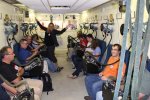
Altitude chamber in OKC:
IMG_6515.JPG
 
PROTE training would be useful for hypoxia but cannot simulate the other effects of rapid depressurization on the body?
I feel like we are losing something, as chamber rides disappear.
What part of this can be safely done in an airplane? (ref to in-flight portion)
 
PROTE training would be useful for hypoxia but cannot simulate the other effects of rapid depressurization on the body?
I feel like we are losing something, as chamber rides disappear.
What part of this can be safely done in an airplane? (ref to in-flight portion)
They haven’t done rapid decompressions for a long time in the civilian world. Too much chance of permanent damage, I suppose. I had a chief pilot that dumped the cabin on a King Air with me at 10,000 feet…I really wouldn’t want to go much farther than that. It wasn’t painful or anything, but I think the risk increases dramatically the more altitude change you’re subjected to.

CAE used to have a course where they’d use the decompression chamber at one of the hospitals in town. Might be worth checking with them.
 
PROTE training would be useful for hypoxia but cannot simulate the other effects of rapid depressurization on the body?
I feel like we are losing something, as chamber rides disappear.
What part of this can be safely done in an airplane? (ref to in-flight portion)

Having experienced a rapid decompression in the chamber at 25000 feet pressure altitude, I wouldn’t want to do one in an airplane just for training purposes. It can be a rather violent evolution.

ETA: there’s also some physiological risks in doing rapid d training at 18000 & above. For that reason alone, I wouldn’t want to do it in the jet, even with medical staff onboard.
 
Last edited:
We did rapid decompression in the chamber when transitioning to the T-38. They put a few people in a small chamber that was set to 10,000 feet while the big part was taken to 35,000 feet. Then they opened the door between them.

Big noise, stuff blowing around, instant fog.

To do this safely, you have to pre-breath 100% O2 for 30 minutes to reduce the chance of getting the bends.
 
PROTE training would be useful for hypoxia but cannot simulate the other effects of rapid depressurization on the body?
I feel like we are losing something, as chamber rides disappear.
What part of this can be safely done in an airplane? (ref to in-flight portion)
I suppose you could go to 15,000 with one pilot on O2 and one not...

IIRC, the FAA's chamber ride they go up to 18,000 and then back down to 10 at reasonable speeds to ensure nobody's got an ear block, then they blow it to 25 with all of the foggy fun. But I can't imagine what a true rapid decompression up at 35-40 would be like. Yikes.
 
We did rapid decompression in the chamber when transitioning to the T-38. They put a few people in a small chamber that was set to 10,000 feet while the big part was taken to 35,000 feet. Then they opened the door between them.

Big noise, stuff blowing around, instant fog.

To do this safely, you have to pre-breath 100% O2 for 30 minutes to reduce the chance of getting the bends.

Yup. That was one of the evolutions we did in the 3-day course. Day one was academics, day two was some academics and the hypoxia flight, day 3 was the rapid -d, IIRC. It’s been a long time, but I seem to recall it was intentional to not do both chamber rides the same day.


When we went back for the 1-day refresher, I seem to recall academics in the morning and hypoxia ride in the afternoon.
 
I did mine at Pensacola in the Navy (many moons ago). I don't recall that that training included a rapid decompression, just an ascent on oxygen, then a period of time half of the chamber occupants take the mask off and perform basic tasks (patty-cake, dealing cards, simple math, etc.), and the other half sees how messed up everyone gets when hypoxic. Then oxygen masks go back on, and the other half tries it. The only facility that I am aware of that does rapid decompressions is the KBR chamber at Brooks City Base in San Antonio, but those runs are for research and equipment qualification purposes only, and they use only active duty military volunteers as subjects.

Spatial disorientation training was fun (for me). They used a device called the MSDD (Multi-station Spatial Disorientation Device) which can simulate all of the standard illusions, plus gives a hell of a ride - at the end they give you a cat shot! 10 pilots ride it at a time, but they can give each capsule an individualized experience. Before starting, they hand you a large trash bag to use (if necessary), and the session can be so stressful on your inner ear that only one ride per day is permitted. The physiologist mentioned that 25% of Navy jet aviators get sick on the ride. I loved it!
 
that's a shame that the FAA program no longer uses military facilies. A real shame.

way back in 1993, I did a ride at Langley AFB through the FAA's program. A 1-day physiology course. It was an extremely good experience. Learned a lot from the classroom stuff too. Sadly their spin chair was broken so I didn't get that experience.
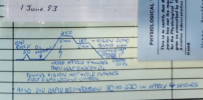
Here's a grab of part of the notation I made in my logbook, documenting the 'flight' profile
I went back on O2 after 4 minutes, my choice because I didn't like the feeling of losing control. Back then I didn't drink, so the feeling of a drinking maybe 2 beers didn't feel right to me. Now I regret not pushing that longer to experience how things would derail a little past that.
The rabid decompression was fun to say that we did, but I remember it being a non-event....just some fog and colder temperatures

and regarding the question about the endorsement, post #3. I received an endorsement covering the ground portion of the training

1748558037861.png
 
There are some portable set ups the FAA uses. They use molecular sieves to separate the O2 from the air. I did my session at Richmond Executive. It was well worth the time.
 
FWIW, when I went through Navy flight training (17 years or so ago), we still rode the chamber in pensacola. My understanding is that it is no longer operational. In the tactical aviation/jet community, we moved over to the Reduced Oxygen Breathing Device (ROBD) trainer many years ago. It is a biannual (if I remember correctly) requirement, and you do it every 4 years as well during your swim physiology recurrent training. You sit in a low cost trainer/partial sim, and they hook you up to an O2 mask attached to your helmet where they can manipulate the O2 concentration. It's pretty effective, and in a matter of a couple minutes, they can get your blood O2 down into the 70% range with full hypoxic symptoms. I imagine much cheaper than a chamber and the associated maintenance that goes along with it. That chamber ride in 2008 was the last one I ever did anyway. Would be cool if the FAA sponsored a similar training device to the ROBD. Having done it many times now, I am pretty well aware of my personal response to oxygen depravation, as it varies from person to person. Biggest one being that my symptoms are very mild until I am on the verge of loss of consciousness from a medical perspective.

 
FWIW, when I went through Navy flight training (17 years or so ago), we still rode the chamber in pensacola. My understanding is that it is no longer operational. In the tactical aviation/jet community, we moved over to the Reduced Oxygen Breathing Device (ROBD) trainer many years ago. It is a biannual (if I remember correctly) requirement, and you do it every 4 years as well during your swim physiology recurrent training. You sit in a low cost trainer/partial sim, and they hook you up to an O2 mask attached to your helmet where they can manipulate the O2 concentration. It's pretty effective, and in a matter of a couple minutes, they can get your blood O2 down into the 70% range with full hypoxic symptoms. I imagine much cheaper than a chamber and the associated maintenance that goes along with it. That chamber ride in 2008 was the last one I ever did anyway. Would be cool if the FAA sponsored a similar training device to the ROBD. Having done it many times now, I am pretty well aware of my personal response to oxygen depravation, as it varies from person to person. Biggest one being that my symptoms are very mild until I am on the verge of loss of consciousness from a medical perspective.
ROBD is the standard in the Air Force now, too. Even the pilot training chambers are (or have) gone away. Seems to me like the same philosophy as why they haven’t done robust parachuting training for pilot trainees in a long time. It wasn’t worth the program’s cost and injury rate considering the marginal benefit over other training options. Seeing a rapid D was cool, but practicing the critical action items, learning hypoxia symptoms, etc is the most important part and can be accomplished in the low-cost trainer.
 
ROBD is the standard in the Air Force now, too. Even the pilot training chambers are (or have) gone away. Seems to me like the same philosophy as why they haven’t done robust parachuting training for pilot trainees in a long time. It wasn’t worth the program’s cost and injury rate considering the marginal benefit over other training options. Seeing a rapid D was cool, but practicing the critical action items, learning hypoxia symptoms, etc is the most important part and can be accomplished in the low-cost trainer.

Hah funny you mention parachuting. We didn't fully do parachuting, but we practiced parachute landings, and in later years, got a VR sim to practice handling various parachute malfunctions while hanging from straps in your harness. But the closest we got was what was referred to as "Redneck Parasailing".......they hooked you up to a line behind a pickup truck while strapped to a parachute. The truck would start driving through a field and you started running until you got enough speed (not much) that the parachute took you airborne. Then they cut you loose and you practiced landing. Seemed pretty simple and hard to screw up to me, but I guess some gal landed wrong a couple years later, broke her hip, and that was the end of redneck parasailing forever.
 
Hah funny you mention parachuting. We didn't fully do parachuting, but we practiced parachute landings, and in later years, got a VR sim to practice handling various parachute malfunctions while hanging from straps in your harness. But the closest we got was what was referred to as "Redneck Parasailing".......they hooked you up to a line behind a pickup truck while strapped to a parachute. The truck would start driving through a field and you started running until you got enough speed (not much) that the parachute took you airborne. Then they cut you loose and you practiced landing. Seemed pretty simple and hard to screw up to me, but I guess some gal landed wrong a couple years later, broke her hip, and that was the end of redneck parasailing forever.
Yes! That was abolished shortly before I went through, to my great disappointment. Too many broken legs, I guess. The VR simulator hadn’t come online yet, though. Just lots of jumping off 5 ft platforms into a gravel pit to practice PLFs over and over and over and over again. None of the ejections I was familiar with involved injuries stemming from the landing, so must’ve been the right call.
 
IIRC, the FAA's chamber ride they go up to 18,000 and then back down to 10 at reasonable speeds to ensure nobody's got an ear block, then they blow it to 25 with all of the foggy fun. But I can't imagine what a true rapid decompression up at 35-40 would be like. Yikes.
USAF chamber rides the ear check was up to 5,000 and back. I had one guy in my class that had a blockage. It took some work to clear it.
 
Yes! That was abolished shortly before I went through, to my great disappointment. Too many broken legs, I guess. The VR simulator hadn’t come online yet, though. Just lots of jumping off 5 ft platforms into a gravel pit to practice PLFs over and over and over and over again. None of the ejections I was familiar with involved injuries stemming from the landing, so must’ve been the right call.
When did you go through?

I was USAF Class 82-01, so did that in December 1980. We did do parasailing. IIRC 3 rides. But they did not cut you loose, they just slowed down. They said that the parasail canopies came down faster.

In water survival school, the last parasail was a full cutaway from the tow rope. Nothing like being paid to parasail over Biscayne Bay. :D
 
Would be cool if the FAA sponsored a similar training device to the ROBD. Having done it many times now, I am pretty well aware of my personal response to oxygen depravation, as it varies from person to person. Biggest one being that my symptoms are very mild until I am on the verge of loss of consciousness from a medical perspective.
They do. The PROTE mentioned is that same thing, but they reduce the O2 level in a big plastic container with several people inside rather than just the mask.
 
Yup. That was one of the evolutions we did in the 3-day course. Day one was academics, day two was some academics and the hypoxia flight, day 3 was the rapid -d, IIRC. It’s been a long time, but I seem to recall it was intentional to not do both chamber rides the same day.


When we went back for the 1-day refresher, I seem to recall academics in the morning and hypoxia ride in the afternoon.
We did 3 chamber rides.

One long one in initial physiological training. One night one just prior to starting night flying in the Tweet (a LONG time ago). Then one with pressure breathing and sudden decompression when doing the T-38 systems course before flying it.
 
When did you go through?

I was USAF Class 82-01, so did that in December 1980. We did do parasailing. IIRC 3 rides. But they did not cut you loose, they just slowed down. They said that the parasail canopies came down faster.

In water survival school, the last parasail was a full cutaway from the tow rope. Nothing like being paid to parasail over Biscayne Bay. :D
I was 11-07. I did the non-parachuting water survival course for the SOF platforms I flew after UPT. Getting turned upside down in a fuselage under water in a dark pool was not as much fun as parasailing over Biscayne Bay, for sure!
 
USAF chamber rides the ear check was up to 5,000 and back. I had one guy in my class that had a blockage. It took some work to clear it.
Even after the check, one person in our group had some trouble at the very end, so we all hung out in the lower flight levels while the safety guy with the bottle of Afrin did his thing.
 
Getting turned upside down in a fuselage under water in a dark pool was not as much fun as parasailing over Biscayne Bay, for sure!
Once I resigned myself to cleaning my sinuses with pool water I thought the dunker was kind of fun. Learning hand/arm tricks to avoid a boot to the teeth during the blindfolded egress drills was a plus.

Nauga,
flushed with success
 
Even after the check, one person in our group had some trouble at the very end, so we all hung out in the lower flight levels while the safety guy with the bottle of Afrin did his thing.
During mine, the Afrin did not work.

So they gave him a sip of water, had him swallow as they applied some air pressure.

It cleared the blockage, but water hit the inside of both his ear cups. But it seems a small hole in the diaphragm is not grounding. :)
 
W
I was 11-07. I did the non-parachuting water survival course for the SOF platforms I flew after UPT. Getting turned upside down in a fuselage under water in a dark pool was not as much fun as parasailing over Biscayne Bay, for sure!
Wow, you were not walking when I graduated. :D
 
W

Wow, you were not walking when I graduated. :D
You're only as old as you feel!

I'm definitely not the young guy walking around the squadron these days either, though. I'm sure that's not helping, though.

Cheers!
 
Once I resigned myself to cleaning my sinuses with pool water I thought the dunker was kind of fun. Learning hand/arm tricks to avoid a boot to the teeth during the blindfolded egress drills was a plus.

Nauga,
flushed with success

For the bad rap it gets, I never found the dunker to be the worst part of our ejection seat aircrew course. Even after some people who freaked out tried to test my drown proofing/head kicking resilience. That being said, I have done my last one already, and I'm not sad about that.
 
The dunker was always an enjoyable experience for me. I'd be the guy asking for another dive at the end of the course, off-script, if there was time. One time the scenario included a "dead" guy blocking the exit, so you had to unbuckle him and get the body out of the way before getting out. In complete darkness, upside-down, unrestrained, while trying to maintain the proper frame of reference in your head.
Didn't work that well the first time.
 
Back
Top