Altimeters and air pressure on hot or cold days

2nd505th

Pre-takeoff checklist
Joined
Apr 11, 2018
Messages
119
Display Name
2nd505th
Can someone explain this contradiction - I cannot get my mind around it.

From ASA Oral Pilot Prep Guide
Non-standard pressure and temperature:
a. Temperature variations expand or contract the atmosphere and raise or lower pressure levels that the altimeter senses.
On a warm day — The pressure level is higher than on a standard day. The altimeter indicates lower than actual altitude.
On a cold day — The pressure level is lower than on a standard day. The altimeter indicates higher than actual

AI Overview
No, generally, pressure is not lower on a cold day. Cold air is denser, meaning it weighs more per unit volume. This denser air exerts more pressure at the Earth's surface, leading to higher pressure in cold weather.
 
What you're missing is that "pressure level" does not mean "pressure." I don't remember where and how well the FAA publications that private pilot applicants are supposed to study covers "pressure level" but understanding it is the key to get your mind around the subject.
 
Ok - So I think I get it: "In aviation, "pressure level" refers to a constant pressure surface within the atmosphere, usually measured in terms of altitude." Meaning to me that pressure level of say 29.92 could be at any altitude above the terrain and could vary over a wide area.

But still not getting this: If two airports are at the same terrain level say 1000' MSL. One is 30.92 and other is 29.92. If the only factor affecting pressure is temperature would not the one at 30.92 be colder?
 
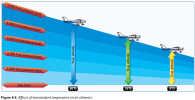
This is figure 8-3 from the PHAK. Maybe it will help you visualize what's going on. As the temperature cools, you can think of the atmosphere becoming "compressed" vertically, so that there is not as great a true altitude delta for a given change in pressure.

1747589486003.png
 
Ok - So I think I get it: "In aviation, "pressure level" refers to a constant pressure surface within the atmosphere, usually measured in terms of altitude." Meaning to me that pressure level of say 29.92 could be at any altitude above the terrain and could vary over a wide area.

But still not getting this: If two airports are at the same terrain level say 1000' MSL. One is 30.92 and other is 29.92. If the only factor affecting pressure is temperature would not the one at 30.92 be colder?
Pressure is given in inches of Mercury (or Bars, Milibars, Pascals).
Pressure level is given in feet (or meters).
 
Ok - So I think I get it: "In aviation, "pressure level" refers to a constant pressure surface within the atmosphere, usually measured in terms of altitude." Meaning to me that pressure level of say 29.92 could be at any altitude above the terrain and could vary over a wide area.

But still not getting this: If two airports are at the same terrain level say 1000' MSL. One is 30.92 and other is 29.92. If the only factor affecting pressure is temperature would not the one at 30.92 be colder?
It would be colder. The pressure level of that airport would be lower than 1000’
 
This is figure 8-3 from the PHAK. Maybe it will help you visualize what's going on. As the temperature cools, you can think of the atmosphere becoming "compressed" vertically, so that there is not as great a true altitude delta for a given change in pressure.

View attachment 141169
That there. The cold air shrinks, and shrinks the pressure columns with it.

The old say we learned in IFR training: "High to Low, Look Out Below." If we fly into a colder area, such as behind a cold front, our altimeters will try to lie to us about how high we are, and we could easily smack into cumulogranite. It's also the reason why some approach altitudes are adjusted during cold weather.

That saying also applies to flying into an area of lower barometric pressure. The altimeter will over-read there, too. https://meteorologytraining.tpub.com/14010/css/14010_203.htm
 
But still not getting this: If two airports are at the same terrain level say 1000' MSL. One is 30.92 and other is 29.92. If the only factor affecting pressure is temperature would not the one at 30.92 be colder?
Temperature doesn’t affect the pressure of the air (pounds of air per square inch of surface, for example) that much, it affects volume. Colder air shrinks, so the same number of molecules of air below you (or technically above you) has roughly the same weight. The description of the temperature effect should include a statement of “constant pressure.”
 
Last edited:
But still not getting this: If two airports are at the same terrain level say 1000' MSL. One is 30.92 and other is 29.92. If the only factor affecting pressure is temperature would not the one at 30.92 be colder?
If it worked that way we wouldn't need barometers would we? Just measure the temperature and apply a formula along with elevation to calculate pressure.
 
Can someone explain this contradiction - I cannot get my mind around it.
...
On a warm day — The pressure level is higher than on a standard day. The altimeter indicates lower than actual altitude.
On a cold day — The pressure level is lower than on a standard day. The altimeter indicates higher than actual
The “pressure level”, not the “pressure” is lower. The pressure level is the indicated altitude. 5000 feet indicated will be closer to the ground on a cold day.
Correct. The intuition I use to remember this relates to how the altimeter works. Ambient air pressure pushes on a flexible diaphragm, and the altimeter needles show how much that diaphragm moves.

As altitude increases, air gets thinner, there's less force pushing on the diaphragm - higher altitude reading.

As air gets hotter, the molecules have more energy. They're zipping around faster, hitting each other harder, bouncing off harder, so the air is expanding and taking up more space. This pushes on the diaphragm more, which causes it to read lower. As air gets colder, the reverse happens.

The altimeter's diaphragm can't tell the difference between dense cold air, and less dense hot air. Both push on it the same.
 
As altitude increases, air gets thinner, there's less force pushing on the diaphragm - higher altitude reading.
More correctly, there is less air above you, less weight, so less pressure at the altitude you're at. Pressure is all about weight in this open-ended system we call the atmosphere. The atmosphere just gets taller as it heats up. In a closed system, like a tank, increasing temperature will create more pressure.
As air gets hotter, the molecules have more energy. They're zipping around faster, hitting each other harder, bouncing off harder, so the air is expanding and taking up more space. This pushes on the diaphragm more, which causes it to read lower. As air gets colder, the reverse happens.
As above: the air column is expanding so that more air is above you so that its weight exerts more force on that diaphragm. The pressure doesn't increase. The locations of the pressure move upward. Open system.
 
More correctly, there is less air above you, less weight, so less pressure at the altitude you're at. Pressure is all about weight in this open-ended system we call the atmosphere. The atmosphere just gets taller as it heats up. In a closed system, like a tank, increasing temperature will create more pressure.

As above: the air column is expanding so that more air is above you so that its weight exerts more force on that diaphragm. The pressure doesn't increase. The locations of the pressure move upward. Open system.
Agreed. It's just a different way of thinking about the same thing, having the same net effect. Either way, cold air collapses the levels, hot air expands them. Different people visualize things differently. If one doesn't seem intuitive, the other might.
 
Pressure is all about weight in this open-ended system we call the atmosphere. The atmosphere just gets taller as it heats up.

Agreed. It's just a different way of thinking about the same thing, having the same net effect. Either way, cold air collapses the levels, hot air expands them.


Yep. Exactly. But as usual, the PHAK does a crappy job of explaining:

Since cold​
air is denser than warm air, when operating in temperatures​
that are colder than standard, the altitude is lower than the​
altimeter indication.​
​
This is true, but simply saying "since cold air is denser than warm air" fails to explain what is really going on. If they would state that the atmosphere is an open system, so the column of air surrounding your plane becomes taller or shorter with temperature changes, I think there'd be less confusion.

It can be visualized as a pipe surrounding your airplane, with the pipe sealed by the ground at the bottom and open at the top. As temperature decreases, the height of the air in the pipe decreases, so to remain at the same pressure level as indicated by your altimeter, you descend closer to the bottom of the pipe.

(As a memory aid, you can also just picture a mercury thermometer with your plane at the top of the mercury column. As it gets colder, the mercury level drops closer to the bottom, and so does your plane.)

I don't know who the hacks were who wrote the PHAK, but they have a way of stating the obvious in an obfuscatory manner while skipping over any meaningful explanation.
 
...
It can be visualized as a pipe surrounding your airplane, with the pipe sealed by the ground at the bottom and open at the top. As temperature decreases, the height of the air in the pipe decreases, so to remain at the same pressure level as indicated by your altimeter, you descend closer to the bottom of the pipe.

(As a memory aid, you can also just picture a mercury thermometer with your plane at the top of the mercury column. As it gets colder, the mercury level drops closer to the bottom, and so does your plane.)
Nicely put. There's only so much air in the atmosphere, so when there's more below you, there's less above you. The most obvious way this happens is when you're flying at a high altitude. Yet the same thing happens when the air near the surface is dense/cold - there's more air below you, so there must be less above you. That's why the altimeter "thinks" you're at a higher altitude than you are. The pipe analogy is a good way to put this.
 
Yep. Exactly. But as usual, the PHAK does a crappy job of explaining:

Since cold​
air is denser than warm air, when operating in temperatures​
that are colder than standard, the altitude is lower than the​
altimeter indication.​
​
This is true, but simply saying "since cold air is denser than warm air" fails to explain what is really going on. If they would state that the atmosphere is an open system, so the column of air surrounding your plane becomes taller or shorter with temperature changes, I think there'd be less confusion.

It can be visualized as a pipe surrounding your airplane, with the pipe sealed by the ground at the bottom and open at the top. As temperature decreases, the height of the air in the pipe decreases, so to remain at the same pressure level as indicated by your altimeter, you descend closer to the bottom of the pipe.

(As a memory aid, you can also just picture a mercury thermometer with your plane at the top of the mercury column. As it gets colder, the mercury level drops closer to the bottom, and so does your plane.)

I don't know who the hacks were who wrote the PHAK, but they have a way of stating the obvious in an obfuscatory manner while skipping over any meaningful explanation.
I’m sure this isn’t the case, but it appears that FAA handbooks are written by interns who don’t understand the subject matter and use words that make them sound more photosynthesis.
 
It might help to understand the concept of pressure level if you think of it as the "constant pressure" level, meaning the level of the aircraft changes even though air pressure remains the same.
 
This should also help show why using an AI overview is only going to make understanding these concepts more difficult if it can't even get it right.
 
id suggest thinking that the altimeter is simply a pressure gauge, much like a tire pressure gauge, but with "feet" painted on face instead of "psi"...with lower pressure=higher altitude. the exact indication is based on standard pres vs altitude calibration table (approx 1k ft each 1"Hg change).

you will always get a lower tire pressure when tires are cold even though same air volume.... instead of a lower psi indication, the altimeter thinks you are climbing based on the standard calibration scale of psi vs altitude (it senses a lower pressure, so it indicates a higher altitude because pressure decreases with altitude).

here, the pilot unknowing gradually and unknownly descends closer to ground to maintain the indicated 5k feet (more accurately, pilot is returning to air layer where pressure = standard 5k ft as it's calibrated. ...thus the high to low look out below saying.

in another words, you are flying a pressure layer which is not really 5k ft MSL, it's just the pressure that equals 5k ft in the altimeter's standard calibration... . altimeter doesn't care what causes the pressure change, it's a simple pressure gauge.

conversely, if you drive around tires (and air inside) get warmer, so pres gage reads greater psi... altimeter now indicates a lower altitude based on what altitude that pressure exist in standard calibration.... so pilot would see a lower indicated alt ... and pilot would climb (again unknowning during his scan as the pres change is not abrupt) until reaching the standard pressure for 5k ft , but now is far higher above the ground.

..like your tire gage, your altimeter doesn't care about temp (at least those in GA pistons), only the resultant ambient air pressure it causes. in extreme non standard cold temps does it make a significant difference and may require you adjust altimeter setting on an instrument approach (we are talking cold like artic regions).

Simply updating local altimeter setting regularly corrects for temp affects.

hope this helpful.
 
Simply updating local altimeter setting regularly corrects for temp affects.
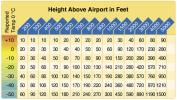
The pressure variation across distances is due mostly to pressure changes in the atmosphere. From high pressure to low pressure, that altimeter will indicate higher, not lower. It acts more like a vacuum gauge. Reading increases as pressure decreases. When flying into or out of an intense low, for instance. where the isobars are all bunched up, one can see a pressure change of half an inch or more in a few hundred miles or less. Half an inch is a 500-foot altimeter error. It would take a major temperature shift to equal that.

1748113847994.png
 
The pressure variation across distances is due mostly to pressure changes in the atmosphere. From high pressure to low pressure, that altimeter will indicate higher, not lower. It acts more like a vacuum gauge. Reading increases as pressure decreases. When flying into or out of an intense low, for instance. where the isobars are all bunched up, one can see a pressure change of half an inch or more in a few hundred miles or less. Half an inch is a 500-foot altimeter error. It would take a major temperature shift to equal that.

View attachment 141337
This is why if you are talking to ATC on a XC trip, they give new altimeter settings when you check in. Each new controller you are handed off to provides a new altimeter setting.
 
This is why if you are talking to ATC on a XC trip, they give new altimeter settings when you check in. Each new controller you are handed off to provides a new altimeter setting.

Is altimeter setting included in ADSB data? My iFly EFB displays the nearest altimeter setting continuously.
 
Simply updating local altimeter setting regularly corrects for temp affects.
I’m not sure I agree with this part of your post. Updating local altimeter setting corrects for pressure changes at the surface, which keeps you from hitting terrain near the reporting station (but see the extreme cold corrections in some places) and from losing vertical separation from other traffic in the area using the same setting.

But your true altitude will still depend on the altimeter setting plus a correction for nonstandard lapse rates. That is, for the same indicated altitude, you are not as high above a 29.92-reporting station when it’s cold as you are when it’s hot. That is because the pressure level (which is the altitude at which the pressure is X) is lower when it’s cold, as the OP was asking about.
 
Last edited:
I did mention corrections for certain cold wx IAPs.....as stated, the bara altimeter flys a pressure level without relation to ground like a radar altimeter... baro altimeters are simply pressure gauges, and a reference pressure plane to keep aircraft separation. TERPS and PANOPS criteria accounts for extreme temps in different ways, such as requiring increasing MDA and ATC changing min vector altitudes or and other min ifr altitudes have sufficient buffers to protect from most temp variations causing too low AGL levels.

But barrier of updating QNH is effective method as it's based on lower level altitude pressure closer to ground as you mentioned. and thus, correct for temps locally sufficient.... at higher altitudes min IFR altitudes are sufficient with a standard enroute buffer margins.

hope this clairifies my post....thanks for your comment
 
Back
Top