ALERT act passes HR

Barrett50

Line Up and Wait
Joined
Oct 3, 2024
Messages
701
Display Name
Barrett50
Text of the bill:

I don't know if it has a chance in the senate, but something like this is coming. The senate has produced their own version so I expect some kind of compromise version will ultimately be passed by both. And, I expect the prez to sign it.

Remember when the FAA offered us and pushed, pushed, pushed ADS-B IN, as a collision avoidance means? They were all hot and ready to get everyone on the bandwagon for ADS-B IN. Of course, all the technology to support collision avoidance was pie in the sky vaporware. So - they trotted out various ADS-B OUT(only) and let the pilot do the heavy lifting on collision avoidance. ADS-B IN first took a backseat. And then, it was removed from the seating completely and no one ever heard about IN at all. Constantly told in the coming 18 months. Which was many years ago, and still no ADS-B IN that was the big push originally.

What a crock of ****. Now, the congress thinks they can mandate a workable ADS-B IN conflict resolution and it'll work. HA! Meanwhile, ADS-B OUT has been polluted to being used for fees and pilot deviations, even though the FAA promised that wouldn't happen. This crap needs to end and some responsible people found who have an ounce of ethics. What a sham, and we're going to pay even more for it coming along. Will it work? Doubtful.
 
After a brief look at the linked bill, I'm not quite as convinced that the sky is falling. The proposed requirement only applies to light GA if we are flying in B, C, and special airspace (SFRA, presumably). It also mandates an AMOC that allows the use of portable receiver, portable EFB devices, and currently installed avionics. My Cherokee already has ADSB in/out and gives traffic advisories. Both GP and Foreflight give similar advisories when receiving from avionics or a portable device.

I wonder if, for most people, this would be nothing more than a software update for the AMOC. I can envision some fairly simplified if/then rules regarding directions, altitudes, and closure rates for advisory conflict resolution. Not sure that the aircraft need to be negotiating with each other, as I understand the current ACAS does.

As far as I can tell, for the sunny-day VFR Cub flyers out there away from large airports, this won't affect them at all.

I'm 100% with you on the ADSB-out abuse though. That needs to get stomped on hard.
 
ADS-B could have been so useful for collosion avoidance... if only it was a secure datalink.

but, designed by committee, ...
 
From AvBrief today. ADS-B Out usage for fee collection.

“According to AOPA, the House version also includes language that will ban the use of ADS-B Out signals to collect landing or other fees or “for anything other than its original purpose—safety and airspace efficiency.” AOPA said the provision is important to ensure compliance with ADS-B Equipage. “This bill is positioned to dramatically enhance aviation safety—as it ensures there is no disincentive for pilots to not use this important technology,” said AOPA’s VP of Government Affairs and Advocacy Jim Coon.”
I don't have time to fully read the bill linked in the OP right now, but a quick search for "fees", "landing", "prohibit", and "collect" did not find any such language.
 
I don't have time to fully read the bill linked in the OP right now, but a quick search for "fees", "landing", "prohibit", and "collect" did not find any such language.
Since there are five entities involved, The House of Representatives, AvBrief, AOPA, the OP and your search engine, your guess is as good as mine. Doesn’t really matter since the House and Senate will cobble something together TBD.
 
Another issue that I can't find any info on is the coverage of TIS-B and ADS-B surface areas. Which - is kinda very important to know, and where it's deployed.
 
Since there are five entities involved, The House of Representatives, AvBrief, AOPA, the OP and your search engine, your guess is as good as mine. Doesn’t really matter since the House and Senate will cobble something together TBD.
FWIW, my "search engine" was Ctrl-F on the actual text of the H.R. bill from the OP link.
 
Copilot's output after I asked it for impacts/compliance needed in Civil Aviation from the perspective of a small plane owner

Condensed Impacts on Small GA Aircraft Owners
  • Likely future requirement for ADS‑B In + traffic‑alerting capability
    • FAA must pursue rulemaking that could require small aircraft to have an electronic collision‑mitigation system by 2031 (cheaper alternatives may be allowed).
  • Reduced ability to hide your ADS‑B identity
    • FAA must implement “anti‑blocking” measures, which may limit anonymous mode or N‑number privacy programs.
  • More reporting after near‑miss events
    • FAA will define “close proximity encounters” and increase data collection, which may mean more pilot reporting obligations.
  • Chart and VFR procedure updates
    • FAA must update visual charts and certain routes, so expect changes in chart symbology or VFR procedures in busy airspace.
  • ATC procedural changes that affect GA operations
    • Adjustments to controller workload, spacing, and conflict‑alert systems may influence how often you get flight following or IFR release timing.
 
I did an F3 text search on the bill and wasn't able to find anything for 'fee', 'collect', or 'prohibit'. I think the jackwad at AOPA spooning this drivel up is a few soldiers short of a squad.
 
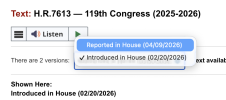
You want the amended "Reported in House" version. You'll see that 'rh' in the PDF name.


SEC. 105. PROHIBITION ON CERTAIN USE OF ADS–B DATA.

(a) IN GENERAL.—(1) LIMITATION ON USE OF DATA.—
Data from Automatic Dependent Surveillance–Broadcast may not be used by any person, governmental agency, or other entity to identify aircraft for the purpose of obtaining revenue from the owner or operator of such aircraft, without the consent of such owner or operator.

(2) USE OF DATA BY AIR TRAFFIC CONTROLLER.— Automatic Dependent Surveillance–Broadcast data may be used to assist air traffic controllers in tracking aircraft and improving air traffic safety and efficiency.

(b) LIMIT ON USE OF ADS–B DATA.— Section 46101(c)(1) of title 49, United States Code, is amended by striking ‘‘the Administrator of the Federal Aviation Administration may not’’ and inserting ‘‘neither the Administrator of the Federal Aviation Administration nor any other Federal, State, local, territorial, or Tribal official may’’.
 

Attachments

  • Screenshot 2026-04-15 at 3.34.49 PM.png
    Screenshot 2026-04-15 at 3.34.49 PM.png
    103.3 KB · Views: 4
(a) IN GENERAL.—(1) LIMITATION ON USE OF DATA.— Data from Automatic Dependent Surveillance–Broadcast may not be used by any person, governmental agency, or other entity to identify aircraft for the purpose of obtaining revenue from the owner or operator of such aircraft, without the consent of such owner or operator.
Look for the following verbiage on every airport website in the near future: "By landing at this airport, you consent to the use of your ADSB data for the purposes of collecting landing fees."
 
From AvBrief today. ADS-B Out usage for fee collection.

“According to AOPA, the House version also includes language that will ban the use of ADS-B Out signals to collect landing or other fees or “for anything other than its original purpose—safety and airspace efficiency.” AOPA said the provision is important to ensure compliance with ADS-B Equipage. “This bill is positioned to dramatically enhance aviation safety—as it ensures there is no disincentive for pilots to not use this important technology,” said AOPA’s VP of Government Affairs and Advocacy Jim Coon.”

Ah the old, “eat this poo sandwich, and I’ll throw in a condiment you want” approach.

Incrementalism is a terrible way to give up ground.
 
How a regulation should be written:

(a) IN GENERAL.—(1) LIMITATION ON USE OF DATA.— Data from Automatic Dependent Surveillance–Broadcast may must never not be used by any person, governmental agency, or other entity to identify aircraft or to capture owner/operator data for the any purpose, including specifically obtaining revenue from the owner or operator of such aircraft, without the prior written consent of such owner or operator.
 
(a) IN GENERAL.—(1) LIMITATION ON USE OF DATA.— Data from Automatic Dependent Surveillance–Broadcast may not be used by any person, governmental agency, or other entity to identify aircraft for the purpose of obtaining revenue from the owner or operator of such aircraft, without the consent of such owner or operator.

So what legally constitutes consent in the context of this regulation. Like @AvNavCom said, is a disclaimer on the FBO counter or airport website that by entering this facility you consent to being billed? Seems like a massive loophole intentionally placed into the legislation to neuter it.
 
Generally speaking, I prefer Congress stays out of rule making for aviation and let the FAA do its job. Only if the FAA fails to act, or fails to create basic standards (like Basic Med) should Congress intervene. Otherwise we get more regulation that costs General Aviation more, with very little gains.
 
How a regulation should be written:

(a) IN GENERAL.—(1) LIMITATION ON USE OF DATA.— Data from Automatic Dependent Surveillance–Broadcast may must never not be used by any person, governmental agency, or other entity to identify aircraft or to capture owner/operator data for the any purpose, including specifically obtaining revenue from the owner or operator of such aircraft, without the prior written consent of such owner or operator.
“Shall not” be used……is the correct terminology for a bill, rule, etc when dealing with the feds
 
“Shall not” be used……is the correct terminology for a bill, rule, etc when dealing with the feds
Weirdly, we have been beaten up recently in the Navy (or at least my corner of Navy Medicine) for using "shall". Apparently, the latest writing guide says we can't use it and must replace it with "must". This is problematic in aviation, as "shall", "should", and "may" have very specific meanings.
 
After a brief look at the linked bill, I'm not quite as convinced that the sky is falling. The proposed requirement only applies to light GA if we are flying in B, C, and special airspace (SFRA, presumably). It also mandates an AMOC that allows the use of portable receiver, portable EFB devices, and currently installed avionics. My Cherokee already has ADSB in/out and gives traffic advisories. Both GP and Foreflight give similar advisories when receiving from avionics or a portable device.

I wonder if, for most people, this would be nothing more than a software update for the AMOC. I can envision some fairly simplified if/then rules regarding directions, altitudes, and closure rates for advisory conflict resolution. Not sure that the aircraft need to be negotiating with each other, as I understand the current ACAS does.

As far as I can tell, for the sunny-day VFR Cub flyers out there away from large airports, this won't affect them at all.

I'm 100% with you on the ADSB-out abuse though. That needs to get stomped on hard.
Once the camel sticks his nose under the tent wall, and sees what is there, he'll take the whole tent. Anything that starts with "only applies to" eventually will apply to everyone.
 
“Shall not” be used……is the correct terminology for a bill, rule, etc when dealing with the feds

Weirdly, we have been beaten up recently in the Navy (or at least my corner of Navy Medicine) for using "shall". Apparently, the latest writing guide says we can't use it and must replace it with "must". This is problematic in aviation, as "shall", "should", and "may" have very specific meanings.

I remember the FAA went through some rule changes a while back, changing "shall" to "must". There must be some legalese behind the terms.
 
I remember the FAA went through some rule changes a while back, changing "shall" to "must". There must be some legalese behind the terms.
There's a GS3 somewhere in the bowels of the Pentagon who's sole job is to make life even more confusing, doing things like this.
 
I remember the FAA went through some rule changes a while back, changing "shall" to "must". There must be some legalese behind the terms.
IEEE has clear definitions for use of "may, "can", "should", and "shall":

Mandatory requirements set within an IEEE standard are clearly distinguished by using specific standard verbs—specifically, shall, should, may, and can.
Shall, should, may, and can are defined in 6.4.7
of the IEEE SA Standards Board Operations Manual.
The word shall indicates mandatory requirements strictly to be followed in order to conform to the standard
and from which no deviation is permitted (shall equals is required to).

Note that the use of the word must is deprecated and shall not be used when stating mandatory requirements; must is used only to describe unavoidable situations. The use of the word will is deprecated and shall not be used when stating mandatory requirements; will is only used in statements of fact.

The word should indicates that among several possibilities, one is recommended as particularly suitable without mentioning or excluding others; or that a certain course of action is preferred but not necessarily required (should equals is recommended that).
The word may is used to indicate a course of action permissible within the limits of the standard (may

equals is permitted to).
The word can is used for statements of possibility and capability, whether material, physical, or causal (can
equals is able to).
 
For those of you who have never taught English:


The time reference modality should have been obvious.
English Grammar and Legal Phrasing are the Same? Just curious since I think the entire Legal Profession is based on obfuscation of Plain English.
 
English Grammar and Legal Phrasing are the Same? Just curious since I think the entire Legal Profession is based on obfuscation of Plain English.
Well - we ARE haggling over a 'legal' document, i.e. a congressional bill which will become law. However, I agree with your point that the legal profession goes out of its way to make things hard to read. No matter, 'must' is the proper modal verb for both the legal and the common usage case.
 
Engineer and teacher are not mutually exclusive. I know this because I was/were both also too combined! :biggrin:

oh I know that. But engineers are famous for not being particularly good with english. Technical languages, sure, but not english.

When I was reviewing/approving contractor technical specifications, one of the engineers for a defense contractor was an english major. We had an ongoing contest to find typos in his documents. Just a fun thing, nobody was being mean or snarky. iirc, I did find one, maybe two. The tyops found were usually in parts of the document that had been previously accepted and hadn't need to be revised/updated.
I had a one of our marketing people (with English degree) argue with me over a few words in a proposal once. "You can't just make up words. That's not a word!". My response, "Yes we can. We're Engineers. We know what we're saying."

I'm convinced we just speak English on a higher plane than most, and only we can understand each other :).
 
English Grammar and Legal Phrasing are the Same? Just curious since I think the entire Legal Profession is based on obfuscation of Plain English.

A lot more work for attorneys than if documents, policies, and laws simply meant what they said and were easily understood.
 
I think the shall/must/will confusion partly stems back to the MacArthur quote. He absolute meant to use "shall" in the correct way. That is, he was going to return, most likely, just as soon as it was safe and convenient for him to do so, and as long as there was someone there to film it. After all, he wouldn't want the effort required to rescue him and leave his men behind to go to waste. But...lots of people thought he was an honorable guy, so that equated "shall" with certainty in their minds.
 
I had a one of our marketing people (with English degree) argue with me over a few words in a proposal once. "You can't just make up words. That's not a word!". My response, "Yes we can. We're Engineers. We know what we're saying."

I'm convinced we just speak English on a higher plane than most, and only we can understand each other :).

I once saw an editor correct (hah!) "Kirchoff's current law" into "Kirchoff's present law." (For the non-EEs, "current" in this context refers to electrical current.)

I had all sorts of run-ins with English majors reviewing proposals over the years. Eventually that group got whittled down to a few senior folks who had some knowledge of engineering terminology and phrasing.

“When I use a word,” Humpty Dumpty said in rather a scornful tone, “it means just what I choose it to mean—neither more nor less.”​
“The question is,” said Alice, “whether you can make words mean so many different things.”​
“The question is,” said Humpty Dumpty, “which is to be master—that's all.”​
 
McArthur was ordered out of PI to AU by the commander in chief. Capturing or killing the most important commander in the US would have been a disaster. Even worse than the publicity hit.

on 11 February, MacArthur announced that he and his family intended to "share the fate of the garrison"...
 
I'll agree he was absolutely the most important commander in his mind. And I suppose to be fair many others probably felt the same about themselves too, it kinda goes with the rank. But he was a bit selective in what he chose to obey or not. And, to be fair, I think he finally took Ridgway's advice in Korea and stopped showing up with the press the day or week before a major operation for a photo op.
 
Back
Top