Airspeed for Steep Turns

DCR

Pre-takeoff checklist
Joined
Jun 14, 2023
Messages
129
Display Name
rudy
Silly question: the 172s I fly have a placard that says something like:

Recommended Entry Speed For Maneuvers...​
​
...​
​
Steep Turns 95 Knots​

And the Private Pilot ACS says:

Establish the manufacturer's recommended airspeed; or if one is not available, an airspeed not to​
exceed the maneuvering speed (VA).​

Just want to confirm that I should aim to maintain 95 KIAS in a steep turn even when my Va is around 85 (solo) or 90 (dual) (30 gal fuel).
 
First, what’s the load factor? Second, what airspeed will give you an adequate margin above the 1G stall speed (not going to get into AOA, or indicated vs true airspeed - TLAR is sufficient for this), say 1.3 Vs1? Do you have enough power to start a level turn at the bank angle you want and maintain that speed without running out of throttle?

Just noticed, you’re referencing the PP ACS. Are you a student? What does your CFI say?
 
What m
Silly question: the 172s I fly have a placard that says something like:

Recommended Entry Speed For Maneuvers...​
​
...​
​
Steep Turns 95 Knots​

And the Private Pilot ACS says:

Establish the manufacturer's recommended airspeed; or if one is not available, an airspeed not to​
exceed the maneuvering speed (VA).​

Just want to confirm that I should aim to maintain 95 KIAS in a steep turn even when my Va is around 85 (solo) or 90 (dual) (30 gal fuel).
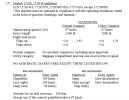
What model of 172 are you flying? From the Type Certificate Data Sheet for the 172M and N landplanes we get this:

1748898420513.png

The placard in the airplane is authoritative and required by law. If it says 95 knots, use 95 knots. Steep turns require more power, and if you entered at, say 100 or 105 knots, you might run out of throttle and start losing speed in the turn.

95 still gives a wide margin above stall. The load factor in a 45° banked turn is 1.41. The stall speed increases by the square root of that, or about 19%. A 55-knot level stall becomes a 65-knot 45° banked-turn stall.
 
Establish the manufacturer's recommended airspeed; or if one is not available, an airspeed not to​
exceed the maneuvering speed (VA).​
Since a recommended speed is available, do you think you should follow the guidance that applies if one is not available?
 
Since a recommended speed is available, do you think you should follow the guidance that applies if one is not available?

I literally just needed to hear someone say that it's OK to fly this maneuver above Va because I always heard that you should fly it at Va. Sometimes a little validation is all we (students) are looking for!

What model of 172 are you flying
N, we have that exact placard.

Thanks all.
 
I teach 90-95kts for steep turns in the 172. The ACS gives +-10kts of variation. Have you looked at that?
 
I literally just needed to hear someone say that it's OK to fly this maneuver above Va because I always heard that you should fly it at Va.
Why?
 
Because I am new and they are contradictory statements??
You might hear plenty of stuff from CFIs that is contrary to the POH or the textbooks. Some instructors like to invent their own, "safer" stuff. They don't know how much they don't know.
 
Because I am new and they are contradictory statements??
They aren’t really contradictory. The manufacturer has determined that 95 knots is a safe speed for the maneuver in that particular airplane. The FAA has to accommodate any airplane that may be used, regardless of certification basis so the ACS and other FAA training documentation use a more conservative, generic, number for airplanes for which the manufacturers didn’t provide a “steep turn” speed
 
Related question - WHY does the manufacturer publish a steep turn speed? What is the advantage or reason for doing so? You can safely do a steep turn on a 172 at 85 knots, and you can safely do it at 110 knots. So what's in it for the manufacturer to publish any value at all? Is this a certification function? And are the steep turns they're talking about 45 deg (private pilot and ATP-style), 50 deg (commercial style), or a generic "anything greater than 30 deg"?

It just seems kind of arbitrary to me. After all, they don't publish a "turns about a point" speed.
I believe it was required at one point for utility category airplanes. It's somewhere in CAR 3 and FAR 23
 
Aerobatic entry speeds are either minimums or maximums, depending on the maneuver. For example, a loop has a minimum entry speed. Try it below the entry speed and you may not have enough energy to get over the top. A split S has a maximum entry speed. Go faster and you may overstress the aircraft.

In the case of steep turns, I believe 95kt is minimum to sustain the bank angle standard without accelerated stall or loss of altitude. If you want to turn steeper, you need to enter at a faster airspeed. If you enter faster and still fly a 45 bank, nothing bad will happen, your turn will just have a wider radius.
 
Last edited:
  • Like
Reactions: DCR
I believe it was required at one point for utility category airplanes. It's somewhere in CAR 3 and FAR 23
Aerobatic category as well. My Decathlon AFM has a published entry speed for each aerobatic maneuver it is approved for.
 
Related question - WHY does the manufacturer publish a steep turn speed? What is the advantage or reason for doing so? You can safely do a steep turn on a 172 at 85 knots, and you can safely do it at 110 knots.
That 95 knots is what they consider a safe speed. The accelerated stall speed will be 65 knots, and if the pilot is hamfisted and doesn't add enough power in the turn, the airspeed will decay and get closer to the stall. If he sees that he's descending he will pull harder. which reduces the speed further and increases the load factor, both bringing the stall closer yet. So you don't want to start at 85 knots.

You won't be able to maintain 110 knots in a steep turn in most 172s. Not even at full throttle, especially in a high-DA situation.
 
I literally just needed to hear someone say that it's OK to fly this maneuver above Va because I always heard that you should fly it at Va. Sometimes a little validation is all we (students) are looking for!


N, we have that exact placard.

Thanks all.
The airplane flying handbook, page 10-2, says steep turns should be performed < Va or Vo.

Then it contradicts that statement by saying the pilot should establish manufactures recommended entry speed, Va or Vo.

You should be prepared to discuss these speeds and why you are using the speed you selected.
 
Last edited:
Related question - WHY does the manufacturer publish a steep turn speed? What is the advantage or reason for doing so? You can safely do a steep turn on a 172 at 85 knots, and you can safely do it at 110 knots. So what's in it for the manufacturer to publish any value at all? Is this a certification function? And are the steep turns they're talking about 45 deg (private pilot and ATP-style), 50 deg (commercial style), or a generic "anything greater than 30 deg"?

It just seems kind of arbitrary to me. After all, they don't publish a "turns about a point" speed.
Does the fact entry speeds for the 172s are found in Section 2 - Limitations of the AFM, addresses maneuvers required for training and listed for thr utility category help?
 
Aerobatic entry speeds are either minimums or maximums, depending on the maneuver. For example, a loop has a minimum entry speed. Try it below the entry speed and you may not have enough energy to get over the top. A split S has a maximum entry speed. Go faster and you may overstress the aircraft.

In the case of steep turns, I believe 95kt is minimum to sustain the bank angle standard without accelerated stall or loss of altitude. If you want to turn steeper, you need to enter at a faster airspeed. If you enter faster and still fly a 45 bank, nothing bad will happen, your turn will just have a wider radius.
VA is defined as the max speed at which sudden control inputs will not exceed structural limits.

One of the aircraft I have flown has a rather large placard that lists every maneuver that is approved for that airframe, along with an entry speed, (which is generally "109 mph" . . . 95 kn).

The first club I belonged to had a "standards manual" which included a clear hierarchy of "rules". In ascending order were club standards, manufacturer's POH as amended, certification document as amended, and regulations.
 
Last edited:
The first club I belonged to had a "standards manual" which included a clear hierarchy of "rules". In ascending order were club standards, manufacturer's POH as amended, certification document as amended, and regulations.
That right there. If the regs say to use the manufacturer's published speeds, then use those speeds. The POH or AFM will reflect what the certification documents say (TCDS), if they are listed there at all. In the case of newer aircraft such as the 172R & S/SP, those numbers are given in the AFM section 2, in "placards." That AFM is an FAA-approved document.

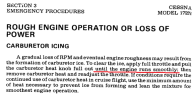
A greenhorn arguing with manufacturer's recommendations sometimes results in big trouble. This is a classic one:

1749049493453.png

"Apply carb heat until the engine runs smoothly." But so many will pull that knob and get an RPM reduction, so they push it back in and the engine soon quits. They never studied that POH and the groundschool instruction was woefully inadequate on carb ice, what causes it and when to expect it. Or they were taught the stuff but did not believe it.

Another big killer is accelerated stalls. The student doesn't understand angle of attack and what changes it. Again, poor education, or simple disbelief.
 
"Apply carb heat until the engine runs smoothly." But so many will pull that knob and get an RPM reduction, so they push it back in and the engine soon quits. They never studied that POH and the groundschool instruction was woefully inadequate on carb ice, what causes it and when to expect it. Or they were taught the stuff but did not believe it.
Or they were taught it in ground school and/or read it, but never saw anybody do it in real life, so it didn’t stick.
 
  • Like
Reactions: DCR
Or they were taught it in ground school and/or read it, but never saw anybody do it in real life, so it didn’t stick.
That is a problem. We can simulate a lot of stuff, or actually do it (stalls and spins) but carb ice isn't one of them.
 
Just need to fly around in the bases long enough. ;)
Yeah, but then the student gets the impression that carb ice only happens in misty conditions, when in reality it's severe clear VFR that often fools them into thinking that they're not at any risk.
 
Yeah, but then the student gets the impression that carb ice only happens in misty conditions, when in reality it's severe clear VFR that often fools them into thinking that they're not at any risk.
have them fly a T-craft in the morning, then.
 
Back
Top