A few questions

bdoss2006

Pre-Flight
Joined
Mar 1, 2025
Messages
72
Display Name
bdoss2006
I have a few more questions


1. Do you really need a kneeboard? All I’ve used mine for is writing down weather, which as long as you get it do you really need to write it down? Albeit I’m still a student, and I have encountered a major need for one yet.


2. How do you tell your distance from things such as clouds laterally, or airspace boundaries when flying without a gps (which I guess is pretty much obsolete anymore), or distance from an obstacle for 91.119?


3. I still have some confusion about VA and structural damage. For an example to hopefully help me comprehend it, could you damage the airplane recovering from a stall if you pull full back pressure (which obviously gets some gs) since you’re well below VA?


4. This is kinda a weird one, but if you know what you’re doing how much should you be changing power on final to remain on glideslope? Should that be something constantly changing, or should you find a good setting and leave it there?
 
not a CFI.
1 - I never used one VFR, but I'm wanting one as I'm learning IFR.
2 - VFR, you should have a chart and know where you're at. Kinda basic and important, not being flippant here. VFR I think you should know that by pilotage.
3 - I think the only way you'd recover from a stall by pulling is if you're inverted. Think you should look up the Va thing and talk with your CFI.
4 - I'll answer a question with a question - is the power setting going to be the same for the same glide angle, same weight, with different headwind?
 
I have a few more questions


1. Do you really need a kneeboard? All I’ve used mine for is writing down weather, which as long as you get it do you really need to write it down? Albeit I’m still a student, and I have encountered a major need for one yet.


2. How do you tell your distance from things such as clouds laterally, or airspace boundaries when flying without a gps (which I guess is pretty much obsolete anymore), or distance from an obstacle for 91.119?


3. I still have some confusion about VA and structural damage. For an example to hopefully help me comprehend it, could you damage the airplane recovering from a stall if you pull full back pressure (which obviously gets some gs) since you’re well below VA?


4. This is kinda a weird one, but if you know what you’re doing how much should you be changing power on final to remain on glideslope? Should that be something constantly changing, or should you find a good setting and leave it there?
1) No, personally I don’t like them and find they get in the way, when first learning, I would try to just fly the airplane, as you get more comfortable and experienced, add foreflight / iPad and use the scratchpad there.

2) You just guess, for airspace boundaries usually the charts have a landmark identified, for example for Chicago, we stay outside the water cribs for TFRs.

3) Watch some videos about American Airlines 587 crash, however even at Va, you cannot abuse the flight controls, the theory is at or below Va, the airplane would stall before causing structural failure.

4) In my opinion, your hand should be glued to throttle and make adjustments as needed, especially to the trim. Winds change and thus you have to change to keep coordinated. On a winds calm day, you shouldn’t have to make any adjustments until just before the flare (depends on your aircraft type too). Cessna 172 floats whereas a low wing will fall like a brick per se.

I’m not a CFI but I’m working on it, so take what I say with a grain of salt, add in what others say, and talk to your CFI too to get their opinion. Then make your informed decision / conclusion.
 
I have a few more questions


1. Do you really need a kneeboard? All I’ve used mine for is writing down weather, which as long as you get it do you really need to write it down? Albeit I’m still a student, and I have encountered a major need for one yet.
No. Use whatever works for you.
2. How do you tell your distance from things such as clouds laterally, or airspace boundaries when flying without a gps (which I guess is pretty much obsolete anymore), or distance from an obstacle for 91.119?
You should be able to estimate distances on the ground based on what you know (one mile square roads are common in the Midwest) and what’s on your chart (the river is a mile and a half from the freeway, etc.) there are often identifiable ground features on your chart that can help pin down airspace boundaries.

Clouds are a little tougher. The only truly accurate way to measure your distance from clouds is to fly through it and then fly a known time at a constant speed away from it. But if there are clear shadows on the ground, you can estimate the distance between your shadow and the shadow of a cloud at your altitude.
3. I still have some confusion about VA and structural damage. For an example to hopefully help me comprehend it, could you damage the airplane recovering from a stall if you pull full back pressure (which obviously gets some gs) since you’re well below VA?
That would result in what is known as a “secondary stall”, but shouldn’t damage the airplane.
4. This is kinda a weird one, but if you know what you’re doing how much should you be changing power on final to remain on glideslope? Should that be something constantly changing, or should you find a good setting and leave it there?
Target settings are best. If the target setting isn’t doing what you need it to do, make a measured adjustment.
 
Last edited:
I have a few more questions


1. Do you really need a kneeboard? All I’ve used mine for is writing down weather, which as long as you get it do you really need to write it down? Albeit I’m still a student, and I have encountered a major need for one yet.


2. How do you tell your distance from things such as clouds laterally, or airspace boundaries when flying without a gps (which I guess is pretty much obsolete anymore), or distance from an obstacle for 91.119?


3. I still have some confusion about VA and structural damage. For an example to hopefully help me comprehend it, could you damage the airplane recovering from a stall if you pull full back pressure (which obviously gets some gs) since you’re well below VA?


4. This is kinda a weird one, but if you know what you’re doing how much should you be changing power on final to remain on glideslope? Should that be something constantly changing, or should you find a good setting and leave it there?

1. I’m a kneeboarding guy, but I’m an old dog. I mostly use it in IFR flights to help with a log of changes. I record each frequency, altitude and heading assignment to act as a subtle reminder of Where I am, What am I doing, etc… It’s really a habit thing, and I absolutely could get away with not doing it. But it’s a habit that has more than a few times helped remind me of useful details.

2. Judging distances is something you learn from practice. If something is less than 5 miles away you are practically on top of it. Cloud clearances are another matter. The minute the cloud no longer appears smooth, and you can resolve the whisps of cloud, you are within 1000’. Just err on being conservative. Remember there are two reasons to keep clear. The first is to maintain visual reference to horizon for VFR flight. The second is that clouds can hide rocket powered jets flying right at you. Keep clear to avoid close encounters.

3. VA is about flying with an high enough AOA such that an abrupt change of AOA would cause a stall before exceeding structural limits. There’s no risk of structural damage from g forces if you’re already stalled. But if you’ve already exceeded the critical AOA and haul back on the yoke to full deflection, guanateeded you just enter a secondary stall. To recover from a stall, you need to reduce AOA, push forward, not pull back. Usually 5 degrees down is enough. Can do 10, but if you’ve already exceeded pitch down too much, then haul back hard at Vr, you can easily stall again.

4. There are two camps on this. Those that promote power idle on final, and the other who control glide path with power changes. The only way to ensure power idle is to fly a high final and pull idle within 1/10th of a mile from the threshold. You can always forward slip to make the landing, but passengers don’t love you for this. The other camp keeps some power all the way to roundout. It means you can’t make the runway if you loose the engine, but the approach can be more confortable for PAX. The only way you can be comfortably power idle on a 3-degree glide path is with virtually no wind. Add wind and some gusts, and you’ll be adjusting power all the home.
 
Maybe not a kneeboard. But taxi/departure instructions needs to be written down on something.

If you're on glide slope, why would you need to make power adjustments. Usually I make 2 power adjustments in the pattern. First once abeam on downwind. Then to idle when the runway is made.
 
I still have some confusion about VA and structural damage. For an example to hopefully help me comprehend it, could you damage the airplane recovering from a stall if you pull full back pressure (which obviously gets some gs) since you’re well below VA?
If you’re below Va, then no. The real question is, do you think you’d actually recover from the stall? Probably not.
 
If you’re below Va, then no. The real question is, do you think you’d actually recover from the stall? Probably not.
I'm wondering why you think a high energy stall/departure below Va that did not cause damage would be unrecoverable?
I think it's more likely that the reality is you (rhetorically) won't be quite as balanced as you think and the post-departure dynamics at say, just below Va can put you in situations not envisioned when the manufacturer did their loads analysis at Va and balanced flight.

Nauga,
and a crisp snap roll
 
1. Learn to use the scratchpad on Foreflight and avoid the kneeboard altogether - it's just more clutter physically and mentally. I have an iPad case that firmly holds the iPad and an Apple Pencil that I use for all note taking. It's especially handy when you include instrument clearances. Plus I usually make notations on the map pages for airspace desired altitudes, obstacles, approaches, etc. Now that FF finally added erasing capability on map pages, I have a unified place for all of my flight info.
 
1. Do you really need a kneeboard? All I’ve used mine for is writing down weather, which as long as you get it do you really need to write it down? Albeit I’m still a student, and I have encountered a major need for one yet.
I've always used my Lapboard, I find it faster to write on paper than in ForeFlight. But you need to write things down somewhere.

2. How do you tell your distance from things such as clouds laterally, or airspace boundaries when flying without a gps (which I guess is pretty much obsolete anymore), or distance from an obstacle for 91.119?
Time & Experience. Keep judging and then see how you did. If you're doing Instrument training and heading towards a cloud, take a guess at the distance. Even if you don't do the math then, quickly write down how far you thought it was and how long it took to get there and your speed. Do the math when you get back on the ground (or in cruse if you have time) and see how close you were. Practice makes perfect... Though I'm still guessing often.

As for 91.119, if you're not landing and you think you are too close, assume you are.

3. I still have some confusion about VA and structural damage. For an example to hopefully help me comprehend it, could you damage the airplane recovering from a stall if you pull full back pressure (which obviously gets some gs) since you’re well below VA?
As others have said, discuss it more with your CFII. But if you are below Va, then you're not going to damage the airframe. Your stall example is a tough one because????..... You can stall at any speed. So review this with your CFII too.

4. This is kinda a weird one, but if you know what you’re doing how much should you be changing power on final to remain on glideslope? Should that be something constantly changing, or should you find a good setting and leave it there?
Very little if at all. If you're renting and flying different planes all the time, you'll probably need to make adjustments. But my guess is your instructor is showing you how to fly by the numbers. When you pull the power back you want learn what number (RPM or RPM & MP) to hit. Do it soon enough for the aircraft to start to slow, then when you intercept the GS/GP and point the nose down, you should be on the speed you want. Sure, temperature, rain and other Wx conditions may require a minor adjustment in power, but you should be pretty close and always get the same airspeed in the descent if you know what power setting to start with.
 
1) No, personally I don’t like them and find they get in the way, when first learning, I would try to just fly the airplane, as you get more comfortable and experienced, add foreflight / iPad and use the scratchpad there.

2) You just guess, for airspace boundaries usually the charts have a landmark identified, for example for Chicago, we stay outside the water cribs for TFRs.

3) Watch some videos about American Airlines 587 crash, however even at Va, you cannot abuse the flight controls, the theory is at or below Va, the airplane would stall before causing structural failure.

4) In my opinion, your hand should be glued to throttle and make adjustments as needed, especially to the trim. Winds change and thus you have to change to keep coordinated. On a winds calm day, you shouldn’t have to make any adjustments until just before the flare (depends on your aircraft type too). Cessna 172 floats whereas a low wing will fall like a brick per se.

I’m not a CFI but I’m working on it, so take what I say with a grain of salt, add in what others say, and talk to your CFI too to get their opinion. Then make your informed decision / conclusion.
How do you trim with your hand glued to the throttle?
 
How do you trim with your hand glued to the throttle?
With my right thumb.
More seriously, I do keep my (left) hand on the throttle during approach and generally make small corrections as the approach progresses. Even though (or "if") I can make the runway power off, I like the precision small throttle adjustments give me.

And how do you operate the vernier?
If you're talking about a throttle vernier, not a trim vernier, when I'm flying I can't reach the trash bin where the vernier would be if I had one.
I despise, with a capital D-E-S-P-I-S-E, vernier throttles.

Nauga,
and his subhuman factors
 
Last edited:
I have a few more questions


1. Do you really need a kneeboard? All I’ve used mine for is writing down weather, which as long as you get it do you really need to write it down? Albeit I’m still a student, and I have encountered a major need for one yet.


2. How do you tell your distance from things such as clouds laterally, or airspace boundaries when flying without a gps (which I guess is pretty much obsolete anymore), or distance from an obstacle for 91.119?


3. I still have some confusion about VA and structural damage. For an example to hopefully help me comprehend it, could you damage the airplane recovering from a stall if you pull full back pressure (which obviously gets some gs) since you’re well below VA?


4. This is kinda a weird one, but if you know what you’re doing how much should you be changing power on final to remain on glideslope? Should that be something constantly changing, or should you find a good setting and leave it there?
1. I have never used a knee board, but you do need a cockpit organization method that will allow you to record information.

2. Flight visibility and cloud distances are an estimate made by the pilot. The plane is moving, the clouds are moving, and the cloud distances are in feet. 1/2 mile laterally (2640 feet) might be easier to mentally process.

3. Va is a function of angle of attack, critical angle of attack. AOA changes, critical AOA doesn’t. A heavily loaded plane is flying at a greater AOA, which is closer to the critical angle of attack.

4. Wind changes both velocity and direction while on an approach. How one fly an approach with wind and not change the power while maintaining airspeed? No one can tell you how much power you need. For anything, if you detect the change very quickly, a very small correction is needed. If you are slower detecting the change, you need more correction. You might looks at the DECIDE model in your text books.
 
regarding a knee board: I dont use one, but I do have a small note pad that reluctantly I dont use often but find myself in positions where I wish I had it readily available.

I use the FF scratch pad for copying IFR clearances. What catches me at the most inconvenient times is the dang taxi routing right at i'm about to turn off the runway after landing. Even at bigger airports that I have landed a 100 times, I get completely all discombobulated when the taxi is not what I expect. Usually its with a long list of taxi instructions. I really need to just place the pad on my lap upon landing and prep to take down taxi instructions. It would save a lot of heartache and looking like a silly goose to ATC. I think FF has a quick way of putting in taxi instructions, but I have not played with it enough to see if that's more efficient than writing it down.
 
I'm wondering why you think a high energy stall/departure below Va that did not cause damage would be unrecoverable?
I didn’t say it would be unrecoverable, I meant that what is being described would likely induce a secondary stall.
 
I didn’t say it would be unrecoverable, I meant that what is being described would likely induce a secondary stall.
Ah, I get it. I was thinking of an earlier question that didn't have the "when recovering from a stall" condition. I do agree that full aft stick/yoke during stall recovery is likely to cause a secondary stall.

We "tested" this during training many years ago - an intentional secondary stall while recovering from a spin was followed by a second secondary (tertiary?) stall that was unintentional. Sporty.

Nauga,
off to the races
 
Personally, I really like the kneeboard from Flyboys my son gave me. Has space for three pens/pencils plus a pulse ox.

I keep the checklist right on top, the emergency procedures checklist as the second page (so it’s easy to get to) and use a scratch pad made from wasted printer papers cut in half. The checklists flip out of the ways easily but are both immediately available.

I copy my clearance on the left, hand write the arrival airport info in the center (ICAO, name, alt, freqs, and a sketch of the runways with traffic patterns plus an arrow from my arrival direction), and track fuel usage on the right as a running tally (I change tanks every half hour).


IMG_7563.jpeg


IMG_7564.jpeg
 
1. Do you really need a kneeboard? All I’ve used mine for is writing down weather, which as long as you get it do you really need to write it down? Albeit I’m still a student, and I have encountered a major need for one yet.
There seems to be a time-honored tradition in aviation of student pilots going to Sporty's and buying a flight bag and enough crap to fill it up.

You don't "need" any of it. Save your $$$ for more important things, like good instruction, a better headset, etc...

The only things I "need" to go fly are an iPad (with ForeFlight and an Apple Pencil) and a headset. When I need to "write" something I use the ScratchPads feature in ForeFlight. I've also moved that up to be one of the always-visible icons for that reason. And the Apple Pencil is great for writing ATIS, clearances, etc.

2. How do you tell your distance from things such as clouds laterally, or airspace boundaries when flying without a gps (which I guess is pretty much obsolete anymore), or distance from an obstacle for 91.119?
Clouds? Guess. Or, you could use your TAS and see how long it takes them to traverse across a fixed angle (say, 2 o'clock to 4 o'clock) and do the math from there.

3. I still have some confusion about VA and structural damage. For an example to hopefully help me comprehend it, could you damage the airplane recovering from a stall if you pull full back pressure (which obviously gets some gs) since you’re well below VA?
The idea is for the wing to stall before it folds. If you are at full speed and pull hard enough to get 6 G in a normal category aircraft, the wings are probably gonna fold up (3.8G limit).

But, if you slow down and pull up hard below Va, the wing will stall before the force of lift is sufficient to break the wing.

4. This is kinda a weird one, but if you know what you’re doing how much should you be changing power on final to remain on glideslope? Should that be something constantly changing, or should you find a good setting and leave it there?
If you do everything right, one setting and leave it there. Nobody makes that work every time, though...

So, in reality, set it at a target setting and monitor your energy state. Low and slow = not enough energy, high and fast = too much energy. Low and fast or high and slow the energy is close but you need to use the elevator to properly redistribute that energy between airspeed and altitude.

However, if you're constantly changing power, you probably don't need to be doing that and it doesn't look good. It means you're overcontrolling. Set a new power setting, and DO NOT move the throttle in the opposite direction. See what happens. Did you overdo it? If so, make a smaller correction.

Be a bit aggressive about increasing throttle, and a bit more gentle about reducing it. Keep working on it until you can almost always get away with setting power once.
 
I'm wondering why you think a high energy stall/departure below Va that did not cause damage would be unrecoverable?
I think it's more likely that the reality is you (rhetorically) won't be quite as balanced as you think and the post-departure dynamics at say, just below Va can put you in situations not envisioned when the manufacturer did their loads analysis at Va and balanced flight.

Nauga,
and a crisp snap roll
Actually AC 23-19A says that Vo is “a speed where the airplane will stall in a nose-up pitching maneuver before exceeding the airplane structural limits.”, not Va.
 
1. Do you really need a kneeboard? All I’ve used mine for is writing down weather, which as long as you get it do you really need to write it down? Albeit I’m still a student, and I have encountered a major need for one yet.
I've never used a kneeboard. That said, I made a kneeboard specifically to hold a tablet, which is my primary VFR navigation when I'm going cross country.
2. How do you tell your distance from things such as clouds laterally, or airspace boundaries when flying without a gps (which I guess is pretty much obsolete anymore), or distance from an obstacle for 91.119?
Practice and experience. And guessing.
3. I still have some confusion about VA and structural damage. For an example to hopefully help me comprehend it, could you damage the airplane recovering from a stall if you pull full back pressure (which obviously gets some gs) since you’re well below VA?
If you're stalling you're probably way below Va, unless you force the plane into a high speed accelerated stall. Recovering from a stall, you should never be pulling full back pressure, it should be just enough to recover from the dive.
4. This is kinda a weird one, but if you know what you’re doing how much should you be changing power on final to remain on glideslope? Should that be something constantly changing, or should you find a good setting and leave it there?
Depends on how you like to fly the approach. Flying the old planes I do, I'm in the "chop the power to idle abeam the numbers" camp, so my glide path adjustment is by slipping (no flaps, either). Every approach is slipping to a greater or lesser extent. If I have to add power it means I misjudged. I know that's not the "stabilized approach" they teach nowadays; I mention it because it's a different technique you'll hear about that makes sense for some aircraft.
 
1. Do you really need a kneeboard? All I’ve used mine for is writing down weather, which as long as you get it do you really need to write it down? Albeit I’m still a student, and I have encountered a major need for one yet.
I use an ordinary clipboard to which I've glued two strips of felt lengthwise on the bottom to keep it from slipping around. It's just a place to write down stuff like amended clearances and keep track of fuel consumption. You can use letter size or 5x8 size, whatever works for you. You don't need anything complicated.
4. This is kinda a weird one, but if you know what you’re doing how much should you be changing power on final to remain on glideslope? Should that be something constantly changing, or should you find a good setting and leave it there?
You need to be learning to fly your aircraft "by the numbers." You should know the pitch plus rpm settings that will result in various flight regimes, e.g., level flight in cruise, max climb at Vy, 500 fpm descent at cruise, level flight at 90 kt (or whatever you choose for your approach speed), 500 fpm descent at 90 kt, etc. Then when you intercept the ILS or GPS glide slope, you know the proper attitude and power setting that will give you a 500-600 fpm descent. From there, you can make very minor adjustments due to actual glide slope angle and headwind component. Your pitch setting will establish the approach speed, and your power setting will alter your descent rate. Minor, temporary deviations from the glide slope (caused by up and down drafts) can be handled with small pitch corrections. If pitch corrections become persistent to maintain glideslope tracking, you adjust power. But it helps to start with a known, close pitch+power setting.
 
I have a few more questions


1. Do you really need a kneeboard? All I’ve used mine for is writing down weather, which as long as you get it do you really need to write it down? Albeit I’m still a student, and I have encountered a major need for one yet.


2. How do you tell your distance from things such as clouds laterally, or airspace boundaries when flying without a gps (which I guess is pretty much obsolete anymore), or distance from an obstacle for 91.119?


3. I still have some confusion about VA and structural damage. For an example to hopefully help me comprehend it, could you damage the airplane recovering from a stall if you pull full back pressure (which obviously gets some gs) since you’re well below VA?


4. This is kinda a weird one, but if you know what you’re doing how much should you be changing power on final to remain on glideslope? Should that be something constantly changing, or should you find a good setting and leave it there?
my short version answers.

1. Depends on what you doing, simple training flight now. More complex country using ATC or IFR you will wan't something to take notes one. Your preferrence how you do that, Paper/ipad,etc.

2. Clouds, make a reasonable guess with the information available. Airspace, don't mess with it have some other way to make sure you stay clear (pilotage, VOR, ATC), something to make sure you miss it. Even with GPS you should have a 2nd way to validate you are staying clear of Airspace you shouldn't be in.

3. Short version, if you are below VA the airplane is going to stall before you damage the airplane (secondary stall in your scenero). There are some exceptions but generally true.

4. per that Airplane Flying handbook (Stable approaches). Minimal power changes. Try to set it so you don't need to change until near the runway, try to detect needed power changes early and make small a smooth power adjustment early rather than larger power adjustment late. Do what your instructor recommends but my opinion about VFR Approaches in small single engine aircraft is the glideslope is the minimum approach angle, My normal VFR approaches are usually well above the glide until within about a 1000 feet of the runway threshold.

Brian
CFIIG/ASEL
 
Actually AC 23-19A says that Vo is “a speed where the airplane will stall in a nose-up pitching maneuver before exceeding the airplane structural limits.”, not Va.
And if you read Part 23.335 and do the math you will see that if the designer is not over- or under-designing the airplane then Va = Vo, and both are only accurate at design gross weight. In all practicality the numbers are the same, although reached by different paths.

And as I said before, if you actually manage to stall at just a hair below that kink in the V-n diagram corrected for your current weight there is no assurance that the post stall gyrations will not result in damage. It just means that you can't symmetrically overstress the airplane at that speed by pulling on the yoke, and that the loads were analyzed and structure verified at your g-limit and CLmax.

Nauga,
the aero mechanic
 
I have a few more questions


1. Do you really need a kneeboard? All I’ve used mine for is writing down weather, which as long as you get it do you really need to write it down? Albeit I’m still a student, and I have encountered a major need for one yet.


4. This is kinda a weird one, but if you know what you’re doing how much should you be changing power on final to remain on glideslope? Should that be something constantly changing, or should you find a good setting and leave it there?
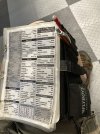
Depending on the type of flying or training, it’s handy to be able to jot things down easily. There are various methods, a kneeboard being a common one.

If you’re coming aboard the aircraft carrier, the throttle seldom stays fixed for very long, always adjusting. In the airliner world, throttle movements on final are much fewer. I still subscribe to the adage of, ‘doing whatever it takes’.
 
Back
Top