2 stroke expectations

DDDowney

Filing Flight Plan
Joined
Feb 14, 2024
Messages
26
Display Name
DDD
I am a Private pilot but do not own a plane. The thought of an ultralight something, just always comes to my mind as a way to just fly for the fun of it locally. If I were to learn really how to care for a 2 stroke, are they a dependable for a small plane like a Kolb or Areolite? I have heard of people who never have any trouble with them, and of course shock cooling locked up things. What are some of your experiences from those who fly with them? You know once bitten by the flying bug it never goes away.

Thanks David
 
TBO for our ancient Lycomings and Continental 4-strokes is 2000 hours. TBO for a typical 2-stroke is 200. There’s a message there…

My consistent experience talking with people who have flown ultralights for any period of time has been that they’ve had at least one and typically multiple engine stops while flying but the nature of UL flying is that it’s less of an event. But still…
 
Getting the jetting right will be the key. Too rich and they bog and foul plugs, too lean and they seize.
 
Getting the jetting right will be the key. Too rich and they bog and foul plugs, too lean and they seize.
Does this depend on the lubrication system? I can see this statement being true for the 2-cycles that contain the oil in the fuel. There are some that have a separate oil feed or sump.
 
I had a Yamaha with an oil injection pump (Autolube), but I still holed a piston due to lean jetting. 2-smokes are just harder to get right.
 
TBO for our ancient Lycomings and Continental 4-strokes is 2000 hours. TBO for a typical 2-stroke is 200. There’s a message there…

I don't know of any two stroke with a 200 hour TBO but you're not far off. Rotax (for the 503) gave 300 hours but we generally ran them to 450 hours. Hirth claimed a 1000 hour TBO but I could never find anyone that got that out of one of them. I refused to fly any Hirth engines back then (the newer ones may be better).

When I was flying ultralight (and later LSA) aircraft with a two stroke, the most reliable was the later versions of the 503 Rotax engines. Even with that said there were several times that the engine clocked out before the flight was over. I used to train under the FAR103 exemption and we had three planes that we used. Dead stick landings (engine idle) were taught as, at some point, it was gonna be needed.

Good maintenance and learning how to fly a two stroke engine are paramount to getting good, reliable service from them. There used to be Rotax repair stations that had reps that would do seminars on the care and and feeding of those engines. We used a repair station in Goldsboro NC but I don't know if it's still in business.
 
Single data point: Yamaha KT 100. We rebuild the top end for karting at 5 hours, and the bottom end at 10 hours. Monitor cylinder head temperature and don’t get it too hot, otherwise you’ll stick the piston ring. Again different engine, different application.
 
I had a Yamaha with an oil injection pump (Autolube), but I still holed a piston due to lean jetting. 2-smokes are just harder to get right.
The "Autolube" injects the oil into the fuel, doesn't it? So setting the carburetor too lean also means that there is too little oil going into the engine too?
 
The "Autolube" injects the oil into the fuel, doesn't it? So setting the carburetor too lean also means that there is too little oil going into the engine too?
Probably, but it’s been a long time and I can’t exactly remember where the oil pump injects the oil.
 
If I were to learn really how to care for a 2 stroke, are they a dependable for a small plane like a Kolb or Areolite? I have heard of people who never have any trouble with them, and of course shock cooling locked up things.
I have many hundreds of hours flying 2-strokes, on paramotors, three Quicksilvers, and my Kolb. Never have I had an engine failure caused by the fact that it's a 2-stroke. I have had reduction drive failures, ignition failures, exhaust system cracks (all on a single cylinder engine with its associated vibration), and carburetor ice, all things that can happen to any engine (though admittedly most 4-strokes, except for Rotax 9xx engines and a few geared Lycons don't have redrives). 2-strokes got a bad rap in the early days because nobody knew how to properly operate them-- you can't operate them like a Lycoming or Continental-- and nobody had much of the way of gauges on them (CHT, EGT).

Shock cooling really isn't a thing. What 2-strokes don't like is long fast descents at partial power; idle is best for descent, with the occasional blip of the throttle to keep it from loading up.
TBO for our ancient Lycomings and Continental 4-strokes is 2000 hours. TBO for a typical 2-stroke is 200. There’s a message there…
More like 500 hours for most 2-strokes. So you rebuild the engine four times as often... which takes less than 1/4 of the time, at less than 1/10 of the cost.
Getting the jetting right will be the key. Too rich and they bog and foul plugs, too lean and they seize.
:yeahthat:

The Cuyuna engine on my Kolb required a jet change twice a year, in the spring and the fall. Other than that it's a matter of keeping an eye on EGT and CHT. The only problem I ever had with the engine was carb ice on a very humid day, and for several reasons even that is rare on a 2-stroke... and I got it restarted before I reached the ground.
Does this depend on the lubrication system? I can see this statement being true for the 2-cycles that contain the oil in the fuel. There are some that have a separate oil feed or sump.
No, that's not the issue. Run too lean (I mean fuel/air mixture, not oil ratio) and the engine seizes due to lack of cooling, not lubrication. So don't do that.

Learn how to maintain (it does take a bit more maintenance, but it's simple stuff that anybody with reasonable mechanical skill can do) and operate a 2-stroke and it can be very reliable.

 
With modern tech, wouldn't an oil system that injects it in the crackcase, adjusting the feed rate based on power demand/rpm, be the best way to keep them healthy?
That would then allow adding a wideband O2 sensor in the exhaust, greatly simplifying the task of getting the mixture set correctly.
 
No, that's not the issue. Run too lean (I mean fuel/air mixture, not oil ratio) and the engine seizes due to lack of cooling, not lubrication. So don't do that.
If the oil is mixed with the fuel, running lean means less oil, doesn't it? Let's call a "proper" mixture to be 100% fuel. Let's call a lean mixture 85% fuel- these numbers are made up, but should demonstrate my confusion.
Going to lean means 15% less fuel, and also 15% less oil because the oil is dissolved in the fuel. That gives less lubrication.

With a 1 cylinder engine, there's no problem with balancing the fuel/air mixture going to the different cylinders, so running lean of peak should be Ok- less fuel is another way of lowering temperatures (as it is for 4-cycle engines).
 
If the oil is mixed with the fuel, running lean means less oil, doesn't it? Let's call a "proper" mixture to be 100% fuel. Let's call a lean mixture 85% fuel- these numbers are made up, but should demonstrate my confusion.
Going to lean means 15% less fuel, and also 15% less oil because the oil is dissolved in the fuel. That gives less lubrication.
Yes, but the engine is quite tolerant to small variations in fuel/oil ratio. It's quite intolerant to small variations in the fuel/air mixture. In fact, 2-stroke kart racers sometimes fine tune the engine by varying the premix ratio... add more oil, there's less fuel, so the engine runs lean and temps go up.

You don't ever run a 2-stroke lean of peak. Remember, the fuel is the engine's coolant so 2-strokes are always run rich. Which is why it's a delicate balance between rich enough not to overheat, and not so rich that you foul the spark plugs.

Oil injection lets you tailor the oil ratio with throttle position (lower throttle setting, you need less lubrication) but it adds its own potential point of failure. For this reason, some people disconnect the injection and just run premix.
 
Yes, but the engine is quite tolerant to small variations in fuel/oil ratio. It's quite intolerant to small variations in the fuel/air mixture. In fact, 2-stroke kart racers sometimes fine tune the engine by varying the premix ratio... add more oil, there's less fuel, so the engine runs lean and temps go up.
How much oil are they adding? I see about 2% oil (50:1 ratio) typical. How much more are they going beyond that? Why wouldn't they lean with the carburetor? I still don't understand why leaning, which reduces the amount of fuel, doesn't also reduce the amount of oil that is premixed with the fuel.
You don't ever run a 2-stroke lean of peak. Remember, the fuel is the engine's coolant so 2-strokes are always run rich. Which is why it's a delicate balance between rich enough not to overheat, and not so rich that you foul the spark plugs.
I thought they are air-cooled? Also, why does the engine overheat when going lean? Less gasoline means less energy. That means less heat, doesn't it?
 
2-strokes got a bad rap in the early days because nobody knew how to properly operate them--
As the 2 seat ultralight scene peaked (and the whole UL thing peaked) people were finally figuring out how to get long term reliable service out of them. But in the years (15? 20?) since the FAA gutted the 2 seat exemption, and by extension the whole 2 stroke aviation segment, a ton of that institutional knowledge has been lost.
 
How much oil are they adding? I see about 2% oil (50:1 ratio) typical. How much more are they going beyond that? Why wouldn't they lean with the carburetor? I still don't understand why leaning, which reduces the amount of fuel, doesn't also reduce the amount of oil that is premixed with the fuel.
IT does, but the range between too rich and too lean is very small in actual numbers, so the difference in the fuel/oil ratio is insignificant.

I believe most of the kart racers run much higher oil ratios. Tweaking the oil ratio can help when the needed adjustment is less than the jet increment (many 2-stroke carbs have no mixture adjustment other than swapping jets), or there's not enough time between races to swap jets.
I thought they are air-cooled? Also, why does the engine overheat when going lean? Less gasoline means less energy. That means less heat, doesn't it?
Yes, they're air-cooled (though the Rotax 582 has watercooled heads), but a lot of the cooling comes from the incoming fuel, which passes through the crankcase and around the pistons via the bypass ports. In particular this helps cool the piston skirt, which is where a seizure from lean running usually occurs.

To give an idea how rich 2-strokes run, the 35HP 2-stroke in my Kolb burned around 4 gph, almost as much as the 65hp Continental in my T-Craft. The 40HP 4-stroke in my Fisher burned a little over 2 gph.
 
I am a Private pilot but do not own a plane. The thought of an ultralight something, just always comes to my mind as a way to just fly for the fun of it locally. If I were to learn really how to care for a 2 stroke, are they a dependable for a small plane like a Kolb or Areolite? I have heard of people who never have any trouble with them, and of course shock cooling locked up things. What are some of your experiences from those who fly with them? You know once bitten by the flying bug it never goes away.

Thanks David
They prolly work fine for the application.
 
Racing experience, with a 2-stroke:

-Leaner is hotter and will smear the aluminum piston across the ring, stick it, and instant no-run due to loss of compression. It’s not a power decline, it shuts off.

-Running a higher oil mix generally gives more power up to a point. We run 16:1.

-Richer is faster, in my experience.

I could take educated guesses why it’s this way, but frankly all I care about is whatever is faster and allows our equipment to run flat-out at the edge for about 1.5 hours. 14k rpm.
 
Last edited:
My expectation is that they will fail a whole lot more often than standard four-strokes, and I need to be ready for off-field landings at all times.
 
To give an idea how rich 2-strokes run, the 35HP 2-stroke in my Kolb burned around 4 gph, almost as much as the 65hp Continental in my T-Craft. The 40HP 4-stroke in my Fisher burned a little over 2 gph.
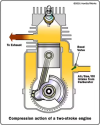
Some of that is also because at least some 2 cycles just waste the fuel because of the way they are ported- inlet and exhaust ports open at the same time so the fuel/air mix just goes in one side and out the other. The image below probably isn't to scale but more-or-less shows the port arrangement- similar to 2-stroke model plane engines (most of them, actually)

1763127743008.png
 
Some of that is also because at least some 2 cycles just waste the fuel because of the way they are ported- inlet and exhaust ports open at the same time so the fuel/air mix just goes in one side and out the other.

View attachment 147164

I would just add that the exhaust (muffler) generally has a cone to send a timed pressure wave back through the exhaust to help eliminate some of the crossflow. Some models use reed valves to prevent the backflow from coming out of the intake ports.

Pretty sure I'm preaching to the choir here ... ;)
 
It's always fun hearing people say that they have installed a "power band" in their 2-stroke bike.
 
Some of that is also because at least some 2 cycles just waste the fuel because of the way they are ported- inlet and exhaust ports open at the same time so the fuel/air mix just goes in one side and out the other.
Yes, but that fuel/air does help to cool the engine as it passes through. You may also get a puff of backflow through the intake, which is one reason carburetor ice is less common (but not impossible!) on these engines.
The image below probably isn't to scale but more-or-less shows the port arrangement- similar to 2-stroke model plane engines (most of them, actually)
Reed valves are used in the smallest (think Cox .049) engines, but most of the mid size engines use hollow shaft porting for the fuel/air mixture into the crankcase. Many of the larger model engines as well as 2-stroke engines in ultralights use piston skirt porting. Adding a reed valve adds performance, but it also adds another potential failure point.
 
The "Autolube" injects the oil into the fuel, doesn't it? So setting the carburetor too lean also means that there is too little oil going into the engine too?
The more sophisticated systems for motorcycles (half a century back!) injected oil into the carb float bowl and/or the intake port, as well as into the main bearings.
 
It's always fun hearing people say that they have installed a "power band" in their 2-stroke bike.

I'm guessing that they are referring to a tuned exhaust where the timing pulse of the exhaust is moved to a narrow RPM range or a higher RPM. There are tricks to make more power from a two stroke but, like anything else, more power means less reliability ...
 
I'm guessing that they are referring to a tuned exhaust where the timing pulse of the exhaust is moved to a narrow RPM range or a higher RPM. There are tricks to make more power from a two stroke but, like anything else, more power means less reliability ...
No, it's people (usually dirt bike kiddies) who heard the term "power band" and think it's a physical thing installed on their engine. When I built a paramotor with a KX100 dirt bike engine I was frequenting a dirt bike forum to get info on the engine. The KX100 is a small youth sized bike. The fathers posting were mostly OK, usually riders themselves, but the kids posting there would say and ask the dumbest things (not their fault, they're just kids; not really stupid, just ignorant). And yes, I did see at least one kid ask how to replace the powerband.

But yes, the "power band" is that rpm range where it's "on the pipe"; the resonance in a tuned exhaust creates a low pressure that draws some of the incoming fuel/air mixture across the combustion chamber and into the exhaust, then the reflected pressure wave from the previous exhaust pulse pushes it back into the cylinder, in effect supercharging it. It makes for a significant increase in power, but it only works in that range where the rpm matches the resonant frequency of the pipe.

Due to the finicky nature and narrow rpm range where they work, most 2-strokes in aviation use don't use a tuned exhaust, or at most a mildly tuned one.
 
Many of the bigger 2-stroke dirt and street bikes of the 70’s were very hard to ride as they had a very narrow light switch like power band. Have a bike like an old Kawasaki H2 come on the pipe mid corner and you had your hands full. They didn’t call it the widowmaker for nothing. Even my RD-350 was a handful at times.
 
Not all 2-strokes are equal. I have a zillion hours on 2-stroke snowmachines. The new ones use direct injection, sip oil, and run forever. But most new ones are water cooled. In the years before DI, we used vacuum balancers that sensed altitude and temperature and literally eliminated the need to swap jets. More air cooled 2-strokes failed from cold seizing than lean burn-down, but both happened. Water cooling solved most failures. DI was a power and efficiency game changer.
 
I love two stroke motorcycles. Might make flying more exciting in a bad way...
 
Not all 2-strokes are equal
This, “screaming jimmy’s” two strokes were a mainstay of the trucking industry for decades before being phased out by emissions regulations. 2 stroke itself isn’t the problem, it’s the simplicity of manufacturing an “easy, disposable” one cheaply that is their curse on their reputation. (Johnson/Evenrude made pretty good ones also, I still run a 1964 two stroke outboard on my john boat for fishing the Des Moines river with nothing more than a new water pump impeller and spark plugs every couple of years).
 
Does this depend on the lubrication system? I can see this statement being true for the 2-cycles that contain the oil in the fuel. There are some that have a separate oil feed or sump.
I am going to guess, being more familiar with 4 strokes, he is referring to fuel air ratio (in some jargon I've heard it said "FAT versus LEAN")
 
This, “screaming jimmy’s” two strokes were a mainstay of the trucking industry for decades before being phased out by emissions regulations. 2 stroke itself isn’t the problem, it’s the simplicity of manufacturing an “easy, disposable” one cheaply that is their curse on their reputation. (Johnson/Evenrude made pretty good ones also, I still run a 1964 two stroke outboard on my john boat for fishing the Des Moines river with nothing more than a new water pump impeller and spark plugs every couple of years).

I’ve got a 10 horse ‘62 Evinrude.

When I bought the boat, I drained the lower unit to fill with fresh fluid. All I got out was a pickle-jar full of water. Bought a seal and gasket kit from NAPA (man that place is great). The entire internals of the shaft and gears were shiny. That deserves a “they don’t make em like they used to”.

I laugh when I dump a whole quart of motor oil into the the 6 gallon tank. I kill skeeters on the river, and leave a sheen for people to be able to find me.
 
the 33rd is no good for me.

This, “screaming jimmy’s” two strokes were a mainstay of the trucking industry for decades before being phased out by emissions regulations.

There are still many EMD 2 stroke locomotives in mainline railroad use. I believe the new ones are now all 4 stroke.
 
This, “screaming jimmy’s” two strokes were a mainstay of the trucking industry for decades before being phased out by emissions regulations. 2 stroke itself isn’t the problem, it’s the simplicity of manufacturing an “easy, disposable” one cheaply that is their curse on their reputation. (Johnson/Evenrude made pretty good ones also, I still run a 1964 two stroke outboard on my john boat for fishing the Des Moines river with nothing more than a new water pump impeller and spark plugs every couple of years).

Screamin Jimmys were made by General Motors' Detroit Diesel, and were the engines that powered Allied forces in all theaters of WW2. Advantages were the commonality of parts and robust design. I recall seeing a 1-71 gen set at a DD exhibit at the NY Boat Show back in the 1970’s that was alleged to have 20,000 hours on it, made in the 1940’s still operational. Probably the only thing original was the data plate! But all the parts were available because the design hadn’t changed.

-Skip
 
The more sophisticated systems for motorcycles (half a century back!) injected oil into the carb float bowl and/or the intake port, as well as into the main bearings.
I remember adding castor oil to the reservoir in my first race bike, a Suzuki TM 75, oil injected, rotary valve 2 stroke engine. It was a real dog.
 
The straight DD 6-71, 2 stroke diesel, was one of the most incredibly robust, durable and reliable engines ever made. Plenty of them still in use across the world on land and marine applications. Although it is a 2 cycle engine, it does have poppet type exhaust valves. Also had a Roots type blower for scavenging. We had one boat with a pair of DD V8-92 TA engines that were screaming demons. No where near to reliability of the venerable NA straight DD’s. I put the sound a large displacement DD V series at full song second only second to a V 10 or 12 F1 engine. Ok…a RR Merlin is in there too!
 
The straight DD 6-71, 2 stroke diesel, was one of the most incredibly robust, durable and reliable engines ever made. Plenty of them still in use across the world on land and marine applications.

A pair of 6-71s in each landing craft seen in all films of WW2 invasions…
 
Back
Top