1975 Cessna 172M Sloppy Axle Bolt Hole In Main Spring Strut

Jon Wilder

Line Up and Wait
Joined
Oct 19, 2015
Messages
613
Display Name
Jwylde
Hi all.

Aircraft currently down for annual. The left main axle assembly was found to have play in it, which was determined to be an out of round axle bolt hole in the main spring strut.

Is this something that can be repaired? Or is that terminal for the spring strut?

Thanks in advance.
 
Drill the damaged hole out to a larger size, creating a perfectly round hole. Press or weld a hardened steel flange bushing into this new hole to return it to the original bolt size.
 
Drill the damaged hole out to a larger size, creating a perfectly round hole. Press or weld a hardened steel flange bushing into this new hole to return it to the original bolt size.
Is that an approved repair? Oversizing a hole weakens the part. I believe you need engineering authorization to repair it in that manner.
 
This is a tube gear correct?

There IS a spec on limits for this and I’ve seen it a couple times.

Get your dimensions and contact Cessna ; Customer Service IIRC.

They gave me good/ bad but not actual limits.
 
Is that an approved repair? Oversizing a hole weakens the part. I believe you need engineering authorization to repair it in that manner.
Standard engineering practice is to design any fitting, where possible, so you can drill it out and go one bolt size larger if necessary. But checking with Cessna is the way to be sure.
 
You’ll likely need a new spring strut. An out-of-round bolt hole there isn’t safely repairable it’s a structural fatigue issue. Don’t try to drill it oversize or bush it. Replace the part.
That there. The leg in that spot is not very big, and any oversizing of the hole in it will weaken it dangerously. Think wheel-snapping-off-on-touchdown kind of weak.

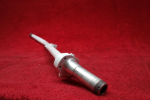
This is the leg without the axle on it. The hole is clearly visible.

1778640211202.png

With the axle installed:

1778640321208.png
 
That there. The leg in that spot is not very big, and any oversizing of the hole in it will weaken it dangerously. Think wheel-snapping-off-on-touchdown kind of weak.
Any oversizing of the hole will weaken it, yes, but it may or may not still have sufficient strength with the oversize hole. As I said, good engineering practice is to design the part with enough margin to accept an oversize bolt/hole, though it's not always possible. It may be that going from 1/4" to 5/16 (I have no idea what the original bolt size is) is OK but going to 3/8 is not. Or both might be OK. Or neither.

Either way, the manufacturer (Cessna) is the one to determine which it is. But absent guidance from Cessna (inquiry to their engineering department or published documentation) allowing a bigger bolt, it would have to be replaced. It's certainly worth a phone call before ordering parts.
 
Is this something that can be repaired? Or is that terminal for the spring strut?
FWIW: I've only seen a handful of struts repaired there, so I'll bet there are very specific requirements to meet for that repair. My first contact would be to Cessna Tech Support to see if any repair options exist.
 
There is a straight hole in the strut and the bolt is straight as well.

Obviously there must be some clearance during manufacture and assembly.

So just what is the manufacturing clearance and tolerance?

First encounter was many years ago with a low - time aircraft.

As I said; Cessna would not give me allowances.

I had to give them specific dimensions and they said it was ok.

There policies may have changed but it can be both a good starting point

and the final word.


IMHO Many fixed gear aircraft have issues like this that are not discovered

due to jacking methods. High wings seem to dominate due to that.

7 and 11 Series Aeronca, Champion, Bellanca often have worn out attach

points. Earlier Cessnas with broke u-bolts. Cherokee attach point has been

discussed previously. All part of a good Inspection.
 
consider welding hole around circumumfrance and re drill.... your AMT can do this or knows if a certified welder.

calling cessna and asking for an approved procedure to repair not likely...they don't want any liability for something they sold 50 years ago.

with most c172s in training mission I expect most holes are not perfect and a used part likely same condition.
 
consider welding hole around circumumfrance and re drill.... your AMT can do this or knows if a certified welder.
Pretty sure that landing gear is heat treated, which makes a welded repair a no-no unless it can be re-heat treated to the original temper.
 
Would imagine the axle wears too.
“They all like that” maybe?
By gosh seeing some 172M’s for sale
16K to 19K hours!
 
consider welding hole around circumumfrance and re drill.... your AMT can do this or knows if a certified welder.
Absolutely not! They are shot peened and heat treated, and welding destroys all of that. It would fail real soon.

Spring steels are high-carbon affairs and welding is generally prohibited.
Would imagine the axle wears too.
“They all like that” maybe?
By gosh seeing some 172M’s for sale
16K to 19K hours!
The axle fits over the end of the leg.
 
consider welding hole around circumumfrance and re drill.... your AMT can do this or knows if a certified welder. calling cessna and asking for an approved procedure to repair not likely...they don't want any liability for something they sold 50 years ago.
Any work would be a major repair so it will take approved data, 337, and an IA to complete it. Provided you want to be legal. But I disagree on discussing it with Cessna support. I've found its 50/50 whether an OEM can provide assistance with these types of repairs with some OEMs better than others. So, its always first on my list to contact the OEM as one never knows what they actually have available regardless the aircraft type or brand.
 
Further to the idea of welding that leg:

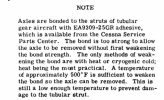
The Cessna Service manual has this to say about the axle's attachment to the leg:

1778713999124.png

So it the axle has been rotating a bit on the leg, someone has had it apart and did not rebond it. And note the warning about heating that leg. 500°F max, or the heat-treatment could be compromised.

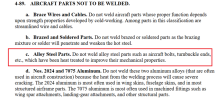
And from AC43.13:

1778714432912.png

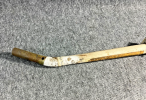
Here's what can happen if any welding is done on one of those gear legs. This was on the earlier flat-leaf 172 leg:

https://generalaviationnews.com/2024/03/25/mechanics-error-leads-to-failure-of-landing-gear/

An excerpt:

1778714909991.png

Also note that the leg in question (the OP's airplane gear leg) is a tube, not a rod. That leaves that area around the bolt hole with even less metal that it appears.
 
Last edited:
Back
Top