What is this under the wing?

Keith Lane

Pattern Altitude
Joined
Feb 25, 2005
Messages
1,637
Location
Conyers, Georgia
Display Name
Keith Lane
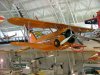
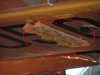
Last week I was teaching some classes at the Washington Metropolitan Area Rapid Transit in our nations capitol, and since my classes ended at 3:00 PM, I got to see a few sights. The most interesting was the Udvar-Hazy museum out near Dulles. A must see if you are in the area. I saw this plane there, the Gulfhawk II which is hanging just above eye level if you are on the upper catwalks, and noticed some sort of device on the underside of the port wing (only that side). I don't think this is an ex-military plane as the plaque indicated it to be a civilian make. What do you folks think it might be?
 

Attachments

  • Gulf Hawk 1a.jpg
    Gulf Hawk 1a.jpg
    255.9 KB · Views: 83
  • Gulf Hawk 3a.jpg
    Gulf Hawk 3a.jpg
    185.2 KB · Views: 120
I volunteer there. If nobody here comes up with an answer I'll ask one of the docents next time I'm out.
 
Last week I was teaching some classes at the Washington Metropolitan Area Rapid Transit in our nations capitol, and since my classes ended at 3:00 PM, I got to see a few sights. The most interesting was the Udvar-Hazy museum out near Dulles. A must see if you are in the area. I saw this plane there, the Gulfhawk II which is hanging just above eye level if you are on the upper catwalks, and noticed some sort of device on the underside of the port wing (only that side). I don't think this is an ex-military plane as the plaque indicated it to be a civilian make. What do you folks think it might be?

Maybe a rack for test instruments?

Doesn't look like any weapon rack I've ever seen....

Here's the a/c description.
 
I volunteer there. If nobody here comes up with an answer I'll ask one of the docents next time I'm out.


You do?

I need to get over there...

I'm in the beltway for meetings monthly, but once the meeting is done all I can think about is "Must be on 270 west before 3:00!!!!!"
 
I volunteer there. If nobody here comes up with an answer I'll ask one of the docents next time I'm out.


Tim, Just out of curiosity, are most of these planes, such as this Gulfhawk II capable of ever flying again with a reasonable (an undefined term at best) amount of work, or are they showpieces which could never be made airworthy?
 
What's the big fish-eye right next to the mysterious rack? Doesn't look like there is one on the other wing.
 
The link Scott posted says this:

One of the most exciting aerobatic aircraft of the 1930s and '40s, the Grumman Gulfhawk II was built for retired naval aviator and air show pilot Al Williams. As head of the Gulf Oil Company's aviation department, Williams flew in military and civilian air shows around the country, performing precision aerobatics and dive-bombing maneuvers to promote military aviation during the interwar years.

Would make sense that if he was doing dive-bombing demos, he'd be dropping something...
 
The link Scott posted says this:


Would make sense that if he was doing dive-bombing demos, he'd be dropping something...

Found this quote here: http://www.aviation-history.com/garber/vg-bldg/curtiss_gulfhawk-1_f.html

When he became affiliated with Gulf Oil Co., airplane repainted, named Gulfhawk 1A, and flown by Williams for exhibitions promoting Gulf products. 1930, appeared in aerobatics contest at National Air Races in Chicago and at Cleveland 1931. Gulfhawk 1A was idol of youngsters in 30s. Williams lived and talked aviation and wrote regular columns for newspapers and magazines. Hd found Junior Aviators which ultimately counted 460,000 members. With Gulfhawk, he staged some 600 air shows for young enthusiasts and for other aviation interests.

Shows consisted of aerobatics with a dive bombing demonstration as finale. Attack used live practice bombs on beaverboard "fort" with black gunpowder inside. As bombs hit, powder was detonated and hut "destroyed" to delight of the audience.

Ernst Udet, a WWI German ace, was impressed with accuracy of dive bombing and bought 2 Hawks to take back to Germany. During WWII, became number-two man for aircraft production and was instrumental in having Ju 87 Stuka, the Do 17, and He 111 designed with heavier structure required for dive bombing. Although initially successful, Luftwaffe later used more conventional bombing techniques. Heavier structure added weight to dive bombers and thus reduced payload and performance in other missions. Williams' dive bombing technique may have helped Luftwaffe initially but, in the long run, the weight penalty probably hurt them. 1936, Gulfhawk IA was replaced by Gulfhawk II (a Grumman G-22, also in the collection).

 
Tim, Just out of curiosity, are most of these planes, such as this Gulfhawk II capable of ever flying again with a reasonable (an undefined term at best) amount of work, or are they showpieces which could never be made airworthy?

I would think so - the restoral work is significant. To my knowldege none of these airplanes are repaired in any way other than with original (or made from the original drawings) parts.

Some airplanes like Concorde and the Stratoliner flew into the museum. Fuel and oil were drained, and engines are pickled. Some airplanes don't have the engines in them.

And that fisheye is likely a landing light, on a housing that swings forward. Beech 18s (and 737s!) have a similar arrangement where the light retracts relatively flush to the underside of a wing or belly.
 
And that fisheye is likely a landing light, on a housing that swings forward. Beech 18s (and 737s!) have a similar arrangement where the light retracts relatively flush to the underside of a wing or belly.

Cessna 195s, too. One of their very cool features.


Trapper John
 
And that fisheye is likely a landing light, on a housing that swings forward. Beech 18s (and 737s!) have a similar arrangement where the light retracts relatively flush to the underside of a wing or belly.

I was thinking that, too, although it is fairly 'deep' to be a landing light. Some Air Tractor's have the fold-down lights as well, although they are used for working as well as landing. ;)
 
Last edited:
If you look closely you can see that the bar through the straps opposite each hinged side is held up by a cable going to a eye hook...and off camera, a release.

It's a bomb rack.

Hmmm...

Must be a custom rack, then (though I can't make out all the details in the pic)

Racks since WW2 use two L-shaped hooks through clevis in the munition. The rack pulls back though the release cycle and the ordnance drops. Simple, and still in use.

Example:
14313_232_2.jpg
 
Last edited:
Tim, Just out of curiosity, are most of these planes, such as this Gulfhawk II capable of ever flying again with a reasonable (an undefined term at best) amount of work, or are they showpieces which could never be made airworthy?

Confirming what Tim said, with elaboration: I did the tour of the Silver Hill restoration facility a few years ago, when U-H was still on the drawing boards. The Smithsonian's restoration standard then was (and I assume still is) to restore an aircraft to its precise form as it came from the factory or at some other significant, identifiable, and documented point in its life. All of the materials, dimensions, tensions, torques, and technology would be identical as nearly as they could do it. I believe they make some exceptions for technologies which just can't be done any more (Bakelite?) or technologies which are downright dangerous (nitrocellulose dope) - but for the most part they want a future historian to be able to take the aircraft apart and answer the "How did they do that back then?" question. So any of the restorations are theoretically as fly-able as the original. Now if they've been hanging from the rafters for 40 years since the restoration they may need a little more work than something that was restored yesterday. But you get the drift.

The above applies to aircraft only. The spacecraft on display which have flown have been damaged by reentry sufficiently that they won't fly again without restoration (which isn't going to happen). Spacecraft which haven't flown were testing or back-up duplicates of ones that did fly, but by virtue of being stored in a dusty museum atmosphere they can never be space-ready.
 
Back
Top