What have you given up due to inflation?

The CPI is not accurate. There are many, many legitimate criticisms about the CPI and how it's entirely divorced from reality. The owners equivalent rent methodology and the way they compute health insurance are two notable factors.
The CPI is entirely accurate. You may think it's not representative of overall inflation, but that's a different statement.

And if that's your claim, please supply a metric you think is more useful. Until then, we have well over a hundred years of CPI data that most people have found to be quite useful in gauging inflation.

Pro-tip: You aren't going to find something that shows that inflation is broadly high ATM, much less runaway...

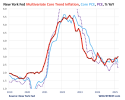
1750079493354.png
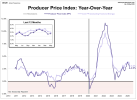
1750079577798.png
 
We're changing metro areas. Not solely due to inflation, but the massive costs of everything in a close to Seattle neighborhood is just too much. Everything just costs SOOO much money that it's really unfun to try to keep up.
 
The CPI is entirely accurate. You may think it's not representative of overall inflation, but that's a different statement.

And if that's your claim, please supply a metric you think is more useful. Until then, we have well over a hundred years of CPI data that most people have found to be quite useful in gauging inflation.

Pro-tip: You aren't going to find something that shows that inflation is broadly high ATM, much less runaway...

View attachment 142003
View attachment 142004
172 guy, what most people are talking about is the cumulative inflation through the pandemic.

I understand your YoY figures, and that's how economists think about it, but the average american remembers 2020 prices and says, "hey, 5 years later, my average is 24% higher". Also note that a LOT of companies basically froze raises for a good portion of that 5 years, so, for many, they got about 24% poorer.

it's worse than that though, if you look at a family that makes $10k per month (using a round number)

If they started in 2020 with
30% for mortgage ($3,333)
30% for taxes ($3,333)
then they had $3,334 for "all the rest"

If their wages were largely stagnant, they kept their house, and taxes stayed about the same then they FEEL much poorer

The stuff they were buying with that $3,334 now costs $800 MORE, for the same stuff. So they've effectively given up 25% of their "stuff"

If you factor in that a lot of the money in that $3,334 isn't discretionary (car insurance, utilities, groceries, etc), the amount they had to actually do something they WANT (have a boat, eat out, etc) has likely evaporated almost entirely.

This is why people "feel" poor even with a good salary. 5 years ago, they paid everything and had some fun money, now, the same job with no increase in things they want to do leaves that at the end of the month with almost no discretionary money.

 
172 guy, what most people are talking about is the cumulative inflation through the pandemic.

I understand your YoY figures, and that's how economists think about it, but the average american remembers 2020 prices and says, "hey, 5 years later, my average is 24% higher". Also note that a LOT of companies basically froze raises for a good portion of that 5 years, so, for many, they got about 24% poorer.
Oh, I totally agree. That's why I'm pointing out that their 'gut' is just flat out wrong. Yes, a few years ago inflation was high by recent standards. But it was never runaway and has been back to normal for a while now.

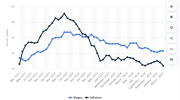
Further, wages have outpaced inflation for two and a half years at this point.

1750081827703.png
 
Our office goes out to lunch a time or two a week. Now that soft drinks are ~$3.50 plus tax and tip, I've downshifted into "I'll have water" mode. A (net) $4 or more soft drink is more than I'm willing to pay for casual dining at lunch.
Yeah, same. When soft drinks are the same or nearly the same price as a pint of beer, "Just water, thanks." The margins on soft drinks were already high, but it seems like it's skyrocketed in the last 5 years.
 
We’re eating a lot less beef. I used to have steak or a burger four or five times a week, but now it’s only every week or 10 days. I did have to cut back on saturated fat, but the price is just too high as well.

People can try all they want to convince me that inflation is settling or down, but the fact is that food prices are still up on many items. And my power bill and insurance is still high and going up every year, while my income is not keeping pace with the price increases. I am financially secure, but at some point in the future we’re either going to have to cancel our homeowner’s insurance and shut off the pool equipment because the rate increases are out of control.

A good two months of my annual income goes to insurance and property tax. You’d think that with the completely uncheck development in Florida, they’d lower property tax rates. Our county has the highest overall tax rate in the entire state, and they’re building five to 10,000 new homes. (Including a 9,000 home development accessible only by a two-lane road.)
 
Oh, I totally agree. That's why I'm pointing out that their 'gut' is just flat out wrong. Yes, a few years ago inflation was high by recent standards. But it was never runaway and has been back to normal for a while now.

Further, wages have outpaced inflation for two and a half years at this point.

View attachment 142008

Not sure where you sourced that, but the St Louis Fed disagrees.

dde395719b7395621105a2a08d4fac31.jpg


https://www.stlouisfed.org/publications/review/2024/04/15/real-wage-growth-at-the-micro-level Real Wage Growth at the Micro Level | St. Louis Fed
 
Not sure where you sourced that, but the St Louis Fed disagrees.
Your chart agrees with the one I posted. Mine ended in 2025, after things returned to normal. Yours ended in 2022, when things were still quite negative. Fast forward three years and that turnaround at the end of your chart we now know was the beginning of the end for higher inflation while wage growth was soon to overtake it.
 
Last edited:
We cut a number of streaming services; down to a single one. Over the past few years switched to more bulk purchasing of some ingredients, this requires some planning but worth it for the savings.

Tim
 
Haven't changed very much, but my wife and I's salaries have kept pace or better since COVID due to new jobs and raises.

The only impact is we were going to start building a house several years ago and are just now doing it. We downsized the house about 15% and are still paying about 50% more than we originally wanted to 5 years ago.
 
We cut a number of streaming services; down to a single one. Over the past few years switched to more bulk purchasing of some ingredients, this requires some planning but worth it for the savings.
You know, it's interesting you bring that up. We've done the opposite on food. Yes, there are absolutely a few things that have very long useful shelf lives and we stock up on when there is a deal. But for the most part the 'deals' turned out to be losses for us as we ended up throwing things out that were objectively bad or subjectively not as good as they should be anymore. So we're much closer to just buying what we need immediately and our grocery bill is lower as a result. In related news, we're old and have no kids.
 
People can try all they want to convince me that inflation is settling or down, but the fact is that food prices are still up on many items.

Of course. Prices won't go down unless we have negative inflation, or deflation. A low inflation rate simply means prices are rising slowly.
 
People drink bottled water at home? Get a filter.

Tell her about microplastics, maybe that will change her mind.

You try to convince my wife; I've given up. She buys locally bottled water that's coming from the same freakin' aquifer as our well. Run it through our filtered pitcher and it's the same water.

:mad2:
 
And one of the few things economists generally seem to agree on is that broad deflation is quite bad for the economy.

Because investment stops. Why spend money on something today that will be cheaper tomorrow. A small amount of inflation helps fuel the economy by stimulating investment in things that will appreciate in value.

Otherwise you might as well keep your money under the mattress.
 
Totally exhausted Saturday after most of the day outside but under the canopy, working with HS kids on an aviation project. (miserably hot at 90 in Denver) Decided to get takeout from my favorite restaurant. An extra bag of crispy noodles was $1.00 last Dec. Now $2.50.
 
You know, it's interesting you bring that up. We've done the opposite on food. Yes, there are absolutely a few things that have very long useful shelf lives and we stock up on when there is a deal. But for the most part the 'deals' turned out to be losses for us as we ended up throwing things out that were objectively bad or subjectively not as good as they should be anymore. So we're much closer to just buying what we need immediately and our grocery bill is lower as a result. In related news, we're old and have no kids.
Here is an example. We tend to buy groceries weekly. As such, if we wanted hamburgers one night, we used to buy 2lbs of ground beef. Same for chicken, I would buy just enough for what we planned on making for the week. Now, I buy 6-7 lbs of ground beef at Costco saving about a buck a pound, and make a lot of hamburger patties, freezing them.

So now, the weekly groceries are little more complicated; we figure out the general menu for the week, and see what is already frozen so it does not have to bought.... The result of these planning changes has been our grocery bill has gone up, but not as much as CPI and other factors have predicted.

I get the old, we are getting there. Three of five kids still at home.... so, we spend a lot more.

Tim
 
I have to go to the grocery store about every three days to get fruit that won’t go bad. I don’t know about the rest of the country, but in Florida the shelf life of fresh fruit is short.

Surprisingly, Aldi has the best produce around here, and Publix - Florida’s biggest grocery store chain and which is supposedly upscale - is on par with Walmart. Publix often has berries going moldy on the shelf.

Just remembered, regarding beef I did find a local shop. A huge ranch has a small retail store with better prices than the grocery stores, and better quality. Headed over for tri-tip!
 
You may think it's not representative of overall inflation, but that's a different statement.
That's a fair statement.
My real argument is that one cannot point at the CPI and suggest it is representative of what Americans experience as inflation. I recognize that's not the same thing as saying the CPI itself is "wrong".
What I should say: what the CPI measures and the weights assigned to each category/product are not an accurate representation of the $ allocation of Americans, ergo you should not expect it to accurately depict inflation. Additionally there are known inherent weaknesses in the proxy methods used to capture this data, even in the major series like rent/vehicles/tuition/healthcare/childcare/etc. And even if you nailed the weights properly, you're still not going to get the "right" number unless you address those shortcomings.

And if that's your claim, please supply a metric you think is more useful. Until then, we have well over a hundred years of CPI data that most people have found to be quite useful in gauging inflation.
In my view, this debate is a lot like visiting a doctor.
Imagine the doctor only has an XRay machine at their disposal. Every year you get an XRay and are issued a clean bill of health.
You're feeling unwell so you go to the doc, they give you an XRay and say you're great. But still, you don't feel very good.
And your doc says: "well, according to this you're fine, this is a comprehensive view of your insides and everything is looking good. And I don't see you showing up with any systematically collected data about your health that establishes a good baseline, so it doesn't really matter how you 'feel'."

That's what using the major CPI measures is like to me. It has known shortcomings, doesn't capture a lot of important things, miscaptures other important things, can give misleading results -- and we continue to use it as our primary measure out of inertia more than anything else.

There are also numerous reasons why it could be constructed to intentionally understate inflation: not least of which is that 70 million people's social security checks depend on the readout for their COLA adjustment -- which has major $ impact for our government, it significantly drives our borrowing rates especially further out on the yield curve (again, major $ implications), and that CPI number can single handedly sway political outcomes. Just something to keep in mind cuz we wouldn't be the first people to fudge that number.

Personally, and this is just me (and I know I'm not offering a great substitute), but I think you'd be well served to at least acknowledge the shortcomings and limitations of the series rather than declaring it's the best we have, therefore it's the only thing worth listening to.
 
Last edited:
Personally, and this is just me (and I know I'm not offering a great substitute), but I think you'd be well served to at least acknowledge the shortcomings and limitations of the series rather than declaring it's the best we have, therefore it's the only thing worth listening to.
Two things...

1) I provided three different measurements. All show the same. Inflation has been tamed for a while now.

2) I didn't say it's the only thing worth listening to. I said, "show me what you got". Absolutely willing (and curious!) to see what measurements people might be using that show inflation being high or 'runaway'. But so far no one has been able to turn anything up. Since three of the best tools we have, including CPI, all show the opposite, it's hard to come to the conclusion that they are all wrong. But show your preferred metric. I'm very interested in seeing it.
 
For now, gave up buying eggs at the store. Can get them sometimes from family/friends cheaper (or free) and better tasting. For the free ones, I might have to wash off some poop, but that doesn't bother me, I'm farm raised as well.
Also, pretty much just laugh at the fish and meat prices and as I pass them by (keeps me from crying).
For the cost of either of those, I can pretty much hit Texas Roadhouse and get one with all the fixins for about the same price...and no cleanup. But it can be loud, and some long wait times.
I saw a small box of Krispy Kreme donuts for $14.99
Holy hell.
 
Bottled water is one of my favorites thing to pick on here, because Coca Cola (Dasani) figured out people value tasteless water and most tap water actually has a tase to it. Run that tap water thru a Brita filter pitcher and you end up with Dasani without the label.. Put either in a glass and they’re indistinguishable, but some people place 10x or more value on bottled over filtered tap. The plastic bottle and label are the only difference.
SWMBO works for Coke and drinks a ton of Dasani. I think she almost dumped me when we were dating because (early on) I commented on how dumb it is to pay for water. Anyway, Dasani isn't just filtered tap water. There's an additive package (minerals, MMO, something like that) which is blended into it. It is still stupid expensive, but I've resolved that we all have our blind spots, and I'm just gonna be blind to that. It keeps things happy on the home front.
 
My real argument is that one cannot point at the CPI and suggest it is representative of what Americans experience as inflation. I recognize that's not the same thing as saying the CPI itself is "wrong".
What I should say: what the CPI measures and the weights assigned to each category/product are not an accurate representation of the $ allocation of Americans, ergo you should not expect it to accurately depict inflation. Additionally there are known inherent weaknesses in the proxy methods used to capture this data, even in the major series like rent/vehicles/tuition/healthcare/childcare/etc. And even if you nailed the weights properly, you're still not going to get the "right" number unless you address those shortcomings.

There are 330 million variations of this. A statistical model is therefore based on the average of the 330 million people. Hence, CPI by definition will likely never match any one individual, it matches the average American which also does not exist.

Tim
 
There are 330 million variations of this. A statistical model is therefore based on the average of the 330 million people. Hence, CPI by definition will likely never match any one individual, it matches the average American which also does not exist.

Tim
The average American has less than four functional limbs.

I do know that when an upstairs of a house being rented at 1300 a month for a 1/1 in a crap area of town, the CPI REALLY isn't a good indicator.

I mean I paid half of that a month to BUY my house with 4x the amount of living area a yard and 5 stalls worth of garage space before all this went crazy.
 
For now, gave up buying eggs at the store. Can get them sometimes from family/friends cheaper (or free) and better tasting. For the free ones, I might have to wash off some poop, but that doesn't bother me, I'm farm raised as well.
Also, pretty much just laugh at the fish and meat prices and as I pass them by (keeps me from crying).
For the cost of either of those, I can pretty much hit Texas Roadhouse and get one with all the fixins for about the same price...and no cleanup. But it can be loud, and some long wait times.
I saw a small box of Krispy Kreme donuts for $14.99
Holy hell.
I wear my airpods to Texas Roadhouse and turn the ANR on. Makes for a very pleasant meal.
 

What have you given up due to inflation?​


Having cash in my pockets, or bank accounts...

But seriously, when, I mean if we eat at a restaurant we get one meal and split it.

And bring our own water.
 
I gave up aircraft ownership.

Pricing baseline for my hobby was based on 2013-2019 nominal inflation; 2020-2024 rates put the baseline above my red line, and threw me out. My wages will likely never catch up given my incoming military "half"-retirement (can't full retire on 35% of my take home income, which is what the military is, contrary to popular lore).

I do hope the rate of inflation by end of decade will tamper with economic stagnation (disinflation to be clear, though there's several elements within that basket that are bona fide DE-flationary already) allowing my wages to catch back up to my acceptable line of discretionary spending. Until then, I just do without. I'm obviously on record about my stark hostility towards the M2 monetary decisions of 2008 and 2020, especially given the non-referendum nature to them, but that's for a different forum altogether.
 
-Buying things not on sale at the grocery store even if they'd be yummy
-Soft drinks at restaurants on the very rare occasion we go out to eat and being very picky about where we go to keep even that expense down
-A/C as cold as I'd like it during the day and no opening the shades during the sunny part of the day to keep inside as cool as possible
-We had switched to eating mostly chicken, but I am currently mostly unable to handle the texture, so now I'm *really* stocking up when there's a good sale on any kind of beef and freezing it for later
-Only buying clothes that are on deep discount and are basic, wear everyday for the next twenty years type of clothes
-Very, very, very limited "hobby/fun" spending, and all of it within a very strict, preplanned and presaved-for budget

We've managed okay despite the rising costs (and no, our income has not kept up in any way with even the nerfed rates of inflation quoted above), but there is definitely a lot less wiggle room monthly than before. Despite being more cautious and cost-conscious when shopping, for example, our weekly food/drink/household supply expenditure has gone up by 30% between 2021 and now for mostly the same or lower quantity or quality of products (but hey, egg prices are finally down to 30 cents an egg here, down from a peak of 73 cents each!). While gas costs are coming back down now, they are still costing us about 25% more than 2021. (And when they were still regularly in the $3.40+/gal range...I don't even want to do the math.)

To be honest, I don't really care whether it's inflation or whatever other name economists give it, the reality is - to maintain even a passing resemblance of the lifestyle you had in 2019, 2020, or 2021, you are probably going to be paying at least 20%, probably 30%, and maybe even more than you did.
 
Smoking store bought cigarettes at home (yes I know smoking is bad, it would be cheaper to quit, it’s a bad habit… and on and on. I’ve been a pack a day smoker for 30+ years, I know I should quit, but I’m not going to). Their price per pack has increased locally 100% in the last 5 years with no signs of slowing down. Almost quarterly (and it’s not supply/demand, in iowa the state lists the minimum legal price they can be sold for). I bought a cigarette packing machine that can load bought prefabricated filtered tubes with bought tobacco for a bit over a $1.75/pack for my personal use vs the store bought ones which are now a bit over $10/pack ($4.95 in January 2020). But I am fortunate that I could afford to make the investment to do so, I’m afraid there are a heck of a lot of low income people very addicted to cigarettes that can not afford to make that investment and will not quit but forgo other things to keep feeding the habit when the end of the month bills are more than the monthly income.
 
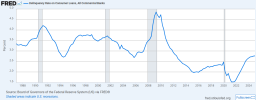
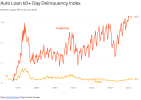
I think it’s also worth noting the consumer debt/income ratio that if I’m not mistaken has been rising rapidly, the past due 30/60/90 day rates, defaults and bankruptcy numbers in addition to the CPI inflation data. I am curious how much of the decrease in inflation rate is being influenced by consumers running out of available credit/ hitting limits. Borrowed money (with interest) will reduce future available discretionary spending as its payed back
 
I left AT&T for Consumer Cellular….cut the bill in half.

We live well off the beaten path. Verizon is the only option. The only carrier that works reliably at home, or in much of the countryside we have to travel to get to shopping and services. So, our cellphone bill for my small family is quite large. We could buy a modest, new compact car for what our phones cost us monthly.
 
I think it’s also worth noting the consumer debt/income ratio that if I’m not mistaken has been rising rapidly, the past due 30/60/90 day rates, defaults and bankruptcy numbers in addition to the CPI inflation data. I am curious how much of the decrease in inflation rate is being influenced by consumers running out of available credit/ hitting limits. Borrowed money (with interest) will reduce future available discretionary spending as its payed back

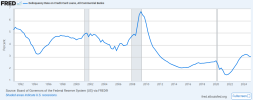
Default rates are increasing currently, as noted in the Fed Beige book released a couple weeks ago; I think they are just over 2% now, not positive on the number. That is still lower then the rates from 2008-20110 (I think it peaked close to 5%). Historical average I think was just under 3%.
But do not quote me on the numbers, I am too lazy to look them up and confirm them.

Tim
Quarterly view of DQ%

Credit card
1750112585501.png

Consumer Loans
1750112612326.png

Auto Loans by credit worthiness bucket (autos constantly make the news for this)
1750112722860.png
 
Why is it such a leap to think that our numbers, which have tremendous political implications that can swing elections, impact interest rate policty, etc -- might also bike incorrect or manipulated?

Because, unlike China, we are not solely dependent on the government for this information. Any university, NGO, political party, or media outlet can assemble an alternate set of data and publish it for consideration. Many do. But nobody seems to do better than the CPI.
 
Because, unlike China, we are not solely dependent on the government for this information. Any university, NGO, political party, or media outlet can assemble an alternate set of data and publish it for consideration. Many do. But nobody seems to do better than the CPI.
I’m quite sure many private corporations probably do, but it would be in their own disinterest to make the data public. (They are spending the money and manpower to do it, why give it away for free when it can give a tactical buisness strategy advantage? Philanthropic persuit aside, it comes down to bottom lines).
 
Back
Top