Viewing a lycoming cam/tappets without cyl removal?

alaskan9974

Pre-takeoff checklist
Joined
Apr 24, 2017
Messages
234
Location
Alaska
Display Name
alaskan9974
Considering a plane with a TIO-540, just a 5 years old from factory but only flown a few hours last year and just 30 before so worried about corrosion on the cam and lifters.

I have read you can snake a borescope through the oil filler tube, or from the oil drain plug on the o540’s I assume the TIO-540s are the same? My mechanic would be conducting the inspection and I figured it was less intrusive then pulling a few jugs.
 
It’s pretty tricky, but if you put a thin borescope up the oil drain port, you can try to work it up through the crankshaft and see the cam. If you can get an eye on one or two of the lobes and check condition, it’s a pretty safe bet the rest are the same.
 
The bottom of the Lyc's crankcase has narrow slots to drain oil back into the sump. You will need a really skinny borescope to get through there, and then you still have to get past the crankshaft. Any oil on the borescope lens will mean starting over.

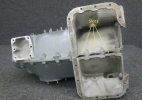
Bottom view of a crankcase, with the sump removed:

1750475604022.png

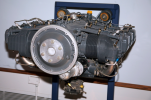
Note that the case itself is not a wide-open affair. It cannot be; that case is carrying the crankshaft and its bearings, the cylinders and cam, and all the forces created by those parts. The case has to be bolted together all around its periphery, and large studs though the bearing saddles and cylinder bases. Access is difficult.

The dipstick tube hole is visible in this photo, bottom right area. Imagine trying to thread a borescope down through that and then upward through a slot and past the crank. Up through the drain is easier, but still not an easy deal. Which is why most cam and lifter inspections involve removing cylinders.

Much easier to check the steel gears in the accessory case by removing a mag. If they're rusty, there's a good chance that the cam and lifters are rusty too. If the owner has been in the habit of ground-running the engine without flying it, there WILL be corrosion.
 
5 years? Does it have roller lifters? In Alaska? Hangared or parked outside? Contrary to popular belief, I think outside is better for the engine. Cam and lifters wouldn’t be my first concern with so few hours. I’d borescope the cylinder walls. If these’s rust, you’ll see it there. But, a little rust isn’t necessarily a show stopper. A lot of rust may be.

FWIW, you could buy a plane with a thousand hours in 5 years and it could be rusted, too.
 
As a seller I'd tell you no way I'd let you stick a borescope inside my engine let alone pulling a cylinder. Now checking through spark plug hole have at it.

Where does this I can do whatever I like on someone's else's plane during a pre purchase come from?
 
Sticking a borescope into the dipstick tube is way less invasive than pulling a spark plug. I doubt any mechanic would even ask permission.

You can see a couple lobes through the dipstick on an io-540; enough to get an idea of the condition. Here's a link to a video I took in my engine a couple years ago.


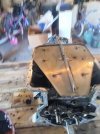
A tio-540 would be the same. Io-540's also have a windage tray..I think all 540's do. It pretty effectively blocks off any access from the sump. Here's a blurry photo of the tray

IMG_20241026_114717489_HDR.jpg

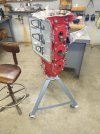
And a clear photo of the brackets that hold it so you can see how impossible it'd be to get around it. Eagle eyed viewers may note that I had the brackets installed in the wrong order... the little one goes in back. They are a ***** to safety. I got to do it twice.

IMG_20250228_103430239.jpg

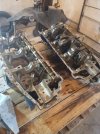
Here's what your engine looks like inside. Notice that the bearing saddles separate the crankcase into three separate compartments. That's why you can only see three lobes at a time, even if you pulled a cylinder.

IMG_20241026_185926031.jpg
 
Sticking a borescope into the dipstick tube is way less invasive than pulling a spark plug. I doubt any mechanic would even ask permission.

You can see a couple lobes through the dipstick on an io-540; enough to get an idea of the condition. Here's a link to a video I took in my engine a couple years ago.


A tio-540 would be the same. Io-540's also have a windage tray..I think all 540's do. It pretty effectively blocks off any access from the sump. Here's a blurry photo of the tray

View attachment 142142

And a clear photo of the brackets that hold it so you can see how impossible it'd be to get around it. Eagle eyed viewers may note that I had the brackets installed in the wrong order... the little one goes in back. They are a ***** to safety. I got to do it twice.

View attachment 142145

Here's what your engine looks like inside. Notice that the bearing saddles separate the crankcase into three separate compartments. That's why you can only see three lobes at a time, even if you pulled a cylinder.

View attachment 142146
Previous posters were talking about going in from bottom. Or any place they could. So my remarks. Damn tire kickers.
 
IMO you should just assume it's got some corrosion going on and negotiate accordingly. Maybe consider it another 25% closer to TBO. In practical terms that is $10K in price, well within the subjective range of a typical valuation. Worst case it makes metal a few years from now and you get an overhaul.

I paid a very good shop to prebuy my first plane. They borescoped the heck out of it and reported it looked great. Two years later at the engine shop I held the cam in my hand and marvelled at the rust on the lobes.
 
As a seller I'd tell you no way I'd let you stick a borescope inside my engine let alone pulling a cylinder. Now checking through spark plug hole have at it.

Where does this I can do whatever I like on someone's else's plane during a pre purchase come from?
Depends on the market. Pulling a cylinder to view in internals isn’t uncommon and isn’t a difficult task.
 
Yes. Some of those big Lycs have the oil filler up top, like so:

1750523315865.png

A borescope through that will let you see one bay, three cam lobes. Better than nothing.

But any Lyc without that provision is going to be real hard to borescope.
 
My guess is that if anyone broke off a piece of the scope they would be

silent.

I met a Cherokee that had not flown in 25 years. It was perched on

jacks for WHEN ( not IF ) the nearby river flooded. We pulled

jugs and found no rust. 10 years and 300 hrs later and no issues.


I agree with Dan re ground running. Include flights that do not get

oil temp up culprits too.
 
Previous posters were talking about going in from bottom. Or any place they could. So my remarks. Damn tire kickers.
tire kicker for seeing if a low calendar time motor is rusted out or not?

Recent quote I got was 105k for an OH motor so it’s not a minimal cost.

Plane is a L48 plane, 100 miles or so from the coast.

The last two planes I bought I pulled cylinders since they had lycoming’s, a o540 and a o360. The o360 did have pitting so I had the shop tear it apart and replace the cam and lifters after I got it home, so it’s something on my mind when looking at another lycoming engine.
 
As a seller I'd tell you no way I'd let you stick a borescope inside my engine let alone pulling a cylinder. Now checking through spark plug hole have at it.

Where does this I can do whatever I like on someone's else's plane during a pre purchase come from?
As part of the purchase agreement it states it will be reassembled iaw maintenance standards after pre purchase inspection. There’s also a clause that states the money held in escrow will be used to settle any disputes, so not sure where the risk really is other then a buyer finding out the engine isn’t worth as much as the seller is presenting, will likely make it contingent on clean motor since I just priced out the LTIO camshaft and it’s about $10 amu just for the cam.
 
Last edited:
Back
Top