Jim_R
En-Route
- Joined
- Feb 17, 2010
- Messages
- 2,568
- Display Name
- Jim
It does kinda look like that. But it's not.It looks like a wire bundle someone tried to pry up.
We have a winner.Post tension slab?
No. I don't know what caused the cable to snap. I suspect corrosion, but if so then I don't know why the corrosion occurred.Was somebody drilling into the slab somewhere else?
Hope for the first, assume and make contingent plans for the second. The location and it being black rust (in my completely uneducated hillbilly opinion) is a plus. Black rust is not as damaging as red with it associated expanding and shearing of surface layers (the bond layers). That is not to say that there is not red rust in other areas, under a kitchen sink is likely to be more damp than other parts, and the fact that it did not fail there, but showed the symptoms there…I would be looking for other locations along the cable line for issues. It’s a very “not good” situation. I can only imagine the result of the same happening in a “living area” with someone standing over the location when the cable snaps through. I would proceed assuming all cables were processed and installed in the same “batch”, and be looking for external factors that caused this single one to fail and if that can not be found assume all are suspect.I don't know if this is a one-off, or the first indication of a systemic problem.
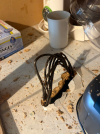
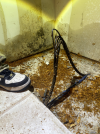
I have only seen these photos, but I can't tell from the pictures that there's any significant corrosion present on the portion of the cable strands that is visible. What remains of the conduit they were in is visible, but I can't tell if the individual strands are also coated or if that's bare metal. The cables emerged through the bottom of a kitchen cabinet, but not the sink cabinet.Black rust is not as damaging as red with it associated expanding and shearing of surface layers (the bond layers). That is not to say that there is not red rust in other areas, under a kitchen sink is likely to be more damp than other parts....
The immediate "solution" was to cut off the loop that emerged. From what I understand the homeowner is investigating permanent options. This is a townhouse complex with multiple units sharing a monolithic slab, but I don't know if this cable ran front-to-back only through one home, or crosswise across the entire length of the slab under multiple homes. From what I understand, the HOA is actually not responsible for foundation issues, which seems weird, but apparently that's how the community's governing documents are written.So, what's the solution? Cut it off with a dremel, float the hole, lay new tile, and make a quick sale?
I don’t understand. Looks like there’s plenty of cable out to determine direction. In my limited experience, I remember them always running straight not zigzagI have only seen these photos, but I can't tell from the pictures that there's any significant corrosion present on the portion of the cable strands that is visible. What remains of the conduit they were in is visible, but I can't tell if the individual strands are also coated or if that's bare metal. The cables emerged through the bottom of a kitchen cabinet, but not the sink cabinet.
Coincidentally, the homeowner had a plumbing leak in the upstairs bathroom that ran down the walls and flooded the kitchen. The leak started several days after the cables were first observed, and so far there is no reason to think the two events are related. The cabinet was actually removed as part of the kitchen flood remediation. I don't know if the spots on the wall are mold, and if they are related to the plumbing failure, or what. (I am friendly with the property manager, not the homeowner, and am not privy to all the details of the situation.)
The immediate "solution" was to cut off the loop that emerged. From what I understand the homeowner is investigating permanent options. This is a townhouse complex with multiple units sharing a monolithic slab, but I don't know if this cable ran front-to-back only through one home, or crosswise across the entire length of the slab under multiple homes. From what I understand, the HOA is actually not responsible for foundation issues, which seems weird, but apparently that's how the community's governing documents are written.

I don’t understand. Looks like there’s plenty of cable out to determine direction. In my limited experience, I remember them always running straight not zigzag
(I am friendly with the property manager, not the homeowner, and am not privy to all the details of the situation.)