
You are using an out of date browser. It may not display this or other websites correctly.
You should upgrade or use an alternative browser.
You should upgrade or use an alternative browser.
Thoughts on Cessna's 140?
- Thread starter AZEL
- Start date
Mtns2Skies
Final Approach
- Joined
- Jul 12, 2008
- Messages
- 5,748
- Display Name
- Mtns2Skies

MauleSkinner
Touchdown! Greaser!
I’d run from aluminized wings, but that’s just me (and maybe a few others.)

- Joined
- Dec 5, 2010
- Messages
- 6,581
- Display Name
- GeorgeC
Do you have a hangar?
If you want aluminum wings, get a 140A.
If you're big and/or tall, consider a 170.
If you're going to fly with 2 adults with any regularity, consider a 170.
If this is your first plane, you will need to learn to be an owner in addition to learning to fly t/w.
They are all antiques and require attention on the ground as well as in the air; you will need to learn to become an active participant when it comes to mx.

- Joined
- Jun 7, 2008
- Messages
- 16,742
- Location
- DXO124009
- Display Name
- Light and Sporty Guy
- Home Airfield
- ONZ
Learned to fly in an 120 with aluminized wings. My brother and I took it from Detroit to Alaska and back.
Easy to fly. The first couple years the gear was (apparently) more bouncy than the later years. Whatever.
Easy to fly. The first couple years the gear was (apparently) more bouncy than the later years. Whatever.

- Joined
- Jun 7, 2008
- Messages
- 6,260
- Location
- Indian Hills Airpark Salome, AZ
- Display Name
- N1431A
- Home Airfield
- 2AZ1
I learned to fly in the mid-50's. Cessna 120-140 and Aeronca Champs were on my Student license. The Champ is a lot more fun. 

tonycondon
Gastons CRO (Chief Dinner Reservation Officer)
love my 120, have about 700 hours on it since end of 2020.
metal wings have a reputation for being heavy. check the actual weight.
patience is required when climbing in the summer. your soaring skills will help. i thermal mine all the time.
metal wings have a reputation for being heavy. check the actual weight.
patience is required when climbing in the summer. your soaring skills will help. i thermal mine all the time.

AZEL
Pre-takeoff checklist
- Joined
- Dec 6, 2025
- Messages
- 261
- Display Name
- AcrftZeroEngineLand
I'm not buying it, just taking lessons. The -337 says the aluminum on the wings added 44 lbs and the prop added 10 lbs.Weigh it.
No - I mean you go and WEIGH IT.
AZEL
Pre-takeoff checklist
- Joined
- Dec 6, 2025
- Messages
- 261
- Display Name
- AcrftZeroEngineLand
The "revised" IRoC (SD, MSL, exhaling) is 590 fpm (down from 630).love my 120, have about 700 hours on it since end of 2020.
metal wings have a reputation for being heavy. check the actual weight.
patience is required when climbing in the summer. your soaring skills will help. i thermal mine all the time.
Last edited:
AZEL
Pre-takeoff checklist
- Joined
- Dec 6, 2025
- Messages
- 261
- Display Name
- AcrftZeroEngineLand
The irony being they built Champs here before the factory burned down.I learned to fly in the mid-50's. Cessna 120-140 and Aeronca Champs were on my Student license. The Champ is a lot more fun.
AZEL
Pre-takeoff checklist
- Joined
- Dec 6, 2025
- Messages
- 261
- Display Name
- AcrftZeroEngineLand
I should have been more specific. I'm not buying it just taking lessons in it.Do you have a hangar?
If you want aluminum wings, get a 140A.
If you're big and/or tall, consider a 170.
If you're going to fly with 2 adults with any regularity, consider a 170.
If this is your first plane, you will need to learn to be an owner in addition to learning to fly t/w.
They are all antiques and require attention on the ground as well as in the air; you will need to learn to become an active participant when it comes to mx.
AZEL
Pre-takeoff checklist
- Joined
- Dec 6, 2025
- Messages
- 261
- Display Name
- AcrftZeroEngineLand
Yeah, the owner would rather have the 54 lbs of useful load.I’d run from aluminized wings, but that’s just me (and maybe a few others.)

- Joined
- Oct 28, 2014
- Messages
- 5,139
- Display Name
- Jack Fleetwood
I've been flying my whole life, owned two Cessna 140s, and today is the first time I heard "aluminized"!! I've always heard "metalized"!
I've flown about every type of Cessna 140/120 out there. I had a 140 with metalized wings, I had one with rag wings, and I flew a couple of 140As. The one with metalized wings had a C-90 in it, the rag wing had a C-85, both flew exactly the same. The 140As feel better in the air and have bigger flaps, which you don't really need. They're all fun to fly.
Be warned, they're posers! Mine always had to be the center of attention!
My advice still stands, unless you are just going to mount it on a plinth and admire it. If you want to commit aviation, 'weigh it'. Here's a guarantee, the actual weight will be more than the added 'book' 55Lb.I'm not buying it, just taking lessons. The -337 says the aluminum on the wings added 44 lbs and the prop added 10 lbs.

40YearDream
Pre-takeoff checklist
- Joined
- Jan 23, 2020
- Messages
- 375
- Location
- Grand Rapids, MI
- Display Name
- 40YearDream
- Home Airfield
- 08C
Had a couple dual hours in a 140 (but not enough to complete a tailwheel endorsement). I was surprised that it will fly crabbed and stay that way, until you center the ball. Too used to a 172, probably. Also, the instructor (who owned the plane) said that the flaps are almost useless, so all the landings we practiced were no-flap. Pretty snug seating, so if you're built like a linebacker, it might be a problem. (Think 150 cockpit)
This particular one had the ailerons rigged too tight (I think) so that the ailerons were stiff, even when parked. The 100 horse engine STC is nice to have.
This particular one had the ailerons rigged too tight (I think) so that the ailerons were stiff, even when parked. The 100 horse engine STC is nice to have.


Plano Pilot
Cleared for Takeoff
I soloed in one back in the late 70's. The last tailwheel plane I flew was also a C140 probably 8 years ago. I guess I have close to 100 hours in them and liked them.

Gary Ward
En-Route
- Joined
- Jan 16, 2020
- Messages
- 3,639
- Location
- Lawrenceburg, Indiana
- Display Name
- Challenger1
- Home Airfield
- I67
I got to stand next to one and look inside it.
My hangar neighbor has his Dad's 140 there sometimes.
My hangar neighbor has his Dad's 140 there sometimes.

MarkH
Line Up and Wait
Every reasonable warning about Cessna 140s is related to the risks of owning an 80 year old plane.I'm not buying it, just taking lessons. The -337 says the aluminum on the wings added 44 lbs and the prop added 10 lbs.
If you can rent one, do it. If you don't fit with your instructor, then you will need to find another option. If you do fit, find out if insurance allows you to solo. Then go fly it.
Steamflyer
Line Up and Wait
- Joined
- Mar 23, 2022
- Messages
- 954
- Display Name
- Steamflyer
Personally I think the aluminized wings are not as nice as the fabric ones, either in look or flying feel. Also, there were something like six different STCs used to aluminize the wings, some of which require the drag wires to be present, and some which may permit their removal. An aircraft without drag wires with a STC that requires them would not be airworthy. In any case, really look at the quality of the metallization, since I've seen wide variations, as well as wing-to-wing variations when a couple guys took one wing home each for a winter and did there thing. Really.
That said, 120/140s are about the best flying aircraft Cessna made. A well rigged one is a finger tip control aircraft and the trim is very effective and very sensitive. They will also handle substantial amounts of crosswind, often more than their bigger brother four seat Cessna taildraggers.
The C-90 engine is a nice compromise between the C-85 and the O-200 conversion. Personally like the stroked C-85 (change crank, rods, and pistons to O-200 parts) best as it is very torquey. Sadly have flown many versions, but none with C-90 but have heard that it is very close to the stroked C-85. With a stroked engine, and possibly the C-90, the standard 71/48 prop behaves more like a climb prop. So you may already be there with the airplane in question, but depends on the pitch.
The 140 outsold the 120 3:1, but it carries 22-25# of flap weight that really don't do much. While prefer the 120, 140s are about as nice. Most 120s have been modded into almost 140s with the addition of electrical systems, d-windows, interiors, etc. Just no flaps.
Not a fan of the gear extenders. They could be added to move the gear axles 3.5" or so forward, allowing for a less tippy airplane. However, they also exert a moment about the gear box and mounting bolt that seems less than great, though many have had them for years. The first year and a half or so models had "straight" gear - they are no more "bouncy" than any other spring gear Cessna taildragger, but they do have the most forward c.g., making them the tippiest (without extenders). Later the gear legs were swept forward, effectively putting the effect of the extenders into the gear itself. There's a reason the landing checklist has an item "feet on the floor." The earlier ones tipping tendency is also accentuated by having cast rather than stamped rudder pedals - the stamped ones pivot point is lower down, making it easier to get inadvertent braking. But again, practice, slow increase in winds, and proficiency make all this moot. Routinely land them in 15 knots direct; have done more from time to time.
The gear boxes must be inspected for cracking. Also, the door post is a multi-layer riveted construct that may crack. Both may be very difficult and expensive to repair. Most have Scott 3200 tailwheel and may or may not chatter at higher speeds. Shims can help to set angles correctly. Tail in generally takes a bit of a beating like all tailwheel aircraft, but this one sits very low to the ground, so there are both debris and condensation issues (corrosion) to look for. Cessna120140 Assoc. has wealth of knowledge.

bbchien
Touchdown! Greaser!
I had the pleasure of owning 76112 for for about five years. Had the gear extenders....fabric wings, a delight to fly and an honest spinner. C90; really glad it didn't have the metallized wings. Nice and LIGHT.
You don't even really need the T&B- when your left thigh gets cold you're overdoing the right rudder.
You don't even really need the T&B- when your left thigh gets cold you're overdoing the right rudder.
- Joined
- Oct 28, 2014
- Messages
- 5,139
- Display Name
- Jack Fleetwood
The gear extenders are hated by most. I've flown both and would never have extenders on one. They are not good on the gear boxes, but the biggest surprise I had was the weight it adds to the tail. Try picking up the tail of one with and one without. And, if you take them off you'll find it's so much better when taking off and even taxiing. They were a solution to a problem that never existed.I had the pleasure of owning 76112 for for about five years. Had the gear extenders....fabric wings, a delight to fly and an honest spinner. C90; really glad it didn't have the metallized wings. Nice and LIGHT.
You don't even really need the T&B- when your left thigh gets cold you're overdoing the right rudder.
Looks like someone took the extenders off of yours after you!

rockyfatcat
Pre-takeoff checklist
- Joined
- Jan 20, 2026
- Messages
- 134
- Display Name
- keith whitcomb
Anything that’ll get you up in the air and learning to fly is great. Many, many people have learned in one.
There are several similar small 2 seat aircraft that have a max gross take off weight of 1450 lbs. This realistically makes it a one person aircraft. Receiving instruction in my Aircoupe (960 empty/1450 MGTOW) required careful planning for removing enough fuel and calculating flight time to land with a 30 minute reserve with a 180 lb instructor.
My aircraft with me and full tanks gives me 130 pounds in the seat next to me with nothing extra. Great fun for the $100 hamburger, but not enough capacity for a weekend trip with my wife.
Flying is great fun. If you are planning on making a career out of it, start with a first class medical. If you can’t pass that, there are plenty of other hobbies that aren’t as expensive.
Remember that 90% of folks who begin taking flying lessons never get their licence. Make a plan and knock it out
AZEL
Pre-takeoff checklist
- Joined
- Dec 6, 2025
- Messages
- 261
- Display Name
- AcrftZeroEngineLand
As stated, I'm taking lessons in it, not buying it. With 1/2 fuel we can put 366 legal pounds in the seats. So, good enough. I don't see much point to the split flaps though. I have a PPL-G, and was just looking to add a "heavy* endorsement." There is an Ercoupe for sale around here (unverified) 888 lb empty, 1320 gross, just 432 useful, C75 ...Anything that’ll get you up in the air and learning to fly is great. Many, many people have learned in one.
There are several similar small 2 seat aircraft that have a max gross take off weight of 1450 lbs. This realistically makes it a one person aircraft. Receiving instruction in my Aircoupe (960 empty/1450 MGTOW) required careful planning for removing enough fuel and calculating flight time to land with a 30 minute reserve with a 180 lb instructor.
My aircraft with me and full tanks gives me 130 pounds in the seat next to me with nothing extra. Great fun for the $100 hamburger, but not enough capacity for a weekend trip with my wife.
Flying is great fun. If you are planning on making a career out of it, start with a first class medical. If you can’t pass that, there are plenty of other hobbies that aren’t as expensive.
Remember that 90% of folks who begin taking flying lessons never get their licence. Make a plan and knock it out
*Heavy defined as over 278 lb. YMMV.
Last edited:

Desmo
Pre-Flight
- Joined
- Sep 16, 2023
- Messages
- 34
- Display Name
- Desmo
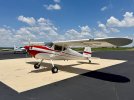
AZEL
Pre-takeoff checklist
- Joined
- Dec 6, 2025
- Messages
- 261
- Display Name
- AcrftZeroEngineLand
Pretty.I have a 140 with metal wings, no gear extenders, and an O-200. I love it. It does weigh little more than others, but I only fly solo. FWIW, the W&B from when the wings were converted indicates that it only gained 24 pounds.

texasclouds
En-Route
- Joined
- Aug 23, 2018
- Messages
- 4,361
- Location
- Bryan, Texas
- Display Name
- Mark
- Home Airfield
- Coulter Airfield CFD
They are the Bee’s Knees, but 170 is better if you can swing it. 195 is King of the Castle!
Steamflyer
Line Up and Wait
- Joined
- Mar 23, 2022
- Messages
- 954
- Display Name
- Steamflyer
190/195 are totally different beasts from the other Cessna tailwheel aircraft.They are the Bee’s Knees, but 170 is better if you can swing it. 195 is King of the Castle!
No way a 170 flies better than a 120/140 anymore than a 172 beats a 150. It’ll carry more but has not the responsiveness of the fingertip controlled two seaters.
Yes much time in both before get castigated…