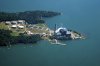
Those Beacon Lights - - -

There is a latching hook made specifically for use on the mushroom head footpegs - which he should have been using (and not the "Gorilla Hooks" visible in the video) - although realistically you should have both, since the available attachment points are different at various stages of the climb.

Damn. Didn't know about those. I need a set. Got a link? (Sigh, something else to buy for my "hobby" job. Ha.)

No doubt there is a reason why the second climber's face is blurred out.

That's interesting. The version I saw a couple years ago wasn't blurred. I bet he lawyered up.
 
You can get boots with reinforced insoles made specifically for climbing. You'd better have 'em for a job like that! Also, some harnesses have a seat built in to them - so you can sit while working or taking a break.

Yup. I don't climb high stuff, so my stiff shank hiking boots work fine. For a quick look/see what's wrong or running a 50 ohm load up to test a cable, regular heavy shoes work ok.

And, yup... my harness has the seat strap. It's like a mini hammock for your butt. ;)

The only downside to that thing is that once you get hooked up that way, the view and the break can become more interesting than finishing whatever you went up to do. ;)

Like flying, you have to know how long things are going to take and keep moving.

Especially around here where it's common to be chased off the tower by afternoon thunderstorms, we're often pressed for time. I don't like climbing at the crack of dawn because the tower usually has condensation on it. Slippery as hell.

Most of our sites are reasonably close drives so you can get started rigging early enough (8AM-9AM) to be down by 1-2PM in the summer.

We consider it bonus time if we can hang out and finish up until 4-5PM.

On the mountain tops, wind is often our nemesis. Starting a nut on a bracket in 30-40 MPH wind can be a real chore. If its cold, taking the mechanics gloves off for that sucks.

Like flying there's also a fatigue issue. If you're tired, it really is time to come off the structure.

 
...I kept feeling like he wasn't taking his handholds seriously :yikes:!

It looked to me like he was being VERY deliberate about making sure he had a firm grip with each hand before moving the other hand. (It was still scary though.)
 
While speaking of towers,
View Central Maine Power's
Big and Little towers.

Over the Island of Cousins,
Often with boats by dozens.
It's found in Yarmouth, Maine,
On this day without the rain.

Hoping for some showers
To water native flowers;
Lest they'd even choke
If ravaged by the smoke.

"Portland Approach, over Cousins Tower,
72Golf South to land within the hour.
A special day for a theater date,
Vectors, please, to land one-eight."
 

Attachments

  • CMP Cousins Island DSC07242.JPG
    CMP Cousins Island DSC07242.JPG
    4 MB · Views: 7
Sorry about multiple posts. Can't quote from iPhone.

Tim, 20 feet is the start of the almost guaranteed fatal zone.

At most tower sites you're falling into hard ground or rocks placed around the base of the structure for drainage and for wildfire protection.

People that survive falls off residential roofs at 20' or so, usually land on their lawn and have immediate EMS.

It's an hour drive down a Forest Service 4WD road from two of the tower sites I work on. Back or neck injuries, probably two hours to go slow enough to keep movement of the patient to a minimum, even if they're on a backboard with a C-collar.

That'd get you to pavement. Then an ambulance for another 1/2 hour or more to a small mountain clinic and/or a designated EMS chopper pad. On both, the two lane pavement isn't wide enough in the trees to plant a chopper. Have to get off the mountain first.

A third site is at a mountain-top fire house that's unmanned. At that site, the parking lot is big enough for an EMS chopper and there's both a phone line and a radio on the Fire dispatch channel inside.

If I were ever injured, I would hope it was at that site. :(
 
Back
Top