Takeoff Minima in Low Visibility Operations(need helps

Terry_zhang

Filing Flight Plan
Joined
Jan 16, 2024
Messages
12
Display Name
Terry_zhang
What is the difference between the reported and operating normally RVR specified in the aerodrome chart and the minimum number of RVRs stipulated in the operator's Operations Specifications (Ops Specs)?
1.For example: The takeoff minimum is RVR 300 in chart. The operator's Ops Specs require a minimum of 2 RVRs, while the aerodrome chart specifies "reported and operating normally RVR". At this point, the controller reports three RVR values: R400, R400, R500, but the mid-point RVR is not operating. Is takeoff permitted in this case?

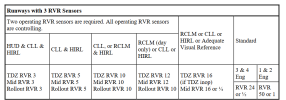
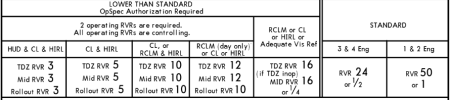
2.All operat ing RVRs are controlling and 2 operating RVRs are required.
All operat ing RVRs are controlling this is mean for controlling?
1758847893166.png
 
"2 operating, all controlling" means you can depart with one of the three RVRs inoperative, but if it is working, you cannot disregard the value.

"At this point, the controller reports three RVR values: R400, R400, R500, but the mid-point RVR is not operating. Is takeoff permitted in this case?"

Question doesn't make sense, if the midpoint RVR is not operating, then it can't give you a number.

Takeoff is permitted if the midpoint RVR is inoperative as long as at least two others are working and report at or above the minimum.

Takeoff is NOT permitted if three RVR sensors are working, but one is below the minimum required value.
 
Last edited:
OPSPEC/LOA C078 AND OPSPEC C079—IFR LOWER-THAN-STANDARD TAKEOFF
MINIMA—ALL AIRPORTS (AIRPLANE OPERATIONS).

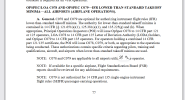
E. Lower-Than-Standard Takeoff Minima for TDZ RVR. C078 and C079 authorize
lower-than-standard takeoff minima for TDZ RVR 1600 (500 m). If TDZ RVR is inoperative,
midpoint RVR may substitute for TDZ RVR. Apart from takeoffs using HUD systems without
guidance, below RVR 1600, two operating RVR sensors are required and controlling. If more
than two RVR sensors are installed, all operating RVR sensors are controlling, with the
exception of a fourth far-end RVR sensor that may be installed on extremely long runways. A
far-end RVR sensor is advisory only. C078 and C079 allow the selection of the following
lower-than-standard takeoff minima based on flightcrew training, checking, and allowed
authorizations:
1) TDZ RVR 1200 (350 m), midpoint (if installed) RVR 1200 (350 m), and rollout
RVR 1000 (300 m).
2) TDZ, midpoint (if installed), and rollout RVR 1000 (300 m).
3) TDZ, midpoint (if installed), and rollout RVR 600 (175 m).
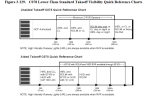
4) TDZ, midpoint (if installed), and rollout RVR 500 (150 m). Table 3-25, Runway
Equipment Requirements for Lower-Than-Standard Takeoff Minima—Example 1, and
Table 3-26, Runway Equipment Requirements for Lower-Than-Standard Takeoff Minima—
Example 2, provide examples of tables that may be included in flightcrew manuals, such as the
Flight Operations Manual (FOM).

1758851280085.png

1758851475976.png
 
Last edited:
OPSPEC/LOA C078 AND OPSPEC C079—IFR LOWER-THAN-STANDARD TAKEOFF
MINIMA—ALL AIRPORTS (AIRPLANE OPERATIONS).

E. Lower-Than-Standard Takeoff Minima for TDZ RVR. C078 and C079 authorize
lower-than-standard takeoff minima for TDZ RVR 1600 (500 m). If TDZ RVR is inoperative,
midpoint RVR may substitute for TDZ RVR. Apart from takeoffs using HUD systems without
guidance, below RVR 1600, two operating RVR sensors are required and controlling. If more
than two RVR sensors are installed, all operating RVR sensors are controlling, with the
exception of a fourth far-end RVR sensor that may be installed on extremely long runways. A
far-end RVR sensor is advisory only. C078 and C079 allow the selection of the following
lower-than-standard takeoff minima based on flightcrew training, checking, and allowed
authorizations:
1) TDZ RVR 1200 (350 m), midpoint (if installed) RVR 1200 (350 m), and rollout
RVR 1000 (300 m).
2) TDZ, midpoint (if installed), and rollout RVR 1000 (300 m).
3) TDZ, midpoint (if installed), and rollout RVR 600 (175 m).
4) TDZ, midpoint (if installed), and rollout RVR 500 (150 m). Table 3-25, Runway
Equipment Requirements for Lower-Than-Standard Takeoff Minima—Example 1, and
Table 3-26, Runway Equipment Requirements for Lower-Than-Standard Takeoff Minima—
Example 2, provide examples of tables that may be included in flightcrew manuals, such as the
Flight Operations Manual (FOM).

View attachment 145492

View attachment 145493
1758864250124.png
Thanks so much for your kind help. I've learned a ton from it.
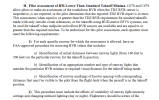
About this RVV,have an FAA-approved procedure for assessing RVR values,during flight operations, how should I handle this?
For example, how using runway markings or runway lights to meet RVV requirements?
 
"2 operating, all controlling" means you can depart with one of the three RVRs inoperative, but if it is working, you cannot disregard the value.

"At this point, the controller reports three RVR values: R400, R400, R500, but the mid-point RVR is not operating. Is takeoff permitted in this case?"

Question doesn't make sense, if the midpoint RVR is not operating, then it can't give you a number.

Takeoff is permitted if the midpoint RVR is inoperative as long as at least two others are working and report at or above the minimum.

Takeoff is NOT permitted if three RVR sensors are working, but one is below the minimum required value.
Thanks so much for your kind help. I've learned a ton from it.
As for the use of RVV, due to variations in runway markings and lighting systems across many international airports, most operators have a method of implementation to meet RVV requirements. Is there a summary of these methods?

1758864547905.png
 
Runway Visibility Value (RVV)− The visibility determined for a particular runway by a transmissometer. A meter provides a continuous indication of the visibility (reported in miles or fractions of miles) for the runway. RVV is used in lieu of prevailing visibility in determining minimums for a particular runway.

Runway Visual Range (RVR)− An instrumentally derived value, based on standard calibrations, that represents the horizontal distance a pilot will see down the runway from the approach end. It is based on the sighting of either high intensity runway lights or on the visual contrast of other targets whichever yields the greater visual range. RVR, in contrast to prevailing or runway visibility, is based on what a pilot in a moving aircraft should see looking down the runway. RVR is horizontal visual range, not slant visual range. It is based on the measurement of a transmissometer made near the touchdown point of the instrument runway and is reported in hundreds of feet. RVR is used in lieu of RVV and/or prevailing visibility in determining minimums for a particular runway.
Check the takeoff minimum standard procedure, check the standards on the aeronautical chart and the lighting facilities, then compare them with the operational specifications, and take the maximum value between the two.For lighting facilities, due to regional and national differences, how to use the lighting equipment?For example, the runway centerline lights or centerline markings distance。
 
I would add this RE takeoff mins.... we know part 91 has no mins ,or any part 135, 135 or 121 unless their ops specs allows lower mins (most ops specs only allow this if airport has standard mins piblished).....BUT, ops specs may allow even lower than what's restricted on the airport:s takeoff restrictions, especially for HUD displays or other equipment. further. certain airports may have a standard min but require a min ceiling as well (mostly mountainous fields) that your ops specs may allow you to ignore as well .... the 787 HUD allows us to go further below even basic ops specs under certain conditions..... point being, just because this airport requires all 3 RVR above a min if reporting, op specs may allow it....not all specs the same.
 
I would add this RE takeoff mins.... we know part 91 has no mins ,or any part 135, 135 or 121 unless their ops specs allows lower mins (most ops specs only allow this if airport has standard mins piblished).....BUT, ops specs may allow even lower than what's restricted on the airport:s takeoff restrictions, especially for HUD displays or other equipment. further. certain airports may have a standard min but require a min ceiling as well (mostly mountainous fields) that your ops specs may allow you to ignore as well .... the 787 HUD allows us to go further below even basic ops specs under certain conditions..... point being, just because this airport requires all 3 RVR above a min if reporting, op specs may allow it....not all specs the same.
I think so,Thanks for sharing this valuable information.
 
Back
Top