Richard McSpadden Crash

Engine with 40 SMOH raises possibilities. I'm certainly no expert, but am currently installing my own engine (under supervision) after OH. I can think of lots of minor installation mistakes that might rear their head about 40 hours later. Failure to properly tighten a fitting or safety a fastener, improper routing of ignition wires, etc. I spend a lot of time thinking about this as I'm doing my install.
 
Engine with 40 SMOH raises possibilities. I'm certainly no expert, but am currently installing my own engine (under supervision) after OH. I can think of lots of minor installation mistakes that might rear their head about 40 hours later. Failure to properly tighten a fitting or safety a fastener, improper routing of ignition wires, etc. I spend a lot of time thinking about this as I'm doing my install.
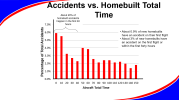
Interesting point. I've plotted my homebuilt accident data vs. aircraft total time. Notice the jump at the 50 hour point.
1698198536666.png
Some of that rise...but not all...can be attributed to the plane now being able to leave the test area. But there *is* a spike in mechanical failures in the 40-70 hour period. I use this chart in my homebuilt safety presentations to demonstrate that making a successful first flight does NOT establish that the airplane is perfect, mechanically.

~40 hours after an engine installation on a Cessna probably falls into the same zone....

Ron Wanttaja
 
Bumping in anticipation of NTSB Final coming out in next few months.
 
Bumping in anticipation of NTSB Final coming out in next few months.
Final report: "The NTSB added that the pilot’s subsequent aggressive use of the flight controls to turn back to the airport ultimately resulted in the airplane exceeding its critical angle of attack and entering an aerodynamic stall at an altitude from which a safe recovery by the pilot was not possible."

There is also a video up here:
ASF video
 
So many things went wrong in this crash.

The CFI that flew with the pilot declaring that he was "upset" with his maneuvering techniques.
Lack of proper W&B.
Not aborting the take-off when it was quite apparent that the performance wasn't there.

A very experienced pilot from our airport told us a few years ago that he will refuse to fly with most other pilots. I can see why.
 
The report mentioned the accident aircraft took off 700 ft behind the other aircraft. Why would anybody do that?
 
The report mentioned the accident aircraft took off 700 ft behind the other aircraft. Why would anybody do that?
Remember this was a photo mission. The Bonanza was the photo ship. They probably wanted takeoff pictures, and they were going to fly formation anyway. That's the whole reason McSpadden was along.
 
Remember this was a photo mission. The Bonanza was the photo ship. They probably wanted takeoff pictures, and they were going to fly formation anyway. That's the whole reason McSpadden was along.
That could be. I read it as that they weren't supposed to meet up for formation and shooting until after they were in the air, and 700 ft seemed like a weird separation for photos on takeoff from a 4k ft field, but I don't know anything about formation photo shooting.
 
The report mentioned the accident aircraft took off 700 ft behind the other aircraft. Why would anybody do that?

Not an unusual method for a loose formation departure. Near enough to maintain visual contact, which facilitates closing up after takeoff. Departing separately and joining in the air takes skill.
 
Even a 10 second go (like this) requires much of that skill. But it’s still a simple way to do a formation departure, and not require the skill of a full join up or section go.
 
Last edited:
Of course with a T-bird pilot aboard, formation skill was the least of their worries, for that ship at least.
 
Of course with a T-bird pilot aboard, formation skill was the least of their worries, for that ship at least.
If he were flying, sure. And 4k feet is plenty of room for a cardinal to take off, twice even. But if he wasn't the one flying, and the pilot flying wasn't used to formation takeoffs, following 700' behind the other aircraft he might not notice a lack of takeoff performance the same way if he were looking at the end of the runway. He might not noticed a problem until the lead aircraft pulled away. Complete speculation.
 
The whole PIC left seat/right seat thing doesn’t matter a lick.

IF this were less experienced guy messing up, the only fathomable reason I can think of for experienced guy to NOT get involved is a misguided politeness sort of thing. Or just plain denial.

About all I can say with near certainty is that McSpadden didn’t go down thinking “I wish I were PIC” or what ever.

All mishaps are chains of unlikely events…

Bad idea to go prolly but easy to slide on (get there itis)…

Both looking to the other about lack of performance on takeoff roll… “well, he ain’t saying nuffin…”

actual event, he can handle it, I’ll stay out…

Not handling it, now I’m late to the party and over correct…

Sort of sequence. No single line entry fatal. Put together, bad things.

Lessons:

1 it can and really will happen to me
2 don’t assume ANYTHING about the other guy
3 see something, say something
4 basics… don’t stall.
5 mitigate startle effect, see number 1.
 
Interesting Francis made similar mistakes on the practice flight with the cfi.
 
One thing I fail to understand is why was McSpadden required to be in that plane at all.

As our own @Lowflynjack has shown us, you can take an air-to-air shot without a ex-Thunderbirds pilot in the other plane. You just tell him to fly a certain heading/speed/altitude, and the more experienced pilot in the photo plane maintains the formation and ensures the two planes don't fly into each other.
 
Prolly not required, but he was very formation experienced, that’s certainly one of several good reasons. The mission certainly isn’t high risk, and the mishap cause clearly isn’t related to the mission.

His experience should have helped with the problem that DID occur… the fact it didn’t is prolly the most learnable point here.

I don’t know if the situation was survivable, but I do know NOT STALLING was an option that should have been employed… and wasn’t. There’s almost no possible way to know why and is what I would like to know the most so I can tuck that away for my use and teach it to others, which I do EVERY DAY.
 
As our own @Lowflynjack has shown us, you can take an air-to-air shot without a ex-Thunderbirds pilot in the other plane. You just tell him to fly a certain heading/speed/altitude, and the more experienced pilot in the photo plane maintains the formation and ensures the two planes don't fly into each other.
Well, kind of! I don't have them fly any specific heading/speed/altitude, I have them match what we're doing and not look at anything but me! My experienced photo pilot keeps us safe and communicates things like turns (we're starting a left-hand turn in 3, 2, 1), etc. The most important thing we do is brief thoroughly before we fly so that nobody is surprised. There's a pretty cool video on my Briefing Page showing what we do.

I'm also a little different than other aviation photographers in the fact that I'm a pilot and most of the time I shoot from the front seat. Even though I'm not the one flying the photo plane, I'm right next to the controls if the subject plane puts us in any danger. Being a pilot also allows me to understand the limitations of the plane and the pilot I'm taking photos of and keep everyone safe.
 
One thing I fail to understand is why was McSpadden required to be in that plane at all.

As our own @Lowflynjack has shown us, you can take an air-to-air shot without a ex-Thunderbirds pilot in the other plane. You just tell him to fly a certain heading/speed/altitude, and the more experienced pilot in the photo plane maintains the formation and ensures the two planes don't fly into each other.

Does there have to be a requirement? Maybe Russ was uncomfortable being in proximity to another aircraft. Maybe McSpadden was working on an article. Maybe they were just friends and felt like flying together.

I tell you right now, if I ran across a T-bird or Blues pilot, I would be following him around the ramp begging him/her to fly with me.
 
Last edited:
I tell you right now, if I ran across a T-bird or Blues pilot, I would be following him around the ramp begging him to fly with me.
From your perspective, I agree 100%.
From the T-bird/Blues pilot perspective, I'd be like "You only have 10 hours in the plane, and the engine has been recently overhauled? No, thank you!"
 
Prolly not required, but he was very formation experienced, that’s certainly one of several good reasons. The mission certainly isn’t high risk, and the mishap cause clearly isn’t related to the mission.

His experience should have helped with the problem that DID occur… the fact it didn’t is prolly the most learnable point here.

I don’t know if the situation was survivable, but I do know NOT STALLING was an option that should have been employed… and wasn’t. There’s almost no possible way to know why and is what I would like to know the most so I can tuck that away for my use and teach it to others, which I do EVERY DAY.

Let’s talk about the wisdom of a form flight/photo shoot with someone who has less than 10hrs time in type.

Seriously, that the PIC was still getting formal instruction just a day or two before the mishap, needed to RTB upon takeoff, threw in 40* bank in at low altitude in the pattern is something I can’t believe AOPA and McSpadden had full awareness of. I’m wondering what was so important that this 177 photo shoot had to happen that day. It’s not there are especially rare, nor are there limited numbers of experience pilots.

I don’t care if he had 10K hours total,recency and proficiency in type seems to have been a factor. Maybe I’m wrong.

And we still don’t have an explanation for the uncommanded shutdown during the mishap flight’s taxi to takeoff.
 
Ya… good point! Prolly understated the wisdom of going at all. Sorta pushing that to McFadden’s side of the court.

The plane owner, a little like the JFK Jr thing, might not of had the experience he needed to realize he didn’t have the experience required.
 
I’m wondering what was so important that this 177 photo shoot had to happen that day.
As someone who has done hundreds and hundreds of shoots for magazines, the answer to this should always be nothing. Nothing should ever be prioritized over safety. I've canceled several photoshoots because I wasn't happy with weather, the planes, or the pilots. Most magazines have backup stories, so even hard deadlines are really set in stone. If it's coverage of an event and something doesn't work out... oh well, we tried!

Once I had a three-ship flight scheduled and I cancelled because two of the pilots got into a big argument during the brief. Nope, not going up with you when you're not in the right mindset!

One of the things we brief is, ANYONE involved in the flight can call off the shoot at any time.
 
Well, kind of! I don't have them fly any specific heading/speed/altitude, I have them match what we're doing and not look at anything but me! My experienced photo pilot keeps us safe and communicates things like turns (we're starting a left-hand turn in 3, 2, 1), etc. The most important thing we do is brief thoroughly before we fly so that nobody is surprised. There's a pretty cool video on my Briefing Page showing what we do.

I'm also a little different than other aviation photographers in the fact that I'm a pilot and most of the time I shoot from the front seat. Even though I'm not the one flying the photo plane, I'm right next to the controls if the subject plane puts us in any danger. Being a pilot also allows me to understand the limitations of the plane and the pilot I'm taking photos of and keep everyone safe.

What's the typical distance between aircraft during a photo shoot? Is the subject aircraft in echelon and offset vertically?
 
What's the typical distance between aircraft during a photo shoot? Is the trail aircraft offset vertically?
Not too far horizontally, maybe two plane widths away, but yes, they're almost always below me. As you can see in most of my photos, the subject plane is below and at about a 5:00 or 7:00 position.

One exceptions are when I'm shooting from EAA's Aircam, but in that case, the subject plane has the lead and we move up behind and underneath them.
 
Back
Top