Retracts and multi-engine planes have higher fatality rates during crash landings

MountainDude

Cleared for Takeoff
PoA Supporter
Joined
Jul 29, 2011
Messages
1,466
Display Name
MountainDude
Home Airfield
KPDX
This study focused on crash landings.
- The risk of pilot death in an airplane with retractable tricycle landing gear was 2.2 times higher than in one with fixed tricycle landing gear
- Multi-engine planes were associated with an 1.9 times higher risk of pilot death

I assume this is because retracts and twins have higher stall speeds.
 
Uh, yeah, sorta cherry-picked the hardest part of ME flying there -- or at least I assume approximately none of the twins who lost engine power while landing gave a ish about it. :D

“These tapes included data on crashes only if they had occurred during landing or takeoff and involved loss of engine power, which we defined as crash landings.”
 
This study focused on crash landings.
- The risk of pilot death in an airplane with retractable tricycle landing gear was 2.2 times higher than in one with fixed tricycle landing gear
- Multi-engine planes were associated with an 1.9 times higher risk of pilot death

I assume this is because retracts and twins have higher stall speeds.
Subjects.— All pilots in general aviation crash landings of airplanes with 10 seats or fewer, from 1983 through 1992.


You are comparing two very different things. All single engine aircraft certified under Part 23/CAR3 have a maximum VSO of 61 knots. The complex model will have a slighting higher published stall speed than the fixed gear model because it is slightly heavier. This difference is usually only 1-2 knots.

A multi engine aircraft is quite different. A multi-engine piston aircraft with a VS0 of 61 knots or less and a maximum weight of 6,000 pounds or less are not required to demonstrate a positive single-engine rate of climb. Their single-engine performance only needs to be measured and recorded, even if it results in a negative rate of climb.

If a multi-engine piston aircraft has a VS0 greater than 61 knots (or weighs more than 6,000 pounds), the manufacturer must prove it can achieve a specific positive single-engine climb performance or gradient. You are talking about rather large multi engine plane with 8-10 seats and a lot of energy that needs to be dissipated on touch down.

If I had to experiance an engine failure in a single engine airplane, I would prefer the retractable gear model. I would enjoy a better glide distance and could opt to land gear up to more quickly dissipate energy after touch down.
 
Last edited:
What airplanes are typically faster and stall at higher airspeeds? Single engine fixed gear types or retracts and multi's?

This is a kinetic energy issue, not a configuration issue.
 
I don't agree with that. A bonanza, for example, with tap tanks and vortex generators, has a low stall speed.
There are exceptions, but in general, (statistically) multis and retracts have higher stall speeds, so higher fatality rates.
If I had to experiance an engine failure in a single engine airplane, I would prefer the retractable gear model. I would enjoy a better glide distance and could opt to land gear up to more quickly dissipate energy after touch down
I'll choose the slow plane with a robust fixed landing gear. When things get quiet with nothing but small rough fields below, would you rather be in a Bonanza or a Cub?
 
There are exceptions, but in general, (statistically) multis and retracts have higher stall speeds, so higher fatality rates.
Multis yes, single engine retracts, I'm not convinced.
I'll choose the slow plane with a robust fixed landing gear. When things get quiet with nothing but small rough fields below, would you rather be in a Bonanza or a Cub?
I'd rather be in my Navion than either. Stouter main gear, bigger tires if I think a gear down landing makes sense (both of my engine failures were gear down). And more substantial structure if I land gear up.
 
Multis yes, single engine retracts, I'm not convinced.
As @kyleb pointed out, it's about speed, and planes with retracts, in general, are faster. And multis and retracts are more likely to be IFR, and CFIT in bad weather is more likely to be usual then a groundlooping Cub.
I'd rather be in my Navion than either. Stouter main gear, bigger tires if I think a gear down landing makes sense (both of my engine failures were gear dow n). And more substantial structure if I land gear up.
Navion is another exception, really it's in a class by itself: built like a tank and relatively slow landing speed compared to its competition.
 
There are exceptions, but in general, (statistically) multis and retracts have higher stall speeds, so higher fatality rates.

I'll choose the slow plane with a robust fixed landing gear. When things get quiet with nothing but small rough fields below, would you rather be in a Bonanza or a Cub?
In Texas the interstate the speed limit exceeds Cub cruise speed. If that’s my choice, I will give it up.
 
Last edited:
Stall speed is only one factor. There are, as Dana pointed out, CFIT accidents. Running into granite in a cloud, for instance. The high cruise speed of a twin or retractable single means that it hits far harder than a fixed-gear single. Impact forces go up by the square of the increase in speed, so a 172 that hits the granite at 100 knots suffers just a bit over half the impact force of one that collides at 140 knots. Survivability goes way down in the faster airplane.

Landing out right at stall speed takes some skill. Most will either land too fast, or will get too slow and stall and spin in.

The retractable singles like the popular Bonanzas and 210s suffer from loss of control accidents, usually in IMC. The pilot (often some guy with more money to buy such a machine, but refuses to spend the time to take advanced training) becomes disoriented and gets vertigo and gets into an ever-steepening spiral that will either overstress the airplane and tear it apart, or it will pop out of the clouds and the pilot sees the ground coming at him and he pulls back hard. The horizontal stab fails and the airplane flips forward onto its back and the wings fail in negative loading. I know of one (a 180) where the whole tailcone tore off. Load factors affect the whole structure, not just the wing spars.
 
If I had to experiance an engine failure in a single engine airplane, I would prefer the retractable gear model. I would enjoy a better glide distance and could opt to land gear up to more quickly dissipate energy after touch down.
Better glide distance, yes - But I'd be putting down the gear before landing, once I had my field made. If you have the gear out you should have a higher chance of control, but you also have some shock absorption that isn't your own body so injuries should be significantly less.

Also, if you land on a hard enough surface, you'll be able to slow quicker with tires than metal.
Really, ever measured the roll distance of an aircraft that landed gear up? Reduced friction is why the wheel was invented.
 
Really, ever measured the roll distance of an aircraft that landed gear up? Reduced friction is why the wheel was invented.
It's quite short. The local school's Duchess was landing before me, I really had to pee, I didn't notice their gear wasn't down, nor did the tower, and they touched down just past the numbers and didn't slide 100 feet. Had to fly elsewhere for relief, as the Duchess hadn't sufficient power to taxi gear-up.
 
As @kyleb pointed out, it's about speed, and planes with retracts, in general, are faster. And multis and retracts are more likely to be IFR, and CFIT in bad weather is more likely to be usual then a groundlooping Cub.
LANDING SPEED. As the others have pointed out, most of the single engine retracts don't have stall speeds much different than their fixed gear counterparts. You can argue that the cruise speed and better gear-up glide ratios work in the retracts favor.
Navion is another exception, really it's in a class by itself: built like a tank and relatively slow landing speed compared to its competition.
Same speeds pretty much as 182RG.
 
LANDING SPEED. As the others have pointed out, most of the single engine retracts don't have stall speeds much different than their fixed gear counterparts. You can argue that the cruise speed and better gear-up glide ratios work in the retracts favor.
This study would have been much more interesting if you limited it solely to accidents where there is a fixed, retract, and multi that are essentially the same airframe. For example, PA28, PA28R, and PA44 or PA32, PA32R, and PA34. Maybe 206, 210, 310 though I don't think those are as similar. There's no fixed version of the Bonanza either, and no twin Mooneys, but M20C vs M20D and Bo vs Baron could still have useful comparisons too.
 
Really, ever measured the roll distance of an aircraft that landed gear up? Reduced friction is why the wheel was invented.
No, but the coefficient of friction between rubber and concrete is nearly double that of aluminum and concrete. It's not like we're gonna leave the wheels rolling. :rolleyes:
 
This study did limit itself to accidents that occurred on takeoff or landing that involved loss of engine power, which largely removes the CFIT and similar accidents from the analysis set.

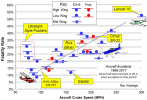
Years ago, I did a similar study, looking at the fatality rates for homebuilt accidents. Obviously, the faster it's going on impact, the more energy gets passed to the occupants and the fatality rate goes up.

However, I felt that plotting it vs. stall speed didn't help much. The range is just too damn short... ~15-20 knots between the slowest and the fastest. For homebuilts, too, reliable stall speed information isn't available (not an issue with the Standard category aircraft used in the referenced study).

What I did instead was compare based on the aircraft's published cruise speed. Sure, airplanes don't often CRASH at that speed, but it is an indicator of how "slippery" an airplane type is; how much it might accelerate before impact if the pilot loses control. Threw in a couple of production-type airplanes, too.

The results were interesting...
1789441915418.png
Lancair IV did come out with the highest rate, but note that the result is in-family with that of slower aircraft.

Ron Wanttaja
 
This study would have been much more interesting if you limited it solely to accidents where there is a fixed, retract, and multi that are essentially the same airframe. For example, PA28, PA28R, and PA44 or PA32, PA32R, and PA34. Maybe 206, 210, 310 though I don't think those are as similar. There's no fixed version of the Bonanza either, and no twin Mooneys, but M20C vs M20D and Bo vs Baron could still have useful comparisons too.
The Mousketeer and the Bonanza have the same stall speed. The 172, 177, 182, all have comperable stall speeds to their RG counterparsts. The 206, 210 have comperable stall speeds to the fixed gear 182.
 
Back
Top