Protecting infrequently used tools

tiger

Pre-takeoff checklist
Joined
Apr 25, 2012
Messages
279
Display Name
tiger
I figure there are a lots of mechanically-inclined individuals on this board.

I'm wondering about a good method of protecting tools - light electrical / bicycle / auto related stuff such as screwdrivers, sockets, cone wrenches etc? Individual specialized (and expensive!) tools might go months or years between uses.

I already know that it's dumb to buy a special tool for a task I only need to do three times a decade, but I enjoy being able to DIY for reasons that have nothing to do with economy.

Aside from ensuring a dry environment, I read that a wipe-down with Boeshield T-9 before storage is a good plan (plus I'm attracted to the aviation connection!).

Thoughts?
 
Mine generally all end up so covered in oil that it doesn't matter and I just leave everything laying on the workbench in the garage.
 
My husband puts all those types of tools in one of the under the bed storage bins or in his toolbox.
 
Living in a desert does a pretty good job of avoiding rust...

Also, 3-in-1 oil is a pretty good preservative.

If you're hard core, clean to a bright surface and then coat with cosmoline. :D
 
I don't do anything special to them, throw them in a tool box and forget them for years, no problem.
 
Keep your tools either in a box, even a shoe box is fine, or wrapped in a rag, or both. For the most part, they will last a lifetime. Mechanical micrometer fittings, or tools with sensitive moving parts, should be lubricated after use and before prolonged storage.

Keeping your tools away from the ambient air, like in a box, is probably the simplest way to take care of them.

Most tools, like wrenches and such, as noted above, usually are in assorted boxes, scattered around on work benches, and in kitchen drawers. The primary requisite to being a DIYer is that of being a detective, having the ability to actually find the tool you need, rather than knowing how to use it properly, as one would at first think.

-John
 
Since the kids now have cars, I've found the best way to protect my tools is with a padlock.
 
Thanks all... ...I think I'm looking for something between 'leave on bench' and 'bury in yard smothered in Cosmoline', so LPS3 should be worth a look. Although interesting that some say 'put back in box' is just fine, perhaps I'm overthinking this.
 
All of my tools pretty much just spend their lives in the toolbox in the garage or hangar, or in a bag on a boat. Some of the stuff that lived on a boat for years accumulated a little rust. But most of the stuff (that dates back to the late '60s early '70s) is fine.
 
Most tools, like wrenches and such, as noted above, usually are in assorted boxes, scattered around on work benches, and in kitchen drawers.
-John
I hate that concept, I spend half my life looking for some thing I just had in my hand.
 
All I've ever done over the last 30 years or so is clean 'em up pretty well and put 'em way. Really never had any issues. This includes rarely used paint guns and some power tools.

It's really amazing how almost everything...well, except an airplane engine, of course...can be idled for long stretches without being damaged.
 
Last edited:
Still have grandpa's tools. The residual motor oil from his shop rags has worked fine for 40 or 50 years.
 
Aside from ensuring a dry environment, I read that a wipe-down with Boeshield T-9 before storage is a good plan (plus I'm attracted to the aviation connection!).

Thoughts?

Yeah. Don't use Boeshield, Boeing sure doesn't anymore. It used to be qualified to BMS 3-23 (Boeing Material Specification) but not since the mid '80s. You know what replaced it as a better performing option? LPS-3.
 
LPS-2.

I have a small machine shop in the garage. Lathe, mill, metal bandsaw. I wipe everything down with LPS-2 in the fall. No rust, no issues.

I don't know anything about LPS-3, but if it works as well as LPS-2, go for it.
 
LPS-2.

I have a small machine shop in the garage. Lathe, mill, metal bandsaw. I wipe everything down with LPS-2 in the fall. No rust, no issues.

I don't know anything about LPS-3, but if it works as well as LPS-2, go for it.

LPS3 leaves a thin wax coating. Nothing real noticeable, but it protects WAY better than anything designed as a lubricant (LPS-2).

You should try it. I've never heard anything but good comments.
 
There is also an impregnated paper that protects tools against rust... New tools you buy often come wrapped in it (google it)... A combination of wipe the finger prints off, spray with LPS3, wrap in barrier paper, and store in a sealed container in a dry place with a packet of silica gel and your tools will be the archeological find of the year about ten thousand years from now...
 
we sent our infrequently used tools to the software testing department, where they were promoted to management. :D
 
I do not like to use greasy tools, when I get done with a tear down, I throw all my tool in the parts washer and dry them and put them away.

That's all I've ever done and I've never seen any rust on my tools.
 
I hate that concept, I spend half my life looking for some thing I just had in my hand.

That has to be the one supreme truth that has plagued all of mankind since Adam figured out what a woody was for. It's not about owning the right tools, or even knowing how to use them properly, it's about finding the damn things.

-John
 
That has to be the one supreme truth that has plagued all of mankind since Adam figured out what a woody was for. It's not about owning the right tools, or even knowing how to use them properly, it's about finding the damn things.

-John

The most difficult thing I had to teach the kids in the Navy, put the tools away so the rest of us can find them.
 
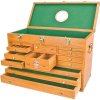
Putting your tools in metal tool boxes is better than leaving them scattered around the garage floor, but like fuel tanks, they do condense moisture. If you want to be really picky about tool storage, wood or cardboard boxes are far better.

Nothing beats a good wood tool box with felt lined drawers, but those things are expensive and/or time consuming to make. They do look very cool though.

http://www.grizzly.com/products/Machinist-s-Oak-Chest/SB1251
http://www.grizzly.com/products/Machinist-s-14-Drawer-Oak-Chest/H8266
h8266.jpg


-John
 

Attachments

  • wood tool chest.jpg
    wood tool chest.jpg
    35.2 KB · Views: 5
Last edited:
Putting your tools in metal tool boxes is better than leaving them scattered around the garage floor, but like fuel tanks, they do condense moisture. If you want to be really picky about tool storage, wood or cardboard boxes are far better.

Nothing beats a good wood tool box with felt lined drawers, but those things are expensive and/or time consuming to make. They do look very cool though.

http://www.grizzly.com/products/Machinist-s-Oak-Chest/SB1251
-John
the machinist box, try putting a 1" combination wrench in it.
 
the machinist box, try putting a 1" combination wrench in it.

Go to the Grizzly web site, they have wood rolling cabinets, individual trays, pretty much anything most would need. I am sure that there is no such thing as an off the shelf tool box that would solve 100% of everyones tool storage problems, but then isn't that what workbenches are for, to take up the slack? :D

-John

I like to think my Snap-On KRL does a good job of storage and serves as a rolling work bench.
 
Nothing beats a good wood tool box with felt lined drawers, but those things are expensive and/or time consuming to make. They do look very cool though.

A pretty toolbox is still annoying as all get out when you have 50 sockets rolling around in a drawer all mixed up...and you have no idea if you left the one socket you need laying on top of the last engine you worked on.

A standard toolbox, 1/4" hardboard and dowels goes a long way. Organized how you want it, easy to find, if one's missing it's easy to tell.
 

Attachments

  • tools.jpg
    tools.jpg
    178.7 KB · Views: 19
For good precision type tools I spray them with LPS-3 and put them In a felt or cloth bag of some form. Normal tools get a wipe and go in the box.
 
A pretty toolbox is still annoying as all get out when you have 50 sockets rolling around in a drawer all mixed up...and you have no idea if you left the one socket you need laying on top of the last engine you worked on.

A standard toolbox, 1/4" hardboard and dowels goes a long way. Organized how you want it, easy to find, if one's missing it's easy to tell.

I get the magnetic trays from Snap On, each socket or wrench has a hole or a slot and you can just grab the whole rack to go to the job.
 
Remember girls, this thread is about what is the best way to store your tools, not the easiest way to use them.

-John
 
I get the magnetic trays from Snap On, each socket or wrench has a hole or a slot and you can just grab the whole rack to go to the job.

I looked at those and others from craftsman and the box stores and decided it was nonsense for my use. I'm extremely limited on storage space and the custom built trays are far superior to the generic tool trays and racks and such. My one 3 drawer tool box holds about 4 same size tool boxes of tools based on the required space that the grab and carry or even the predrilled trays wastes. It's not even that heavy either. It's easy enough to set the whole box two feet from where I'm working and have 95% of anything I can possibly need right there within reach.
 
I looked at those and others from craftsman and the box stores and decided it was nonsense for my use. I'm extremely limited on storage space and the custom built trays are far superior to the generic tool trays and racks and such. My one 3 drawer tool box holds about 4 same size tool boxes of tools based on the required space that the grab and carry or even the predrilled trays wastes. It's not even that heavy either. It's easy enough to set the whole box two feet from where I'm working and have 95% of anything I can possibly need right there within reach.

The magnetic racks opened up a bunch of space in my box and also is great with taller boxes because I stick them on the vertical lid for easy viewing.
 
A pretty toolbox is still annoying as all get out when you have 50 sockets rolling around in a drawer all mixed up...and you have no idea if you left the one socket you need laying on top of the last engine you worked on.

A standard toolbox, 1/4" hardboard and dowels goes a long way. Organized how you want it, easy to find, if one's missing it's easy to tell.

Damn, I like that. Which means I'll have to go,out to the garage and build it.

Why hasn't anyone made a plastic version of that?!
 
Actually, those fancy toolboxes are just the starting point. It is up to you to organize them, make dividers, or whatever else it takes to keep your stuff the way you want it.

Sadly, that is rarely the case, most people just fill up the drawers and let it go at that. Sometimes they will make a secret pact with themselves to someday set it up properly.

We are the home handyman, or self envisioned craftsmen, even a few professionals that rely on off the shelf, store bought organizers rather than actually doing it ourselves. Kind of like the people who take the escalator up to the gym so they can exercise on fancy machines, that replicate walking, jogging, push ups, pull ups, sit ups and other things we actually do not need a commercial gym for at all.

We visit 3rd world countries and marvel at the simplistic methods the natives use as solutions for things that we would spend thousands, if not millions, of dollars, in order to achieve the same results.

If you want to protect your tools, put them in a box. If you want them organized, organize the box. It is not all that complicated.

-John
 
Organized "enough" is fine for me. If I can find everything and everything has a place, I'm good.

My sockets are a disaster though. Too many sets and that dowel thing looks simple.

I have some of those bars with the springs on them and hate them with a passion.
 
Damn, I like that. Which means I'll have to go,out to the garage and build it.
Why hasn't anyone made a plastic version of that?!

Each of us have a different tool box and different tools. That's instant wasted space for mass produced holders which means you're back to the generic trays or doing it yourself.

They do make plastic versions of it though, or at least they partially do. It's expensive IIRC 5"x5" plastic sheets with standard spacing holes in it and plastic pins for the sockets. Then there are the bigger socket spring racks that are to be just tossed in a drawer and the huge wrench holders. Just measuring when I was designing it, it takes up 3 drawers to hold half of the tools in that one drawers, plus you need deeper drawers to handle the added height and you still haven't dealt with the deep sockets or extensions - and you haven't even considered the other two drawers and lid full of tools. Then you have about 3 inches of wasted space per drawer for stuff to roll around in while the sheets slide around on their own. And the deep sockets, or anything taller than a standard socket or larger 1/2" stuff, forget about it, you need a larger toolbox and it would still be a mess.

I did all 3 drawers in one day (laying it out took the most time) and did the 1/2" and other stuff in the big box when I had time. Top drawer is a bunch of combination wrenches and a speeder wrench. Bottom drawer is just about every 3/8" socket you can ever need. The lid is screwdrivers, caliper, micrometer, allen wrenches and other assorted stuff. And the deep sockets laying on their side won't roll around when you take a few of them out even if the box is tilted 30deg off level.

I've been told my box is excessively organized and I'm a freak for doing it that way (usually by people who are horders who can't find any of their tools without a 45+ minute search) however when you're severely limited on storage space and prefer to do actual wrenching more than tool hunting, you do what you gotta do.
 
My Dad always told me that Craftsman tools have a lifetime warranty, so no matter how old and beat up it is, we can still bring it in to exchange for a new one. It's great because we find old tools and do this a lot.

Despite that, I keep my tools relatively clean and in a box.
 
My Dad always told me that Craftsman tools have a lifetime warranty

Don't depend on that anymore. Some frigging idiot beancounter took over the craftsman tools department and started making lower quality tools and eliminating the quality and warranties they are known for. The forever replacement warranty is now limited to simple hand tools only. Screwdrivers, sockets, ratchets, speeder wrenches, etc. No more powered anything, or compressors or jacks or even borderline simple hand tools. I've heard of problems getting them to replace torque wrenches though it's, hopefully, just counter clowns who don't know the rules. I was hassled by the counter wacko's when I was getting them to replace a broken ratchet. If it has moving parts, they want you to buy the replacement...though if you throw a temper tantrum and the 'forever warranty' sign around in front of a bunch of customers buying tools they will back down just to get you out of the store..for now.

Hang onto those old craftsman tools. My dad's ancient craftsman tools can break my craftsman tools like my stuff is made of chinese knockoff junk. The old lifetime warranty was there because they use to make tools you couldn't break without a great deal of unreasonable effort. They knew they weren't selling junk thus the warranty. I'm not so sure about that anymore and their lack of warranty tells the rest of the story.
 
Back
Top