People Make Fun of it, but

spiderweb

Final Approach
Joined
Feb 22, 2005
Messages
9,488
Display Name
Ben
Really good barbershop quartet singing is something to witness. You may think it is simple, but close harmony, frequent chromatic modulations, and complicated tempo changes--all this can be found in the performances of the best groups. Listen and enjoy!


Last edited:
One of my favorite acapella groups is Davinci's Notebook.

 
Really good barbershop quartet singing is something to witness. You [may] think it is simple....

having once been called the Van Gogh of music, I know very well it isn't easy.

(it's simple, just not easy).
 
I am a big fan of barbershop. The membership in SPEBSQSA, according to their brochure, says it was open to congenial gentlemen of good character. I figured that let me out three ways.

Being a bass I love the second half of the Tennessee Waltz there...
 
Last edited:
Really good barbershop quartet singing is something to witness. You make think it is simple, but close harmony, frequent chromatic modulations, and complicated tempo changes--all this can be found in the performances of the best groups. Listen and enjoy!

I've done a fair amount of a cappella singing, mostly Derek Johnson arrangements. (Google Voices of Liberty) It's not easy, at all. I sing tenor, and I've done this one many a time:

http://www.youtube.com/watch?v=p8ve_OWWTAk

This is one of the ones we do every Christmas:

http://www.youtube.com/watch?v=mgImymb6Tu8

I also waaaay expanded my comfort zone and joined a local theatre company and sang in a broadway review recently. I'm considering studying and trying out for the part of Schroeder in their upcoming fall production of Your a Good man, Charlie Brown.

Waaaay outside my box, yet so much fun.
 
Recipes, barbershop quartets, what's next on POA? A sewing bee? :rolleyes:


:lol:


;)

This is the iron I have for the hangar. It does have an auto shutoff (boo) but it takes 30 minutes and has a reset button so the shutoff hasn't been a problem even when I am calibrating it. Temperature control is decent. An expensive digital would probably be better for temperature, but the shutoff would be harder to defeat.
 
Having performed Music Man three times now, no, barbershop is not at all easy.

Especially if your familiar with the Buffalo Bills! No quartet before or after half as good. Then there's the 1961 chorus of the Chesapeake, now a shadow of their former selves.
 
This helps me understand why people think Metal is annoying.
I love it. It is insanely complex and very difficult to play. The precision, speed, coordination, etc is not simple.

The Barbershop Quartet helps illustrate to me that complex doesn't equal pleasant.

More importantly, That is one sweet Iron Geoff!
 
Thanks for posting this. I am an a capella nutcase. I bought the BOCA CDs for many years.

This is the iron I have for the hangar. It does have an auto shutoff (boo) but it takes 30 minutes and has a reset button so the shutoff hasn't been a problem even when I am calibrating it. Temperature control is decent. An expensive digital would probably be better for temperature, but the shutoff would be harder to defeat.

I prefer the Rowenta.
 
Especially if your familiar with the Buffalo Bills! No quartet before or after half as good. Then there's the 1961 chorus of the Chesapeake, now a shadow of their former selves.

No kidding. There was a reason they were cast in the original movie version with Robert Preston. Those guys were amazing.

And the quality of the barbershop makes or breaks that show. You can have the best used car salesman expounding on the evils of pool and threatening to drop marbles in the library, but if the school board is out of tune, it's just, well, over. Similarly, a good quartet can hide a less than stellar lead.
The reason was they were the best in the country at that time. Shirley jones ( beautiful!)and Robert Preston were superb also. No one will ever take their places in those roles.
 
I love a good barbershop quartet, and I am not at all ashamed to proclaim it. I love when a singer or singers can use their own voice as a musical instrument, and envy those people and their exceptional talent.

It is interesting; when I sing a song in my mind, my pitch and timing are flawless; out loud, not so much!
 
So this thead got me to thinking...why are barbershop quartets called that?

From one source:

Barbershop vocals are characterized by the second tenor (the “lead”) carrying the melody, with the first tenor singing harmony above him. The lowest voice, the bass, provides the foundation, and the baritone fills in the middle spaces. All done a cappella, of course.

Even though barbershop is considered an American invention, the idea had its roots in England. During the 1600s, Muzak was not yet available, so British barbers kept a cittern (a stringed instrument similar to a lute) handy for their customers to strum while awaiting their shave and haircut. Sometimes customers got inventive and did things like fill candlesticks with coins to add a little percussion to the mix. The resulting cacophony was referred to as “barber’s music.”

Flash forward to 1830s America. The local barbershop is a common gathering place for Average Guys—the ones who couldn’t afford to join posh social clubs, and who didn’t hang out in saloons (which still had something of a stigma at that time). Sometimes to while away the hours on his feet, the barber would start crooning a tune. Eventually, patrons added their harmonies in a call-and-response type format. By 1890, both the proliferation of printed sheet music and the presence of a piano in most middle-class homes made barbershop-style singing a bona fide fad.

How did the oversized mustaches, striped jackets and straw hats become synonymous with the genre? It started with Vaudeville. Barbershop quartets were often used in front of the curtain to entertain while other acts were setting up. In order to be seen by those in the “cheap seats” they donned distinctive costumes.

 
So this thead got me to thinking...why are barbershop quartets called that?

From one source:

Barbershop vocals are characterized by the second tenor (the “lead”) carrying the melody, with the first tenor singing harmony above him. The lowest voice, the bass, provides the foundation, and the baritone fills in the middle spaces. All done a cappella, of course.

Even though barbershop is considered an American invention, the idea had its roots in England. During the 1600s, Muzak was not yet available, so British barbers kept a cittern (a stringed instrument similar to a lute) handy for their customers to strum while awaiting their shave and haircut. Sometimes customers got inventive and did things like fill candlesticks with coins to add a little percussion to the mix. The resulting cacophony was referred to as “barber’s music.”

Flash forward to 1830s America. The local barbershop is a common gathering place for Average Guys—the ones who couldn’t afford to join posh social clubs, and who didn’t hang out in saloons (which still had something of a stigma at that time). Sometimes to while away the hours on his feet, the barber would start crooning a tune. Eventually, patrons added their harmonies in a call-and-response type format. By 1890, both the proliferation of printed sheet music and the presence of a piano in most middle-class homes made barbershop-style singing a bona fide fad.

How did the oversized mustaches, striped jackets and straw hats become synonymous with the genre? It started with Vaudeville. Barbershop quartets were often used in front of the curtain to entertain while other acts were setting up. In order to be seen by those in the “cheap seats” they donned distinctive costumes.
cool, thanks.
 
That's because elevators had yet to be invented.

Elevators were invented long before the 1600's...from that wonderful, always correct source, Wikipedia:

The first reference to an elevator is in the works of the Roman architect Vitruvius, who reported that Archimedes (c. 287 BC – c. 212 BC) built his first elevator probably in 236 BC.[1] In some literary sources of later historical periods, elevators were mentioned as cabs on a hemp rope and powered by hand or by animals. It is supposed that elevators of this type were installed in the Sinai monastery of Egypt.
In 1000, the Book of Secrets by al-Muradi in Islamic Spain described the use of an elevator-like lifting device, in order to raise a large battering ram to destroy a fortress.[2] In the 17th century the prototypes of elevators were located in the palace buildings of England and France. Louis XV of France had a so-called 'flying chair' built for one of his mistresses at the Chateau de Versailles in 1743.[3]
Ancient and medieval elevators used drive systems based on hoists or winders. The invention of a system based on the screw drive was perhaps the most important step in elevator technology since ancient times, leading to the creation of modern passenger elevators. The first screw drive elevator was built by Ivan Kulibin and installed in Winter Palace in 1793. Several years later another of Kulibin's elevators was installed in Arkhangelskoye near Moscow.
 
Having performed Music Man three times now, no, barbershop is not at all easy.

I'd do that show again in a heartbeat. I've done it with three different companies, each time as Ewart Dunlop, Storekeeper; and Lead in the barbershop quartet. In each of the companies I was also one of the fast-talking salesmen in the opening Pullman scene. Costumes stacked one over the other, at the blackout I headed for stage right, kicked off my shoes, unbuttoning the outer shirt while an actress was pulling off my outer trousers. Grabbed the storekeeper's apron in such timing that I "cheated" in from stage right about eight bars into "Iowa Stubborn," the opening production number. If only three characters had been on stage the "cheat in" wouldn't have worked, but with 30+ performers on stage it worked like a charm. The last year I did it in Lincoln County Community Theater(Damariscotta, Maine) there was a man -- I think Vern Reed -- living in retirement in nearby Bristol, Maine. He and Al Shea were the only two original Buffalo Bills with the quartet for their entire existence.

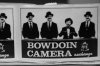
I've done other SPEBSQSA work but my favorite gig was as The BOWDOIN FOUR, in numerous radio jingles and TV commercials for my camera store.
Yes, I sang all four voices and was all four actors, wrote the script, and did the voice-overs.
(The image is a poor copy of an advertising sticker the store used.)

HR
 

Attachments

  • The Bowdoin Four.jpg
    The Bowdoin Four.jpg
    183.3 KB · Views: 9
As a pit musician, I almost never have to do quick-changes (though I do get put on stage on occasion). But I'd do that show again in a heartbeat as well. I get to play the 76 trombones (well, with 73 or 75 of them missing, depending on the orchestration).

Believe it or not, the first time was an employee rec club at work! These guys: www.madtheater.org. The best production was a community theater group several years later, with a Harold Hill reviewed as "being able to sell used cars to his mother."
 
Last edited:
When I did the show in Freeport, Maine the tenor was a lady, Ellen, with a terrific voice. Her husband was the baritone, the bass was Steve, a well-known jewelry artisan. I was Lead voice. When Ellen was made up and costumed her hair was tight to her head and no one would be the wiser. The normal routine of the theater group was to open final dress rehearsal to Seniors and Students at a much reduced ticket price.

So came that night. When the quartet started "It's You" during which each voice has an introductory solo "line," when it got to Ellen's line, after it a student's voice was heard from the rear of the auditorium: "HEY!, He's a GIRL." It was a funny moment.

HR
 
Last edited:
When I did the show in Freeport, Maine the tenor was a lady, Ellen, with a terrific voice. Her husband was the baritone, the bass was Steve, a well-known jewelry artisan. I was Lead voice. When Ellen was made up and costumed her hair was tight to her head and no one would be the wiser. The normal routine of the theater group was to open final dress rehearsal to Seniors and Students at a much reduced ticket price.

So came that night. When the quartet started "It's You" during which each voice has an introductory "line," when it got to Ellen's line, after it a student's voice was heard from the rear of the auditorium: "HEY!, He's a GIRL." It was a funny moment.

HR

Love it!
 
Back
Top