wanttaja
Final Approach
- Joined
- Jun 7, 2008
- Messages
- 5,667
- Location
- "War-Torn" Portland
- Display Name
- Ron Wanttaja
- Home Airfield
- Twin Oaks Airpark
On this date in 1967, one of the most unusual aviation accidents was caught on camera.
Britain’s Royal Engineers had been tasked with developing systems to quickly insert construction equipment into forward operating locations. Front and center was the RAF’s first contingent of C-130 Hercules aircraft, based at RAF Fairford.
The solution the RE planners came up with is parachute insertion of equipment from the transport aircraft. Unusually, the drop of the equipment would be accompanied by an operator, who would, for safety’s sake, be wearing his own emergency parachute.
Hercules XV179 was selected for the first trial. To minimize the financial risk, older used equipment was to be used; for the most part, out-of-date farming equipment. A Ferguson-Brown Model A tractor was the lost machine loaded into the Hercules, right next to the exit ramp. Sapper Harry Fenton was selected to ride the tractor to the ground.
The aircraft took off from RAF Fairford, but the drop location was RAF Wattisham, which had just received its first contingent of English Electric Lightning fighters.
The drop didn’t go well. The parachute on the Ferguson-Brown didn’t deploy, and Sapper Fenton was forced to use his emergency parachute.
On the ground, Flight Lieutenant Andrew Fidoe, RAFVR, was preparing to start one of the Lightings for his first orientation flight in the aircraft. Standing in the cockpit, he had watched the approach of the Hercules, and became alarmed when he saw how close the wayward tractor would come to his aircraft.
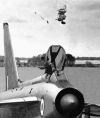
In an incredible coincidence, Aircraftsman Iain MacDonald had been taking pictures of Fidoe to document his first flight, and caught the plunging Ferguson-Brown, the opening parachute of Sapper Fenton, and Flt. Lt. Fidoe in a single shot.
There were no injuries relative to the event. The test conductor, Major William Hills RE, canceled further testing after the incident.
Ron Wanttaja
Britain’s Royal Engineers had been tasked with developing systems to quickly insert construction equipment into forward operating locations. Front and center was the RAF’s first contingent of C-130 Hercules aircraft, based at RAF Fairford.
The solution the RE planners came up with is parachute insertion of equipment from the transport aircraft. Unusually, the drop of the equipment would be accompanied by an operator, who would, for safety’s sake, be wearing his own emergency parachute.
Hercules XV179 was selected for the first trial. To minimize the financial risk, older used equipment was to be used; for the most part, out-of-date farming equipment. A Ferguson-Brown Model A tractor was the lost machine loaded into the Hercules, right next to the exit ramp. Sapper Harry Fenton was selected to ride the tractor to the ground.
The aircraft took off from RAF Fairford, but the drop location was RAF Wattisham, which had just received its first contingent of English Electric Lightning fighters.
The drop didn’t go well. The parachute on the Ferguson-Brown didn’t deploy, and Sapper Fenton was forced to use his emergency parachute.
On the ground, Flight Lieutenant Andrew Fidoe, RAFVR, was preparing to start one of the Lightings for his first orientation flight in the aircraft. Standing in the cockpit, he had watched the approach of the Hercules, and became alarmed when he saw how close the wayward tractor would come to his aircraft.
In an incredible coincidence, Aircraftsman Iain MacDonald had been taking pictures of Fidoe to document his first flight, and caught the plunging Ferguson-Brown, the opening parachute of Sapper Fenton, and Flt. Lt. Fidoe in a single shot.
There were no injuries relative to the event. The test conductor, Major William Hills RE, canceled further testing after the incident.
Ron Wanttaja
Last edited: