O-360-A4M Cool/Cold Starting

idahoflier

Pattern Altitude
Joined
Jul 21, 2017
Messages
1,901
Display Name
idahoflier
Curious what procedures others are performing when starting their O-360-A4M powered aircraft when it has sat overnight in cool/cold temperatures and the morning is cool?

A specific example like I had today: Overnight low of ~ 32°F, OAT when starting 55°F at a DA of ~ 7,400. What procedure works best for you?

For more discussion, if there's interest...

I have owned a 1978 C172N with the Air Plains conversion for almost 8 years. I have found it to be temperamental when starting cold the whole time I have owned it. For the most part it hasn't been a problem because I tend to be a late riser, so in the summer months the engine is already fairly warm when I go fly. In the winter months I always preheat, so the engine is usually warmer than it is in the summer when starting. In any case, my starting procedure is full rich, throttle open ¼", one shot of prime, engage the starter and off it goes in one or two blades. Occasionally that doesn't work after 5 or 6 blades, so I give the starter a minute or two, give it one more shot of prime and then it starts.

That didn't work today. I tried a couple more shots of prime and the prop was just windmilling. I thought maybe I flooded it so idle-cutoff throttle open half way (yep, I know it should have been full throttle). Then I tried a couple of pumps of throttle. Nothing. I then tried starting and then a shot of prime. At one point it seemed like one cylinder was going but the rest weren't. After three attempts I gave what I thought would be the final try as I didn't want to leave the battery drained and/or kill my starter and it roared to life.

I don't think the engine should be that hard to start when cold. I have flown other Air Plains C172 conversions and I don't recall similar issues. But I also don't remember how many, if any, of those flights were in cold/cool starting conditions. I also have flown several Cherokee Archers and don't recall them having issues like this either, but that was many years ago, so maybe I just don't recall... Of course it could be something mechanical, but I had my engine overhauled four years ago, so at that time it had new mags and an overhauled carburetor, but I still found it temperamental in the cold. So it's probably improper starting technique on my part.

The Air Plains supplement doesn't provide any guidance on cold starting.

The C172N POH (for an O-320-H2AD) says full rich, throttle ⅛", prime as required (2 to 6 strokes, none if engine warm), crank.

The Cherokee Archer II (O-360-A4M same engine!) says full rich, throttle ¼", crank. If after 10 seconds the engine doesn't fire, prime the engine and repeat starting.

The C172Q Information Manual (O-360-A4N, almost the same engine, looks like different mags) says full rich, throttle - PUMP once or twice then ¼", crank.
Under Cold Weather Operation the IM says "Prior to starting on cold mornings, it is advisable to pull the propeller through several times by hand to "break loose" or "limber" the oil thus conserving battery energy" - I found that interesting as I had heard that's something that shouldn't be done because of excessive wear on start. Anyway, it further says when preheat isn't available:
Mixture Idle-cutoff, prime 4 to 8 strokes as the propeller is turned by hand (quite an ask if you're alone), primer charged for an additional stroke, then, full rich, pump throttle twice then ¼", crank, continue to prime until smooth operation or pump the throttle ¼ of travel until smooth operation.

Finally, the Lycoming Operator's Manual which covers both the O-360-A4M and O-360-A4N (among others) says full rich, throttle ¼ travel (that's a lot more than a ¼" so maybe a typo?), prime 1 to 3 strokes, crank. Cold weather: Preheat the engine and oil.

None of the above is consistent, but it seems most agree full rich, ¼" throttle. So how much prime? Looks like anywhere from 1 - 6 strokes. What consistently works for you on colder starts with no preheat? Thanks!
 
If it's gotten worse you can have your primer overhauled with new o-rings. But in general it seems like you need to prime more when it's cold. Remember the fuel is cold soaked so it's probably not atomizing well.

Cessna says that flooding is indicated by "weak, intermittent firing followed by puffs of black smoke."

Odd about the 172Q procedure. I thought Cessna recommended pumping the throttle for start only for the retractables due to the sidedraft carb.
 
For my old O-360-A4A, I give it three shots of primer for a cold start, and 1-2 shots for a hot start. My technique for cold start, which I've found works very well, involves putting two shots in normally and then the final shot immediately AFTER I start cranking the engine. Unless it's very cold or the engine has been sitting for a long time, I generally get a solid start within 2-3 blades. On really cold days, it might need another start attempt with an additional single shot of primer (again delivered with the starter already engaged). Hot starts are usually a non-issue, just needing that single shot of primer. Other than that, throttle cracked slightly (usually left where I turned it off at 1000rpm) and mixture full-rich, rapidly leaned to near-shutoff after start is confirmed.
 
In summer I rarely prime. In 32° I use 5-6 strokes. Cold temps require lots of fuel to start. At 32° there’s zero chance of frosting the plugs so little chance that flooding will be a problem.
 
Starting aircraft should not be super sensitive on procedures.

With your own aircraft it is annoying. With a Flight School it may be a

financial disaster. Failure to start can result in renters burning out Starters

and other components. Cancellations and repairs can be pricey!

Several ways to address are:

1. Primer nozzles coked. How many are on YOUR aircraft and do they

all work? I remove and connect to Primer Line to observe spray.

2. Ignition is a likely culprit. I find the A4M sensitive to correct E-gap.

500 Hrs is often too long of an interval.

3. Starter Speed. The faster the engine spins the more the

“ Effective Starting Timing “ ( my term ) is retarded. Lycoming published

charts on this phenomenon.

4. Having dual Impulse Couplings and/or adding “ SlickStart” can be

cost effective by assuring Starts and reducing burned out Starters

and cancellations.
 
Back when I had a 172N with a PennYan O360 conversion, turning the prop manually a few times before starting when cold helped a lot. But I never experienced Negative temps. The coldest I experienced was low teens (F).
 
I did not mean to imply that this is a problem engine.

Rather problem operators.

When mags and other components are produced the parts are made in

groups or batches. Things like Capacitors, Contact Points and Coils

are subject to variance over several years. Extreme cases are addressed

with Service Bulletins or Airworthiness Directives. Even the lubrican

on the Contacts is a variable. Incorrect amount or a improper amount

will result in the Breaker Cam wearing at an accelerated rate.

Note: New is not always better!
 
For my old O-360-A4A, I give it three shots of primer for a cold start, and 1-2 shots for a hot start. My technique for cold start, which I've found works very well, involves putting two shots in normally and then the final shot immediately AFTER I start cranking the engine. Unless it's very cold or the engine has been sitting for a long time, I generally get a solid start within 2-3 blades. On really cold days, it might need another start attempt with an additional single shot of primer (again delivered with the starter already engaged). Hot starts are usually a non-issue, just needing that single shot of primer. Other than that, throttle cracked slightly (usually left where I turned it off at 1000rpm) and mixture full-rich, rapidly leaned to near-shutoff after start is confirmed.

Sounds like more prime is in order. I'll try that. Thanks!
 
1. Primer nozzles coked. How many are on YOUR aircraft and do they all work? I remove and connect to Primer Line to observe spray.

Only one cylinder has a primer. IDK what most aircraft have, prior to my situation I never thought about it. I do see that Air Plains started offering a kit to add primer nozzles to two more cylinders. As they put it "Our new three-cylinder primer is particularly effective in cold-weather locations, but it gives anyone a smoother, quicker start"...

2. Ignition is a likely culprit. I find the A4M sensitive to correct E-gap. 500 Hrs is often too long of an interval.

Mags have a little more than 300 hrs on them. I'll ask the shop to remove the mags and check the E-gap the next annual.

3. Starter Speed. The faster the engine spins the more the “ Effective Starting Timing “ ( my term ) is retarded. Lycoming published charts on this phenomenon.

Not sure I'm following you on that. The engine has a Sky-Tec starter so does spin a little faster.

4. Having dual Impulse Couplings and/or adding “ SlickStart” can be cost effective by assuring Starts and reducing burned out Starters and cancellations.

Sounds like a good idea. I'll do that at the 500 hour inspection/replacement.

Thanks!
 
Only one cylinder has a primer. IDK what most aircraft have, prior to my situation I never thought about it. I do see that Air Plains started offering a kit to add primer nozzles to two more cylinders. As they put it "Our new three-cylinder primer is particularly effective in cold-weather locations, but it gives anyone a smoother, quicker start"...

My preference is to have 1/2 of the jugs with primers. That way 1/2 of them may wind up a correct starting mixture. If they fire the others will get the idea. All rich or all lean is not good.
Mags have a little more than 300 hrs on them. I'll ask the shop to remove the mags and check the E-gap the next annual.

Not sure I'm following you on that. The engine has a Sky-Tec starter so does spin a little faster.
While these engines use “ Fixed Timing” that’s not entirely true.

Running Timing - 25* BTC for your engine.

Impulse Coupling Timing - static. The IC is a spring loaded device that
retards timing to about TDC. Exact amount is dependent on the
“Lag Angle” specified for the engine /mag combo.

Effective Starting Timing - The IC is a mechanical device that engages a stop
while cranking. This loads a spring that is triggered by a cam.
This “Latch, Load & Fire” takes a little time. The more the
engine is rotated by the Starter during this time the more thetoo
Timing will be retarded. Lycoming has a chart depicting this.
Now if I could only find it!

IF all goes well the stock individual IC will do the job. With different folks trying to coax the beast to action other factors become more sensitive.
Can’t have too much spark when starting though. Just at the right time.

Sounds like a good idea. I'll do that at the 500 hour inspection/replacement.

Thanks!
 
Primer line nozzles ("injectors") may be coked up.
That there is very possible, if the mechanic installing the engine used the old nozzles from the old engine.
Looked at the primer early on (pre overhaul) and it was working great. Still, it has been four years so maybe worth a look again.
The nozzles are not the primer. They are in the intake ports and are supposed to atomize the fuel as the primer feeds it. When they get coked up they either deliver no fuel, or a straight stream of it that does not atomize and vaporize well and can make the engine very hard to start when cold.
Only one cylinder has a primer. IDK what most aircraft have, prior to my situation I never thought about it. I do see that Air Plains started offering a kit to add primer nozzles to two more cylinders. As they put it "Our new three-cylinder primer is particularly effective in cold-weather locations, but it gives anyone a smoother, quicker start"...
Only one cylinder. Well there's a big hint that you need more primer nozzles. 172s with Lycomings all had three cylinders primed.

The magneto concerns are also valid. If those 300-hour mags have internal wear, the spark is weak, and a weak spark won't fire reliably when the fuel is cold and not vaporizing well. You need a hot spark, meaning that you need mags that are working properly and sparkplugs that are sparking enthusiastically. Are those plugs the old-stock Champions with the spring-loaded resistor? Bad junk, that. Disconnect the plug lead from the plug and look down the well. If you see what looks like the head of a screwdriver-slotted screw, you have the garbage plugs that Champion discontinued some years ago now. There should be no slot in there.
 
My O360A4K needs a lot of prime. It depends on how many primer nozzles you have. I use 5-6 shots of prime and then a fill the primer bulb and shoot it in just as I hit the starter. Works every time. That was not always the case. For the first few years, starting was a hit or miss event. I have run the battery down many times before I was taught this trick.
 
fill the primer bulb and shoot it in just as I hit the starter. Works every time.
Loading the primer and injecting right after the starter is engaged really does seem to be helpful in achieving a good start. I think I recall Mike Busch discussing it in one of his books (or possibly on Ask the A&Ps). After hearing that, I decided to give it a try and I've done it ever since with good success.
 
Loading the primer and injecting right after the starter is engaged really does seem to be helpful in achieving a good start. I think I recall Mike Busch discussing it in one of his books (or possibly on Ask the A&Ps). After hearing that, I decided to give it a try and I've done it ever since with good success.
I learned about that method from the late Michael Rellihan. Mike was a great guy who put me up for the weekend when he replaced the shock cushions on my landing gear. He was a true gentleman, and was uniquely knowledgeable about Beechcraft.

For the first few years of ownership, it was a crapshoot whether it would start. It was nothing more than a toy, something to be played with when it wanted to cooperate. Since I learned this trick, it has started virtually every time, and almost always in one blade or less.
 
Last edited:
Loading the primer and injecting right after the starter is engaged really does seem to be helpful in achieving a good start. I think I recall Mike Busch discussing it in one of his books (or possibly on Ask the A&Ps). After hearing that, I decided to give it a try and I've done it ever since with good success.
I did that in my 150, but it was specifically recommended by the POH. And yes it worked great. But that's a Continental O-200.
 
@Magman Thanks, makes sense.

@Dan Thomas Understood, I meant the primer nozzle. It was good, but that was ~ 350 hours ago, definitely worth another look. Will work with my shop on that and likely look into installing the new Air Plains primer kit. I'll also check the plugs, they are Champion from late 2019...

It sounds like I need to be priming more. Still wondering - for those that are using 3 - 4 shot of prime, how many cylinders are plumbed? For example, if an engine has three cylinders receiving prime then 3 - 4 shots of prime gives each cylinder one shot of prime. On my engine with one cylinder primed, is 3 - 4 shots too much and going to flood the cylinder?
 
Mine has three primer lines. You can prime much more than 2 or 3 shots. I think there is little chance of flooding the engine. I have heard that over priming can wash the thin film of oil off of the cylinder walls, but I have not heard of over priming flooding the engine, as long as it is all within reason.
 
Be careful though, you don't want to fill your intake up with fuel then hydraulic lock your cylinder.

You can also after starting to crank use one or two applications of the throttle to get the accelerator pump to get more fumes into the non primered cylinders. But don't over do this either.
 
but I have not heard of over priming flooding the engine, as long as it is all within reason.
Overpriming and flooding can happen real easy. It's common, and engine fires have resulted from it. The excess fuel runs down through the intake manifolding and through the injection servo or carb, and dribbles out the airbox. Since rich mixtures burn very slowly, the sparkplug can ignite the fuel in a flooded cylinder, and that flame burns until the intake valve opens and lets it set the whole manifold afire. If there is fuel in the airbox or cowling, it will likely catch, too. You can lose the whole airplane.

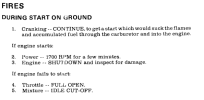
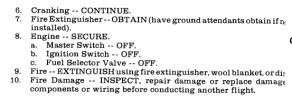
From a 172 POH:

1749425327673.png
1749425355617.png

If flooding and fire wasn't a thing, it wouldn't be in the POH.
 
Last edited:
My mechanic says I am flying one of the easier lycoming to start since it has a D mag and both mags are impulse fired?
I never use the primer because it starts so well on 2 throttle pumps when it is cold. 3 pumps when it is single digits cold. Always starts hot with one pump on the throttle. I have flown 2 different D mag 0-320 this way since 2018. Knock on wood no back fires so far.

My late buddy had 0-360 air plains in a 127N that I flew a couple times. I started it the same way with a couple throttle strokes and it started effortlessly.
When I installed my new engine in 2020 it got 2 new primer nozzles and I soldered up 2 new primer lines. But I don’t use them. Couple times a year I use the primer to keep it in shape. But when I do it makes for a rich start and takes couple more blades to start.

IMO I would look at the mags…plugs wires cap…
 
Last edited:
The O-360-A4M in my 1980 172N (Penn Yann STC) has primer lines on 3 of the cylinders. It starts easily hot or cold.

You can feel whether the primer is working properly. When you pull it back (and then wait for a couple of seconds) you should hear it slurping up fuel. When you push it forward you should feel resistance the entire stroke.

Don't open the throttle too much. Pull it all the way back and then push it forward just enough to get it off the idle stop.

Primer strokes: 1 if hot, 2 if cold (sitting more than an hour), 3 if below 40*F, 4 if freezing.

If your engine has the Slick 4370 mags, the left one normally has the impulse coupling. Slick issued a SB on the IC rivets working loose, which can impair cold starts and the rivets can fall into the engine compartment causing severe damage, so definitely get that checked at the next 500 hour inspection.
 
Another thing that can help is to wait a bit (30 - 60 seconds) after priming to allow the fuel to evaporate.

I am fuel injected, but these days, I turn on the master and prime. Then wait for the G3X to finish booting and selecting the EIS page. THEN start.
 
My mechanic says I am flying one of the easier lycoming to start since it has a D mag and both mags are impulse fired?
Correct. One impulse coupling, so both mags get the impulse and both will fire. The Lycoming O-235 was famously hard to start, so many, if not most, now have two impulse mags.
If your engine has the Slick 4370 mags, the left one normally has the impulse coupling. Slick issued a SB on the IC rivets working loose, which can impair cold starts and the rivets can fall into the engine compartment causing severe damage, so definitely get that checked at the next 500 hour inspection.
That SB, like some other Slick SBs, should have been an AD. Slick seemed to be reluctant to ask the FAA for an AD for some of their bigger mistakes. After all, it's usually up to the manufacturer to initiate an AD.
Another thing that can help is to wait a bit (30 - 60 seconds) after priming to allow the fuel to evaporate.
In cold weather, that fuel is more likely to coalesce on the induction and cylinder surfaces and be reluctant to ignite. At low temps, the fuel's vapor pressure falls way off. In the flight school we had much better starting by priming a couple of strokes, then pushing in a third stroke while cranking. That sends the fuel mist into the cylinder before it can fall out of the airstream.

All of the various tricks and remedies can often be rendered moot if the primer and nozzles are working properly, and the mags and plugs are up to snuff. I have found primers that sucked air past their O-rings instead of sucking fuel from the fuel strainer. Worn-out O-rings that collapsed under suction, but sealed OK during pressure on the pumping stroke. And way too many primer nozzles that will no longer atomize the fuel. I've even found AN fittings where the nozzles should be, and they just dribble a thick, nearly-useless stream of fuel into the manifold, risking fire. False economy of the worst sort.
 
Curious what procedures others are performing when starting their O-360-A4M powered aircraft when it has sat overnight in cool/cold temperatures and the morning is cool?

A specific example like I had today: Overnight low of ~ 32°F, OAT when starting 55°F at a DA of ~ 7,400. What procedure works best for you?

For more discussion, if there's interest...

I have owned a 1978 C172N with the Air Plains conversion for almost 8 years. I have found it to be temperamental when starting cold the whole time I have owned it. For the most part it hasn't been a problem because I tend to be a late riser, so in the summer months the engine is already fairly warm when I go fly. In the winter months I always preheat, so the engine is usually warmer than it is in the summer when starting. In any case, my starting procedure is full rich, throttle open ¼", one shot of prime, engage the starter and off it goes in one or two blades. Occasionally that doesn't work after 5 or 6 blades, so I give the starter a minute or two, give it one more shot of prime and then it starts.

That didn't work today. I tried a couple more shots of prime and the prop was just windmilling. I thought maybe I flooded it so idle-cutoff throttle open half way (yep, I know it should have been full throttle). Then I tried a couple of pumps of throttle. Nothing. I then tried starting and then a shot of prime. At one point it seemed like one cylinder was going but the rest weren't. After three attempts I gave what I thought would be the final try as I didn't want to leave the battery drained and/or kill my starter and it roared to life.

I don't think the engine should be that hard to start when cold. I have flown other Air Plains C172 conversions and I don't recall similar issues. But I also don't remember how many, if any, of those flights were in cold/cool starting conditions. I also have flown several Cherokee Archers and don't recall them having issues like this either, but that was many years ago, so maybe I just don't recall... Of course it could be something mechanical, but I had my engine overhauled four years ago, so at that time it had new mags and an overhauled carburetor, but I still found it temperamental in the cold. So it's probably improper starting technique on my part.

The Air Plains supplement doesn't provide any guidance on cold starting.

The C172N POH (for an O-320-H2AD) says full rich, throttle ⅛", prime as required (2 to 6 strokes, none if engine warm), crank.

The Cherokee Archer II (O-360-A4M same engine!) says full rich, throttle ¼", crank. If after 10 seconds the engine doesn't fire, prime the engine and repeat starting.

The C172Q Information Manual (O-360-A4N, almost the same engine, looks like different mags) says full rich, throttle - PUMP once or twice then ¼", crank.
Under Cold Weather Operation the IM says "Prior to starting on cold mornings, it is advisable to pull the propeller through several times by hand to "break loose" or "limber" the oil thus conserving battery energy" - I found that interesting as I had heard that's something that shouldn't be done because of excessive wear on start. Anyway, it further says when preheat isn't available:
Mixture Idle-cutoff, prime 4 to 8 strokes as the propeller is turned by hand (quite an ask if you're alone), primer charged for an additional stroke, then, full rich, pump throttle twice then ¼", crank, continue to prime until smooth operation or pump the throttle ¼ of travel until smooth operation.

Finally, the Lycoming Operator's Manual which covers both the O-360-A4M and O-360-A4N (among others) says full rich, throttle ¼ travel (that's a lot more than a ¼" so maybe a typo?), prime 1 to 3 strokes, crank. Cold weather: Preheat the engine and oil.

None of the above is consistent, but it seems most agree full rich, ¼" throttle. So how much prime? Looks like anywhere from 1 - 6 strokes. What consistently works for you on colder starts with no preheat? Thanks!
I only open throttle 1/8” and leave fuel off until it fires and then full rich. No primer pumps. It always fires up and idles at 650-700 for the first 10 seconds and when oil pressure goes all the way up I push the throttle up to 900-1000 rpm to warm up. I lean it on the ground.
1/4” seems like too much throttle to start?

Edit...I just noticed you said DA 7400' That sounds like some cold thin air and I bet it is different than what us flatlander's experience?
I drove a 1970 hi compression V8 to top of Pikes peak 10 years ago. When I came out to start it, it spun so fast that I thought someone stole my spark plugs. It finally started but it took more cranks than normal. And it was tuned for the mountain before I got there with it. Otherwise it would have not have made it, it seemed. It was like a little motor boat engine on top of the mountain.
 
Last edited:
1/4” seems like too much throttle to start?
There's a bit of a balancing act there. Too little throttle and the engine doesn't get much air to mix with the fuel, or doesn't carry fuel from the idle fuel ports into the cylinder. Too much throttle means too little suction is generated at the throttle plate edge to pull fuel from those ports.

My old A-65 never needed prime except on very cold days. Otherwise, closed throttle and it would start in 6 blades. Hand- propping. But it also had two Case impulse mags, 1946 vintage, that made a hotter spark than I ever saw from any Bendix or Slick.
 
I should mention: Heavy single-grade oil in a cold engine is not only bad since it is not easily sucked into the oil pump, but it also makes the impulse coupling sluggish so you don't get a good snap. That impulse spring is tightly wound so that the coils are against each other and need to slide against each other. Sticky oil slows that down. A sluggish snap means little or no spark.
 
I only open throttle 1/8” and leave fuel off until it fires and then full rich. No primer pumps. It always fires up and idles at 650-700 for the first 10 seconds and when oil pressure goes all the way up I push the throttle up to 900-1000 rpm to warm up. I lean it on the ground.
1/4” seems like too much throttle to start?
When cold? Like 40° engine? Have to admit, your’s is one technique I haven’t tried. How fast is your engine turning on idle/cutoff the previous flight? Will try this first. Thanks!
 
Another thing that can help is to wait a bit (30 - 60 seconds) after priming to allow the fuel to evaporate.

I am fuel injected, but these days, I turn on the master and prime. Then wait for the G3X to finish booting and selecting the EIS page. THEN start.
Wish it was fuel injected, always found them easy to start. Of course, never found other carbureted engines hard to start either…
 
Wish it was fuel injected, always found them easy to start. Of course, never found other carbureted engines hard to start either…
OMG did the school I went to have trouble starting the IO-360s when hot. It was terrible in the hot cabin to crank for 20 seconds and then have wait for the starter to cool down for 2 minutes on a 95°day. It sucked, sometimes 4-5 attempts and no start. Every instructor had his own opinion on how to prime.
I watched the owner come out and get in and crank it 60+ second straight to get one started and a big puff of black smoke came out. He shortened the life of the starter but he had students and instructors waiting to fly it. I was glad it wasn't me that day.
At first I wanted fuel injection but I am fine with a carb.
I'd get those Mags, plugs, etc inspected. Good luck with it.
 
The O-360-A4M in my 1980 172N (Penn Yann STC) has primer lines on 3 of the cylinders. It starts easily hot or cold.

You can feel whether the primer is working properly. When you pull it back (and then wait for a couple of seconds) you should hear it slurping up fuel. When you push it forward you should feel resistance the entire stroke.

Don't open the throttle too much. Pull it all the way back and then push it forward just enough to get it off the idle stop.

Primer strokes: 1 if hot, 2 if cold (sitting more than an hour), 3 if below 40*F, 4 if freezing.

If your engine has the Slick 4370 mags, the left one normally has the impulse coupling. Slick issued a SB on the IC rivets working loose, which can impair cold starts and the rivets can fall into the engine compartment causing severe damage, so definitely get that checked at the next 500 hour

Really sounds like two more cylinders primed is the answer. Since you have three cylinders with primer, 3 shots = 1 shot per cylinder. Primer pump is definitely working. Primer could be clogged/coked. Pretty sure I checked the Slick AD’s before, 4370 and 4373 if memory serves, both new in late 2019 overhaul, so think they’re good.
 
I should mention: Heavy single-grade oil in a cold engine is not only bad since it is not easily sucked into the oil pump, but it also makes the impulse coupling sluggish so you don't get a good snap. That impulse spring is tightly wound so that the coils are against each other and need to slide against each other. Sticky oil slows that down. A sluggish snap means little or no spark.

Running W100+ so there is that. As mentioned earlier, always preheated in the spring, fall and winter so, hasn’t been a problem.

This last issue probably wouldn’t have been a problem if it hadn’t been an unusually cold night and I had waited until it had warmed up a bit more.

I probably wouldn’t care as much either but I’m going to try and camp out a few nights in the backcountry and not interested in getting stranded somewhere…
 
Anyone have thoughts on the DA? Seems like that would make it harder to start, but IDK???
 
OMG did the school I went to have trouble starting the IO-360s when hot. It was terrible in the hot cabin to crank for 20 seconds and then have wait for the starter to cool down for 2 minutes on a 95°day. It sucked, sometimes 4-5 attempts and no start. Every instructor had his own opinion on how to prime.
I watched the owner come out and get in and crank it 60+ second straight to get one started and a big puff of black smoke came out. He shortened the life of the starter but he had students and instructors waiting to fly it. I was glad it wasn't me that day.
At first I wanted fuel injection but I am fine with a carb.
I'd get those Mags, plugs, etc inspected. Good luck with it.

LOL! I always had good luck starting hot IO-360’s, right up until the day of my Commercial check ride. But that’s another story…
 
Anyone have thoughts on the DA? Seems like that would make it harder to start, but IDK???
I've started the engine up to about 9000 DA and didn't notice any difference from sea level. At least not in starting, of course it was down on power.

If only 1 cylinder is primed, you can pump the throttle (move it forward and then immediately pull it back) while cranking. This exercises the accelerator pump which squirts a little extra fuel. This fuel squirts from the carburetor, not near the cylinder, so only do this while cranking, so the engine vacuum draws the fuel up the intake manifold. And don't pump it back and forth constantly, but do a single pump and let it keep cranking for a moment longer.

Note: you said O-360-A4M, which is carbureted, right? Some are giving advice on fuel injected engines, which have different procedures.
 
Getting a good start is not always easy; especially with marginal ignition.

The correct mixture of fuel and air is needed.

A “ when all else fails “ system I’ve used on many different engines:

1. Full ( Wide Open) Throttle

2. Slowly close Throttle while cranking

3. When it fires IMMEDIATELY bring the Throttle back to 800 ish.


Wide open throttle is providing a lot of air. Lean?

Closing the Throttle has the effect of richening the mixture.


Together with variations in prime this may provide a good starting mixture.


IMMEDIATELY means just that. RPM should not exceed 1000.

No sleeping at the switch.
 
I've started the engine up to about 9000 DA and didn't notice any difference from sea level. At least not in starting, of course it was down on power.

But was it cold at 9,000 DA? Might not make any difference, but seems like the starting conditions would be more rich than sea level.

If only 1 cylinder is primed, you can pump the throttle (move it forward and then immediately pull it back) while cranking. This exercises the accelerator pump which squirts a little extra fuel. This fuel squirts from the carburetor, not near the cylinder, so only do this while cranking, so the engine vacuum draws the fuel up the intake manifold. And don't pump it back and forth constantly, but do a single pump and let it keep cranking for a moment longer.

Yeah, that may have been how I got the thing finally started. I tried several things. I don't like doing that for the fire hazard which is why I found the C172Q instructions surprising.

Note: you said O-360-A4M, which is carbureted, right? Some are giving advice on fuel injected engines, which have different procedures.

Yes, familiar with carb vs injected procedures. I think advice given has all been for carbs though @Gary Ward 's procedure sounds like injected, but I believe he is giving two throttle pumps before lean and cranking. I'm going to try that. The problem is temps here are now 20ºF warmer than normal (low is only 65ºF tonight) so I probably won't get to try anything new and make meaningful conclusions before fall.
 
Back
Top